School Programs Available for Students Grades K-12
by Lindsay McNamara, Communications Manager
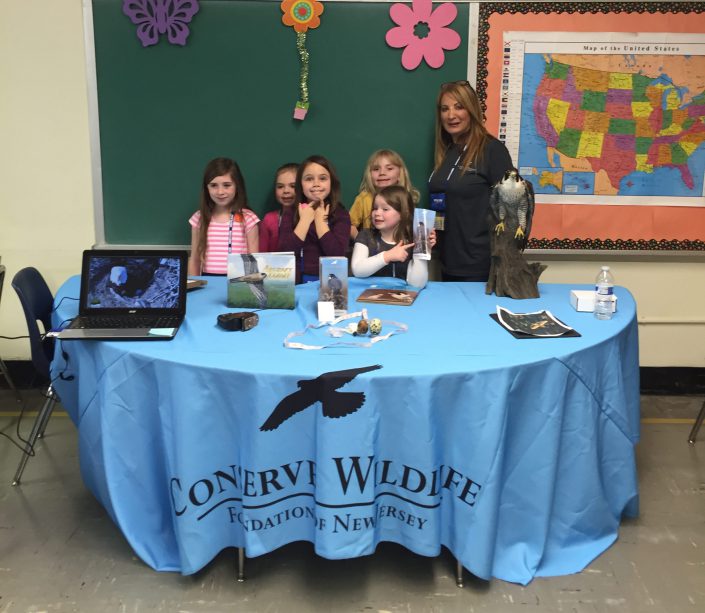
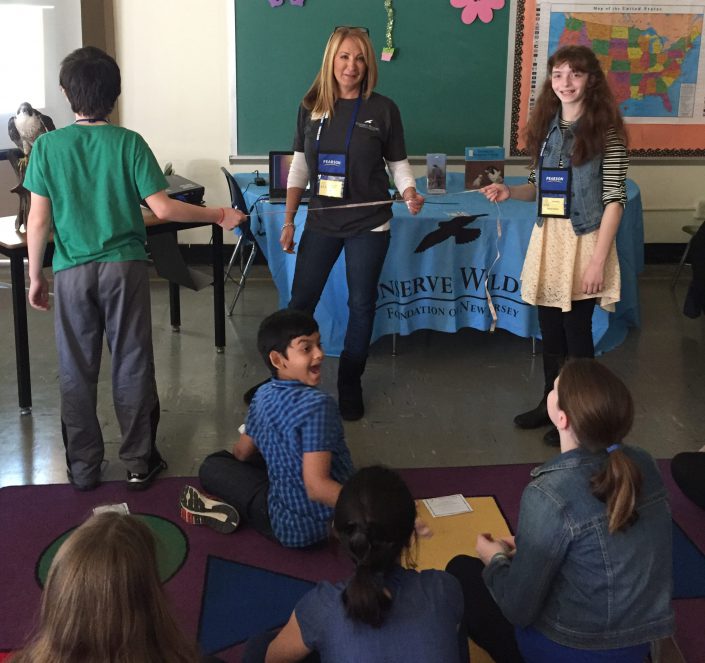
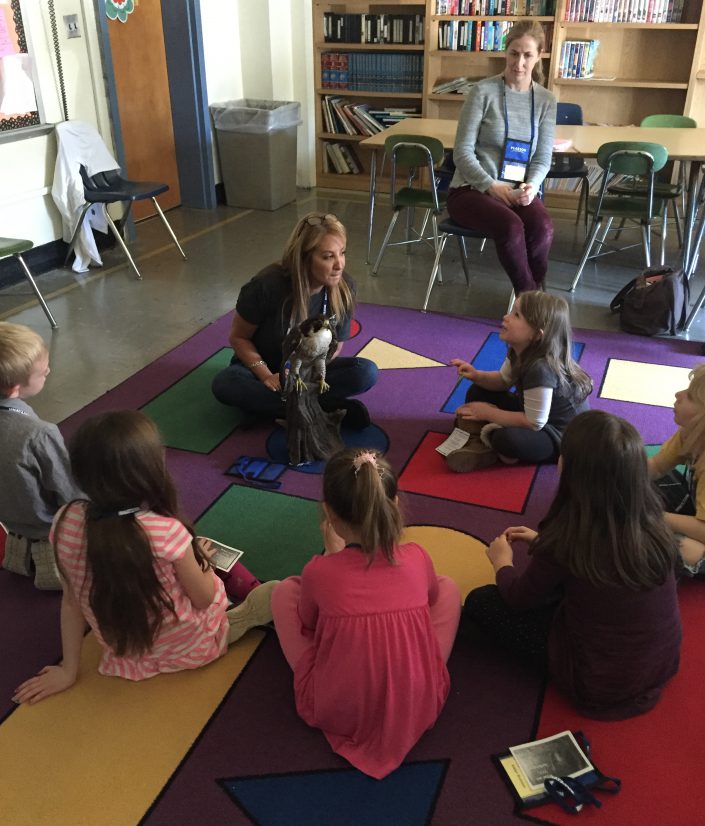
Director of Education Stephanie DAlessio with students from Memorial School in Cinnaminson, New Jersey.
Conserve Wildlife Foundation’s Director of Education Stephanie DAlessio has been out on the road educating students throughout New Jersey about rare wildlife. Last month, Stephanie gave over ten presentations and outreach events, reaching 1,400 children and adults.
Director of Education Stephanie DAlessio with students from Memorial School in Cinnaminson, New Jersey.Director of Education Stephanie DAlessio with students from Memorial School in Cinnaminson, New Jersey.
Stephanie offers specialized programs tailored for your students’ needs and interests! For more information about scheduling a classroom program with Conserve Wildlife Foundation, visit our website.
CWF Biologist Larissa Smith Looking for Data from EagleCam Viewers
by Lindsay McNamara, Communications Manager
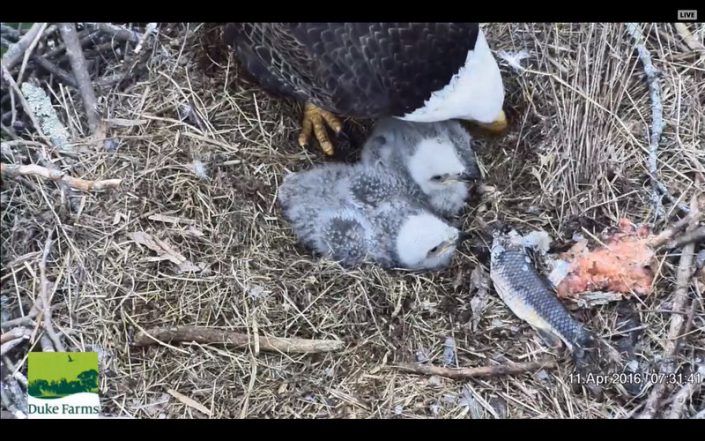
Conserve Wildlife Foundation eagle biologist Larissa Smith has launched a new citizen science project in an effort to learn more about New Jersey’s eagles. We know that many teachers, students and bird lovers watch the wildly popular Duke Farms EagleCam, and now those viewers can help Larissa gather data by participating in the Eagle Food Observation Project.
Larissa holding an eagle at a banding last week.
Jim Wright — author of the popular posts about the eagles for Duke Farms’ “Behind the Stone Walls” blog, as well as, “The Bird Watcher” column for The Record — interviewed Larissa Smith in the most recent post on Duke Farms’ blog. In this interview, Larissa explains her latest citizen science project to learn more about the Duke Farms eaglets’ diet.
Reflections Three Years into the Shorebird Sister School Network Program
by Stephanie Egger, Wildlife Biologist
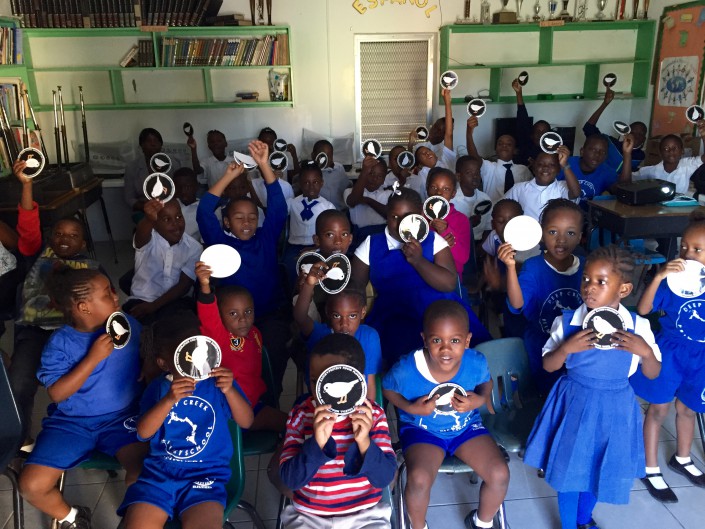
Deep Creek Primary students with the migratory and wintering Piping Plover decal.
As we begin to wrap up our third year of the Shorebird Sister School Network, we are able to reflect on how far we have come in just a short time. In our first year, we started with just one class at Amy Roberts Primary School (Green Turtle Cay, Abaco, The Bahamas), led by teacher Jan Russell, which was paired up with a class at Ocean City Intermediate School (Ocean City, New Jersey), led by teacher Deb Rosander. We presented the students with information on the full life cycle of the Piping Plover, commonly referred to as “our birds” in New Jersey. Really they are residents of The Bahamas, spending over half their life on the warm sandy beaches surrounded by turquoise water. Piping Plovers in The Bahamas, in most cases, see less disturbance than what is experienced by plovers on their breeding grounds in the United States and Canada.
We not only focus on breeding, migration, and wintering of the plovers, but the importance of their habitat to a suite of species. In The Bahamas, the tidal flats used by the Piping Plovers are of huge importance to the ecological value and economy of The Bahamas, as the flats are also used by bonefish, conch, and shark species. We had both classes conduct similar projects — interpretive signs placed on the breeding and wintering grounds — using their writing skills and original artwork. The students also participated in field trips where they learned how to use spotting scopes and binoculars to find and identify shorebirds.
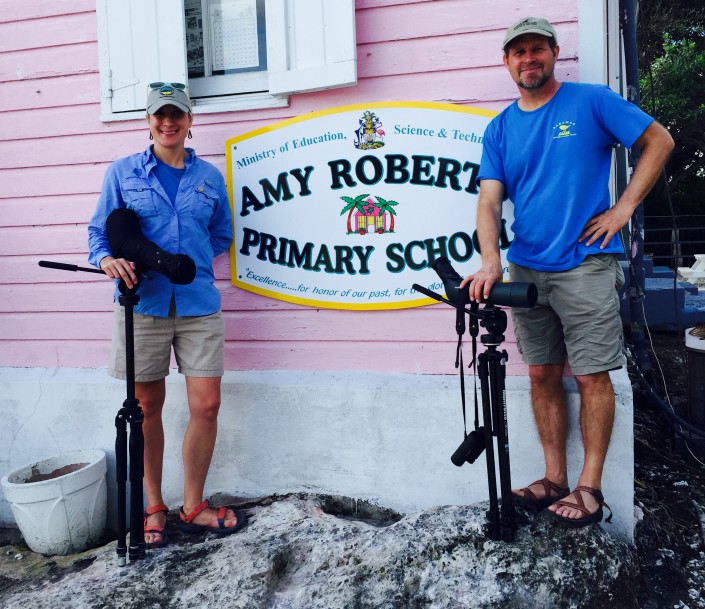
Shorebird Sister School Network leaders and CWF biologists, Stephanie Egger and Todd Pover at Amy Roberts Primary School, one of the first sister schools in the program.
Three years later, we still are teaching our core lessons, but have vastly expanded on the curriculum and projects, as well as extending the program onto another island, Eleuthera, which is just south of Abaco. We now are working with Cherokee Primary in the settlement of Cherokee Sound (Abaco) and Deep Creek Primary (Deep Creek, Eleuthera). We have continued working for the last three years with Amy Roberts Primary School and Ocean City Intermediate School. Back in the United States, we have added a second class from Ocean City, as well as the Leeds Avenue Elementary School Environmental Club (Pleasantville, New Jersey) led by Mary Lenahan. We’ve added new components to the curriculum such as bird anatomy, foraging differences between species of shorebirds, invasive species, habitat assessments (including macroinvertebrates) and marine debris.
We continue to implement interpretive signs as a project with classes that are in their first year of the program, but have come up with new and exciting projects to keep the students (and teachers) motivated and engaged to continue participating as a sister school. For example, during the second year we worked with Amy Roberts, we removed 1,500 Australian pine (Casuarina spp.) from Green Turtle Cay as it degrades the habitat for piping plovers and other species. We created a Piping Plover activity book complete with crossword puzzles, word searches, and mapping activities designed mainly by the students at Ocean City Intermediate School, Leeds Avenue Elementary School, and Amy Roberts Primary School. Because Cherokee Primary and Deep Creek Primary are new to the program this year we hope to have their students create interpretive signs, while the second and third year students in the Program may develop PSA-type videos this year and pen pal letters to their respective sister schools in the United States.
Throughout the year, each class receives one or two classroom lessons and a field trip. We keep busy during the few short weeks we have in The Bahamas; coordinating the field trips, conducting surveys, presentations, and working to continue to build and strengthen our existing relationships with partners, such as Friends of the Environment and local citizen scientists. This year, we’ve reached over 120 students in the program, both from the Bahamas and in the United States.
One of the most rewarding aspects of the Shorebird Sister School Network is that we are able to provide lessons to the some of the same children throughout multiple years in the program, which strengthens the conservation messages we are trying to instill in the upcoming generations. We hope to foster a greater appreciation for wildlife, especially for the Piping Plover and its habitat, and inspire students to help now — and later on in their lives as adults — ensure the recovery and survival of the bird for years to come.
Conserve Wildlife Foundation introduces new educational contest for 5-8th grade students in New Jersey
by Lindsay McNamara, Communications Manager
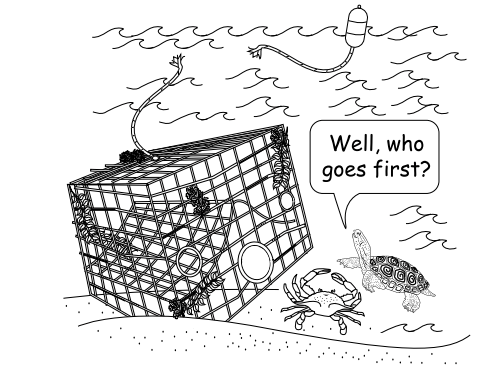
Image by: Jessie Peter (2009) “The Educator’s Guide to Marine Debris”
The scientists at Conserve Wildlife Foundation, NOAA, students from the Marine Academy of Technology and Environmental Science (MATES), and other partners are working with local fishermen to locate and recycle over 1,000 abandoned crab pots that litter the Barnegat Bay watershed.
Abandoned crab pots are a form of marine debris, or litter that ends up in oceans, seas, or other large bodies of water. Every year, tons of marine debris is left behind in Barnegat Bay and surrounding waters. When a fisherman’s gear is lost or abandoned it can trap, hurt or even kill marine wildlife like fish, crabs and the diamondback terrapin, a small turtle that lives in the salt marsh.
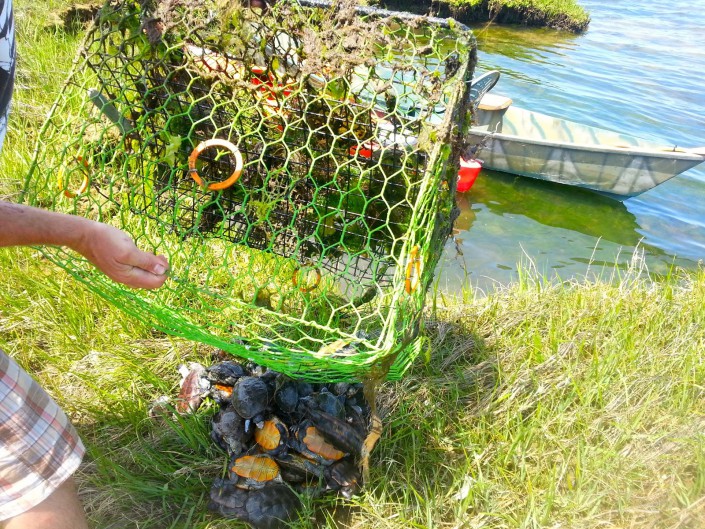
Nearly 50 diamondback terrapins drowned in one abandoned crab pot. Photo by Shannon Alexander of Bay Country Kayaking
To help fix the problem, our team of scientists will locate (with sonar technology) and take the crab pots that have been lost or left behind in the water. The old and rusty crab pots that are recovered will be recycled and converted into energy!
Calling all students! Do you want to help too? Enter our Species on the Edge: Marine Debris Edition contest and draw a design that shows how our project will help Barnegat Bay and marine wildlife like the diamondback terrapin.
Open to all New Jersey fifth-eighth graders in public, private, or home schools.
The contest opens on Friday, March 4 and closes on Friday, May 20, 2016.
Decal designs will be judged by marine scientists. Judging takes place in June.
The winner will be notified by the end of June.
The winning design will be printed on 2,500 stickers to use as the official “logo” of the project. The winning student will receive two free passes to Jenkinson’s Aquarium and spend a day in the field with one of CWF’s wildlife biologists.
Our abandoned crab pot project brings together the NOAA Marine Debris program, Fishing for Energy partnership, CWF, MATES, Monmouth University, Stockton University, ReClam the Bay, and local fishermen and baymen. Funders of this project include: NOAA Marine Debris Program, National Fish and Wildlife Foundation, Covanta, and the New Jersey Corporate Wetlands Restoration Partnership.
In New Jersey and throughout the world, almost every ecosystem is under some degree of disturbance caused by human impact. In particular, urbanization and deforestation often have negative consequences on ecosystems because they typically lead to overall habitat loss. A reduction in available habitat creates habitat fragmentation, where an ecosystem becomes segmented and broken apart. Habitat fragmentation can have multiple negative effects on wildlife, including dispersal, genetic isolation, and community structure impacts. Here in New Jersey, wildlife species are up against steady urbanization and a dense network of roads compromising the connectivity of habitat and wildlife populations. Today, the state of New Jersey remains the most densely populated state in the country occupying about 39,000 miles of public roads.
Connectivity is vital for wildlife. Different color habitat patches represent different resources essential for survival. Lines represent possible corridors connecting patches.
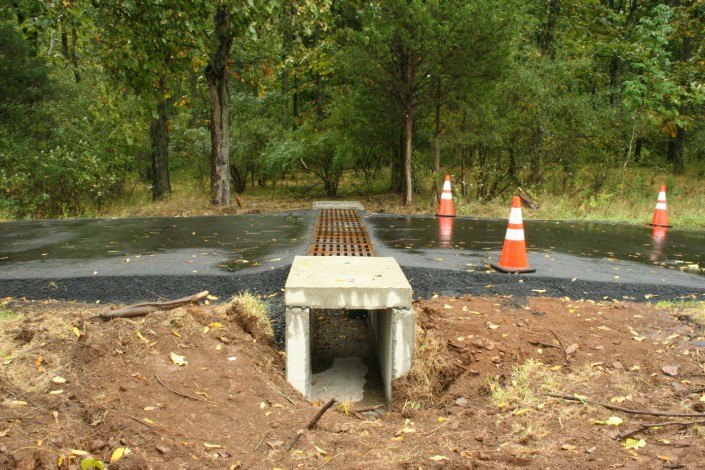
In order to maintain diversity and sustain healthy wildlife populations, we must connect various fragmented habitats and wildlife communities. Animals need to be able to move through the landscape to find food, shelter, mates, and other resources. Without that ability to move, healthy populations cannot persist over the long term. In order to curb the effects of roads and habitat fragmentation, wildlife road crossing structures can be installed to reduce wildlife road mortality. In addition, wildlife habitat corridors can be prioritized for land management, restoration and acquisition.
What is New Jersey doing to create habitat connectivity for our state’s diverse wildlife?
Connecting Habitat Across New Jersey(CHANJ) was formed in 2012 by the Division of Fish and Wildlife, with the vision of making our landscape and roadways more permeable to wildlife movement. CHANJ represents a blueprint for strategic habitat conservation that will identify key areas and the actions needed for preserving and restoring habitat connectivity for terrestrial wildlife in New Jersey. CHANJ has the potential to increase the sustainability of New Jersey’s terrestrial wildlife populations and de-list endangered species. Connecting populations of wildlife will improve gene flow and allow wildlife to move freely throughout the landscape.
How can you help?
Be mindful of wildlife while driving: Peak wildlife crossing season occurs in the spring and summer as wildlife travel to find food and mates. If wildlife such as amphibians and turtles are on the road, safely pull over and carry them to the shoulder in their direction of travel. Always be mindful of safety and do not attempt to handle any wildlife if you are not comfortable.
23 WILDLIFE SPECIES ADDED TO CWF’S ONLINE FIELD GUIDE
By Michael Davenport, GIS Program Manager
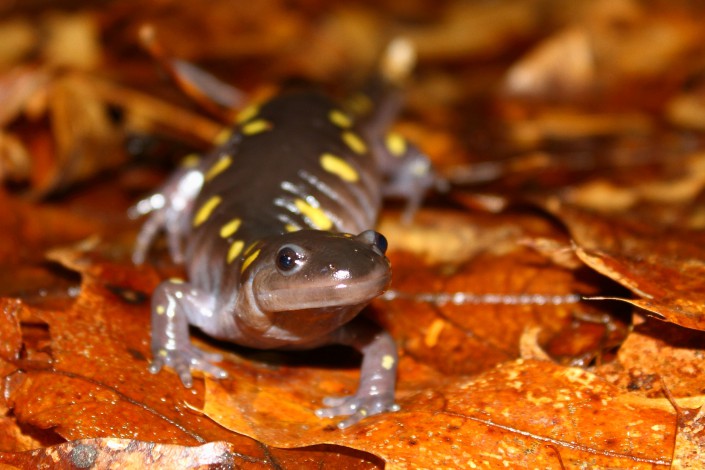
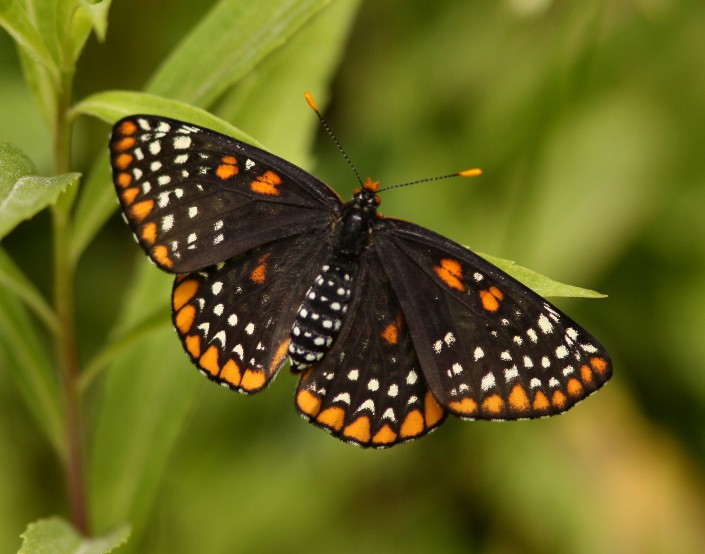
Conserve Wildlife Foundation of NJ’s online field guide, a one-of-a-kind free reference focused on New Jersey’s wildlife, has recently expanded to include 23 additional species. As a result of recent status reviews by the state’s Endangered and Nongame Species Program for reptiles, amphibians, and butterflies, additional species within the state will be receiving an imperiled status of either Endangered, Threatened, or Special Concern. Six reptile species are being added as well as four amphibians and thirteen butterfly species.
The Baltimore checkerspot, a species recently added to CWF’s on-line field guide. Photo courtesy of Eric C. Reuter.
Later this week, two additional blog entries will be posted regarding the status review process and the new listings. The posts will be: “Species Status Review process” (WEDNESDAY); and “How you can help fill-in data gaps” (FRIDAY).
The list of “new” species is below and each species name links to its field guide entry on our website:
Freshwater mussels are distant relatives of marine mussels with a life cycle which includes a larval stage where they hitch a ride on fish as a parasite. There are a dozen species native to New Jersey and some species are known to live for over 100 years. This is an often overlooked group of species which deserves greater attention since many species are imperiled and because they are indicator species of water quality.
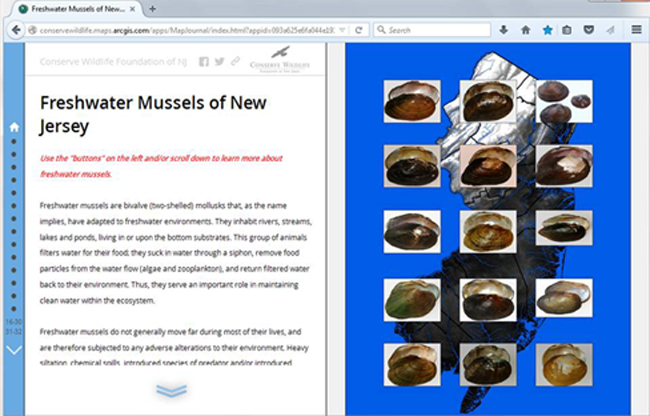
Conserve Wildlife Foundation of New Jersey (CWF) has partnered with the NJ Endangered and Nongame Species Program to create and release our latest Story Map, “Freshwater Mussels of New Jersey.”
This Story Map is a web-based field guide to New Jersey’s freshwater mussel species. The field guide explores the diversity of this group of species, how to identify them, their life history, threats and conservation measures, as well as providing range maps for each species. This is the only freshwater mussel field guide specific to the state of New Jersey and developed by state biologists.
Photos and interactive range maps are available for all 12 of New Jersey’s native species as well as several non-native species found within the state. Several short videos are also included which demonstrate different methods of surveying for freshwater mussels.
Funding for the creation of this Story Map was provided in part through a New Jersey Division of Fish & Wildlife grant.
“Veterans Day on the Bay” brings families, volunteers and veterans to South Reeds Beach on New Jersey’s Delaware Bayshore
by: Lindsay McNamara, Communications Manager
[slideshow]
Conservation organizations leading the efforts to restore New Jersey’s Delaware Bay beaches today organized “Veterans Day on the Bay,” a celebration to dedicate the oyster reef at South Reeds Beach in honor of military veterans’ service to our country.
“We want to dedicate this work to our nation’s armed forces veterans to give them well deserved recognition for their service to all Americans,” stated Dr. Larry Niles, a biologist with American Littoral Society and Conserve Wildlife Foundation of New Jersey who has studied federally-listed Red Knots for three decades. “We also hope to give them an intimate experience of successful wildlife conservation to spark their interest and encourage them and their families to take part in future work.”
Veterans Day on the Bay dedicated the South Reeds Beach oyster reef to all veterans and highlighted veteran involvement in the effort to restore New Jersey’s Delaware Bayshore. Event attendees honored their own military veterans by inscribing that special person’s name on a shell and placing that shell on “Veterans Reef.” Guests also helped study the wildlife living in this new reef with hands-on, interactive marine science activities like seining, trapping, trawling, and species identification.
“Delaware Bay has been so vital to this community for generations, and through this project we hope to strengthen the connections that young and old feel to this incredible natural resource that is home to wildlife of global importance,” said David Wheeler, Executive Director for Conserve Wildlife Foundation of New Jersey. “The living construction of Veterans Reef is a small but meaningful embodiment of all that our military veterans have done in building a strong American defense to give us security and protect the many freedoms we hold dear.”
Volunteers and veterans worked alongside American Littoral Society and Conserve Wildlife Foundation of New Jersey to establish a near-shore oyster reef at South Reeds Beach in Cape May Court House on the Delaware Bayshore in April 2015. The reef was built to prevent sand loss from wind-driven waves. Conservation groups will continue to monitor whether the reef bars help reduce beach erosion and create calmer water for spawning horseshoe crabs.
The South Reeds Beach Oyster Reef is one of the many projects that American Littoral Society and Conserve Wildlife Foundation are working on to restore the ecology and economy of the Delaware Bayshore.
“We are rebuilding habitats along Delaware Bay in order to strengthen the ecology, communities and economy of that area. Grants for the project enabled hiring several military veterans, and they continue to play a valuable role in the work. It is in recognition of the service veterans provide to their country and communities, that we are dedicating the reef at Reeds Beach to them,” said Tim Dillingham, Executive Director for American Littoral Society.
“Congratulations to the American Littoral Society, the Conserve Wildlife Foundation of New Jersey, and the veterans who helped build this oyster reef,” said Amanda Bassow, Northeastern Regional Director for the National Fish and Wildlife Foundation, which helped fund the project in partnership with the Department of Interior. “This project will help Reeds Beach be more resilient to the impact of future storms, while also providing important habitat in Delaware Bay.”
Shorebirds, like the federally listed Red Knot, depend on an uninterrupted supply of horseshoe crab eggs when they stopover in Delaware Bay during their migration. In recent years, countless horseshoe crab eggs have been lost because of the devastating storms that swept away the beach habitat they depend on.
“Restoring beach habitat on the Delaware Bay benefits Red Knots because it provides important feeding habitat for a bird threatened with extinction. The restored beach and oyster reef also protects the local community by providing increased resilience to future storms. Projects like these that help fish and wildlife, in addition to supporting local communities, are a priority for the U.S. Fish and Wildlife Service,” explained Eric Schrading, Field Supervisor for the New Jersey Field Office of the U.S. Fish and Wildlife Service.
The new oyster reef will attenuate waves but still allow for horseshoe crab breeding. In existing areas where crabs can breed without interruption, egg densities can exceed ten times the egg densities on unprotected beaches.
Projects like the South Reeds Beach oyster reef are being funded by National Fish and Wildlife Foundation through their Hurricane Sandy Coastal Resiliency Grants Program, and are being developed in partnership with U.S. Fish and Wildlife Service and New Jersey Division of Fish and Wildlife.
Students created videos, websites and social media channels to promote New Jersey’s wildlife
by Lindsay McNamara, Communications Manager
First Place Winner David Tattoni’s video “Plover Biologist”
On Thursday, October 1, Conserve Wildlife Foundation of New Jersey and sponsor PSEG celebrated and recognized the winners of the 2015 Species on the Edge 2.0 Multimedia Contest, a statewide educational contest with a S.T.E.M. (Science, Technology, Engineering, and Mathematics) focus for New Jersey high school students.
“Too often, we worry that technology has made the youngest generation lose touch with the world around them. Yet these four promising individuals are instead connecting all of us with nature through their expertise with modern technology,” said David Wheeler, Executive Director, Conserve Wildlife Foundation. “Their innate skills, boundless creativity, and inspiring enthusiasm help make the wonders of New Jersey’s wildlife come to life online – and help so many others understand why it’s so vital to protect that wildlife.”
The Species on the Edge 2.0 Multimedia Contestinvited students to submit an original video, digital graphic design, webpage, or other multimedia project showing why wildlife protection is important in New Jersey. The contest showcased high school students’ interest in new media technologies, as well as their talent, creativity, and love of nature.
David Tattoni, a senior at Peddie School from Princeton won first place in the contest and was awarded a $1,000 scholarship for his YouTube channel featuring rare wildlife, like piping plovers, a state endangered beach nesting bird, and wild places in New Jersey.
Victoria Momyer and Priyanshi Jain, both seniors at Biotechnology High School in Freehold shared second place and the $500 scholarship prize for the development of the website “New Jersey Wilds” and their accompanying Facebook page.
Kayleigh Young, a junior at Cresskill High School in Cresskill was awarded a $250 scholarship for her Vimeo video “Endangered in New Jersey.”
The Species on the Edge 2.0 Multimedia Contest scholarships were made possible by sponsor PSEG.
“PSEG is proud to support our next generation of leaders in using modern technology to better connect with the environment around us,” said Lisa Gleason, program officer, PSEG Foundation. “Through projects like Species on the Edge 2.0, PSEG’s corporate sustainability leadership continues to benefit innovative educational and environmental programs across New Jersey.”
“My career goal is to be a wildlife biologist. I love birding, herping [studying reptiles and amphibians], and looking for rare plants. I like to photograph and film wildlife. I also really enjoy doing conservation work,” explained first place winner David Tattoni. “As you could tell from my video I spent a lot of time this summer working with piping plovers and I would love to do similar work protecting endangered birds for the rest of my life.”
Since 2003, over 10,000 children from across New Jersey have entered Conserve Wildlife Foundation’s Species on the Edge educational contests. The contests are a great way to engage and excite students into learning about New Jersey’s over 80 endangered and threatened wildlife species.
Wildlife Biologist Celebrated for Inspiring Non-Scientists of All Ages to Become Passionate Conservationists
by Lindsay McNamara, Communications Manager
MacKenzie Hall, 2015 Women & Wildlife Inspiration Award Winner
A powerful force behind the conservation of wildlife in New Jersey, MacKenzie Hall began working as a wildlife biologist for Conserve Wildlife Foundation in 2004 and was been involved with projects spanning bat colonies, migrating amphibians, and grassland birds. What is most remarkable about Ms. Hall, however, is her ability to motivate the public to participate in these projects, inspiring non-scientists of all ages to become passionate conservationists.
Ms. Hall has supported and participated in bat research projects throughout the state. She took part in colony monitoring, mist-netting, and banding, working through many nights in order to benefit these enormously important species. In 2012, she launched a “Bats in Buildings” program offering New Jersey homeowners bat-friendly “eviction” resources, as well as free bat houses for displaced colonies.
In addition to her involvement in bat conservation, Ms. Hall is a passionate advocate for New Jersey’s amphibians and reptiles. She worked to address amphibian mortality on state roads, teaming up with working groups to help species of frogs and salamanders safely cross roads during their spring breeding season. She successfully coordinated amphibian surveys throughout the state, a task requiring road closures, the cooperation of multiple municipalities, the recruitment and training of volunteers, and the willingness to work outdoors overnight on cold, rainy nights!
We asked MacKenzie a few questions about what working in wildlife conservation means to her:
What motivates you to get out of bed each morning and go to work?
So much to do! Somehow the day always ends with more on the to-do list than it started with. Working statewide means a lot of ground to cover, a lot of emails to answer, and a lot of people to convince that the bats in their eaves aren’t looking to murder their family. Every day is a different adventure, even if I never leave my desk. Days that I actually get to spend up-close with animals or see our work making a difference – like finding kestrel eggs in a nest box we put up for them, or cupping a beautiful salamander in my hands and moving her to the safe side of the road – those are the little moments of glory that make it all feel so simple. It’s also really great to work with people who look at the world the same way I do, and who I can keep learning from.
What do you find most challenging about your profession?
Same answer as the last one, I think. This is work that’s never done. We rarely get to clap our hands together and say, “Ok, that species is saved, who’s next?” Most of our successes take years and years, a lot of educating others, a lot of help from others, and endurance.
Name one thing you can’t live without.
Sunshine…summertime. These crisp October days feel clean and refreshing, but I don’t want to close the windows and put a coat on! I want to bask in the sun like a turtle. I want sand that’s almost too hot to stand on. I want to run around in a tank top and pick berries and stay out in the balmy night in flip-flops, with frogs screaming from the trees.
What interests you the most about New Jersey’s wildlife?
Most of them live at or near some interface with the human world, because so much of New Jersey is covered in our footprints. We’ve got falcons on skyscrapers and shorebirds raising their chicks between houses and beach umbrellas. And yah, colonies of bats living up in the eaves. There’s a sense of sharing, because we’re all trying to make the most of our little spaces. We have so many chances to connect and commune with wildlife on common ground, if we just pay attention and learn to share nice.
Name one piece of advice you would give to someone who wants to change the world.
Figure out what you want the change to look like, and start with you. Be a positive example for the people who are close to you, and they’ll help you pass it forward. Don’t get too frustrated by the ones who don’t.
Please join us on Wednesday, October 28, 2015, from 6:00 – 9:00 p.m. at Duke Farms in Hillsborough, New Jersey to honor the contributions that MacKenzie Hall, Tanya Oznowich, and Pat Hamilton have made to wildlife in New Jersey.
This year’s very special event will feature keynote speaker Governor Christine Todd Whitman. The event will also celebrate CWF’s past decade of honoring women for their success in protecting, managing, restoring, and raising awareness for the Garden State’s endangered and threatened wildlife species.