2015 Species on the Edge Art & Essay Contest Winners Represented on New Story Map
By: Kathleen Wadiak, Wildlife Conservation Intern
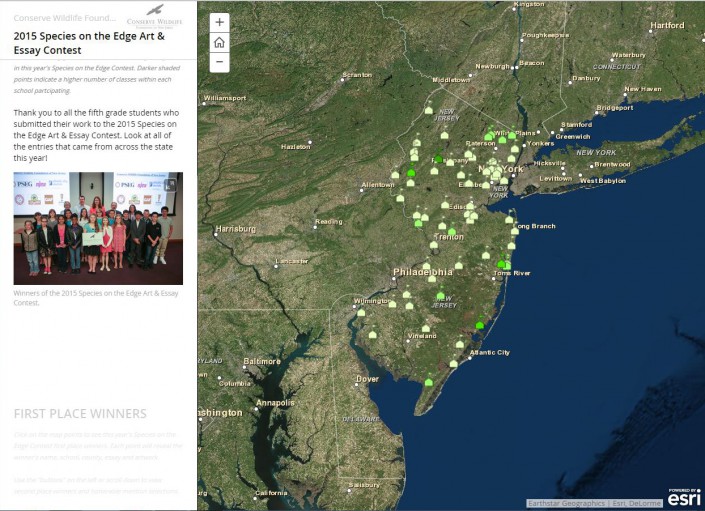
Conserve Wildlife Foundation’s 2015 Species on the Edge Art and Essay Contest gave fifth grade students from across the state the opportunity to research an endangered species and submit a drawing and essay written from the animal’s perspective. Meant to support awareness of endangered species in students, the Species on the Edge Art & Essay Contest encourages fifth graders to think like wildlife biologists as they gather research and learn about pressing environmental issues. The results of this contest are the subject of our newest story map!
This interactive map allows the user to click on icons to see participating schools, first and second winners from each county, and honorable mention entries. Scrolling through the text on the left side changes the content of the points on the map. A click on each map point brings up more information, like the number of classes from each school that submitted an entry. While scrolling through the list of winners, users can even click on the schools’ icons to bring up the students’ names, essays, and artwork.
The format of this story map is simple and easy to use, allowing for an interesting, interactive way to display the hard work of students across New Jersey.
Public urged to use caution while driving in shore areas this summer
By: Ben Wurst, Habitat Program Manager and Stephanie Egger, Wildlife Biologist
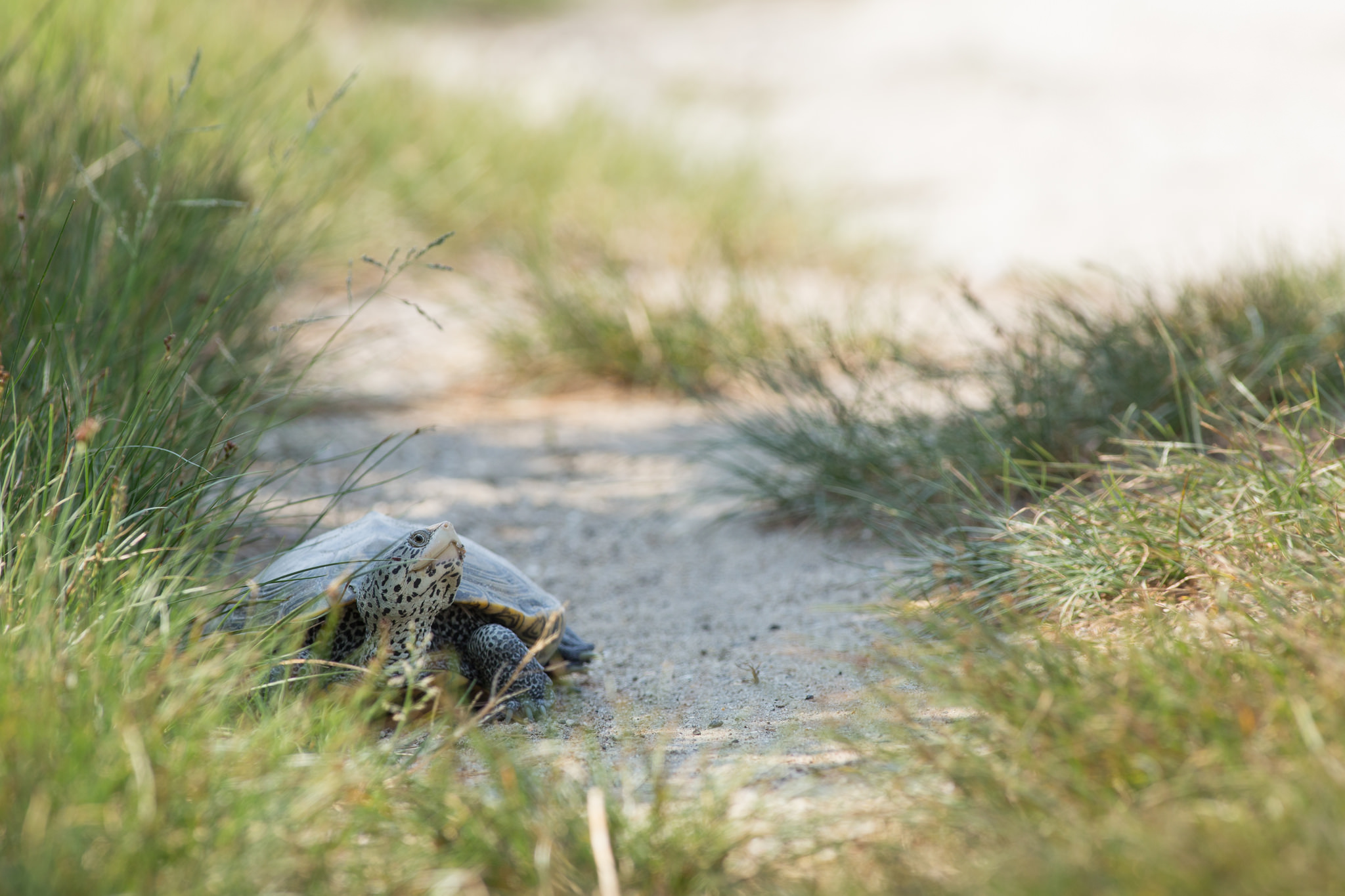
An adult female northern diamondback terrapin searches for a suitable nest site along Great Bay Blvd. Photo by Ben Wurst
Each year in late May and early June the annual nesting season for northern diamondback terrapins begins. This unique species of turtle is the only one to inhabit our coastal estuaries year round. They live exclusively in brackish water.
During this time of year, adult females emerge from the protection of their aquatic habitat to find suitable areas to lay eggs. They seek nesting areas with a sandy gravel type substrate that’s above the high tide line.
Throughout their range along the coast, terrapins face a variety of threats to their survival. Terrapin nesting habitat has been lost due to commercial and residential development, shoreline hardening and flooding which poses a greater threat to these limited nesting areas. Loss of terrapin nesting habitat along marsh systems put terrapins at greater risk of mortality as a result of increased time searching for adequate nesting areas (Winters 2013). Terrapins will utilize roadsides for nesting which increases the threat of being hit by motor vehicles. Roads are essential to our daily life but they often are barriers to wildlife, especially small critters like terrapins. Studies have shown that adult females have become less abundant and smaller from road mortality. (Avissar, 2006).
You can help terrapins several ways during the nesting season. Driving more cautiously from now until mid-July is a simple way to be more aware of terrapins crossing the roads. Nesting peaks during the full and new moon cycles and they’re more active during the high tide (less distance to travel on land to nest sites). We ask drivers in coastal areas to “Be Terrapin Aware” while driving in these areas. If you find a terrapin crossing the road use these steps to help it cross safely:
Stay safe. Never put yourself at risk! Make sure that you do not endanger yourself, or others, by walking into traffic.
When safe to do so, pull your car over and onto the shoulder, if possible. Turn on your hazard signals.
When safe to enter the roadway, approach the turtle and pick it up by grabbing its shell with both hands between its front and hind legs. HOLD ON – Terrapins have strong legs!
It is important that you move the turtle in the direction that it is heading. They are not always headed directly towards water. They will turn around if you put them in the wrong direction, so work with their instincts.
Place the terrapin off the road onto the soft shoulder (dirt or grass).
If you have a GPS or a smartphone then record your location and submit your sighting on our website.
Please do not move a terrapin long distances to “somewhere safe!” They have very small home ranges and moving them will only hurt them.
Rescuing a live terrapin (or any other turtle) from the road is a rewarding experience. It’s a great way to engage future generations in caring for our terrapins.
You can also help terrapins during the nesting season by supporting our new “Turtle Gardens” project. CWF, in partnership with the Marine Academy of Technology of Environmental Science, will develop and implement an educational initiative to promote terrapin nesting habitat enhancement. These “Turtle Gardens” will raise awareness of the benefit of living shorelines to terrapins and other coastal wildlife, as it relates to sea level rise and coastal flooding within the Barnegat Bay Watershed. Turtle Gardens for terrapins are patches of sandy nesting habitat above the high water line that are less susceptible to flooding. They also reduce the risk of road mortality. We will be having informational training sessions for those that would like to volunteer for monitoring Turtle Gardens or have property that would support a Turtle Garden. Information on these sessions will be announced in mid-June.
In addition, we will also be looking for terrapin sighting information with Project Terrapin in Berkeley and Lacey Townships in Ocean County as part of an initiative to fill in data gaps for this species on the mainland. If you see terrapins in these locations please report your sightings online.
Ben Wurst is the Habitat Program Manager for Conserve Wildlife Foundation of New Jersey and Stephanie Egger is a Wildlife Biologist with Conserve Wildlife Foundation of New Jersey.
2015 Species on the Edge Art & Essay Contest Winners announced at Awards Ceremony
By: Lindsay McNamara, Communications Manager
2015 Species on the Edge Winners with representatives from CWF and PSEG
Today, Conserve Wildlife Foundation of New Jersey celebrated and recognized the winners of the 2015 Species on the Edge Art & Essay Contest, a statewide educational contest open to all fifth-graders, which encourages students to become wildlife biologists through their research and artwork on the endangered and threatened wildlife species in New Jersey.
“The vibrant artwork and passionate essays that we received from fifth-graders across the state reveal just how much these talented children poured their hearts into the Species on the Edge contest,” said David Wheeler, Conserve Wildlife Foundation Executive Director. “We are so thrilled to help connect the next generation of New Jersey conservation leaders with the natural world around them. Through their art and essays, all of us can see the wonders of nature – and the many challenges that we must overcome to help rare wildlife survive in our densely populated state.”
Students were asked to draw a picture of one of New Jersey’s 83 endangered and threatened wildlife species and compose an essay about how the animal became endangered and what can be done to help protect it. The Species on the Edge Art & Essay Contest encourages students to learn about local environmental issues, express their concerns for the world around them, think creatively about ways to improve it, and to consider how their actions impact the natural world.
Abby Miller, a student at T.P. Hughes Elementary School in Union County believes that it is important to protect wildlife in New Jersey because “everything deserves to be saved when they’re endangered.”
Bald Eagle from Mercer County Wildlife Center
This year’s ingenious group of winners was honored at an awards ceremony which was hosted at the New Jersey Education Association, in Trenton, New Jersey. The contest was sponsored by PSEG, NJEA, GAF, Atlantic City Electric, Church & Dwight, ShopRite and Six Flags Great Adventure. Mercer County Wildlife Center brought a live Bald Eagle to the event.
The statewide contest drew over 2,000 entries from across the state. Since 2003, over 10,000 children from across New Jersey have entered the Species on the Edge Art & Essay Contest.
Barnegat Bay Blitz set for Wednesday, June 3, 2015
By: Lindsay McNamara, Communications Manager
Concerned about the health of the Barnegat Bay ecosystem? Consider participating in a day of action for the Bay! The New Jersey Department of Environmental Protection (DEP) will be hosting its next Barnegat Bay Blitz clean-up day on Wednesday, June 3.
You can join thousands of volunteers as they fan out across the watershed, which includes all of Ocean County amd parts of Monmouth County, to clean up the Barnegat Bay Watershed and spread awareness about the people pollution impacting the Bay. Clean-up events are happening in all 37 municipalities!
DEP Commissioner Bob Martin will be kicking off this year’s Barnegat Bay Blitz at the iconic Barnegat Lighthouse State Park. Hundreds of volunteers will gather at this one location to learn about the Bay and start a day full of awesome stewardship activities. Take part in the fun at 10 AM on June 3rd at the Lighthouse! To volunteer, visit DEP’s website.
In the middle of Barnegat Bay, there are many small islands called Sedges. These islands are home to a number of species of plants and animals, but unfortunately are impacted by litter that the tide washes in. Volunteers by boat, kayak and standup paddle board will make their way out to many of these islands, including Island Beach State Park, Seaside Heights and Brick to sweep them clean of debris. Get involved!
It’s not just the bayfront communities that impact Barnegat Bay. Communities miles and miles inland also play a role. After all, we are all downstream! That is why at the Barnegat Bay Blitz, volunteers will work to clean up all over the watershed, from inland areas of Plumsted to the barrier islands. In Plumsted, a farming community, volunteers include more than just people! Llamas will also join the crew to help haul out trash and debris that volunteers collect from the Colliers Mills Wildlife Management area. To make friends with llamas, register for the Plumsted clean-up on DEP’s website.
We hope to see you on Wednesday, June 3, for DEP’s next Barnegat Bay Blitz!
Conserve Wildlife Foundation Releases New Story Map: “The Return of Bald Eagles in New Jersey”
By: Brian Henderson, GIS Specialist
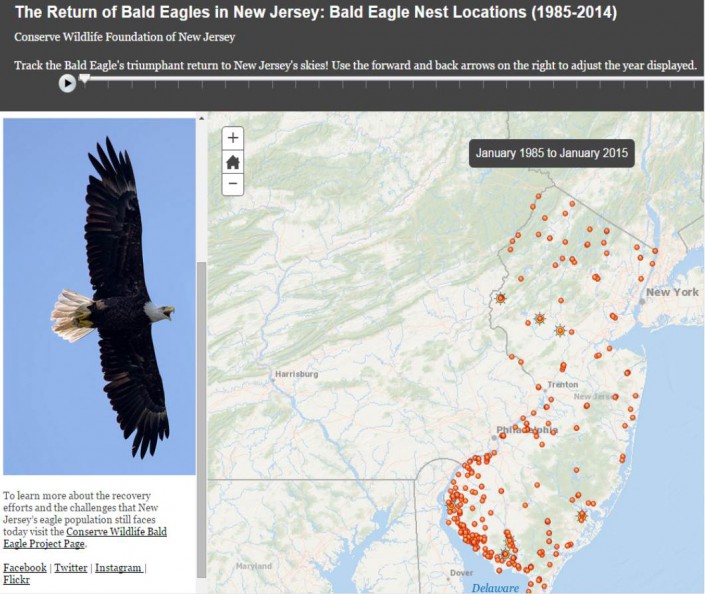
Today, Conserve Wildlife Foundation of New Jersey (CWF) announced the release of “The Return of Bald Eagles in New Jersey” a Story Map that provides a new way to visualize the increasing number of bald eagle pairs nesting in New Jersey over time.
For years, CWF has worked closely with the New Jersey Endangered & Nongame Species Program (ENSP) to track and restore the bald eagle population within the state. It has been a rewarding experience for all involved to witness the return of bald eagles to the garden state, and now the public can appreciate the scope of their return as well.
The recovery of bald eagles nationally and in New Jersey is fairly well known, but some may not realize that as recently as the mid-80’s there was only a single pair of nesting bald eagles in all of New Jersey. The ban of DDT, combined with restoration efforts by ENSP biologists, resulted in population increases to 23 pairs in 2000, 48 pairs by 2005 and 82 pairs in 2010.
In 2014, there were a record 146 active bald eagle pairs nesting in New Jersey. This year, 190 nesting territories are being monitored and currently 88 chicks have been reported at 52 nests; it is still early in the season so we don’t have a count for all nests yet.
“The Return of Bald Eagles in New Jersey” Story Mapdisplays the locations of all the known active bald eagle nests in New Jersey from 1985-2014. Users can choose to view the nests active in a single year or over a longer period of time. By choosing a one year interval and beginning in 1985, it’s possible to watch as nests multiply from a single nest in Bear Swamp to densely populating the Delaware Bay coast and spreading across the southern portion of the state and eventually into almost every county of New Jersey. In 2014, the only counties in New Jersey without an active bald eagle nest were Essex and Hudson.
The Story Map also highlights “featured” nests, or nests of special significance, including the Duke Farms nest which has been featured on a webcam since 2005 and the Millville nest where a juvenile eagle was fitted with a GPS tracking device in 2014. These featured nests include more information, pictures and links to pages that explore related projects in greater depth.
As the bald eagle population has reached record numbers in New Jersey, the raptors have expanded into non-traditional parts of the state, providing more and more people with a chance to glimpse this iconic species. This map highlights the ongoing success of conservation efforts and illustrates that whether you realize it or not, you’re never very far from a bald eagle nest in New Jersey!
Contest winner to help band EagleCam chicks at Duke Farms next month
By: Lindsay McNamara, Communications Coordinator
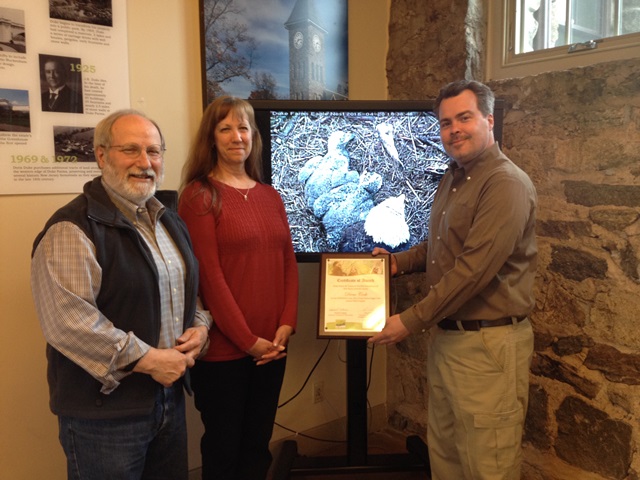
From Left to Right: Duke Farms Executive Director Michael Catania, Contest Winner Diane Cook, CWF Executive Director David Wheeler
Copper Hill School computer teacher Diane Cook was recognized by Duke Farms and Conserve Wildlife Foundation for winning their EagleCam lesson plan contest earlier this week. Cook will join wildlife biologists to help band the new Duke Farms EagleCam chicks next month.
The EagleCam Lesson Plan contest, jointly organized by Duke Farms and Conserve Wildlife Foundation, called on educators to submit lesson plans incorporating the Duke Farms EagleCam into their classrooms. Installed in 2008, the Duke Farms EagleCam, a web cam on a tree adjacent to a Bald Eagle nest, has provided a streaming look into the daily lives of the eagle family for over 10 million viewers.
Diane Cook submitted three creative lesson plans for the contest and is working with the Duke Farms and Conserve Wildlife Foundation EagleCam team to expand the camera’s potential as an educational vehicle.
“Duke Farms is delighted to support dedicated teachers that bring nature to life in their classrooms. Diane Cook’s winning lesson plan featured innovative strategies to teach digital citizenship through student observations of the nesting eagles,” explained Michael Catania, Duke Farms Executive Director. “Her participation in this year’s banding of the Duke eagle chicks will be a highlight for our staff.”
The EagleCam has been a staple of Diane Cook’s classrooms since the webcam was installed in 2008. Cook began blogging about the eagles in 2011 and allows students in grades kindergarten through four to share their thoughts, observations or questions on what they see happening in her computer literacy class. Cook also live streams the EagleCam in her classroom for her students to watch. Her first graders use the webcam as a part of an internet safety unit and her third and fourth graders use the EagleCam to learn how to write blogs themselves.
“Watching the EagleCam gives us all, adults and students, the opportunity to experience nature happening right before our eyes. It opens the way for meaningful discussions and great questions, both at school and at home as families watch together,” said Computer Literacy Teacher and Contest Winner Diane Cook. “This year, I am using the EagleCam to teach how to write a thoughtful and meaningful comments in social media forums. Fourth graders are learning how to blog. They are excited to write about a topic that excites them.”
“As a dedicated and inspiring teacher, Diane Cook is helping us realize the incredible potential for connecting our kids with the natural world around us,” stated David Wheeler, Conserve Wildlife Foundation Executive Director. “The amazing comeback of Bald Eagles across New Jersey mirrors the recovery that our state has made from the devastating legacies of unchecked pollution. Teachers like Diane Cook work so hard to make sure the next generation of leaders understands first-hand how much all of us – humans and Bald Eagles alike – depend on a clean and healthy environment.”
Originally from Branchburg, New Jersey, Cook now resides in Ringoes. She has been an educator at Cooper Hill School in the Flemington Raritan School District for 19 years, teaching first grade, second grade and now computer literacy. Cook gets outside as often as she can, and she enjoys gardening, birding or looking for other wildlife, hiking, walking, fishing, and learning her newest craft of photography.
“I’m hoping to instill in all who learn about the EagleCam in my class a sense of wonder, appreciation for our natural world, and a desire to take care of our world,” explained Cook. “Environmental science is one of my passions. I want to pass along a small part of that to others.”
Lindsay McNamara is the Communications Coordinator for Conserve Wildlife Foundation of New Jersey.
Enter Conserve Wildlife Foundation’s New Species on the Edge 2.0 Contest by May 22, 2015
By: Lindsay McNamara, Communications Coordinator
Attention New Jersey High School Students!
Love experimenting with new multimedia and technology programs? Want to express your concern for New Jersey’s endangered species and help show the public why wildlife protection is important in the Garden State? Make sure to enter our Species on the Edge 2.0 Multimedia Contest!
Open to all New Jersey high school students, this contest invites students to submit a video, app, podcast, digital graphic design, webpage, or other multimedia component showing why wildlife protection is important in New Jersey. Watch the new Species on the Edge 2.0 video, created by 2015 Video Intern Tyler Grimm, to learn more about this great opportunity.
New website promotes natural resources and recreational opportunities found at Island Beach State Park
By: Ben Wurst, Habitat Program Manager
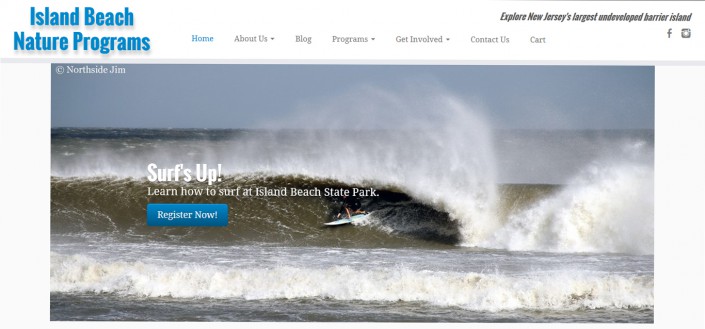
Make sure to bookmark: www.islandbeachnatureprograms.org!
Over the past few months, we have been working with interpretive staff at Island Beach State Parkto develop a new website. The new website showcases the rich natural resources available to visitors of the Park. Daily and guided programs are offered throughout the summer, starting in June.
Programs include:
Daily programs include: daily beach walks and Seining (these are free)
Guided programs (cost between $5-25) include: Birding by Kayak, Surfing, Coastal Cooking, Kayak Eco-Tour, Beginner’s Surf Fishing Clinic, Clamming, Moonlight Hike, Nature Photography Seminars, and more!
Make sure to point your browser to the new, Island Beach Nature Programs website. Check out the list of programs. Bookmark the site and share it with your friends! Make sure to include some awesome, educational outdoor recreational plans for your summer vacation along the Jersey Shore!
Ben Wurst is the Habitat Program Manager for Conserve Wildlife Foundation of New Jersey.
Conserve Wildlife Foundation of New Jersey Releases a New Story Map: “Harbor Seals in New Jersey”
By: Michael Davenport, GIS Program Manager
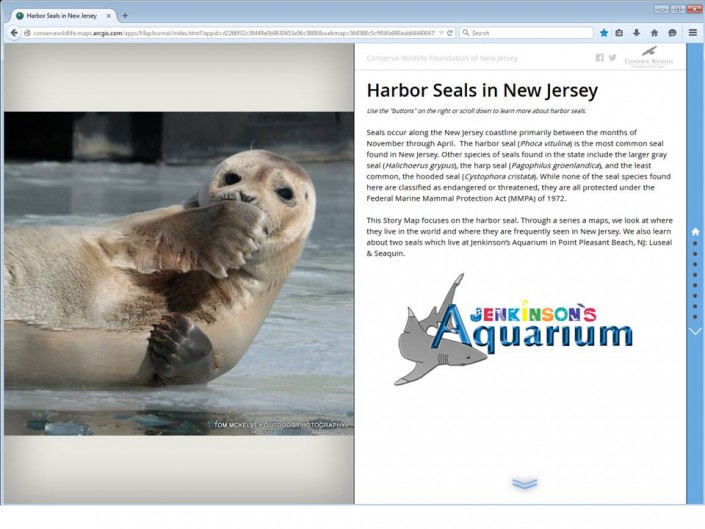
Conserve Wildlife Foundation of New Jersey (CWF) has partnered with Jenkinson’s Aquarium of Point Pleasant Beach, New Jersey to create and release our latest Story Map, “Harbor Seals in New Jersey.”
Over the years, CWF staff have worked with a number of marine biologists in order to monitor seal populations in New Jersey and minimize disturbance or harm to them. Most recently, CWF held two workshops in 2014 to educate first responders on handling marine mammal (and sea turtle) strandings. We’re continuing our efforts at educating the public about these amazing animals with our “Harbor Seals in New Jersey” Story Map. A Story Map is a web-based interactive map embedded with multimedia content, such as text, photographs, and video.
The release of this Story Map coincides with the renovation of the seal exhibit at Jenkinson’s Aquarium. Jenkinson’s has been home for harbor seals since 1991, when their first seal (“Luseal”) moved in. She was soon joined by another seal, “Seaquin.”
This Story Map provides general information about harbor seals: where they live, how they live, and what dangers they face in the wild from both predators and humans. Luseal and Seaquin also have pages devoted to them, with photos and interesting facts about their lives and behaviors.
CWF Releases its First Annual Report Ever Using a Story Map Format: “2014 Annual Report“
By David Wheeler, Executive Director
Technology has proven to be vital to Conserve Wildlife Foundation’s work protecting rare wildlife species over the years. Our biologists depend greatly on modern technologies to band, track, and share online the journeys of wildlife. Our webcams broadcast the most intimate behaviors of nesting birds and bats across the web. And we seek out ever-evolving communications technologies to spread the word about the inspiring stories of wildlife, from social media and infographs to e-books and Story Maps. These technologies offer newfound abilities to share complex data on multiple levels, while still incorporating the awe-inspiring photography and videos that bring wildlife’s stories to life.
Conserve Wildlife Foundation of New Jersey is excited to offer our 2014 Annual Report in a unique format that utilizes one of those technologies – Story Maps. In the past year, we have explored the wonders of American oystercatchers with our first Story Map – and now the annual report allows all of our projects to be highlighted in this interactive format.
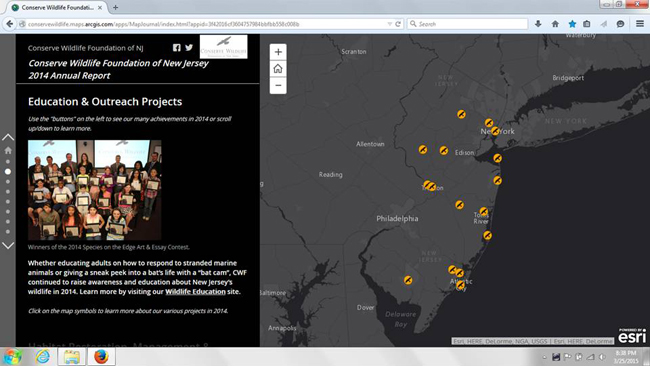
A screen capture of one of the pages of the CWF 2014 Annual Report Story Map.
Visit the multiple pages within this Story Map to learn about Conserve Wildlife Foundation’s many projects and partnerships in 2014, and the imperiled wildlife species in need of our help. Find examples of the innovative and dedicated leadership of our biologists and volunteers. And take an online journey across the state to learn how our projects made a difference in all corners of New Jersey in 2014 – a great year for wildlife in the Garden State!