By Todd Pover, Beach Nesting Bird Project Manager and Stephanie Egger, Wildlife Biologist
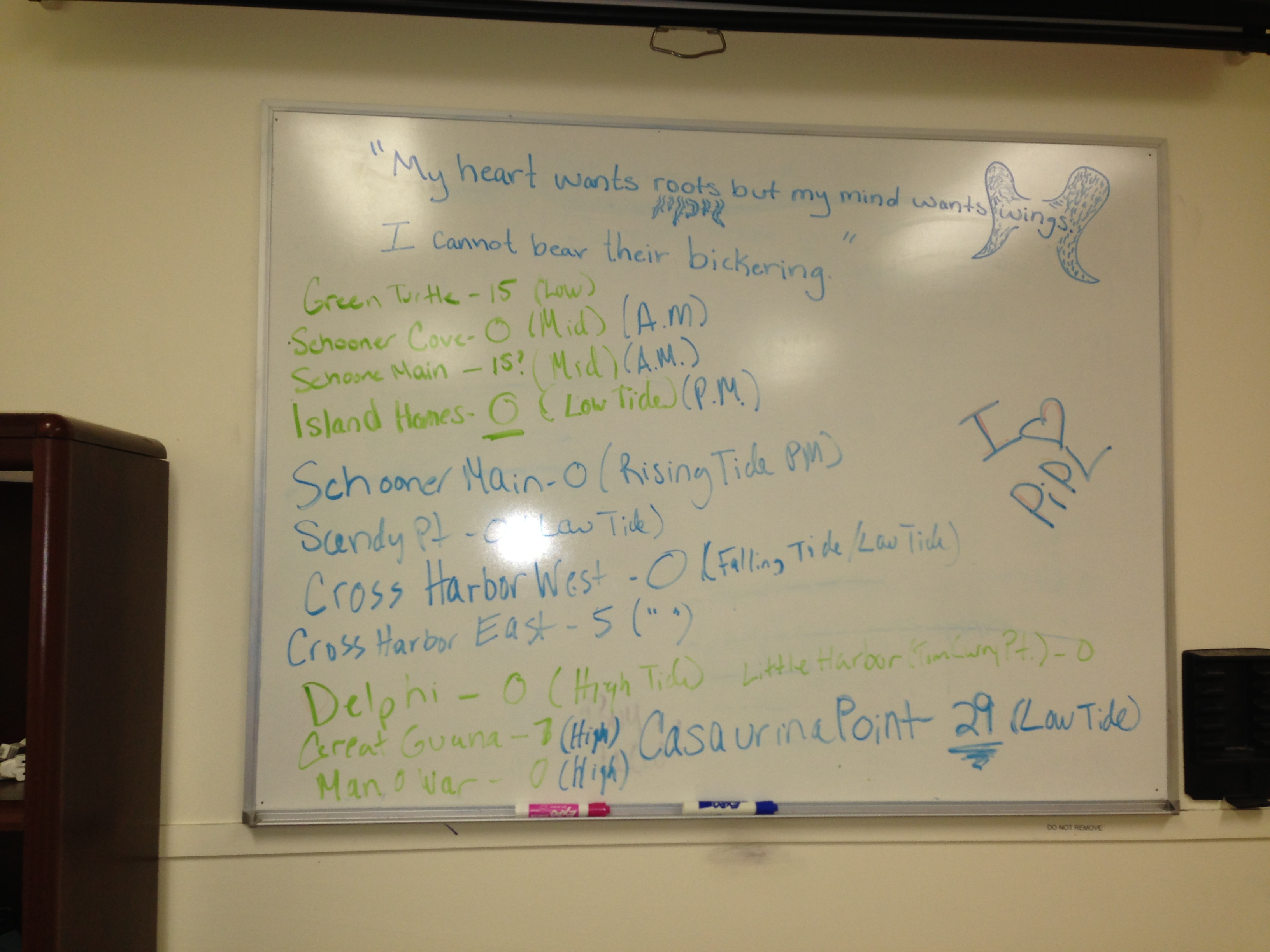
The Bahamas piping plover survey tally board in the “central command” room at Schooner Bay Institute.
An integral part of this Bahamas trip entailed surveying several sites not previous covered on Abaco and revisiting some sites not checked since the 2011 International Piping Plover Census. Although we didn’t find large concentrations of piping plovers at any one new site, we did make some noteworthy discoveries.
One of the most exciting find was the resight of a piping plover that was banded on the breeding grounds last summer in Massachusetts as part of a flight behavior study. New Jersey also participated in this research and we briefly thought it might be one of the birds banded in our home state – but it turned out that it was banded (and nested) on Chapin Beach, Cape Cod and is wintering at Schooner Bay, Abaco (amongst 15 other piping plovers found on our survey). Continue reading “BAHAMAS PIPING PLOVER PROJECT”
This trip to the Bahamas we had three volunteers, piping plover experts, to help us survey stretches of Abaco that we have either not been able to survey or had limited opportunity to survey in the past. Our volunteers have a wide range of experience ranging from the U.S Fish and Wildlife Service, Pronatura Noreste A.C. Mexico, and a wildlife consulting company in Virginia. Below is their experiences from the week. Enjoy!
Annette Scherer, Retired U.S. Fish and Wildlife Service Endangered Species Biologist
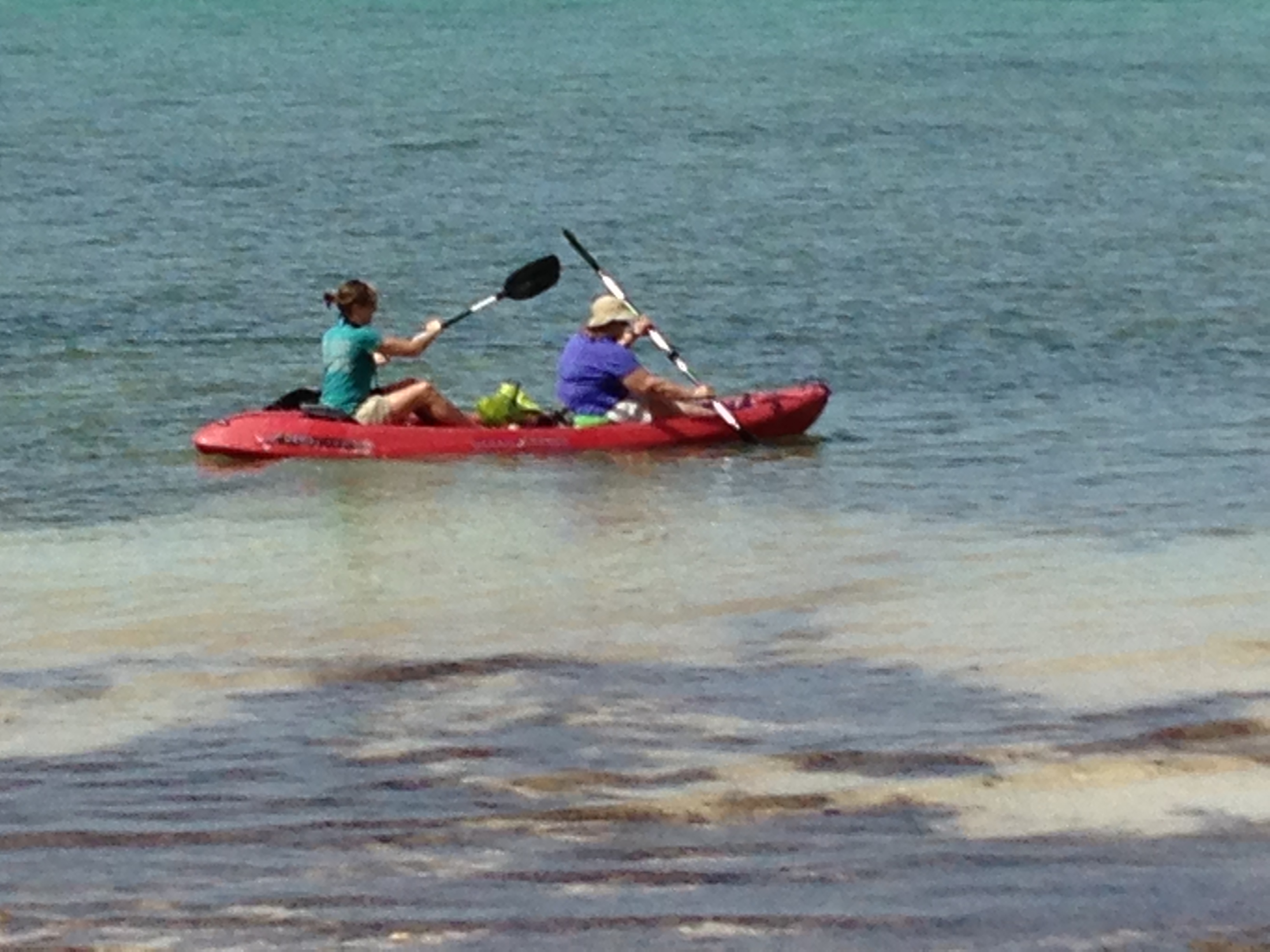
Annette Scherer, retired U.S. Fish and Wildlife Service Endangered Species Biologist (R), kayaking with Stephanie Egger, CWFNJ Biologist (L), to the marine flats in search of Piping Plovers.
When I retired a year ago after spending the better part of my career negotiating with stakeholders and regulatory agencies to balance piping plover protection with shoreline stabilization projects and human recreational use, I often joked that I was going to move somewhere with no plovers- no piping plovers, no snowy plovers, and not even mountain plovers. But when CWFNJ invited me along to survey for piping plovers in Abaco, Bahamas I jumped at the chance to learn more about piping plovers on their wintering grounds. My work with plovers in the northeast U.S. had focused on plovers on their breeding grounds where individual pairs of plovers fiercely defend their nesting territory. As a result, its unusual to see more than a pair of plovers and their brood of up to 4 chicks in a single spot. Here on the wintering grounds the bird’s habitat characteristics are very similar to that of their breeding areas – wide sandy coastal beaches, but their behavior is very different. The plovers congregate in small groups, roosting and feeding together. On my first survey day, I was thrilled to observe a group of eleven plovers roosting high on the beach. It was strange to see so many plovers calmly sitting together. Each bird was nestled down in a small depression that gave protection from the wind, reminding me of the shallow scrapes they make when building nests. It was great to finally see where the birds go when they leave the northeast and personally rewarding for me to now have observed the birds throughout their entire annual cycle. Continue reading “Volunteer Guest Bloggers – Bahamas Piping Plover Project!”
Piping plover roosting beach on the island of Eleuthera, Bahamas.
Up until now, nearly all of our piping plover conservation work in the Bahamas has been focused on the island of Abaco. One of the objectives of our Disney Worldwide Conservation Fund grant is to identify other islands and partners where and with whom the model we are developing on Abaco might be implemented as well. With this in mind, we spent the past several days on the island of Eleuthera.
Although we believe the basic elements of our Abaco work are transferable to other islands, a “one size fits all” approach may not entirely work. The various major islands are unified under the Bahamas flag, but each also has its own flavor, history, and way of life. The best analogy would be that they operate much like the individual states in the U.S.
On Abaco, we have been partnering with Friends of the Environment, a non-profit organization with a strong education and outreach component to all of their work – not so different from what we do here at the Conserve Wildlife Foundation. On Eleuthera we are hoping to partner with the Cape Eleuthera Institute (CEI) and The Island School. Although education is at the core of their work as well, it is also different in that they carry out and support primary research and host visiting scientists and students at their campus. Continue reading “Bahamas Piping Plover Project”
By Todd Pover, Beach Nesting Bird Project Manager and Stephanie Egger, Wildlife Biologist
Today we arrived on the island of Abaco in the Bahamas to start our piping plover project, which was made possible courtesy of a grant from the Disney Worldwide Conservation Fund. It was mostly a travel day to for us, nonetheless, still exciting to finally be here to start a project that was has been over a year in the planning.
We will hit the ground running tomorrow with a visit to a local school, participation in a round table discussion with stakeholders on tidal flats conservation, a piping plover survey, and filming for an educational video. And that’s just the first day!
So while we still have time to catch our breath, this is a good opportunity to review the purpose of our trip here. Over the course of the past two decades, considerable resources have been put into the recovery of the Atlantic Coast population of piping plover, a federally threatened species, with most of the effort taking place on the breeding grounds in the U.S and Canada. Recent research has revealed that the vast majority of the population winters in the Bahamas. Furthermore, there is a growing realization that recovery and long-term sustainability will only occur with full life cycle conservation – protection during the breeding, migration, and wintering phases of the piping plover’s life. Continue reading “Plovers in Paradise”
By Emily Heiser, Piping Plover Research Technician
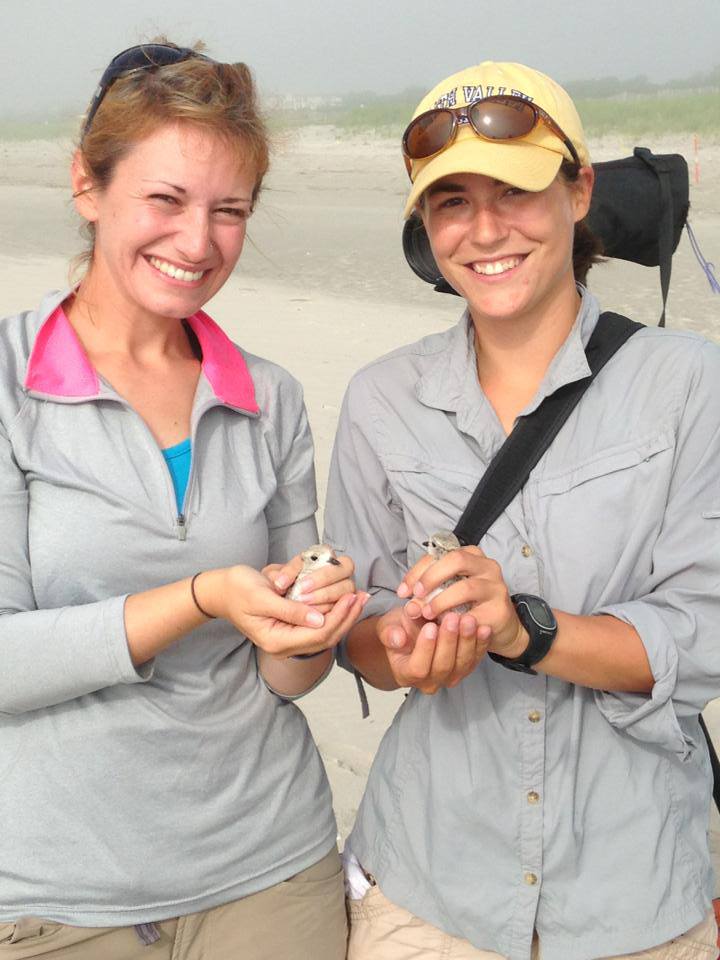
Emily Heiser (l) and Lauren Gingerella (r) with piping plovers in hand for banding.
Call me crazy, but the combination of piping plovers and New Jersey are just too much for me to resist! Over the last six years, I have spent the majority of my time working for Conserve Wildlife Foundation of New Jersey and New Jersey Division of Fish and Wildlife protecting piping plovers on their nesting grounds. Most recently I worked on a research project with the State University of New York-ESF that dealt with piping plover flight behavior in Stone Harbor, Avalon and Strathmere, New Jersey. The project’s graduate student, Michelle Avis conducted the other half of the study on Cape Cod, Massachusetts. The project was specifically designed to look at piping plover flight patterns across their breeding grounds. The results of the study could have implications for the management of coastal wind turbine development. Continue reading “Overview of piping plover flight behavior research”
Wondering how you can learn more about shorebirds? Look no further.
Despite its part in one of the world’s most incredible migrations, the annual arrival of tens of thousands of shorebirds in Delaware Bay remains relatively unknown to many New Jersey residents. Only recently have shorebirds received some news coverage, but it’s not good news – their numbers are declining rapidly. Scientists have begun to fear that without concerted conservation efforts, species like the red knot may soon go extinct.
The Delaware Bay Shorebird Project, a study led by the New Jersey Division of Fish & Wildlife’s Endangered and Nongame Species Program, has documented shorebird activity in Delaware Bay for nearly thirty years. The result has been an extensive knowledge base that documents every aspect of shorebird life – from measuring food availability and weight gains to tracking migration routes and breeding success – in New Jersey and beyond. Now, as a longtime partner on this project, the Conserve Wildlife Foundation of New Jersey is proud to introduce a new way to learn about these wonderful birds and the work underway to save them: a brand new shorebird site!
These new additions are loaded with content to bring you up to date on all the latest developments in the protection of shorebirds. Learn about these special birds on the Key Species page, and find detailed descriptions about their appearance, life cycle, and where to see them on their own pages in our online Field Guide. Check out the Media page for videos, photos, news articles, scientific publications, and more. Take an in-depth look at all the different areas of shorebird study currently underway on the Research page, and click on the Conservation page to discover how these birds are being protected. Finally, visit our Get Involved page to learn how you can become part of the efforts to help save these remarkable species from extinction.
CWF’s Larry Niles is in Northern Canada searching for Red Knots and other shorebirds in their Arctic breeding territory. We are following him and posting summaries of his blog entries as he reports from the field.
Our small camp. The cold weather and frigid rain confined us to our tents on the second-to-last day of our trip.
Our second-to-last day in the Arctic was rained out. A constant cold drizzle punctuated by brief downpours confined us to our tents, as the limited visibility would have made it impossible to spot Red Knots or their nests – or approaching polar bears.
We saw our first (and last) polar bear on the final day of the trip. When it saw us coming his way, he slowly lumbered off in the opposite direction, posing no threat.
But on our last day on Knot Plateau, we woke to a brilliant sunny day. While Rick, Steve, and Mandy broke camp, Josh, Mark, and I drove our ATVs out to the two knot nests we had found two days prior. As we had only banded one parent at each nest, we were hoping to find the unbanded birds this time. But the newly hatched knots and their parents had already left for the nearest wetland, and the incubating bird on the second nest was the bird already tagged with a geolocator. With nothing more to be done, we made our way back to camp to help finish packing.
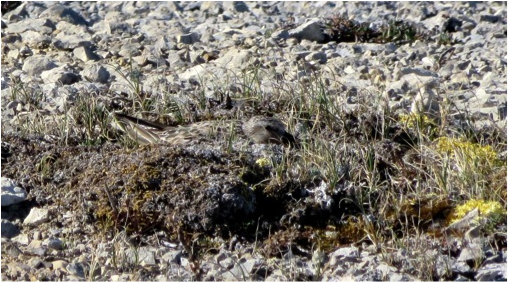
A knot incubates her eggs on a small patch of vegetation.
It took two days to return to Coral Harbour and civilization. After staying the night with Josh and his family, we will begin our two-day journey by commercial flight back to Newark, anticipating the shift from 45 degrees to 95 degrees, but glad to be coming home.
The expedition was a success simply because we are all coming home safe and sound. But it was also a complete success because we achieved all of our primary goals. First, we established the presence of a new Red Knot breeding area from the ground. Second, we found a significant number of knots compared to our previous study sites on both Southampton and King William Islands, where most of the knot population had disappeared after the rapid decline in stopovers like Delaware Bay. Third, we finished the fieldwork needed to complete our range-wide mapping of rufa knot breeding habitat, which will help future investigations into Red Knot ecology. And finally, we attached the first geolocators to knots in the Canadian Arctic and set a firm foundation for a more successful effort in the future.
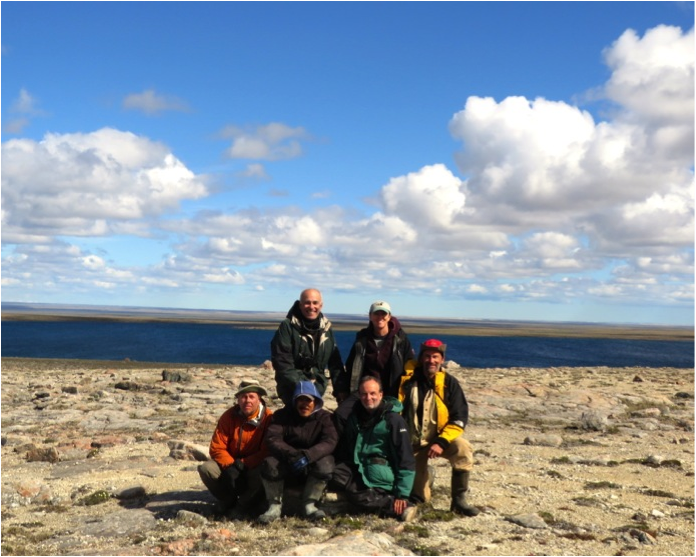
Our team. Back row, L to R: Larry Niles and Mandy Dey. Front row, L to R: Mark Peck, Joshua Keenainak, Steve Gates, and Rick Lathrop.
We are grateful to many people. The expedition would have been impossible without the support of Paul Smith of the Canadian Wildlife Service. The Conserve Wildlife Foundation of NJ, the Canadian Wildlife Service, Rutgers University, the Royal Ontario Museum, and The Steve Gates and Julie Fox Foundation all supported the expedition. The Coral Harbour Hunters and Trappers Organization provided essential support. Bruce McKitrick helped us with supplies. Finally we thank Joshua, Suzy, and their family for their hospitality. This expedition was only successful because of all of you.
CWF’s Larry Niles is in Northern Canada searching for Red Knots and other shorebirds in their Arctic breeding territory. We are following him and posting summaries of his blog entries as he reports from the field.
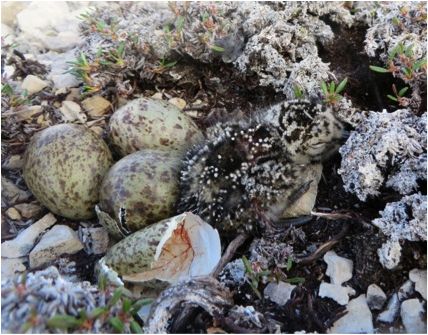
The first nest we found had one hatched chick, so fresh you can still see the embryonic material in the shell.The second nest we found was on the side of an almost completely barren hill.
After 10 days in the field, 5 of them searching for knots, and with only one day before we must leave, we have at long last found knot nests – two, in fact. As we suspected, both still contained eggs, although one adult was also brooding a chick that was only hours old. Also as we suspected, we found them on small ridges in gravel-sized frost-cracked rock with very sparse vegetation.
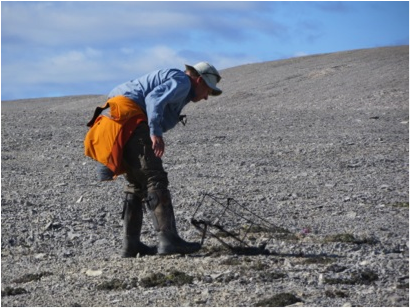
Mark sets the trap to catch the nesting adult knot. The trap falls when the bird sits on a small line across the nest.
There are fewer knots than the number of potential knot nesting sites in our study area, meaning the knots have two possible strategies when they choose a nesting site: they could be fanning out at very low densities, or they could be clustering and keeping a certain distance apart. Our experience at our first red knot study site suggested the latter possibility. In the first few years, when knot populations were still fairly high, knots occurred along ridges one kilometer apart. This fell apart as the number of knots collapsed in the period between 1999 to 2006, but our experience suggested knots will stay together and keep territories of about one square kilometer. In other words, knots like their space, but they still want neighbors.
So after finding the first nest, we started searching about 1 km away in adjacent habitat and soon found a second nest, corroborating our theory. But by then it was close to the end of the day and we had only an hour or so to search for a third. Finding none, we rode the 4 miles of hard trail back to camp with some satisfaction. We will try again tomorrow to find more in the area, but unfortunately it will be our last day.
A geolocator, about to be attached to a knot
Rain is falling against our tent, as it has through most of the night. Rain in the Arctic is always cold – more of a winter rain than one of summer. The knot nest with one chick will almost certainly have four by now, as it usually only takes 24 hours for all eggs to hatch. The adult will brood the chicks as best he can, but it’s not unusual for weather such as this to kill young shorebirds. This is one of many reasons why northbound stopovers like Delaware Bay must provide shorebirds with a good start every year.
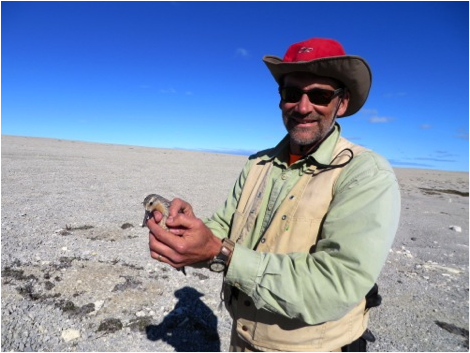
Rick released the knots at their nests.
If the rain abates, we will continue searching for nests tomorrow, but only time will tell whether our final day in the field will be a washout. Regardless, it is a wonderful feeling to have finally found what we came searching for.
CWF’s Larry Niles is in Northern Canada searching for Red Knots and other shorebirds in their Arctic breeding territory. We are following him and posting summaries of his blog entries as he reports from the field.
Arctic Fox are one of the top predators of shorebird eggs. A mottled brown color in the summer, their fur turns snow white every winter.
Our camp here on knot plateau is spartan. We had to jettison many of the luxury items, like the cook tent, so that we would need to make the 25-mile ATV trip into the plateau only once. Even then, the ATVs were overloaded, and we had numerous problems like flat tires and a cracked support for the back rack.
Josh’s skills have proven invaluable, as he has repaired our ATVs multiple times. Here, he fixes a slice in an ATV’s tire from a sharp rock.
At this point in our trip, the rigors of conducting daily field work and sleeping on therm-a-rest mattresses in unheated, low-ceilinged tents are starting to wear us out. Of course, much of this is age-related. The author of this blog, being on the older side of the crew, finds the need to get dressed in a tent the size of a refrigerator box to be the most difficult part of our field experience. Ironically Joshua, the youngest of our crew, has a small campaign tent in which he can stand.
A typical ridge nesting habitat on knot plateau.
But complications such as these are minor compared to what we have discovered: numbers of knots at least equal to the high densities we saw years ago. Better yet, the amount of potential nesting habitat on knot plateau is far greater than other Arctic sites we have surveyed because the knots here are nesting in much greater profusion. This plateau is perfect nesting habitat because these potential nesting sites are surrounded by wetlands where the newly-hatched young can feed, and the complex is also within 10 kilometers of the Sutton River basin. The river remains clear almost year-round, making it a perfect feeding spot for the adults while the nesting area is still frozen.
Team member Mark Peck examines an unhatched American Golden Plover nest.
The greater area of habitat, however, causes great difficulty in finding nests, and it doesn’t help that knot nests are the notoriously hard to locate to begin with. Most shorebirds react to intruders on approach because both adults stay near the nest. But Red Knots, on the other hand, don’t react to intruders because one adult is elsewhere feeding and the incubating bird won’t leave the nest until he is almost stepped on. So far, we have found the nests of several shorebird species such as American Golden Plover, Semipalmated Sandpiper, and Dunlin, as well as those of other birds like Long-tailed Jaegers – but so far no knot nests.
A Google Earth image of our study area.An interpreted map of the same area. Each color represents a different level of desirability for Red Knots.
Our mapping work is going well and may yet prove the most valuable result of this trip. Under Rick’s guidance we are ground truthing interpreted satellite images that already distinguish tundra habitat with good precision. Our task is to train the map to distinguish habitat important to knots. In the end we will create a precise mapping of optimal knot habitat.
All in all, we still have a lot of work to do and not much time left to do it. But even though we have yet to find the knot nests we came for, we cannot help but be pleased by what we have already found.
CWF’s Larry Niles is in Northern Canada searching for Red Knots and other shorebirds in their Arctic breeding territory. We are following him as he reports from the field. The following is a summary of his latest blog posts.
Our camp along the Sutton River.
It has been a grueling, but exhilarating, last few days for our team. At long last, we’ve reached our study site. Anyone else would have looked at this barren plateau and wondered what all the fuss was about, but our team fist-bumped with pride. After three tries, we had finally made it – but getting here was an arduous process we won’t soon forget.
Once into the formidable wetland of the Sutton River, our machines frequently sank up to the axles in mud. And all the while, we had to keep watch for bears.
We left Coral Harbour on Wednesday afternoon with three ATVs and a truck, as well as a new team member. Josh is our “bear-watcher,” an experienced Inuit hunter whose job is to discourage or, if absolutely necessary, kill an attacking polar bear. We can only hope his services will not be required.
Rick Lathrop uses both topographic maps and satellite imagery to help guide us through this tundra wilderness. Next to Rick, our 3 ATVs are packed with 10 days’ worth of supplies for 6 people.
We had hoped that the road out of town, which was recently extended, might take us all the way to our study site – but it was not to be. Four hours after leaving Coral Harbour, we reached a point where we had to depart from the road and traverse out into the roadless tundra.
We set out by ATV the next morning, but soon ran into trouble. To get to the knot plateau, we had to cross the Sutton River, one of Southampton Island’s major rivers. It’s a gentle stream where it crosses the road, but at the place where we needed to cross it was a wide valley, within which lay one of the most formidable wetlands in the Arctic. The ground shook like Jell-O as we walked, and if an ATV so much as scratched the surface it was down to its axles. After five hours, we had to give up.
Making one of four attempts to cross the Sutton River.
At Josh’s suggestion, the next day we travelled about 15 miles downriver to a crossing used by Inuit hunters. The river was wider there, but we were optimistic because the riverbank was high ground, so we could drive up or downriver over easily-traversed terrain. But after four attempts with the ATV, we could see the river was too deep to cross. The knot plateau was within sight on the other side, but for a second time we had to drive away.
After several days of trying to cross the treacherous Sutton River, we were spent.
Finally, Rick found an almost entirely dry ridge of high ground about three miles to the west of our camp. After crossing the Sutton River near its headwaters, it was five hours of rough riding with fully-loaded ATVs along the ridge to get back to the knot plateau. When the plateau finally rose up before us, we were elated. We drove six more miles before finally setting camp along one of the many lakes in the complex.
Thankfully, water is not an issue. One of the joys in the Arctic is the clear ice melt water almost everywhere. Here, Mark collects water from the Sutton in an Arctic sunset.
The big question we will answer tomorrow is: do knots still use this area? In 1999, there were at least four times as many knots as there were three years ago, following the collapse of the Delaware Bay horseshoe crab population. Knots have disappeared entirely from many areas of the Arctic – are they still here? We shall find out tomorrow.