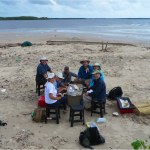
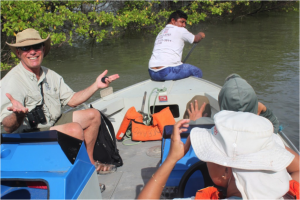
Data nerds rejoice! Today, Wednesday, November 19 is GIS Day. Geographic information systems (GIS) technology helps our wildlife biologists protect rare species throughout New Jersey. GIS technology is used to create our species range maps and other important tools that show where wildlife occur and what habitat they need to exist.
Conserve Wildlife Foundation is a key player in updating the NJ Endangered and Nongame Species Program’s (ENSP) database of rare wildlife species. The database called “Biotics” is a GIS and Oracle-based system developed by NatureServe, the leading source of information on the precise locations and conditions of rare and threatened species and ecological communities in the Western Hemisphere.
Although CWF and ENSP biologists submit a majority of the data on Biotics, we rely on the help of citizen scientists to fully understand the wildlife picture in New Jersey. Do you want to help biologists monitor certain areas of the state and locate the presence of species of concern? Visit our website to learn how you can get involved.
In addition to the Biotics database, GIS was used to create range maps for all 190 species featured on our online field guide! Check it out.
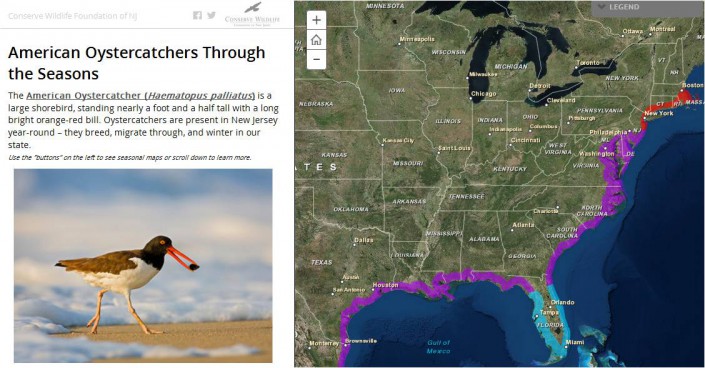
Have you seen our American Oystercatcher Story Map? GIS was used to create that tool as well! A Story Map is a web-based interactive GIS map embedded with all kinds of content, like text, photographs, and video.
On behalf of our friends – the piping plovers, red knots, American oystercatchers, least terns, ruddy turnstones, black skimmers, and many others – Conserve Wildlife Foundation wishes you a happy World Shorebirds Day.
To learn more about our beach nesting birds work, click here.
You can click here to learn about our migrating shorebirds work.
And if you haven’t seen the Delaware Bay beach restoration video yet, enjoy it here!
Finally, you can help support our shorebirds work with a donation, or through volunteering on one of our shorebird projects.
Click here to make a donation to our shorebird work here!
One other fun way to cozy up to a bird this fall is to visit Unreal Birds, and consider making a purchase of those adorable birds. A portion of every purchase benefits CWF!
This marks the second story in Shorebird Week! Our first blog post, on Tuesday, introduced the film “A Race Against Time” and directed you to a free viewing of the film on our website. Today’s blog post, will highlight an incredible news story about a resighting of the iconic Red knot B95 on the Delaware Bay! And tomorrow’s blog post, will highlight volunteer’s incredible efforts to save stranded horseshoe crabs!
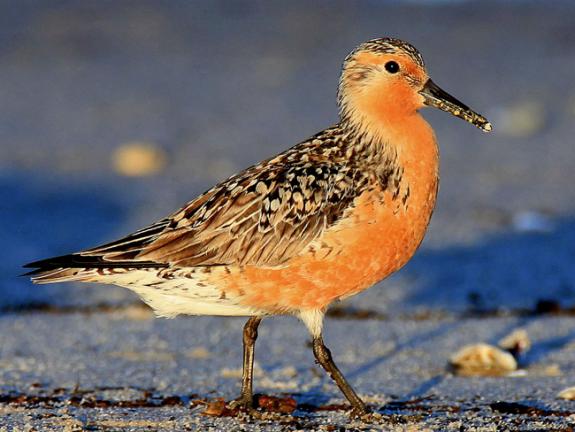
This story highlights the iconic Red knot, B95, being resighted on the Delaware Bay. B95, nicknamed Moonbird, is at least 20 years old, which makes him the oldest Red knot on record. He received his nickname because he has flown the equivalent of the distance between the earth and the moon and at least halfway back in his lifetime.
Iconic Red knot shorebird B95
One of Conserve Wildlife Foundation’s partners, Manomet Center for Conservation Science, highlights this bird in an fascinating news story about his resighting and the research efforts being done by the CWF biologist Dr. Larry Niles and Amanda Dey, senior biologist with the Endangered and Non-game Species Division of N.J. Fish and Wildlife and their team to restore the Delaware Bay.
A banded red knot searches for food on a Delaware Bay beach.
This week for Animal Week, we will be spotlighting Shorebirds in the Media! Endangered red knots, ruddy turnstones, and other magnificent birds travel from South America to the Canadian Arctic during their migration, and make an important stopover along the Delaware Bay Shore from May to June.
The 2014 Shorebird film, “A Race Against Time” celebrates the Delaware Bay Beach Restoration
The film can now be enjoyed for free on our website:
Greener New Jersey Productions this spring produced a 30-minute film documenting the ambitious campaign by Conserve Wildlife Foundation, American Littoral Society and other partners to restore Delaware Bayshore beaches decimated by Hurricane Sandy. This project ensures that the at-risk horseshoe crabs and globally migrating shorebirds relying on this habitat can survive.
Conserve Wildlife Foundation of New Jersey and the Endangered and Nongame Species Program (ENSP) of the New Jersey Department of Environmental Protection’s Division of Fish & Wildlife, and New Jersey Audubon have partnered for many years to conduct research on Delaware Bay shorebirds in order to prevent their decline.
Now is a great time to get out to the Delaware Bay beaches and see the shorebirds. Learn more about the shorebird project and the best spots for viewing the birds and crabs.
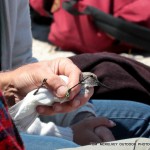
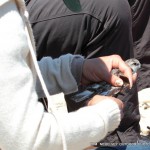
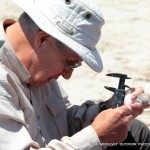
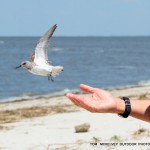
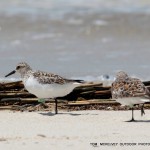
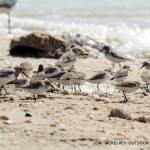
On Monday May 19th CWF volunteer Tom McKelvey took photos of the shorebird project research team banding sanderlings.
Check out a recent article from the Press of Atlantic City about CWF and partners work to restore habitat along the Delaware Bayshore.
MIDDLE TOWNSHIP — Tons of sand were hauled, dumped, poured and shifted Wednesday along Pierce’s Point Beach, part of a massive effort to avoid what biologists say could be a catastrophe. Read more.
The ambitious campaign of Conserve Wildlife Foundation and American Littoral Society to restore Delaware Bay beaches in the wake of Hurricane Sandy’s destruction was documented in the Greener New Jersey Productions video, “A Race Against Time.” This new film will be screened on Earth Day, April 22nd, at the historic Levoy Theatre in Millville, New Jersey. Details can be found here
CWF’s Larry Niles and his colleagues are on a two-week trip to northern Brazil to trap and band Red Knots, Ruddy Turnstones, and other shorebirds on their wintering grounds. We’ll be posting summaries of his blog entries as he reports from the field.
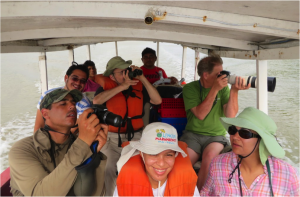
Our team enjoys the ride to Curupu, unsuspecting of the wretched experience ahead. Our captain Joabe, seated at the back of the boat, not only helped us get on and off the island, but also helped us make the four-kilometer trip from the boat landing to the catch site.
After several days of trapping efforts on the mainland, we took the hour-long boat trip to Curupu, an island just off the coast of Panaquatira. Our trapping work here last year went off almost without a hitch, and we were off the island in less than 24 hours. So when we arrived this year, we naively expected this year’s expedition to go just as easily.
It didn’t. Instead, we suffered three days and two nights of oven-like tropical heat while being blasted by fine wind-driven sand and fighting the tides to catch birds. We slept with the tents sealed to protect us from the blowing sand, but this left us wet with sweat every morning. Mosquitoes met us in droves as we emerged from our tents before dawn light to set the cannon net. Sudden downpours chilled us to the bone, while the blazing sun that followed fried us.
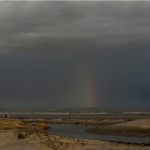
A rainbow follows one of the many downpours that drenched us as we struggled to catch red knots on Curupu. A few rounds of soaking rain followed by blazing sun on our last day left the team in terrible spirits.
On the morning of our last day, the team endured several of these drenching rainstorms while resetting the net twice, following the retreating tide line. But our perseverance finally paid off. After three days of frustration, we were finally able to make a small catch. The eight red knots (compared to a catch of 115 last year) were fitted with new geolocators and set free to join the rest of the flock. After our short-lived deprivations, we hoped to be free of Curupu.
Not quite. We had hoped that we could leave by midday, but transporting our equipment to the boat landing was delayed by yet another downpour. When we finally made it to the landing, we found that we couldn’t leave until an incoming tide. We were facing the possibility of another night on the island.
A happy team gets to work processing the final day’s catch, which included four ruddy turnstones with geolocators. Combined with our previous catch of nine, we have deployed all 30 geolocators and recovered six thus far. Geolocators collect data for 1 to 2 years and can store it for far longer.
Expecting only tribulation, we were suddenly met with kindness. Indio Sousa, the father of a Brazilian student who joined us for our misadventure, and who manages a compound of houses on the island, invited us to stay in the guest quarters. While we luxuriated in what felt like our first shower in months, he served us platters of watermelon and pineapple and cooked a plate of shrimp, then fish. As we enjoyed his generosity, we relaxed in the languid late afternoon tropical heat, cooled by gentle breezes, while being serenaded by the melodious song of native forest birds and amphibians.
The overnight provided us with more than cool air. It also provided a last chance to trap, this time for willets. We had brought 30 geolocators to attach to these poorly understood temperate breeders, one of only three shorebirds that breed in New Jersey, and an emblematic species of the breeders of Delaware Bay.
The author wonders what else could go wrong, while Joabe paddles his boat after running out of gas.
Unfortunately, it was not to be. The operation needed precise timing, an unlikely event in our short-lived experience in northern Brazil, especially given our bad fortune. The captain of the small boat that brought us to this island came late, then ran out of gas while taking us to the catch site. Finally arriving at the roost that we scouted at the start of the trip, we faced an already declining tide. We tried to catch, but the island defeated us one final time.
But back on the mainland, we were once again blessed with kindness. As we fled to our home base, the parents of another Brazilian student on our team graciously offered a home-cooked meal, a very generous offer considering the size of our group and their own modest means. We left their home with full stomachs, warmed hearts, and mixed feelings about the wild coast of Brazil.
CWF’s Larry Niles and his colleagues are on a two-week trip to northern Brazil to trap and band Red Knots, Ruddy Turnstones, and other shorebirds on their wintering grounds. We’ll be posting summaries of his blog entries as he reports from the field.
Joe Smith, Mark Peck, Ana Paula, Humphrey Sitters, this author, and Steve Gates process our first catch of 9 turnstones and 40 sanderlings. Two of the turnstones had geolocators from last year, a digital bonanza that we can’t unlock until we get home. (photo taken by Carolina Linder)
Cannon netting in a remote place increases the odds of failure, and cannon netting in Brazil may be the most difficult of all. For one thing, cannon netting requires an enormous amount of equipment not easily available in places like northern Brazil. Take covering material, the opaque cloth that is widely available in the US to shade hothouses. We use it to shade the birds caught under a net to protect them from the sun and to calm them. After visiting many stores, we found something similar in São Luís, not equal to the need, but sufficiently suitable to be useful.
Mark Peck and Joe Slusher are loading cannons with igniters made from Christmas tree lights. They work, but have a more uncertain reliability.
But for the igniters we use to fire the cannons, it’s a much different story. Even in the United States, the authorities tightly control their use for obvious reasons. Igniters are what miners use to blow up rock, and thus potentially dangerous in the wrong hands. As far as we know, they cannot be found in Brazil, and we can’t even receive them if we sent them from the US. Only a government official can do that, and our colleagues in Brazil were unable to get permission to do it.
We overcame this nearly insurmountable difficulty by going to the Internet. We soon learned how to create an igniter with small Christmas tree lights. Cut the glass top off of the light and charge with a minor electric current, and they pop like the real thing.
Worse yet is gunpowder. We use it to fire the projectiles that carry the net over the birds. Without it, we have no expedition. But in the South American countries in which we have worked, the authorities tightly control gunpowder. Here in Brazil you need a license, and forget about getting one if you are from the United States.
We found gunpowder in this religious goods store in the center of São Luís. The other side of the store was filled with (to my mind creepy) goods from African or Caribbean origins. Being Catholic, I have to admit that I was reluctant to photograph this store for superstitious reasons. Being Methodist and British, Humphrey Sitters had no qualms whatsoever.
But we persisted, and after a bit of investigation, we learned that Brazilians use black powder in religious ceremonies. We would eventually find powder in, of all places, a religious goods store with a mix of religious iconography impossible to find in the US. Think Blessed Virgin Mary meets voodoo goat head devil god. As if blessed by the Holy Mother, we found all the powder we needed just beneath her benevolent and loving image.
Omar Sousa (far right) and Carolina Linder (seated, middle) help us with the mechanic that finally fixed our generator. Between the two we have been able to overcome the cultural and linguistic barriers that normally plague a field expedition.
In other words, to be successful in a cannon netting expedition, one must be resourceful. Ultimately it depends on two things: the team and the people in country that help you. This year in Brazil we are fortunate on both counts. Our Brazilian colleague, Ana Paula Sousa, is from the Universidad Federal de Maranhão and lives in São José de Ribamar, only five miles from our field station. We work under her banding permit and with her professor, Dr. Augusto Rodrigues. It was her that provided us with the field station we call home.
Ana’s generous nature comes naturally. Her father and mother Omar and Diva Sousa have been vital to overcoming the minor obstacles that seem to arise everyday when running an expedition in a rural area, from fixing the cranky generator and well pump to finding hard to find supplies like net-mending line and block ice. All this, and yet Mr. and Mrs. Sousa refuse our offers of compensation for their time. They do it because of their pride for their daughter’s chosen vocation, the native spirit of generosity, and their own big hearts.
For the original blog entry, see Larry’s post Down to Work.
CWF’s Larry Niles and his colleagues are on a two-week trip to northern Brazil to trap and band Red Knots, Ruddy Turnstones, and other shorebirds on their wintering grounds. We’ll be following him and posting summaries of his blog entries as he reports from the field.
When most people think of Brazil, they think of Rio de Janeiro, a modern city that will soon host both the World Cup and the Summer Olympics. Or they may think of the Amazon jungle, and all the wonders of a wilderness alive with fascinating wildlife and plants that can found in no other place.
The town of Panaquatira perches precariously along the Atlantic shoreline of northern Brazil, about 250 miles east of the mouth of the Amazon.
Except for an eight-hour layover in Rio, we are not going to these places. Instead, our home for the next two weeks will be Panaquatira, a tiny town on the northern coast about 250 miles east of the mouth of the Amazon. You could not imagine a more coastal town – the main street is the beach. Residents ride the mile-long strand to get to their modest homes in all but lunar tides, when the sea laps onto the stone driveways. The town is a resort for the working class, who mostly stay for the day, often arriving by bus to enjoy a frolic on the wave-washed sandy beach.
Heavy projectiles powered by gunpowder pull the net over birds quickly. The speed of the cannon net is key to catching fast-moving shorebirds.
But we have not come to recreate. Our team of nine hearty souls will attempt to capture shorebirds that breed in the Arctic and winter here in the Maranhão state of Brazil. This forlorn and remote shoreline supports one of the most important concentrations of shorebirds in the hemisphere. Each year, thousands of red knots, ruddy turnstones, black-bellied plovers, whimbrels, and other species spend the winter here in a hot and humid climate that is the exact opposite of Arctic weather. Why do they winter here? What attracts them to this place? Where the Arctic do they breed? What other places are vital to their enigmatic lives? These are some of the questions we hope to answer.
The output of a recovered geolocator, this map shows the yearlong track of a red knot with the flag Y7H. We attached its geolocator on Delaware Bay in 2011 and recaptured it in 2012. The track shows it left Delaware Bay, passing through Hudson Bay on its way to its Arctic nesting area. In July, it flew south though James Bay, stopping on the US Atlantic Coast before making an epic flight that took it over 1,000 miles out into the ocean to avoid a storm. After four days of flying, Y7H finally reached the coast close to our study site.
Last year we trapped the beaches of Panaquatira and nearby island of Curupu. We caught red knots and ruddy turnstones with cannon nets and banded them with tiny devices called geolocators that track movement and store daily locations on a tiny memory chip. Geolocators are a digital treasure chest, but they can only be unlocked if we recapture the same birds and retrieve the devices.
Working in this remote place at the center of the world creates a challenge. What we call necessities are luxuries here, only available to a lucky elite. Everyone else struggles to achieve modest livelihoods at best. It’s a place where basic sanitation and clean water are still a modern improvement not yet available to the majority of the population; a place where warm-hearted and generous people must face persistent lawlessness, both in the street and in the halls of power. I fear the water, the parasites, and the thievery that the residents suffer with equanimity.
These colorful fishing boats, typical of the region, are powered by one-cylinder engines similar to those that served as workhorses of small boats 50 years ago in the United States. Some rely on sail power alone.
Don’t get me wrong. I live in New Jersey, less than an hour from Camden – one of the poorest places in the country and one of the “murder capitals” of the US. Still, we are threading a needle here. We don’t come as tourists, or on business per se. Panaquatira will be our home, and we must pull together a complicated effort that can only be successful with help and generosity of the residents. In return we hope to shed light on the circumstances of the birds and people of this wild and isolated place.
For the original blog entry, see Larry’s post Braving Brazil.
By Todd Pover, Beach Nesting Bird Project Manager and Stephanie Egger, Wildlife Biologist
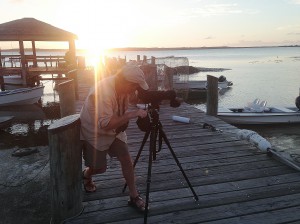
The Bahamas piping plover survey tally board in the “central command” room at Schooner Bay Institute.
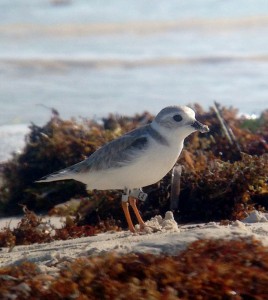
An integral part of this Bahamas trip entailed surveying several sites not previous covered on Abaco and revisiting some sites not checked since the 2011 International Piping Plover Census. Although we didn’t find large concentrations of piping plovers at any one new site, we did make some noteworthy discoveries.
One of the most exciting find was the resight of a piping plover that was banded on the breeding grounds last summer in Massachusetts as part of a flight behavior study. New Jersey also participated in this research and we briefly thought it might be one of the birds banded in our home state – but it turned out that it was banded (and nested) on Chapin Beach, Cape Cod and is wintering at Schooner Bay, Abaco (amongst 15 other piping plovers found on our survey). Continue reading “BAHAMAS PIPING PLOVER PROJECT”