Join us onMarch 18, 2021 at 7pm,for a virtual presentation of the 23-minute documentary hosted by “Monty and Rose” director Bob Dolgan and CWF Senior Biologist Todd Pover. This will mark the film’s first screening on the East Coast!
Written and directed by Bob Dolgan, “Monty and Rose” tells the story of a pair of endangered piping plovers that nested at Chicago’s Montrose Beach in the summer of 2019, becoming the first of the species to nest in the city since 1955. With a music festival scheduled to take place within feet of the plovers’ nest site, volunteers, advocates, and biologists get to work in order to protect the vulnerable pair. The documentary follows these efforts, including interviews with those there to help this special pair nesting on one of the busiest beaches in Chicago.
The screening will include an introduction to “Monty and Rose” provided by the director prior to the film screening. After the film, Bob Dolgan and Todd Pover will host an audience Q&A and conversation about the film, piping plovers, and beach nesting birds!
One lucky participant will also be chosen at random to win a Piping Plover Prize Pack! Prizes include a newly designed CWF PIPL hat and other assorted beach nesting bird goodies to be shipped right to your home.
We hope you’ll join us for an evening celebrating piping plovers and those who work to protect them.
Bob Dolgan is a life long birder and filmmaker from Chicago. He’s the founder of Turnstone Strategies, author of the This Week in Birding newsletter, and a past Board Member of Chicago Ornithological Society.
Todd Pover has been involved in research, monitoring, and management of beach nesting birds for over 25 years in New Jersey and other portions of the flyway. He heads up the CWF beach nesting bird project and leads our Bahamas piping plover wintering grounds initiative.
A bulldozer trims back vegetation as a part of maintenance at the Barnegat Light Habitat Restoration site.
Even though all the major construction at our Barnegat Light Habitat Restoration site was complete over the past two winters, CWF returned in January 2021 to help oversee a “touch up”. Beach nesting birds, such as piping plovers, prefer open, lightly vegetated beaches to nest, and in two years the vegetation had filled in quickly at the site. Using a bulldozer, the thicker vegetation was trimmed back or as the machine operator said, we gave it a “haircut”.
At the same time, the shallow edges of the foraging pond were enhanced. The pond, in particular a portion engineered to mimic “foraging flats”, was a key part of the success of piping plovers during the 2020 breeding season. We were able to expand that feature in hopes of providing even more high value foraging opportunities in years to come.
Initial construction was obviously the most important step to make this long-anticipated project a reality, but ongoing maintenance is an important part of any restoration, as habitat, especially in the dynamic coastal zone, rarely remains static. Still, follow-up maintenance is often overlooked or underfunded, but we know it will be absolutely critical as a long-term measure at Barnegat Light to sustain quality nesting habitat and high reproductive success.
The work this winter was done in tandem with Rutgers, the State University of New Jersey, our primary technical partner on the project. A special thanks to the U.S. Army Corps of Engineers – Philadelphia District for funding and facilitating the maintenance construction. We also greatly appreciate the ongoing partnership on this project of the U.S. Fish and Wildlife Service – New Jersey Field Office and State of New Jersey’s Endangered and Nongame Species Program.
Todd Pover is a biologist with Conserve Wildlife Foundation of New Jersey.
Ocean dwelling wildlife species are among the most interesting and most valuable to humans. They fascinate us with their unique life histories and provide us with a vast fisheries resource that creates a multitude of jobs and lets us have a delicious meal of local seafood.
In this episode of our podcast State of Change, “Our Changing Coast,” we delve into how our ocean species could be affected by climate change. We interviewed Dr. Thomas Grothues, a research professor with Rutgers University who specializes in abundance and distribution of fish, as well as Joe Reynolds, the head of Save Coastal Wildlife, a nonprofit dedicated to protecting New Jersey’s coastal species and educating the public about them.
As water temperatures in the Atlantic Ocean rise, aquatic species such as fish and marine invertebrates will be among those who feel the effects first. Evidence points to many northern species becoming less frequent and many southern species becoming more frequent. This is bad news for fisheries centered around species that could become less abundant.
Like many other climate change related issues, understanding how marine species will be affected by warming waters is complicated but also fascinating. Listen to the podcast to learn more!
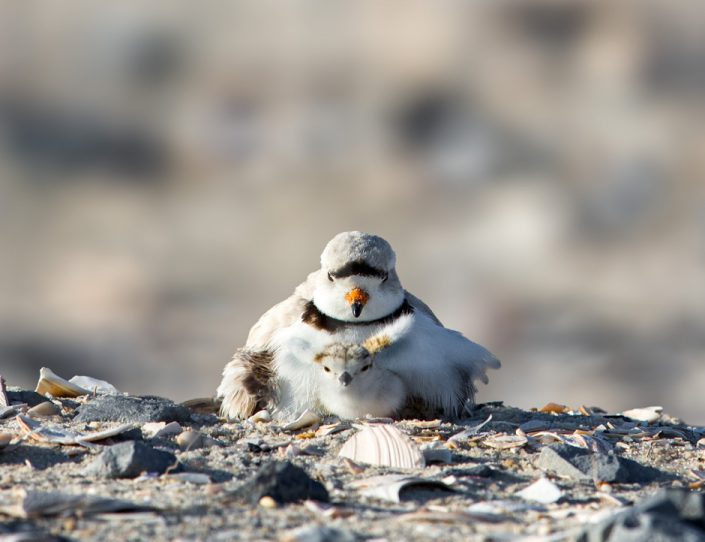
An adult Piping Plover (Charadrius melodus) looks over their chick.
Piping
plovers may have left New Jersey for their wintering grounds months ago, but
our staff continues to be busy assessing the results of the 2020 breeding
season and making plans for ways to improve outcomes next year.
As we look back, one pattern is very clear; the piping plovers nesting at sites monitored and managed by CWF did very well in 2020. This includes 39 pairs at the Edwin B. Forsythe National Wildlife Refuge (Holgate and Little Beach Units), which CWF manages on behalf of the Refuge, as well as one pair at the National Guard Training Center in Sea Girt. Collectively, these pairs fledged 68 chicks or 1.70 chicks per pair, well above the federal recovery goal of 1.50 and at near record levels for the Refuge. These pairs represent just under 40% of the statewide total, as a result the high productivity at CWF-managed sites helped drive the state’s overall success. For a detailed look at how piping plovers did statewide, click here for the recently released state report.
Plover chick next to a seabeach amaranth plant. Photo by Alice Brennan.
Despite hundreds of trash bins conveniently located on the beach, litter is still found in the sand every day. Many people enjoy their summer days at a key beach nesting bird site in Sea Girt. Beach goers leave behind trash that litters the crucial environment. These include plastic bottles, bags, cans, wrappers, straws, fishing line, etc. Plastic pollution effects the surrounding environment and wildlife that inhabits it.
At the Sea Girt beach, piping plovers (Charadrius melodus), an endangered beach nesting bird species, travels hundreds of miles to breed and nest during the summertime. This species is directly affected by the amount of litter that pollutes the beach. Every year shore birds, and many other species, ingest plastic or get entangled in fishing line which lessens their chance of survival.
Seabeach Amaranth. Photo by Meghan Kolk.
Another significant endangered species located at Sea Girt beach is seabeach amaranth (Amaranthus pumilus). This annual plant needs a healthy ecosystem free of debris to thrive every season. It is important to maintain a strong coastal habit for reproduction and population growth.
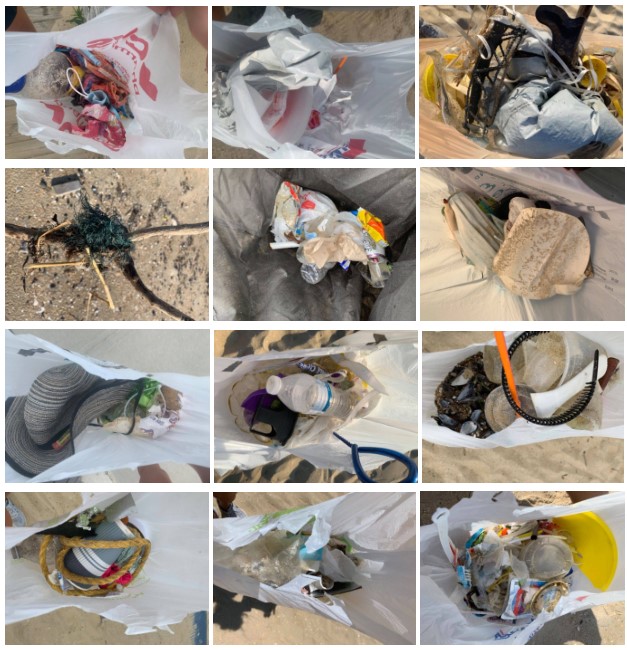
Twenty weeks of litter was collected at the Sea Girt beach with approximately 200 plastic straws, 50 plastic bags, 75 bottles, and 25 pieces of fishing line. Pollution on the beach can be prevented if patrons are mindful of properly disposing their trash at the end of their trip.
20 weeks worth of beach trash recovered from the Sea Girt beach.
Mary Emich is an assistant biologist with Conserve Wildlife Foundation.
Piping plover chick feeding at the restoration-created pond. Photo courtesy of Northside Jim.
Last winter the Conserve Wildlife Foundation, in partnership with Rutgers University, the United States Fish & Wildlife Service, and New Jersey Fish & Wildlife’s Endangered and Non-Game Species Program, completed the final stages of a beach restoration project in Barnegat Light State Park.
The project, which broke ground the winter before last, aimed to create more ideal habitat for the endangered piping plover away from human disturbance at Barnegat Light’s more recreationally busy beaches. This was accomplished by removing vegetation, grading dunes to be more suitable for nesting, and creating alternative feeding sites (i.e. ephemeral pools).
Now, with the beach nesting bird season at its peak and the final stages of the project complete, we can start to assess the effectiveness of the work that has been done.
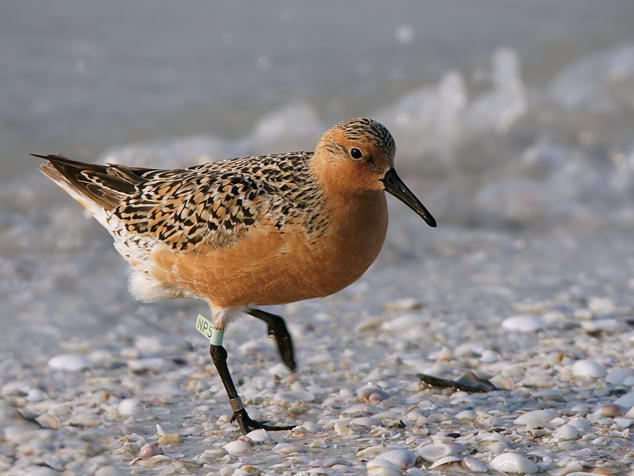
Conserve Wildlife Foundation’s research with scientist Dr. Larry Niles was highlighted in today’s New York Times feature detailing the 80 percent decline in red knots in New Jersey’s Delaware Bay this spring.
by Jon Hurdle, The New York Times
A sudden drop in the number of red knots visiting the beaches of Delaware Bay during migration this spring has renewed concern among scientists about the survival of the threatened shore bird’s Atlantic Coast population.
According to biologists, the number of knots that stayed to feed at the bay in May declined by about 80 percent from the same time last year. The Delaware Bay is one of the world’s most important sites for shorebird migration.
by: Dr. Larry Niles of Wildlife Restoration Partnerships. Dr. Niles is working in Delaware Bay on behalf of Conserve Wildlife Foundation. He has helped lead the efforts to protect at-risk shorebirds and horseshoe crabs for over two decades.
A migratory stopover for arctic nesting shorebirds must provide each bird the energy necessary to get to the next stopover or to the ultimate destination, the wintering or breeding area. Delaware Bay stands out among these shorebird refueling stops because it delivers fuel in the form of horseshoe crab eggs giving birds options. Our telemetry has shown that Red knots, the species we best understand, may leave Delaware Bay and go directly to their Arctic breeding areas, or stopover on Hudson Bay. The choice of going straight to the breeding area or stop at another stopover may be critical to understanding the ecological dramas now underway on Delaware Bay.
When asked to describe the ecological conditions of any one year of our 23 years of work on Delaware Bay, Humphrey Sitters, one of the first biologists to understand the value of Delaware Bay to shorebirds would respond “every year is unprecedented”. And so it seemed until this year.
Some of the species (super) volunteer John King has helped.
When I retired from teaching, one of my first tasks was to search for local organizations that encouraged volunteers, especially in areas of wildlife conservation. Luckily, I found Conserve Wildlife Foundation. I have to say that over the past few years, my volunteer service with CWF has been both rewarding and inspiring!