The Coastal Barn Owl Project team is gearing up for another round of nest box installations in coastal southern New Jersey. After a successful fundraising appeal, we can now thank our donors by adding more potential nesting opportunities for barn owls, a species in population decline.
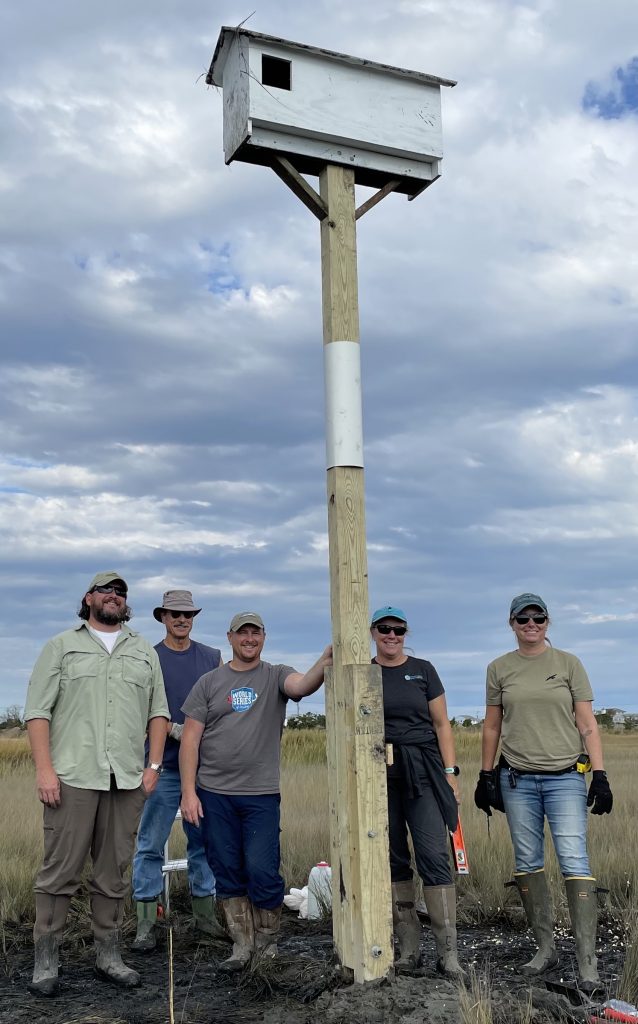
Our fourth and most recent box was just installed on October 22 in the saltmarshes of Cape May County. With each install, the team is becoming more efficient, and we hope to get several more boxes up in key locations before early spring when the owls begin their search for suitable nesting sites.
The newest barn owl nest box with volunteers Kevin Knutsen, Steve Eisenhauer and Mike Lanzone on left. Team leaders Tricia Miller and Meghan Kolk on right. Photo by Lisa Ferguson.
Coverboards are typically placed along ecotones, where species diversity is expected to be greatest. The corrugated tin board, pictured above, was positioned along a forest edge where larger deciduous trees meet a more open, sandy landscape.
How do you survey for animals that spend most of their time hidden under leaf litter or wedged between fallen tree limbs and rocks?
In the case of reptiles and amphibians, the answer is to use coverboards!
Coverboards are materials that are intentionally placed within a potential habitat, often along ecotones (where different habitat types- e.g., wetland and forest, field and forest, etc. come together) that trap moisture and retain heat, creating favorable conditions for our “cold-blooded” (ectothermic) friends. Researchers often arrange coverboards in long transects or arrays and collect data on the diversity of the community underneath the boards as compared to the surrounding environment. This technique was used by NJDEP Division of Fish and Wildlife to survey for herptiles in 17 wildlife management areas in the early 2000s (Golden, 2004). A total of 30 species were recorded during the first year of the study, including long-tailed salamanders, pine barrens tree frogs, and northern pine snakes, all of which are listed as threatened in New Jersey.
Pair of Piping Plovers Tending Nest. Courtesy of Northside Jim
The 2021 New Jersey piping plover breeding season was a classic “good news, bad news” result. According to the annual report released by the state’s Endangered and Nongame Species Program earlier this month, the breeding population increased to 137 pairs in 2021, third highest since federal listing in 1986. That is an unprecedented 33% rise over the previous year and just short of the record high of 144 pairs in 2003. On the downside, the number of chicks fledged statewide was just 0.85 chicks per pair, the lowest since 2013 and about half of the 1.50 federal recovery goal. The low productivity was largely the result of a severe Memorial Day weekend nor’easter and persistent predator activity throughout the season.
Holgate, a unit of the Edwin B. Forsythe National Wildlife Refuge, hosted 46 pairs, the most in the state. This site, which is monitored and managed by CWF through a cooperative agreement with the Refuge, has seen an astounding increase in piping plover pairs in recent years, up about 2.5 times from the 18 pairs it had in 2018. CWF also monitors Little Beach, the adjacent Refuge-owned site, where another 13 pairs nested in 2021. Combined the two sites had 59 nesting pairs, a new record, by far, for the Refuge. Unfortunately, like the statewide results, productivity was very low this year at both Refuge sites, combined only 0.80 chicks fledged per pair, about half the rate just a year ago. The Memorial Day weekend nor’easter flooded those sites, wiping out most nests, and although most of the pairs nested again afterwards, many of those renests (or hatched chicks) were lost to predators, especially coyotes at Holgate.
CWF also oversaw piping plover breeding at the National Guard Training Center, which had just one pair in 2021, but that nest successfully hatched and fledged three chicks, helping boost the state average. Overall, CWF was responsible for monitoring 44% of the statewide population, giving it a significant role in helping guide conservation of this highly vulnerable state endangered (and federally threatened) species.
Although CWF does not conduct the daily on-the-ground monitoring and management of piping plovers at the Barnegat Inlet nesting site, it was a co-leader of the habitat restoration that was completed there two winters ago, and as such has had a big role in the nesting outcomes at the site. The number of pairs using the site has noticeably grown, up to five pairs in 2021 from just one pair when the project began. Productivity has also been consistently high at the restoration site and 2021 was no different with the pairs exceeding the federal recovery goal and statewide average with 1.6 chicks fledged per pair this year.
With the breeding results for 2021 now “in the books”, we are already looking forward to next year. The biggest question will be whether the state can sustain the progress towards recovery it made this year, especially given the big drop in productivity, which typically drives population. But for now, all we can do is wait until next spring to learn the answer to that question.
To read the state’s entire 2021 piping plover report:
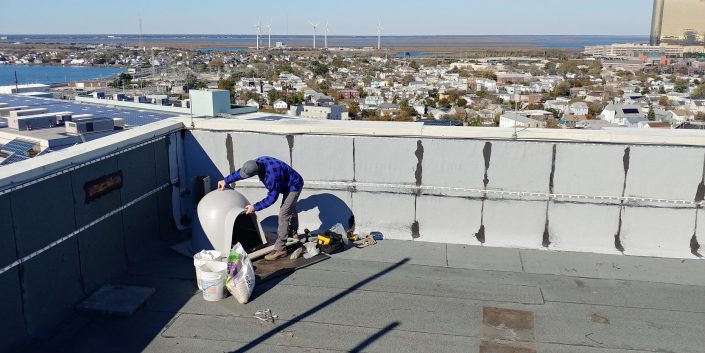
Putting the final touches on a new nestbox for peregrine falcons in Atlantic City, NJ. photo by Kathy Clark/ENSP
This past week I had the pleasure of assisting Supervising Zoologist, Kathy Clark with NJ Fish & Wildlife’s Endangered and Nongame Species Program to install a new nestbox for state endangered peregrine falcons. The new nestbox was installed atop the Sheraton Atlantic City Convention Center Hotel. Peregrine falcons are not new to Atlantic City. They have nested in A.C. since 1987, where the first pair nested on the 23rd floor of the Hilton/Atlantic Club. Since then new pairs have established nests on other tall buildings and structures, like the Hard Rock Casino and A.C. water tower.
Healthy New Jersey wetlands feature a gorgeous explosion of colors each summer as wildflowers, including the Ironweed (purple), Joe Pye weed (pink), and Jewelweed (gold), displayed here, come into bloom.Photo by Kristen Meistrell, NJ Audubon.
We’ve all heard the expression “you can’t have your cake and eat it too”. For example, as a wildlife biologist, I can’t be promoted and still expect to spend most of my time in the field playing with turtles and salamanders- that would simply be too good to be true! The same phrase could probably be applicable to land; your property can’t simultaneously be profitable to you, the landowner, and beneficial to rare wildlife… right?
Well, in this case, I would have to disagree with the proverbial wisdom.
For many years, CWF biologists have worked with private landowners, other nonprofits, and the state and federal government to spread the word on programs that make wildlife conservation not only accessible, but economical. Why? Because >80% of New Jersey is privately owned. This gives residents a unique opportunity to be a part of the success story for every endangered, threatened, and at-risk species that, like us, call the garden state home. In the words of everyone’s favorite ‘90s superhero, Captain Planet, “The power is yours” – truly.
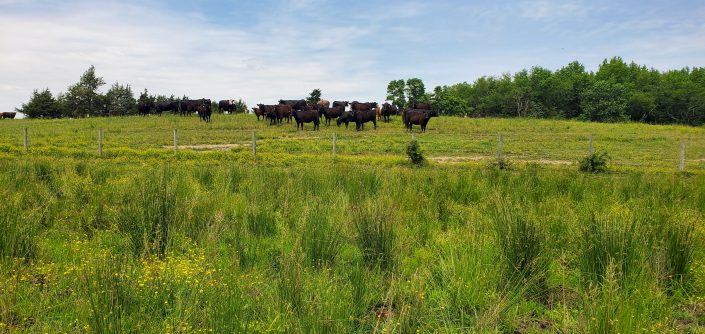
Prescribed grazing by livestock, like the cows pictured above or water buffalo below, can help improve hydrology in certain types of wetlands. If your property fits the criteria, NRCS can assist with the maintenance or installation of fencing as part of your restoration plan.Photo by Kristen Meistrell, NJ Audubon.
Seabeach Amaranth, a state endangered/federally threatened beach plant.
Most people would enjoy their summer days being spent on the beach. Long, sunny days listening to crashing waves and shorebird calls with a salty breeze blowing gently across your face – sounds lovely, doesn’t it? Wouldn’t it be awesome to experience that nearly every day of the summer? Well, that’s been my life since early June of 2021. I am a new recruit of Conserve Wildlife Foundation of New Jersey, and when I was offered to take on the role of rare plant technician, surveying Seabeach Amaranth and other protected shore plants along the Jersey coast, I jumped on the opportunity.
Now to give everyone a little background on Seabeach Amaranth before I continue – this federally threatened and state endangered beach plant is an annual bloomer, growing low and branching out along the ground, sometimes reaching up to a meter in diameter or more. However, many plants remain relatively small and some may never grow more than a few centimeters across. Larger plants produce more seeds, and therefore are more successful at propagating the species. It has red stems and thick, waxy, greenish-red leaves that are somewhat reminiscent of spinach. In mid to late summer, these plants produce tiny pale-yellow flowers in the center of leaf clusters at the tip of each stem. These flowers contain the seeds that will hopefully go on to produce next year’s amaranth. The seeds are dispersed in a variety of ways. They may drop near the “parent” and remain relatively close to where plants have germinated in previous years. Some may be carried by wind as sand is blown along the beach. Rising tides may wash out seeds, as well, sometimes redistributing them on the shore in what are known as “wrack lines.” Wrack lines contain the debris left behind by the high tides, typically consisting of sea grass, shells and human litter. Amaranth is often found growing in them.
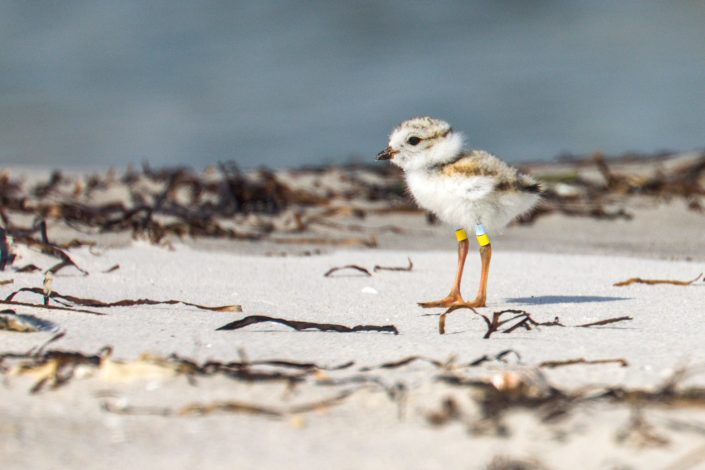
Pi Patel, one of the eight piping plovers chicks that fledged from the Barnegat Inlet Restoration site in 2021. Photo courtesy of Matt Reitinger.
The success of a habitat restoration project is typically measured in numbers, number of acres restored, the abundance of target species, breeding success of the wildlife using it, that sort of thing. And we certainly have good numbers for the Barnegat Light Habitat Restoration Project… 40 acres restored, including two foraging pond, five pairs of piping plovers using the site this year, a substantial increase from one pair just two years ago, and breeding success above the federal recovery goal and well above the state average for two years running since the project was fully completed.
But there’s more to the success than numbers, it can also be told through names. So first a disclaimer; we name our banded piping plovers in New Jersey. This practice is sometimes frowned upon by other researchers who fear anthropomorphism undermines their scientific credibility or leads to misunderstanding about biological processes. Point taken, but in the case of piping plovers, we believe naming can potentially lead to better engagement in their conservation through dynamic outreach, much the way Monty and Rose, Chicago’s famous plovers have garnered huge public support. Also, in New Jersey our banded plovers typically have four bands, so it is much easier for our monitoring staff to identify and communicate about a bird named “Major Tom” than orange over light blue (left), orange over black (right). Finally, some people are just plain curmudgeons about this issue, but endangered species recovery work is hard, so having a little fun with it isn’t such an awful thing! So, let’s get to the names and the “stories” they tell.
There are many aspects to the Delaware Bay Shorebird Project. During the month of May researchers survey, re-sight and band shorebirds as well as conduct horseshoe crab egg counts. Nine beaches in Cape May and Cumberland Counties have restricted access during May, which allows the shorebirds to feed on the horseshoe crab eggs.
Shorebird Steward Bill Reinert@ Dom Manalo
Shorebird stewards are out on the beaches in all types of weather and insect seasons making sure that the restricted areas are respected. They do this through education and explaining to beach goers the importance of allowing shorebirds to have these undisturbed areas to feed. Stewards really make a big difference in shorebird protection on the bay and we thank them for all of their efforts this shorebird season. This season there were plenty of horseshoe crabs spawning with eggs in abundance, but unfortunately the shorebird numbers were down this season. For more details on the 2021 Shorebird season can be found in the article ,Red knot numbers plummet, pushing shorebird closer to extinction.
Ben Wurst, CWF Habitat Program Manager (right) with local volunteers, AC Electric and DuBois Environmental Staff who helped install this osprey nest platform in Atlantic City.Continue reading “Photo From the Field: #213”
Conserve Wildlife Foundation’s Delaware Bay Shorebird Stewards will be on Restricted access beaches in Cape May and Cumberland Counties from May 15th through the 31st. We will be educating beach goers about the horseshoe crabs and shorebirds.
Plan a visit to the bay in May to witness this spectacular wildlife phenomena!