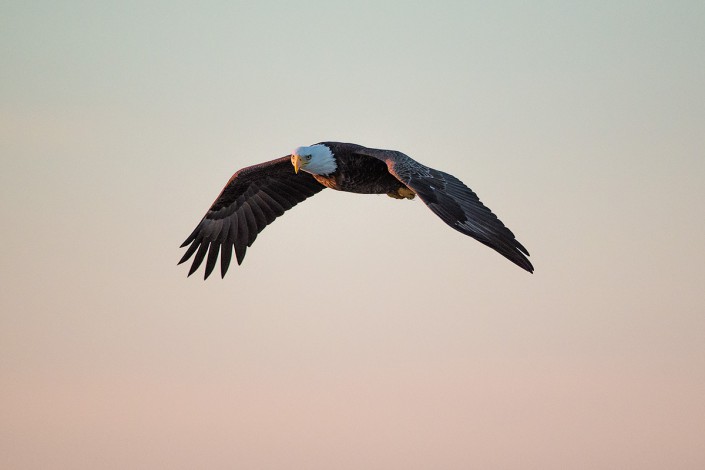
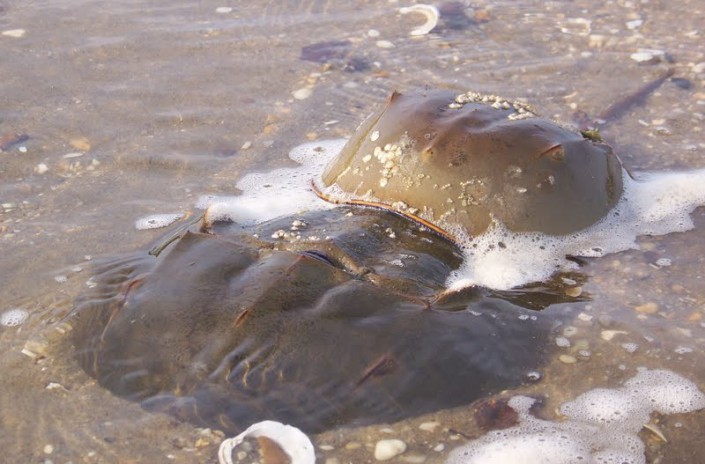
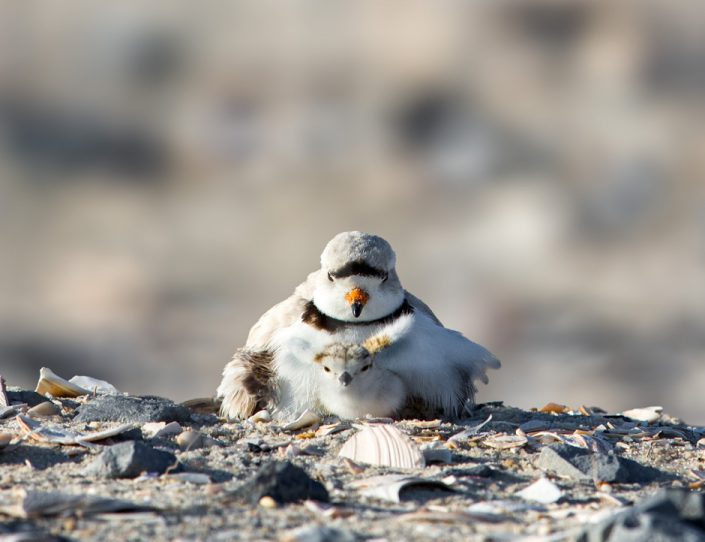
Conserve Wildlife Foundation’s Delaware Bay Shorebird Stewards will be on Restricted access beaches in Cape May and Cumberland Counties from May 15th through the 31st. We will be educating beach goers about the horseshoe crabs and shorebirds.
Plan a visit to the bay in May to witness this spectacular wildlife phenomena!
Regular winter visitors to the Jersey Shore, this group of harbor seals (Phoca vitulina) and harp seals (Pagophilus groenlandicus) catch some sun in the tide. Photo courtesy of Joe Reynolds.
Today we focus on a winter visitor from the Arctic.
Excerpt from Chapter 13
Great White Hunter
Pick a sunny but frigid day in the heart of winter. Find a remote, windswept location along the Jersey Shore. Bring a high-powered spotting scope or binoculars, extra layers of winter clothes, and a healthy supply of patience.
Voila! That might be enough to get you a sighting of a seal – or fifty – in the Garden State.
Incredibly enough, seals are becoming more and more common along the coast each winter, eating a daily ration of up to 20 pounds of flounder, other fish, shellfish, crustaceans, and mollusks. Four species visit New Jersey’s coastal waters in a given winter. Spotted most frequently are harbor seals hauling out onto exposed sandbars or dredge spoils along the coast. Gray and hooded seals from as far as the Norwegian island of Svalbard visit less often. Each has a unique look. The gray seal’s large snout earned it the nickname “horsehead seal.” The male hooded seal inflates its nose to attract female seals – and looks like a veritable Bozo the Seal.
The harp seal, on the other hand, is the equivalent of a seal supermodel. You may have seen them many times before. In the 1980s the harp seal’s puppy-eyed white pups served as the adorable public face of the anti-seal hunting movement. Far less common in estuaries than harbor seals, the harp seal usually sticks to the North Atlantic and Arctic oceans. Nonetheless, young harp seals are found regularly on New Jersey’s coast each winter.
Sandy Hook is a great place for seeing a seal in the wild. Seals often hunt at night and spend their days resting onshore – an ideal schedule for wildlife enthusiasts. That is, for those willing to walk the most windswept waterfront locations in the coldest months of the year. Joe Reynolds, of the Bayshore Regional Watershed Council, is just such an adventurer.
“When it’s low tide on a really sunny day, you have the potential to see thirty to fifty seals out basking together on Skeleton Island,” says Reynolds.
Seals can typically be found in New Jersey from December through April. Photo courtesy of Joe Reynolds.
The Rescuers
Reynolds is also one of around a hundred active volunteers with the Marine Mammal Stranding Center. These volunteers up and down the coast serve as the eyes and ears of the unique Brigantine-based center, which was started in 1978 to rescue and rehabilitate injured or stranded seals, whales, dolphins, and sea turtles. Sheila Dean, the center’s co-director, has worked for more than two decades to help such marine animals.
“We had a little seal – we named her Tak, after the harbor where she was born, Takanassee – that was stranded just after being born,” says Dean. “Her mother left the baby on the beach – there was just no way she could keep people away. We raised it, but she was just too imprinted on humans. We ended up giving her to the Indianapolis Zoo. I felt really bad, but she would not have survived out there.”
Dean wasn’t being overprotective. A dolphin in Florida, after being rehabilitated for nine months, was released into the wild. Sharks killed it immediately upon release, with everyone watching in horror. Clearly nature takes its own course.
Many of New Jersey’s stranded seals are victims of shark bites. In 2009 at least five seals were mauled by the same shark, which was caught off the Sea Girt Reef.
“Shark-bit seals are quite common, and we sometimes get a lot of them,” says Maurice Tremblay, a Marine Mammal Stranding Center volunteer. “We even had one with a bite from an orca.”
After my tour of the center, I realize I just have to see a seal in New Jersey for myself. I had seen seals off the coast of Northern Ireland and enjoyed the fussy orchestra of the famed sea lions at San Francisco’s wharfside, but seals never seemed possible in New Jersey.
I pick the right day: it is absolutely glacial, with a winter storm scheduled to hit within a few hours. My daughter and I head first to Skeleton Island, a long barrier strip on the bay side of Sandy Hook. It is low tide, and the tangy smell of saltmarsh fills the air. Many dark, long shapes pepper the distant sandbars beyond the island, and our hopes are high. A closer look through my binoculars reveals no movement. My “seals” turn out to be driftwood logs and rocks.
We watch gulls drop clams against the rocks and plummet after them, and then we head for the northern end of Sandy Hook near Fort Hancock. Looping around, I drive south along the bay’s edge, peering through the passenger window and hoping against hope for a seal. A male red-breasted merganser catches Kayla’s eye, its green head feathers tussled in the back like a case of bedhead. I pull to the right and back up for a closer look. It is then that I see a dark shape that almost immediately goes under. It does not register as a bird, so could it be…?
I turn the car around for a direct look with my binoculars, and there it is! A clear shot of a seal head, dark black with puppy dog eyes, long face, and whiskers. We watch for a few seconds as it stares back before finally going under. Between the seal and the approaching storm, Sandy Hook might as well be the Arctic.
Ten Years Gone
Seals continue to visit the Jersey Shore each winter, with sightings steadily increasing in recent years. Among the best places to see them each winter are Sandy Hook, Liberty State Park, and Cape May. Sightings typically occur through April, so if you’re interested, best to try as soon as possible!
The Marine Mammal Stranding Center continues to protect and rehabilitate marine mammals and sea turtles along New Jersey’s coastline, with over 300 volunteers. And Joe Reynolds has since founded the nonprofit Save Coastal Wildlife in 2018 to engage people with the biodiversity along the Jersey Shore.
For every dark day there was always hope for a brighter future. Results from the 2020 New Jersey Osprey Project.
Ben Wurst, Habitat Program Manager
This was likely one of the most challenging, at least in recent years, in the history of the New Jersey Osprey Monitoring Project. From social distancing and working from home (with children) to severe wind events and dealing with the impacts of humans on ospreys, 2020 turned out to be quite the year. Overall, our work was largely unaffected by the global covid-19 pandemic. Most of our work is conducted outdoors and away from mass gatherings of people. It was important for us to ensure the safety of our volunteers and the general public safe.
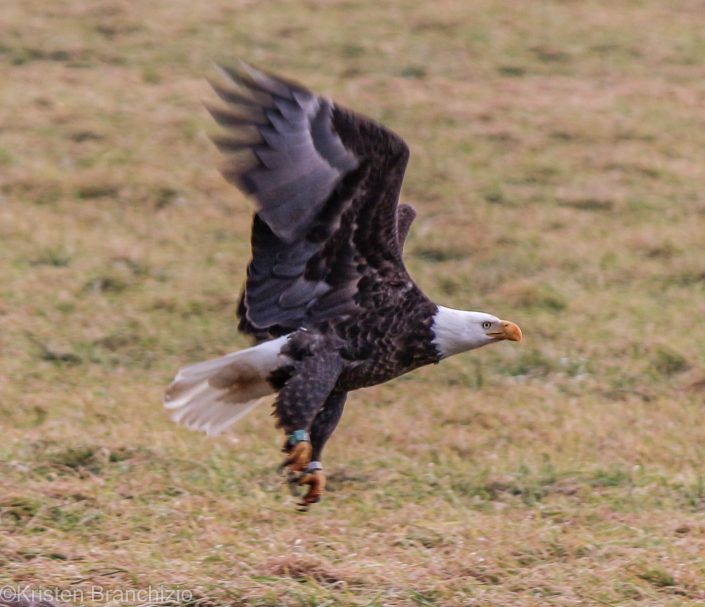
It is always exciting to receive a report of a New Jersey banded eagle, especially when it is from Duke Farms eagle cam. D/99 was resighted two years ago during the winter of 2019. The blog post Duke Farms Alumni D/99: All Grown Up, has all the details of those sightings.
D/99, January 2021 @ Kristen Branchizio
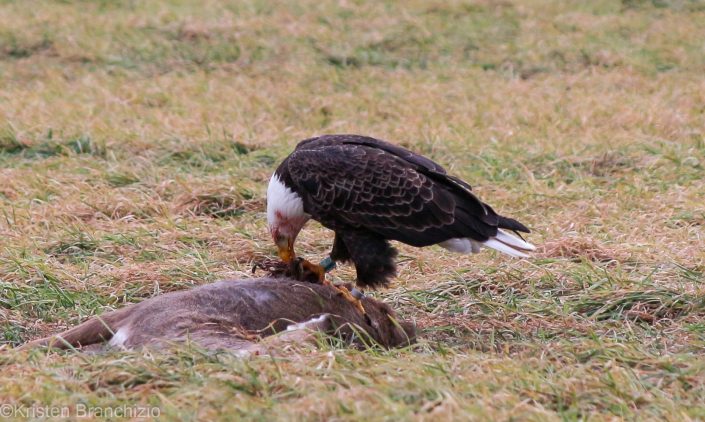
D/99 has been sighted again, this time in Freehold, Monmouth County. He was seen for several days feeding on a deer carcass along with a few other eagles.
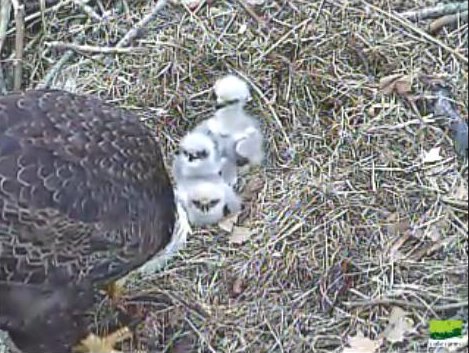
D/99 was the youngest of three chicks in the 2014 Duke Farms nest. It’s amazing to see the “before” and “after” photos. The little fuzzy wobbling chick is now a full grown majestic adult.
D/99 and siblings, April 2nd, 2014
D/99 is now seven years old and could possibly have a mate and be nesting in the area. We hope to get more resightings of D/99 in the future to know that he is doing well and raising his own family.
Long-legged spider crab (Libinia emarginata). Photo courtesy of Save Coastal Wildlife.
A special thanks to Juliet Kaszas-Hoch for spotlighting the most recent episode of CWF’s podcast, State of Change, as part of her Art & Entertainment Column on TheSandpaper.net!
The episode, Our Changing Coast, takes a deep dive into how our ocean species could be affected by climate change. CWF Multimedia Producer Matt Wozniak interviewed Dr. Thomas Grothues, a research professor with Rutgers University who specializes in abundance and distribution of fish, as well as Joe Reynolds, the head of Save Coastal Wildlife, a nonprofit dedicated to protecting New Jersey’s coastal species and educating the public about them.
NJDEP & CWF REPORT RECORD NUMBER OF BALD EAGLE NESTS, WITH EAGLES CONFIRMED IN ALL 21 NJ COUNTIES
by Ethan Gilardi, Wildlife Biologist
Photo by Northside Jim
2020 was a record breaking year for Bald Eagles in New Jersey. Going from just one recorded nest in 1980, New Jersey’s Bald Eagles hit three major milestones this year in terms of new nests, locations and total nests monitored.
A record 36 new eagle nests were found in 2020. 22 nests were found in southern New Jersey, seven in northern New Jersey, and seven in central New Jersey.
This means that Bald Eagle are now confirmed to nest in every county in the state!
An astounding (and record breaking) 220 nesting pairs of eagles were also monitored in 2020. These pairs produced a total of 307 eaglets, with an additional 28 nesting pairs tracked to nests, but laying no eggs. Of the 210 known-outcome nests, an average of 1.46 young were produced per nest, exceeding the productivity rate necessary to maintain a stable population of 1.0 young per nest.
These numbers could not have been achieved or documented without the dedicated efforts of the almost one hundred volunteers with the Bald Eagle Nest Monitor program, managed by the Conserve Wildlife Foundation of NJ in partnership with the Endangered and Nongame Species Program. These volunteers conduct the majority of the nest-observation work vital to the Endangered and Nongame Species Program in tracking the population and nest distribution of our state’s Bald Eagles.
“The comeback of the bald eagle in New Jersey ranks among the most inspiring recoveries of endangered wildlife species anywhere,” said David Wheeler, Executive Director of the Conserve Wildlife Foundation of NJ. “The bald eagle’s return illustrates what is possible for many other rare species when you bring together proactive wildlife management, strong public investment, and the unparalleled dedication of biologists and volunteers.”
CWF thanks our dedicated volunteers and partners who make our bald eagle conservation work possible, including PSE&G, Wakefern Food Corp./ShopRite Stores, P&G, Wells Fargo, Mercer County Parks, Wildlife Center Friends, the American Eagle Foundation, and the Zoological Society of New Jersey.
Ocean dwelling wildlife species are among the most interesting and most valuable to humans. They fascinate us with their unique life histories and provide us with a vast fisheries resource that creates a multitude of jobs and lets us have a delicious meal of local seafood.
In this episode of our podcast State of Change, “Our Changing Coast,” we delve into how our ocean species could be affected by climate change. We interviewed Dr. Thomas Grothues, a research professor with Rutgers University who specializes in abundance and distribution of fish, as well as Joe Reynolds, the head of Save Coastal Wildlife, a nonprofit dedicated to protecting New Jersey’s coastal species and educating the public about them.
As water temperatures in the Atlantic Ocean rise, aquatic species such as fish and marine invertebrates will be among those who feel the effects first. Evidence points to many northern species becoming less frequent and many southern species becoming more frequent. This is bad news for fisheries centered around species that could become less abundant.
Like many other climate change related issues, understanding how marine species will be affected by warming waters is complicated but also fascinating. Listen to the podcast to learn more!
CBC Radio Canada program “The Current” interviewed Conserve Wildlife Foundation executive director David Wheeler for its feature on the fascinating story of New Jersey’s horseshoe crabs playing an irreplaceable role in the urgent search for an effective COVID-19 vaccine.
Conservationists are raising concerns that horseshoe crabs and the shorebirds that feed on them could become unexpected casualties of the COVID-19 pandemic.
“The milky blue blood of this ancient animal has made it into a modern medical marvel,” David Wheeler, executive director of the Conserve Wildlife Foundation of New Jersey, said of the horseshoe crab.
The medical industry captures the critters to draw out some of their blood, because it contains a unique component called limulus amebocyte lysate, or LAL. LAL can detect harmful toxins in vaccines — including those being produced for COVID-19 — or other medicine undergoing testing, he told The Current‘s Matt Galloway
“It’s really extraordinary,” said Wheeler. “The concern now, of course, is at some point we would really like to see it shift to a synthetic alternative rather than continuing to only use the crabs for that.”
An adult Piping Plover (Charadrius melodus) looks over their chick.
Piping
plovers may have left New Jersey for their wintering grounds months ago, but
our staff continues to be busy assessing the results of the 2020 breeding
season and making plans for ways to improve outcomes next year.
As we look back, one pattern is very clear; the piping plovers nesting at sites monitored and managed by CWF did very well in 2020. This includes 39 pairs at the Edwin B. Forsythe National Wildlife Refuge (Holgate and Little Beach Units), which CWF manages on behalf of the Refuge, as well as one pair at the National Guard Training Center in Sea Girt. Collectively, these pairs fledged 68 chicks or 1.70 chicks per pair, well above the federal recovery goal of 1.50 and at near record levels for the Refuge. These pairs represent just under 40% of the statewide total, as a result the high productivity at CWF-managed sites helped drive the state’s overall success. For a detailed look at how piping plovers did statewide, click here for the recently released state report.
‘Tis the season for osprey nest platform repairs — and being thankful for the volunteers who make it happen!
by Ben Wurst, Habitat Program Manager
AmeriCorps Watershed Ambassadors clean out nesting material from a 20-30 year old nest platform.
After migratory birds depart, leaves fall and northwest winds prevail, a small group of dedicated volunteers descend on our coastal saltmarshes. They’re there to maintain osprey nest platforms. Around 75% of our nesting ospreys rely on these wooden structures to reproduce. They were used to help jumpstart the early recovery efforts of ospreys in coastal New Jersey, where much of their native habitat was lost to development in the 1950-60s. Today many of these platforms are reaching their life span or are very close.