A new pollinator habitat is created in Middle Township
By: Larissa Smith; CWF Wildlife Biologist
The Middle Township Environmental Commission in cooperation with the Conserve Wildlife Foundation of NJ worked to create a pollinator habitat at a recreation site in the township which is located in Cape May County. Commission members had been working to obtain permission to plant a pollinator garden on a township site. The Ockie Wisting Recreation Complex was just officially opened in the end of October. This recreation site will have playing fields, a playground and a wooded trail that leads to a lake and fishing pier.
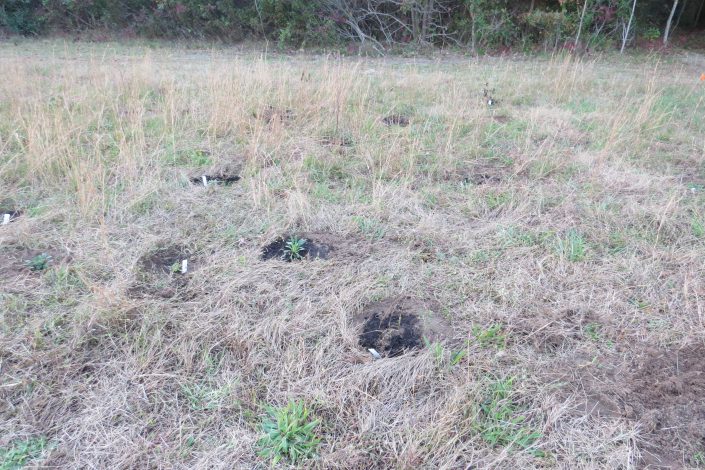
With funding from Atlantic City Electric volunteers with the Middle Township Environmental Commission and Conserve Wildlife Foundation of NJ planted 138 native perennials . While it doesn’t look like much right now, come next spring and summer there will be plants for bees, butterflies and birds to use for food and habitat. Not only will this pollinator meadow be great for wildlife, it won’t have to be mowed. The Environmental Commission will be in charge of maintenance and plans another work day in the spring to remove any non-native plants and trees in the area. We also plan to use this site as a demonstration garden for others interested in planting for pollinators.
Ockie Wisting Pollinator Habitat: List of Plantings – Fall 2017
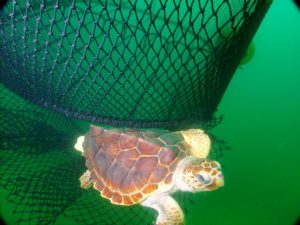
Conserve Wildlife Foundation’s Barnegat Bay ghost crab pots project is featured in this blog story covering a wildlife threat killing millions of marine animals every year. Read the full story here.
Photo by: AFP/NOAA via NewsDeeply Oceans Deeply blog
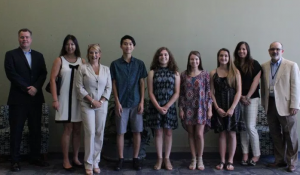
(From Left) CWF Executive Director David Wheeler, Claire Ang of Marine Academy for Science & Technology, CWF Director of Education Stephanie DAlessio, 1st Place Winner Ethan Chang, 3rd Place Winner Olivia Gemarro, Honorable Mention Nina Colagiovanni, Honorable Mention Sarina Schmidt, Maria Spina of PSEG Foundation and Russell Furnari of PSEG Services Corporation
Hundreds of high school students from across the state competed in Conserve Wildlife Foundation’s “Species on the Edge 2.0 Multimedia Contest”, engaging more than 23,000 people on social media with messages of wildlife protection. Of the entrants, three select winners earned scholarship funds.
“Today’s high schoolers grow up with an inherent expertise with technology and multimedia, yet it is far too easy for them to grow disconnected from the stunning nature and wildlife all around us. This contest utilizes their talents for technology to engage thousands of people across New Jersey and beyond with the wonders of wildlife – and a reminder for all of us to balance our lives by getting outdoors as well as online,” said David Wheeler, Executive Director of the nonprofit Conserve Wildlife Foundation.
Thanks to the generosity of corporate sponsor PSEG, Conserve Wildlife Foundation’s third annual multimedia contest focused on social media, giving students the opportunity to submit an original social media campaign showing why wildlife is important to protect and preserve in New Jersey and beyond. Winners were recognized this summer at a ceremony at PSE&G headquarters in Newark.
In addition to the student winners, CWF recognized Claire Ang, a marine science teacher from the Marine Academy for Science and Technology. Ms. Ang’s exceptional leadership engaged her high school in the contest, raising awareness about species protection.
Fifteen-year old Ethan Chang from Woodbridge High School won first place, while second and third place winners were Caitlyn Drace from Woodbridge High School and Olivia Gemarro from the Marine Academy of Science and Technology. In addition, Sarina Schmidt of Manchester Township High School and Nina Colagiovanni of Point Pleasant Beach High School were recognized for their wildlife videos. Each of the honorees plan to pursue wildlife conservation in various ways.
All three winners were awarded a gift bag, scholarships, and a special invitation to an eco-tour at Sedge Islands. Off the coast of Barnegat Bay, winners will have the unique opportunity to spend the day fishing, clamming, and wildlife watching.
Director of Education Stephanie DAlessio said, “The Species on the Edge 2.0 contest capitalizes on high school students’ expertise with social media platforms and provides them with the opportunity to showcase their talents, creativity, and their love for nature. This year’s contest allows high school students to advocate for wildlife conservation and to help raise awareness on social media about the importance of preserving and protecting wildlife.”
PSEG’s commitment to environmental stewardship made the contest possible by supporting funding for the scholarships. PSEG is a leader in conservation and restoration projects, including efforts to increase numbers of pollinators in the state.
The video submissions for Species on the Edge 2.0 can be viewed here.
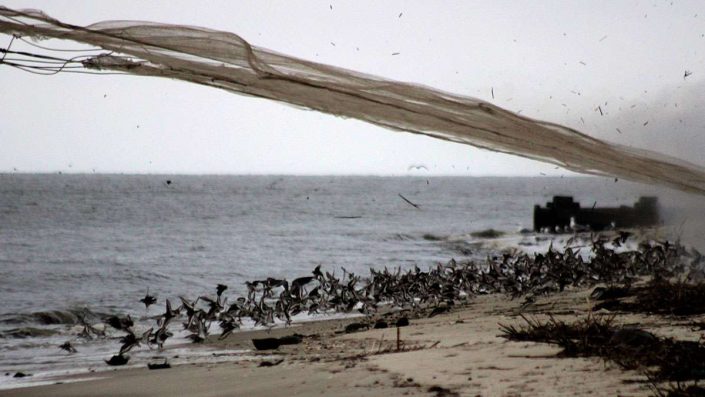
This recent story highlights the threats facing red knots and the horseshoe crabs they depend on, as well as Conserve Wildlife Foundation’s role in protecting the species.
As part of the Beach Nesting Birds team last season, I had grown accustomed to scouring the beach daily for signs of birds: tracks, scrapes, nests and eventually adorable chicks. On my free time, my beach walks are spent combing the beach for various treasures. Yesterday, I had a new reason to walk the beach and I had to re-train my focus to something that never caught my interest before. It was my first survey for the endangered beach plant, seabeach amaranth (Amaranthus pumilus). Continue reading “Beach Plants Need Love, Too”
NewsWorks ran a feature story on red knots and the incredible team of international volunteers who make Conserve Wildlife Foundation’s past two decades of scientific surveys possible.
Conserve Wildlife Foundation’s “Rare Wildlife Revealed: The James Fiorentino Traveling Art Exhibition” can be found at the famed Hiram Blauvelt Museum in Oradell with a free reception this Friday night, May 19 from 6 to 8 PM. Former Governor Tom Kean will join nationally renowned artist James Fiorentino and CWF Executive Director David Wheeler for brief remarks, and guests will also be served refreshments.
The Hiram Blavelt Museum was established in 1957 as a natural history museum to garner support for wildlife conservation. Today, it is one of only five museums in the United States to exclusively display wildlife art. The museum is located at 705 Kinderkamack Road, Oradell, NJ 07649.
This innovative three-year exhibition is spotlighted in a nine-minute video by videographer Ed English focusing on a previous stay at the Studio 7 Fine Art Gallery in Bernardsville. The exhibition has also been featured at D&R Greenway in Princeton, the Mayo Performing Art Center in Morristown, the Flying Fish Brewing Company in Somerdale, the Salmagundi Art Museum in New York City, and the Princeton Environmental Film Festival in Princeton.
Rare Wildlife Revealed will be shown at Hiram Blauvelt Museum through July 30, 2017.
To learn more about hosting a future showing of Rare Wildlife Revealed – whether for an extended exhibition or a single night’s event – please contact Liz Silvernail, CWF Director of Development at 609.292.3707.
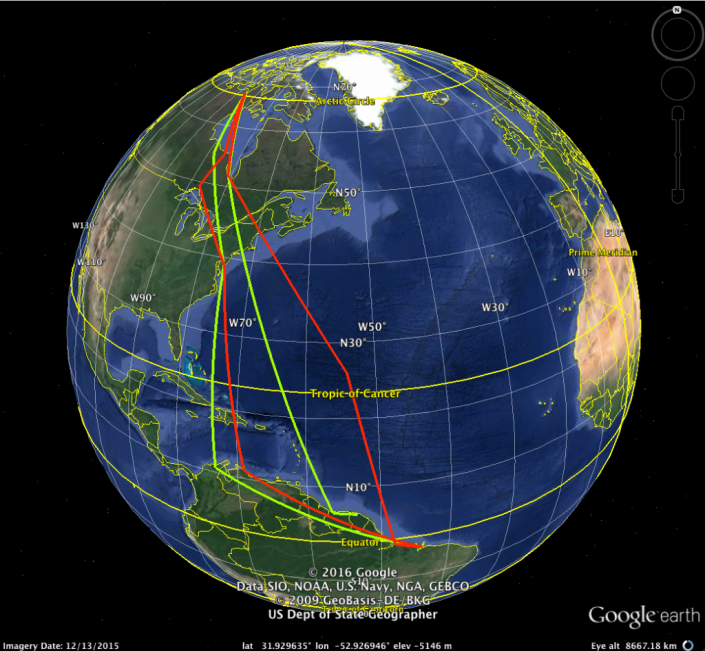
Over the last few days of our expedition, we left the state of Para and flew to Sao Luis in the adjacent state of Maranhao. There we began the next phase of our work, trapping red knots, ruddy turnstones and other species, as we have done since 2014.
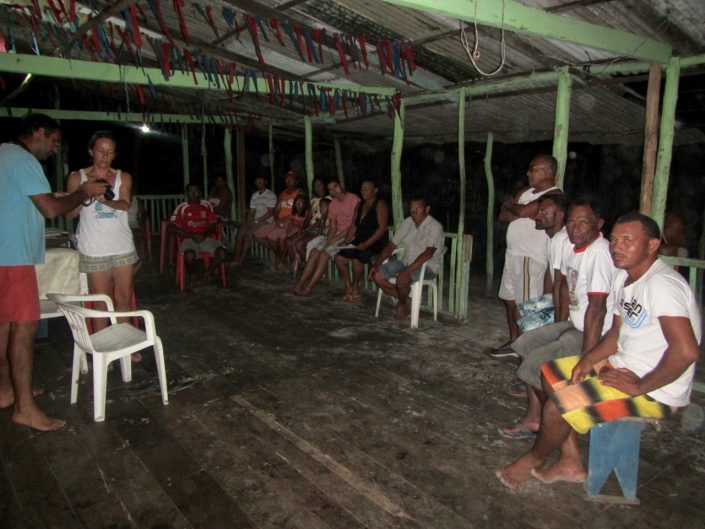
But prior to leaving Para, while we stayed in the village of Apiu Salvatore, the fishermen asked to meet with Max. He hadn’t planned it, so at first, the reason was unknown. The fishermen of the village knew Max represented ICMBio, and that Apiu Salvatore fell within Resex Gurupi-Piria, one of the Brazilian agency’s many extractive or Resex reserves. As I described in the previous post, ICMBio conserves natural resources in each reserve for the benefit of traditional communities, such as this one. So Max had a good idea what the community had on their mind.
David and Danielle prepare for the meeting with the fishermen of Apiu Salvadori.
We entered the large open meeting space under a thatch roof with a good breeze cooled by a sudden evening downpour. The association leader, Antonio, got down to business. He explained the problem of immense ships lurking offshore, spreading giant purse seines or immense lines of baited hooks, and stealing all the fish. It threatened their own lives, not only their livelihoods but their very existence. One could see very clearly how vital fish were to these fishermen. The community consumed virtually no goods; most of their daily needs came from the sea or their backyards. Chickens, pigs, even lambs filled backyards. Fruit like mangos and avocados literally fell from the trees. I saw no washing machines, microwaves, coffeemakers, or nearly any of the appliances that litter a typical U.S. kitchen.
There was one modern device found in every hut and cabin, no matter how small or dilapidated. All had TVs. How, I imagine, can they fit in this primitive world while gapping at the lives of the rich and famous? These were not people ignorant of the world, but unfortunately, they could be innocent as lambs when faced with the greedy schemers and politicians of Brazil. And as the ongoing corruption scandals here evolve, it seems like nearly every politician serves their own or other greedy interests.
So it is understandable that the fishermen’s first thought was to go to the Catholic Church. But then we came. So they asked for Max’s advice.
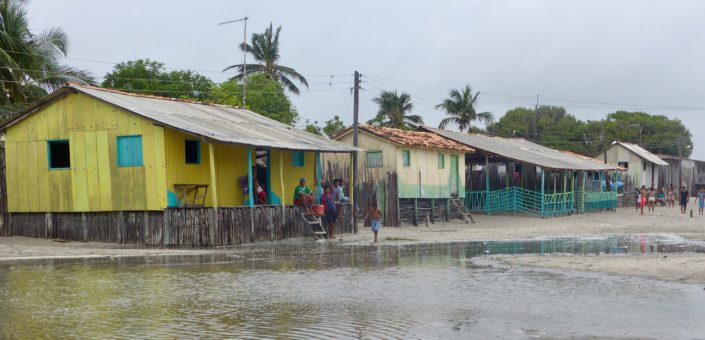
The people of the village live simply with no luxuries except TVs. The town, located on a small island has no electricity except when the community generator is turned on at night. (Photo by C. Buiden.)
He quickly determined the fisherman had no idea they had legal rights to the fishery. He patiently explained the concept of ICMBio reserve system, the system of which they are a part. In theory, they could unify and certify their observations, take it to a judge and get a decision that would force the government to stop the theft by the international fishing fleet, at least in principle. Max and Danielle explained these rights and the group seemed sufficiently inspired. At least they left happy.
Why did they not know their rights? Max explained to me that the reserve manager for this area covered 60 other villages and that ICMBio has suffered 3 years of budget cuts. He reminded me how long it took to get to this village. So it’s the usual story familiar to U.S. agency biologists. Here, as it is in rural U.S., but with a more obvious impact, starving good government often only starves the people who live on the land, the land itself and the wildlife, who depend upon it.
For me, it meant something more. We proposed this project to create better protection for shorebirds. We took the usual approach. First, do the surveys then will create scientifically defensible descriptions of the habitat’s value. Finally, we overlay the threats: shrimp farming, oil spills, human disturbance, predators etc. then develop counter-measures.
I learned that nigh there is only one threat in this, one of the most important shorebird habitats in the world. It looms large above all others – if you erode ICMBio’s system of protection all the other threats will grow and decimate the fragile ecology of the area. Grow the ICMbio system and the traditional communities will enforce their legal right to conserve. They can monitor the threats and work with the agency to stop them. The laws already exist. The monitoring system is already in place. But this meeting pointed out they need more help.
Photos by C. Buiden.
Dr. Larry Niles has led efforts to protect red knots and horseshoe crabs for over 30 years.
The capture of Arctic nesting shorebirds first brought us to Brazil in 2013. We brought 125 geolocators and caught both ruddy turnstones and red knots, attaching 85 on the former and 30 on the latter. But we also came to create a new perspective on shorebirds in this place, one of the most important shorebird habitats in the world.
For all intents and purposes, shorebird work in this area started in the mid 1980’s, when Canadian biologists, Guy Morrison and Ken Ross surveyed from an airplane, the entire coast of South America. In this monumental and dangerous survey they established an invaluable historic baseline of the number of Arctic nesting shorebirds wintering in South America. This was before shorebirds caught the interest of the public, and way before foundations and agencies devoted significant funding or staff time. They surveyed the entire continent, but on the coast of Maranhao and Para they found the motherlode of shorebirds. They did not, however, get close and personal.
Guy Morrison and Ken Ross about to conduct an aerial survey (also in the photo is Guy’s daughter Clair, Brad Winn, Jorge Jordan and Luis Venegas).
That challenge belonged to a team led by the late Allan Baker of the Royal Ontario Museum and Ines Serrano, then with CEMAVE, the Brazilian counterpart of USGS. They also flew the coast but followed up with a ground survey and the capture of a small group of red knots. Along with Guy and Ken, their work cemented the hemispheric importance of this area.
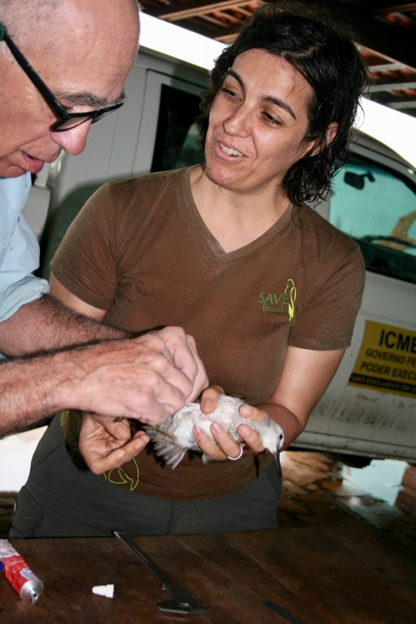
Juliana holds one of the two birds caught in our second day of trapping. (Photo by C. Buiden)
Over the last 4 years we captured knots, turnstones, sanderlings, whimbrels, collared plovers, semi-palmated sandpipers, semi-palmated plovers as well as South American terns and other species. Last year we recaptured 20 geolocators in a catch of over a hundred ruddy turnstones. But only in 2013 were we able to catch red knots. Although abundant in the region, populations are estimated at 10 to 15K, they are remote and elusive.
So we were happy to find on our first day of surveillance this year over 400 red knots. They roosted within a flock of about 1000 shorebirds located at the west end of a small working class beach resort called Panaquatira, about an hour out of Sao Luis. The flock including black bellied plovers, semi-palmated sandpipers and plovers, collared plovers, South American terns, Black Skimmers and a few whimbrels. We readied that night for an early morning attempt.
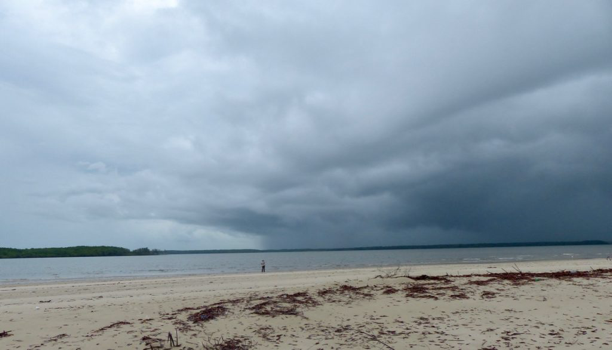
First we needed to figure out the tide. It rises and falls 13 feet in northern Brazil, twice that in Delaware Bay. The spring tide or full and new moon tide increases the range to 18 feet. Consequently, the high tide line moves every day and catching birds with a cannon net depends on placing the net near the predicted tide line, because birds move with it to stay as far from the dangers lurking on dry land. Wind speed and direction changes the high tide line, and so does barometric pressure.
So much rides on where we place the net. On our first two attempts, we missed by just a few yards, but it could have been a mile. The birds moved with the tide and stood just outside the 30 by 100-foot area within which the birds must be to be caught. We tried moving them but they spooked and most gradually left the area altogether. Ultimately, we fired but caught only two knots and two whimbrels.
We were blessed on the third day. We arrived near dawn, over four hours before high tide so we had plenty of time to measure elevations. We knew the morning’s high would be about four inches lower than the previous night’s high, which snaked along the sandy peninsula used by the birds to roost. Standing on the tide line we used a method borrowed from Clive Minton to determine the location on the beach four inches lower.
Laying my head flat on the sand I trained my eye towards the horizon. This establishes a level line. Using her hand, Stephanie marks four inches on her leg than moves until the four inch mark lines up with the level line. Her location depends on the slope of the beach. In this way we determined the location of the tide line four hours hence. We dug in the net.
Larry Niles and Mandy Dey take training on measuring elevation from Clive Minton in Australia.
At about an hour before high tide, shorebirds started crowding into the area around the net. At first, oystercatchers, black bellies, short-billed dowitchers and a small flock of skimmers. Most of the knots hung back on an adjacent sand bar. With a little push, they too piled in right into the catch area.
We fired and caught 175 knots, 30 sanderlings, 20 short-billed dowitchers and 5 black-bellied plovers. Among the knots were 3 with geolocators. We flagged, banded and measured 145 birds, all the while releasing unprocessed birds that appeared stressed by the heat. By late afternoon we were back at the house cracking open beers. We completed all our objectives with one day to spare.
CWF Biologist Stephanie Feigin moves birds closer to the net. (Photo by Yann Rochepault.)
Stephanie and Julianna begin taking birds out of the cannon net. (Photo by Yann Rochepault)
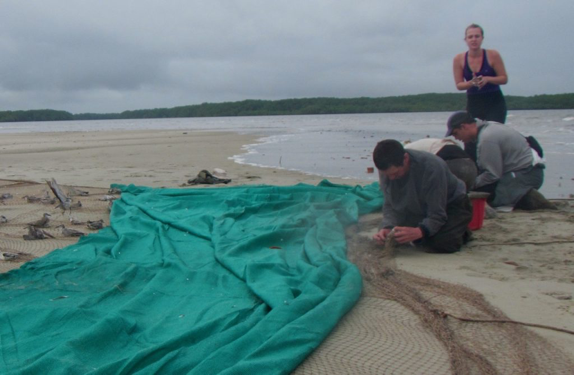
We must cover birds with a light shade cloth to calm birds while they are extracted and placed into keeping cages. (Photo by Yann Rochepault.)
Processing our catch. (Photo by Yann Rochepault.)
One of the many values of catching shorebirds is examining their condition and molt. Here we compare two knots, an adult on the right and a second year or sub adult on the left. The latter molts its flight feathers much earlier than adults and it shows in the fading to brown. (Photo by C. Buiden).
Our team includes Carla Meneguin, Paulo Siqueira, Ana Paula Sousa, Larry Niles, Juliana Almeida, Carmem Fedrizzi Joe Smith, Stephanie Feigin, Yann Rochepault, Laura Reis and Christophe Buiden. (Photo by Juliana Almeida).
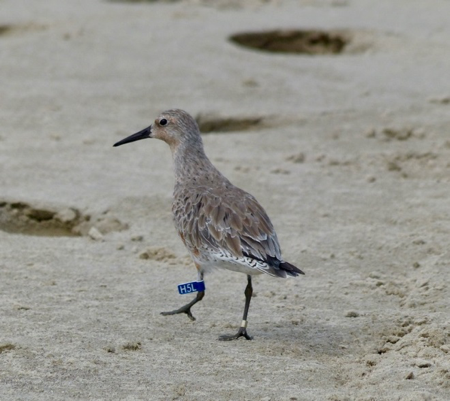
A red knot after banding and processing. (Photo by Y. Rochepault).
Dr. Larry Niles has led efforts to protect red knots and horseshoe crabs for over 30 years.
Reporter James O’Neill covers the impacts on plants and wildlife from the unseasonably warm weather for New Jersey this winter in this story for The Record.
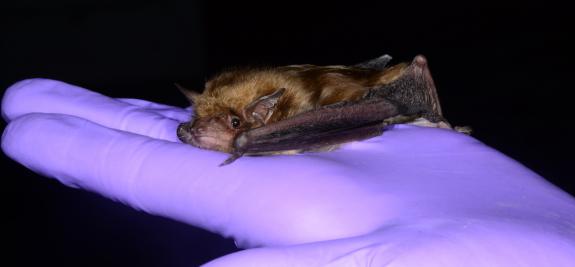
Big Brown Bat by Blaine Rothauser.
Bats, migratory birds, and other wildlife are challenged by earlier than usual spring-like conditions, says Conserve Wildlife Foundation’s David Wheeler.