An Update on the 2015 Delaware Bay Shorebird Project
By: Dr. Larry Niles, LJ Niles Associates LLC
We had about 13,000 knots on the New Jersey side of the Delaware Bay (an additional reported 2,000 on the Delaware side of the Bay). Yesterday, we suffered strong NW winds in excess of 20 kts and the birds virtually disappeared. Our daily survey turned up about 6,000 knots, the rest we suspect, finding refuge in Egg Island and Goshen Marshes or with a flyover to Delaware.
We will know where they went today. The team will comb the Bayshore for shorebirds with a coordinated ground, boat and aerial survey. The birds gain weight in good time and we expect the first Arctic lift-offs by the 26th. At the current rate, most of the Bay’s population will be off to the Arctic by the 30th.
Above is a clip from a new video about knots and our work by Mitch Smith, a longtime supporter of the team and head of the Mitch Smith Media.
An Update on This Season’s Horseshoe Crab Spawn and Shorebird Migration, Ten Days In
By: Dr. Larry Niles, LJ Niles Associates LLC
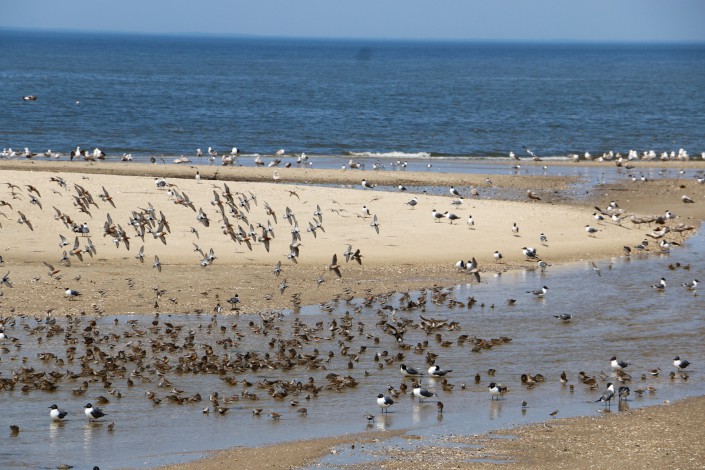
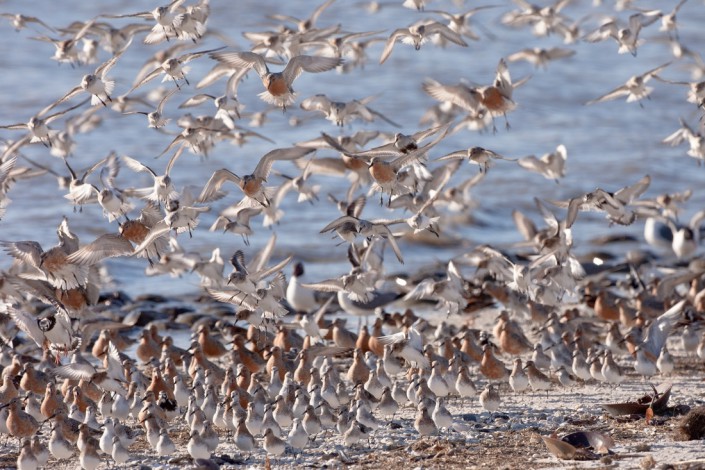
Thousands of shorebirds now fill Delaware Bay’s beaches and marshes in a determined effort to regain lost reserves with free-for-the-taking fatty eggs of the horseshoe crab. The crab spawn began ten days ago and has gained momentum over the last week as the volume of eggs grows like a well-funded savings account. The eggs surface as each new female crab digs up egg clusters laid by other crabs or as wind-driven waves pound the always-fluid sandy beaches. At least 8,000 red knots slowly get fat on the eggs scattered on New Jersey’s Delaware Bay beaches.
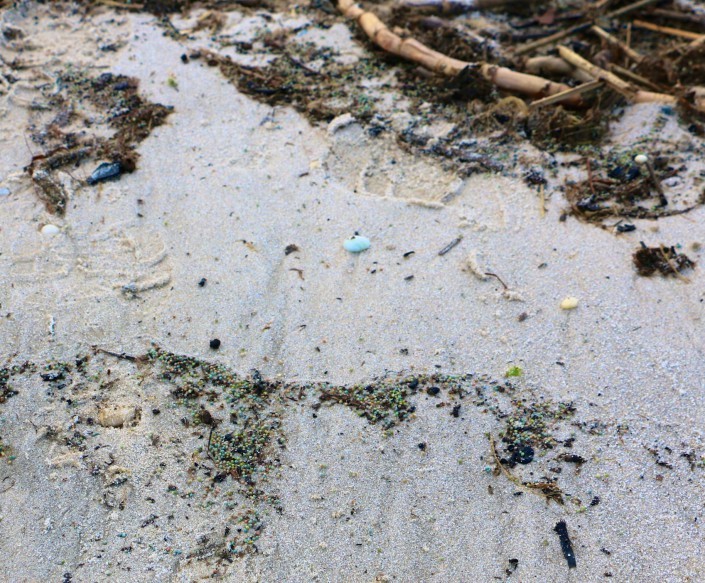
Eggs on Beach
Both crabs and birds are the beneficiaries of the increasing number of beaches that are highly suitable for egg-laying. In October, 2012, Hurricane Sandy ravaged two-thirds of New Jersey’s best crab-spawning beaches, its strong westerly winds lifting sand and spreading it far from the sea’s edge. Left behind was a jagged sod bank, completely unsuitable for horseshoe crab breeding. The mucky sod starves eggs of oxygen or gasses them with hydrogen sulfide, the by-product of decaying mud.
The American Littoral Society, Conserve Wildlife Foundation of New Jersey, the U.S. Fish and Wildlife Service and the National Fish and Wildlife Foundation came to the rescue, restoring many of these beaches to a condition superior to that before Sandy. The restoration team even repaired damages that predated Sandy — beaches with tons of rubble that entrapped crabs in nasty concrete, killing them by the thousands. Now beaches like Thompson’s Beach and Fortescue Beach join the growing number of delicate sandy strands that provide excellent spawning habitat.
Thompson’s Beach Before and After Restoration
This week, eggs can be found in many places on the New Jersey side of Delaware Bay, and the birds have the freedom to move to those that best suit them. Earlier this month, strong northwest winds drove red knots from the Reeds Beach area to other, more northerly, beaches that saw good crab spawning — beaches that also provide shelter from the winds. Now that the wind and sea have calmed, the birds have returned to the Reeds Beach area, less than 20 miles away, and have resumed gorging on the plentiful eggs that built up in their absence.
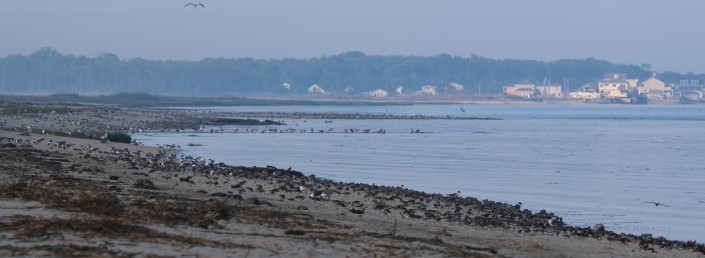
Early Morning Shorebirds on Delaware Bay
If one were to look for any cloud on the Delaware Bay shorebird horizon, it would lie in the lack of any evidence of horseshoe crab recovery. The current, reduced, population of crabs spawned eggs in great numbers early this May because of a spike in the water temperature, a consequence of unusually warm weather. So far the promise of this early spawn is holding, and crabs continue to spawn in good numbers. But will it hold until the end of May?
Crabs in Slew
If not, the readers of this blog will witness the outcome. The graph below, developed by long-time team-member Dick Veitch tells the story of a past egg failure. In the early 2000’s, although the population of shorebirds had not yet declined to its current number, the crab population had already fallen to its current number, crushed by the onslaught of a poorly regulated fishing industry. In those years, all the horseshoe crabs that could spawn had finished by the third week of May and egg densities on the bay plummeted. The birds crammed into the few beaches with eggs like Mispillion Harbor, Delaware, so densely that the beach reeked of off-gassing urinary ammonia.
But the number of eggs there was not sufficient to feed the still-large shorebird populations and birds failed to reach a weight – about 180g for red knots — suitable for their journey to the Arctic and subsequent breeding. Where once 80% reached the “good” weight, only 5% did in 2003 (see the second graph).
Percentage of Red Knots Reaching 180 Grams
The percentage has improved thankfully, but only because the number of shorebirds have fallen over the last 10 years, bringing a balance of sorts. Hopefully, with the new beaches, the new protection afforded by the red knot listing and the growing number of volunteers taking part in conservation of the crab and birds, this kind of disaster is behind us.
Another Season of the Delaware Bay Shorebird Project Underway
By: Dr. Larry Niles, LJ Niles Associates LLC
The value of a shorebird stopover like Delaware Bay can be seen in the shaky cam movie by this author. Red knots – some recently arrived after a grueling 6,000-mile flight over 6 days of continuous flying – arrive on the Bayshore desperate for food. Over the last 10,000 years, the species has evolved to fly directly to the Bay to feed on the eggs of the horseshoe crab.
The 450-million year-old crab – which is actually in the spider family – crawls ashore and lays pin-sized eggs about 6 inches deep in the sand. When there are many crabs, as here on Delaware Bay, one crab often unearths the eggs of another. Thus they leave millions of fatty eggs on the surface, offering an energy-rich, soft feast for the starving birds. In turn, we get to watch the birds racing for an egg ‘hot spot’!
The birds often arrive beyond depleted. A normal weight for a knot is 130 grams. Many arrive on Delaware Bay below 100 grams, the equivalent of a human in the throes of profound starvation. But when the birds fly north from the coast of northern Brazil, there’s no turning back. Once they go, they must go all the way.
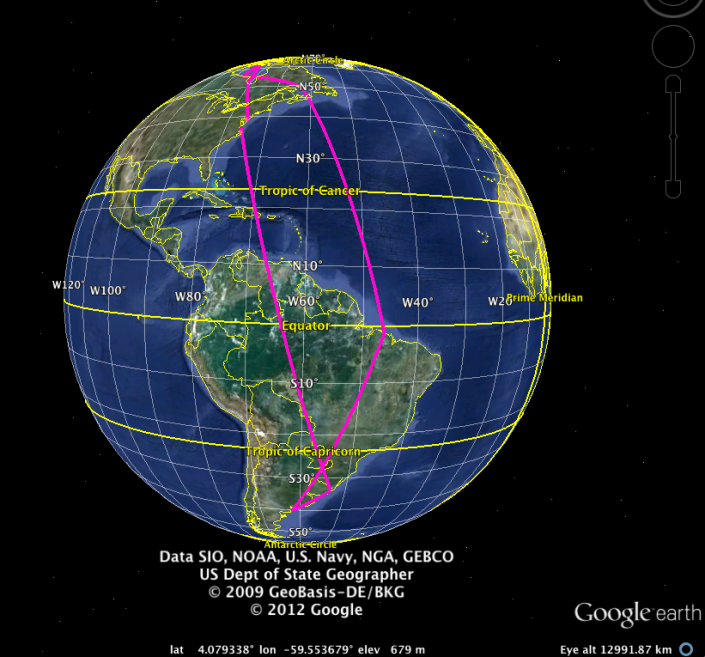
Map of geolocator track of a South American wintering red knot
This year, migrating shorebirds faced a freak tropical storm that could have forced them out to sea, far off-course. In severe cases, some birds with no remaining fat reserves even metabolize their own muscles, like airplanes throwing out vital equipment to stay aloft. Storms can also prevent birds from lifting off on migratory flights. They are capable of detecting atmospheric pressure changes and can just stay put until a storm passes. We think this is what happened this week when a storm, followed by a strong cold front and consequent northwest winds, prevented a movement north.
The sum of these challenges was lower than normal shorebird numbers during the first week of the stopover. The Heislerville impoundments support a good number of short-billed dowitchers and dunlin, but these species usually arrive earlier than the others and probably came in ahead of the adverse winds. Yet there are very few ruddy turnstones, sanderlings and semipalmated sandpipers on the Bay.
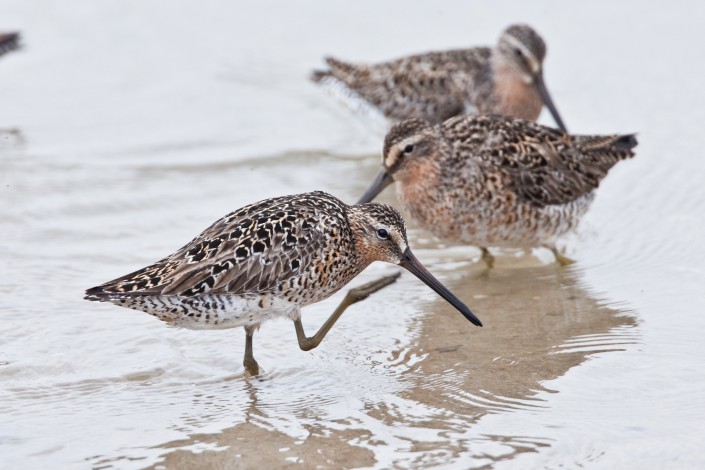
Short bill dowitcher (c) Jan van der Kam from Life on Delaware Bay
The one exception on the Bay is the red knot. At first, we thought that only about 1,000 red knots had arrived in and around Reed’s Beach. Then Jerry Binsfeld and Peter Fullagar, Canadian and Aussie members of our team, found an amazing 7,000 knots at Gandys Beach on the northern Bayshore in New Jersey. Very likely, these are short-distance migrants, coming in from wintering areas in Florida, Georgia and the Caribbean.
Red Knots on Fortescue
Our catch results support this working hypothesis. The knots we caught at Fortescue were at higher weights than normal for this early part of the season, which would be expected if fewer very thin long-distance migrants were part of the average.
The graph shows the weight relative to previous years.
The histogram shows the distribution of all the birds weights in the catch.
Restoring Critical Delaware Bay Habitat for Migratory Shorebirds
By: Kelsey Lawler, Spring 2015 Intern
Photo Credit: Jan Van der Kam
Saturday, May 9 is International Migratory Bird Day (IMBD) 2015! It is time to celebrate and bring awareness to the spectacular event that is bird migration. Since 1993, IMBD has been serving as a celebration as well as a call to action for migratory bird conservation.
Conserve Wildlife Foundation of New Jersey has been doing their part for bird conservation. We have developed a range of programs to increase the numbers of endangered migratory birds, like the Red Knot, since their decline in the late 1990’s.
Red Knots use New Jersey’s Delaware Bayshore as a stopover for feeding after their long journey from the Arctic and South America. Delaware Bay plays a major part in the Red Knot life cycle, so we’ve focused our efforts on restoring this critical habitat. The Red Knot migration is timed to take advantage of the spawning of the horseshoe crabs that use the same beaches as breeding grounds. Their eggs provide a rich food source for the Red Knots at a time when they are in desperate need of nutrients.
We have been working to benefit both horseshoe crabs and the migratory shorebirds that feed on their eggs, like the Red Knot, through our beach restoration projects, oyster reef construction and monitoring projects. Since Superstorm Sandy, we have successfully restored over a mile of impacted horseshoe crab habitat. We’re working to further protect these beaches from erosion and to create calmer waters for horseshoe crabs through our oyster reef construction experiments. To learn more about our restoration work in Delaware Bay, visit RestoreNJBayshore.org.
Of course, we haven’t been able to do this work alone. Volunteers are one of the reasons why these projects are possible!
Celebrate International Migratory Bird Day by getting involved in migratory bird conservation:
CWF Releases its First Annual Report Ever Using a Story Map Format: “2014 Annual Report“
By David Wheeler, Executive Director
Technology has proven to be vital to Conserve Wildlife Foundation’s work protecting rare wildlife species over the years. Our biologists depend greatly on modern technologies to band, track, and share online the journeys of wildlife. Our webcams broadcast the most intimate behaviors of nesting birds and bats across the web. And we seek out ever-evolving communications technologies to spread the word about the inspiring stories of wildlife, from social media and infographs to e-books and Story Maps. These technologies offer newfound abilities to share complex data on multiple levels, while still incorporating the awe-inspiring photography and videos that bring wildlife’s stories to life.
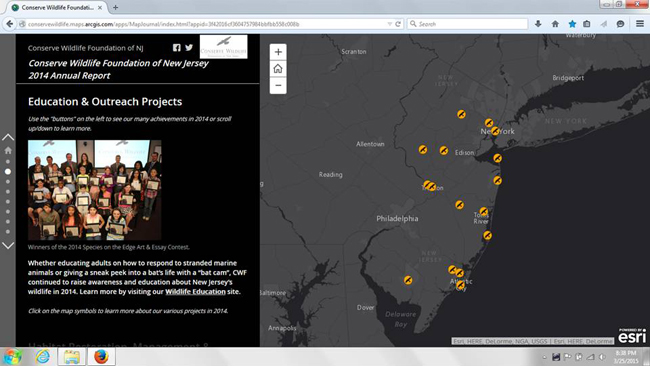
Conserve Wildlife Foundation of New Jersey is excited to offer our 2014 Annual Report in a unique format that utilizes one of those technologies – Story Maps. In the past year, we have explored the wonders of American oystercatchers with our first Story Map – and now the annual report allows all of our projects to be highlighted in this interactive format.
A screen capture of one of the pages of the CWF 2014 Annual Report Story Map.
Visit the multiple pages within this Story Map to learn about Conserve Wildlife Foundation’s many projects and partnerships in 2014, and the imperiled wildlife species in need of our help. Find examples of the innovative and dedicated leadership of our biologists and volunteers. And take an online journey across the state to learn how our projects made a difference in all corners of New Jersey in 2014 – a great year for wildlife in the Garden State!
The Rufa red knot (a shorebird) named “Moonbird,” or “B95,” photographed in a crowd of birds at Fortescue, NJ. Credit: Christophe Buidin.
“Moonbird is the most famous, charismatic member of a group of mid-sized shorebirds called Rufa red knots, whose numbers have plummeted so dramatically in the past several decades that they just became the first bird ever listed under the Endangered Species Act with climate change cited as a “primary threat.”
Rufa red knots are among the avian world’s most extreme long range flyers (especially in light of their relatively small size). They travel vast distances — some flying over 18,000 miles — in the course of an annual migration that begins in Tierra del Fuego, Argentina, and extends all the way up to the Canadian Arctic (and back again).
Which brings us to Moonbird’s distinction: Because he is so old — he is at least 21 — he is believed to have flown as many as 400,000 miles in his lifetime. The distance to the moon varies, depending on where it is in its orbit, but the average distance is about 237,000 miles. Thus, Moonbird has not only flown the distance it takes to reach the moon — he has also covered the bulk of the return voyage.
Assuming that Moonbird is still living — the last sighting was in May — there are reasons to wonder whether there will ever be another bird that is his equal. Why? Simply put, his subspecies has been devastated, and climate change will only make matters worse — making extreme survival of the sort that Moonbird has achieved that much more difficult.”
Washington Post Science and Environment Reporter Chris Mooney explores Moonbird’s journey, threats to the species, and the recent Endangered Species Act listing of the Rufa Red Knot:
Wildlife conservation organizations leading the efforts to restore New Jersey’s Delaware Bay beaches for at-risk shorebirds today applauded the U.S. Fish and Wildlife Service decision to designate the Red Knot, a migratory shorebird, as “threatened” under the Endangered Species Act. A “threatened” designation means a species is at risk of becoming endangered throughout all or a significant portion of its range.
“This federal designation will make a big difference in strengthening the protections of this incredible shorebird,” said David Wheeler, Executive Director for Conserve Wildlife Foundation of New Jersey.
“Here in New Jersey, we are restoring the vital beach habitat that had been decimated by Hurricane Sandy, and this designation ensures the safeguards we are providing can be complemented along the East Coast,” Wheeler added.
Since the 1980’s, the Knot’s population has fallen by about 75 percent in some key areas. Wildlife biologists believe the major threat to the Red Knot is the dramatic decline of horseshoe crab eggs, an essential food source at the most critical stop over during their 8,000 mile trip from southern wintering grounds to Arctic breeding territory. High-energy horseshoe crab eggs provide nourishment for Red Knots to refuel and continue their journey.
“This is an important and needed step in the conservation and recovery of the Red Knot. It is an essential step in preventing the extinction of this amazing long distance traveler,” stated Tim Dillingham, Executive Director forAmerican Littoral Society.
The largest concentration of Red Knots is found in May in the Delaware Bayshore of New Jersey and Delaware, where the shorebirds stop to gorge themselves on the eggs of spawning horseshoe crabs. In just a few days, the birds nearly double their weight to prepare for the final leg of their long journey.
“The major decline of horseshoe crabs in Delaware Bay is one of the largest threats to the survival of the shorebird,” explained Dr. Larry Niles, a biologist who leads the beach restoration efforts for Conserve Wildlife Foundation of New Jersey and American Littoral Society, and has studied Red Knots for three decades. “Agency groups have been working hard for the last two years, and will continue for the next two years going forward to rebuild the habitat damaged by Hurricane Sandy that the horseshoe crabs rely on. This work is integral to the recovery of the Red Knot and the shorebird’s best hope for survival.”
In the wake of Hurricane Sandy, American Littoral Society and Conserve Wildlife Foundation of New Jersey worked with the U.S. Fish and Wildlife Service, the New Jersey Division of Fish and Wildlife and the New Jersey Recovery Fund to remove 8,000 tons of debris and added 45,000 tons of sand to the beaches just before the annual spring arrival of the Red Knot in 2013.
On behalf of our friends – the piping plovers, red knots, American oystercatchers, least terns, ruddy turnstones, black skimmers, and many others – Conserve Wildlife Foundation wishes you a happy World Shorebirds Day.
To learn more about our beach nesting birds work, click here.
You can click here to learn about our migrating shorebirds work.
And if you haven’t seen the Delaware Bay beach restoration video yet, enjoy it here!
Finally, you can help support our shorebirds work with a donation, or through volunteering on one of our shorebird projects.
Click here to make a donation to our shorebird work here!
One other fun way to cozy up to a bird this fall is to visit Unreal Birds, and consider making a purchase of those adorable birds. A portion of every purchase benefits CWF!
This marks the second story in Shorebird Week! Our first blog post, on Tuesday, introduced the film “A Race Against Time” and directed you to a free viewing of the film on our website. Today’s blog post, will highlight an incredible news story about a resighting of the iconic Red knot B95 on the Delaware Bay! And tomorrow’s blog post, will highlight volunteer’s incredible efforts to save stranded horseshoe crabs!
This story highlights the iconic Red knot, B95, being resighted on the Delaware Bay. B95, nicknamed Moonbird, is at least 20 years old, which makes him the oldest Red knot on record. He received his nickname because he has flown the equivalent of the distance between the earth and the moon and at least halfway back in his lifetime.
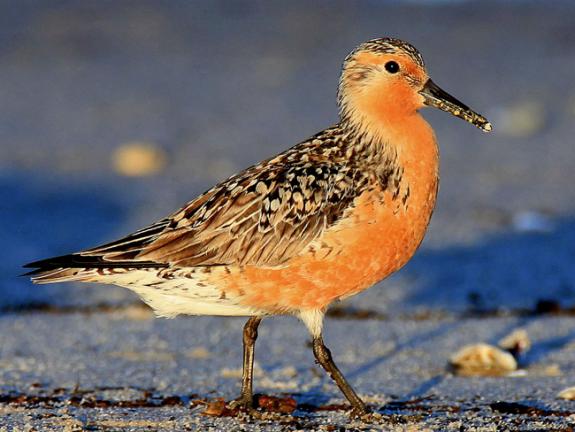
Iconic Red knot shorebird B95
One of Conserve Wildlife Foundation’s partners, Manomet Center for Conservation Science, highlights this bird in an fascinating news story about his resighting and the research efforts being done by the CWF biologist Dr. Larry Niles and Amanda Dey, senior biologist with the Endangered and Non-game Species Division of N.J. Fish and Wildlife and their team to restore the Delaware Bay.
A banded red knot searches for food on a Delaware Bay beach.
This week for Animal Week, we will be spotlighting Shorebirds in the Media! Endangered red knots, ruddy turnstones, and other magnificent birds travel from South America to the Canadian Arctic during their migration, and make an important stopover along the Delaware Bay Shore from May to June.
The 2014 Shorebird film, “A Race Against Time” celebrates the Delaware Bay Beach Restoration
The film can now be enjoyed for free on our website:
Greener New Jersey Productions this spring produced a 30-minute film documenting the ambitious campaign by Conserve Wildlife Foundation, American Littoral Society and other partners to restore Delaware Bayshore beaches decimated by Hurricane Sandy. This project ensures that the at-risk horseshoe crabs and globally migrating shorebirds relying on this habitat can survive.
Conserve Wildlife Foundation of New Jersey and the Endangered and Nongame Species Program (ENSP) of the New Jersey Department of Environmental Protection’s Division of Fish & Wildlife, and New Jersey Audubon have partnered for many years to conduct research on Delaware Bay shorebirds in order to prevent their decline.