A wild turkey spotted in a Manitoban provincial park. Photo by Vince Pahkala.
Over the years, the wild turkey (Meleagris gallopavo)
has been widely domesticated for food and has become part of this country’s
heritage for Thanksgiving dinner. There is evidence that Native Americans have
been hunting turkeys as early as 1000 A.D. Each year, over 46 million turkeys
are eaten each year on Thanksgiving – but how much do you really know about the
turkey?
Instead of our holiday emblem, the wild turkey nearly found
a drastically different role in American culture. Ben Franklin proposed it to
be the official bird of the United States, and though some say he did it in
jest, he praised the turkey as “a true original native of America…a bird of
courage…and a much more respectable bird” than the bald eagle!
By Michael Sol Warren | NJ Advance Media for NJ.com.
Photo credit: Ed Murray, NJ Advance Media for NJ.com
Freezing water and colder winds keep most New Jerseyans away from the Shore during the winter months. After all, who wants to spend a day on the beach bundled up and shivering?
But winter on the Shore is a downright balmy vacation for some annual visitors from the Northern Latitudes — it’s seal season again in the Garden State.
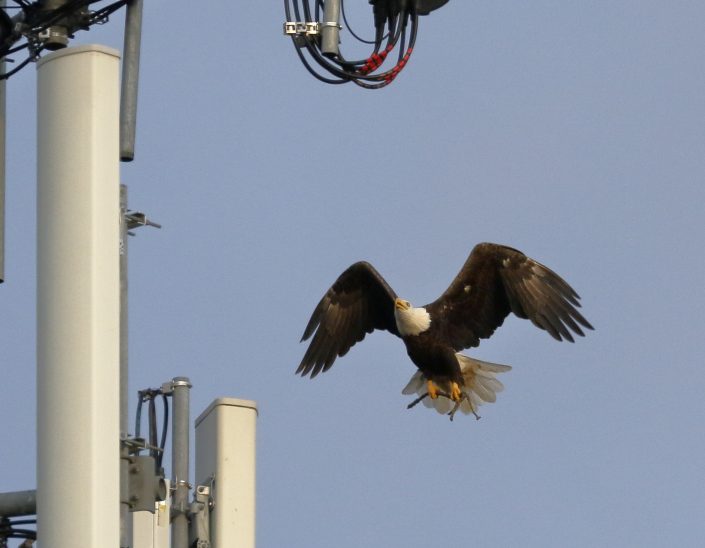
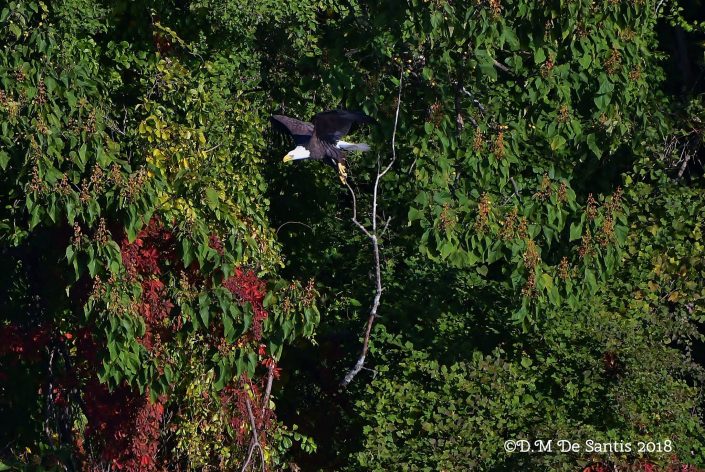
Some of New Jersey’s eagle pairs are getting an early start on the 2019 nesting season. Eagles in NJ will begin incubation anywhere from January through March. NJ Eagle Project volunteers usually report eagles back and working on the their nests in the late fall/early winter. But some pairs have already been spotted sprucing up their nests in preparation for the upcoming nesting season.
Volunteer Nicole Dion ready to conduct mobile acoustic survey
Across the country bat populations continue to decline due to the threat of White Nose Syndrome. Last year, to collect important population data to monitor population trends of New Jersey’s bat species, Conserve Wildlife Foundation of New Jersey (CWF), in partnership with Endangered and Nongame Species Program (ENSP), re-launched their Statewide Mobile Acoustic Surveys with new equipment and protocol. With all the kinks of a revamped project worked out, CWF entered their second year of this project. Continue reading “Acoustic Monitoring Drives Efforts to Save Bats”
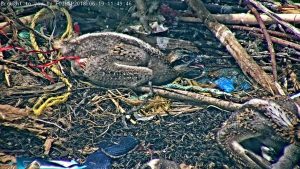
An osprey with a balloon ribbon around its leg at Island Beach State Park. Volunteers from the Conserve Wildlife Foundation of New Jersey removed the ribbon and cleaned the osprey’s nest on Tuesday afternoon. Photo by Jeff Goldman, NJ.com
Two volunteer groups and the Seaside Heights public works department teamed to help a baby osprey that had a balloon ribbon tangled around its leg in a nest at Island Beach State Park.
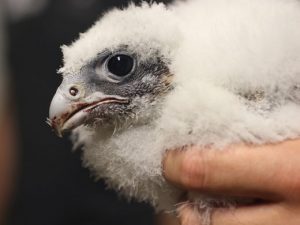
A peregrine falcon chick is shown after it was removed from its nest for banding.
Several scientists, protected by the curious combination of an umbrella, a duster and a hard hat, scrambled across the roof of a Jersey City high-rise this week to fend off the fierce attack of two adult peregrine falcons.
The scientists were there to briefly retrieve three falcon chicks from a nest box 42 floors above the city streets, so they could weigh, measure and band the birds before returning them.
The three chicks, still covered in fluffy white down, are the latest additions to a growing population in New Jersey of the world’s fastest animal.
NJ.com reporter Alexis Johnson at Duke Farms in Hillsborough
Conserve Wildlife Foundation has long partnered on the famed Eagle Cam at Duke Farms in Hillsborough, which has thrilled over 13 million viewers since it started.
In this video, NJ.com reporter Alexis Johnson covers the state’s longest running Eagle Cam with an interview with Duke Farms Executive Director Michael Catania.
Bald eagles have nested at Duke Farms since 2005. Currently the pair has laid two eggs in this nest, with the first egg laid on Valentines Day this year.
From just a single nest remaining in the state in the late 1970s and early 1980s, bald eagles have recovered to over 170 nests, thanks largely to scientists and volunteers from the New Jersey Endangered and Nongame Species Program and Conserve Wildlife Foundation.
The Duke Farms Eagle Cam can be found here, and author Jim Wright’s e-book “Duke Farms’ Bald Eagles” provides some fascinating additional information about this nest.
CWF’s Bald Eagle webpage and annual Bald Eagle report details the story of bald eagles in New Jersey, with a number of other helpful links.
The Press of Atlantic City covered the troubling findings of Conserve Wildlife Foundation’s recent expedition to Tierra del Fuego in Chile to survey wintering red knots.
The numbers of red knots – an endangered migratory shorebird that spends every May along New Jersey’s Delaware Bay coast feasting on horseshoe crab eggs – declined by more than 20 percent between the team’s counts last year and this year.
The WNET-PBS Nature program Peril & Promise’s second live interview with Conserve Wildlife Foundation marked the Great Backyard Bird Count by focusing on the inspiring recovery of the bald eagle. This interview, taking place at DeKorte Park in the Meadowlands, features program host Emily Harris speaking with CWF Executive Director David Wheeler, CWF Trustee Kumar Patel, and Jim Wright, who has written two e-books about bald eagles.
Holding an authentic (empty) can of DDT, Wright noted, “Eagles had some tough times…with things like DDT, a really nasty pesticide that got into the food chain and would get into the fatty tissues of the bald eagles, and they had trouble laying their eggs because their eggshells were so weak. It got to the point in New Jersey where they were down to one nesting pair in the late 1970s, and they were not producing eggs…. But now there are…approximately 170 nesting pairs in New Jersey, including two right here in the Meadowlands.”




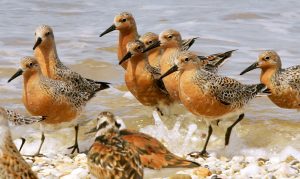 The Press of Atlantic City covered the troubling findings of Conserve Wildlife Foundation’s recent expedition to Tierra del Fuego in Chile to survey wintering red knots.
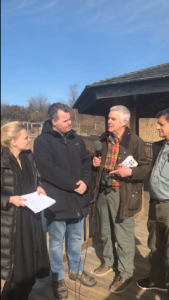 The WNET-PBS Nature program Peril & Promise’s second live interview with Conserve Wildlife Foundation marked the Great Backyard Bird Count by focusing on the inspiring recovery of the bald eagle. This