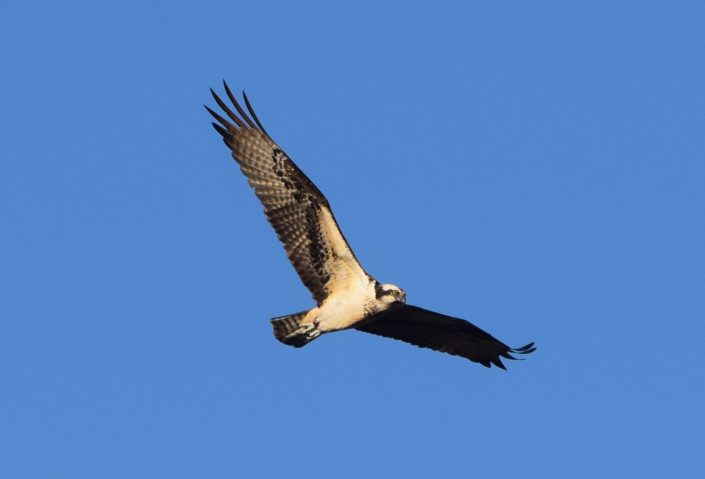
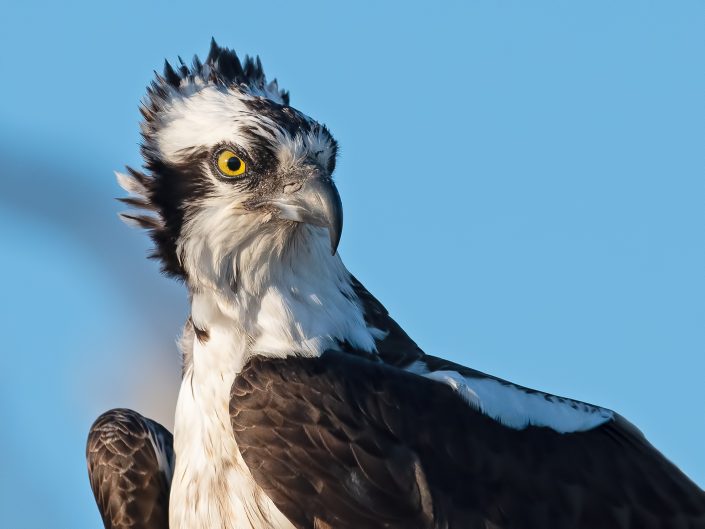
Thanks to dedicated Conserve Wildlife Foundation of NJ staff and volunteers three osprey chicks were saved from what could have been an unhappy fate.
NJ Osprey Project Volunteers Matt Tribulski, Wayne Russell and John King were surveying osprey nests in the Wildwood back bay area this past weekend. They checked on a nest with three chicks and found that the platform top was broken and a strong possibility it could collapse, especially with any heavy rains or winds. The chicks weren’t old enough to fly and would have fallen to the marsh and died. Continue reading “Osprey Chicks Get A Necessary “Home” Upgrade”
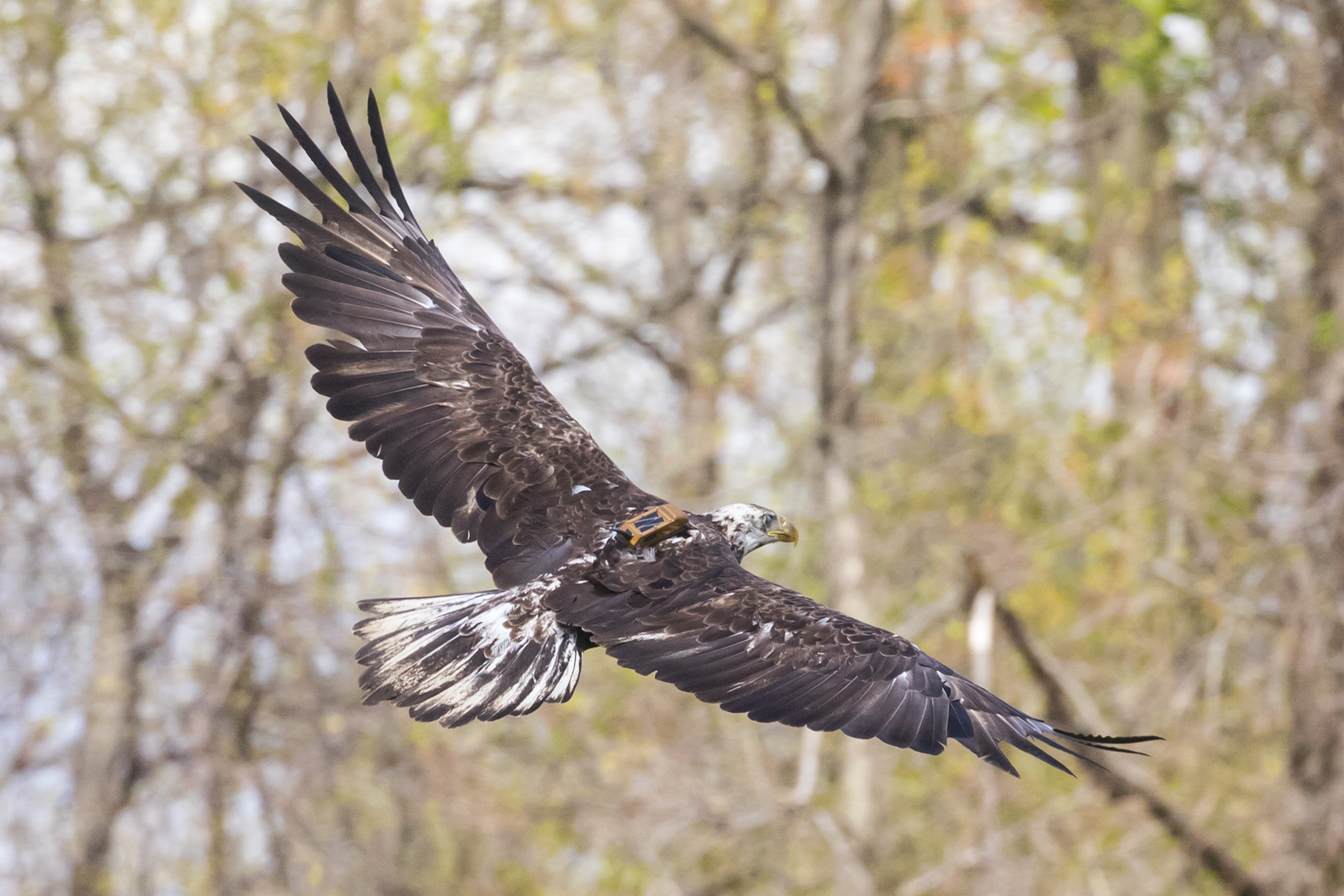
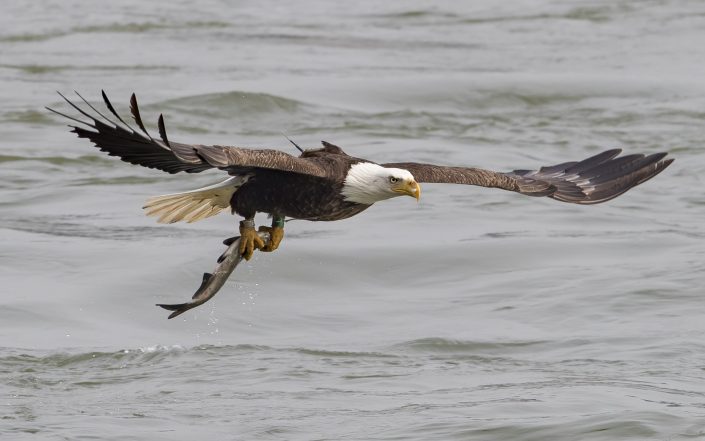
Andrew Drummond captured this image of “Harmony 2” on Memorial Day in Marlboro, VT. She was banded as D/64 and outfitted with a transmitter May 29th, 2012 at Merrill Creek, Warren County. We have since been following her movements on Eagle Trax. She fledged in 2012 and spent her first winter on the lower Chesapeake Bay before traveling to Maine. She has spent the last five years in a 100-mile swath of western Connecticut and Massachusetts, and now into southern Vermont. She is of breeding age so we suspect that she will be nesting in the area next season.
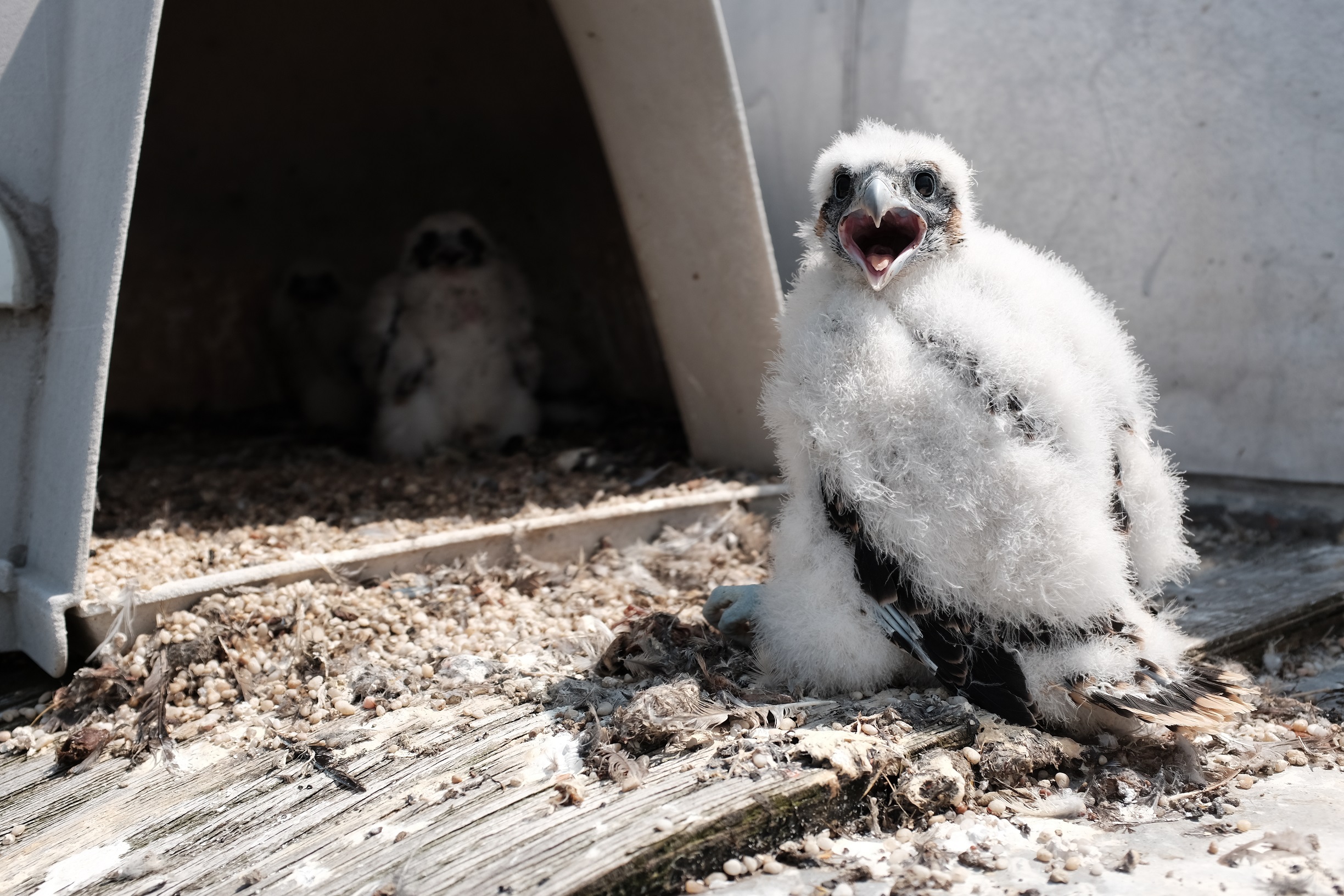
Earlier this week we visited two urban falcon eyries to band young for future tracking. Both bandings were streamed live on our Facebook page. Here at the Elizabeth eyrie, BD/73 showed us who rules the roost! We have a feeling that we’ll be seeing her again sometime in the future!
Bald eagle rescued, rehabilitated and released with satellite transmitter to track movements
by Kathy Clark, Endangered & Nongame Species Program, NJ Division of Fish & Wildlife
Pedro takes flight! photo by Marian Quinn.
On Sunday, April 15th, I got a call that three bald eagleswere spotted in a farm field. Not too unusual in rural Salem County, but this good neighbor was rightly concerned that something was wrong. Pedricktown resident Steve Wilson approached the eagles and not only did they not fly away from him, but two could barely sit upright and a third was stumbling away. Steve made phone calls and, at 7:30 at night, couldn’t reach any of the wildlife centers or offices. Persisting, he made a connection with Dr. Erica Miller, a wildlife veterinarian who for over 20 years was both clinician and surgeon atTri-State Bird Rescue & Research in Newark, Delaware. Erica is also a long-time partner on the NJ Bald Eagle Project, and called me about 7:45 that evening. Continue reading “Quick Action Ensures Survival of Poisoned Eagles”
Horseshoe Crabs Just Beginning To Breed as Shorebirds Arrive
Delaware Bay horseshoe crab eggs reach sufficient levels to give red knots and other shorebirds a good start on the fat they need to fuel the last leg of their yearly journey in the first week of the stopover ( May 12-19). Knots need at least 180 grams to fly to the Arctic and breed successfully. This week we caught birds that weighed 93 grams which is 30 grams below fat-free weight. These birds had just arrived from a long flight, probably from Tierra del Fuego, Chile or Maranhão, Brazil. In the same catch, we weighed red knots as high as 176 grams or only 5 grams from the 180-gram threshold. These birds are probably from Florida or the Caribbean wintering areas and so arrive earlier, resulting in them having more time to gain weight. All together it looks like a normal early migration and a modest horseshoe crab spawn, just barely enough for the birds in the bay.
Our team prepares a catch of knots turnstones and semipalmated sandpipers for extraction to keeping cages. The birds will be covered to prevent feather abrasion before extraction (Photo by Stephanie Feigin)
However, we are still short of about half the population. Our bay wide count won’t take place until next week on May 22 and 26. At this point it looks like we have about 14,000 knots in the bay, of which 8,000 are in New Jersey. In the last 5 years we have had a bay wide population of about 24,000 red knots. The situation is similar for ruddy turnstones and sanderlings. The southernly winds of the next few days will almost certainly bring in the rest of the flock by mid-week.
The Stopover Habitat is Growing
The condition of the stopover is mixed.
The work of Niles & Smith Conservation Services, Conserve Wildlife Foundation of NJ, and American Littoral Society continues to supply high-quality habitat for horseshoe crabs. We have developed an efficient system for maintaining the essential requirements of a good spawning beach, deep and large grain sand with berm heights that prevent over washing in a way that keeps cost down. First, by creating low oyster reefs to break waves in lower tides, thus protecting beaches from wind waves at low and mid tides. Second, by placing sand on beaches that typically erode fast losing sands to adjacent creek inlets and the next beach south. This way we can use one restoration to restore three different places. For example, Cooks Beach loses sand to South Reeds.
Thompsons beach before and after restoration by American Littoral Society and partners. (Photo by Larry Niles)
Oddly these successes may be contributing to the next big problem for the birds. The state of Delaware has been carrying out much larger scale beach replenishment projects that have added significant new sandy beach for crabs spawning. At the same time the Atlantic States Marine Fish Commission has failed to deliver on its promise to increase the number of crabs. The population is still 1/3 below carrying capacity or the number that existed 20 years ago. The same number of crab divided by more beach equals decreasing crab densities. Decreasing densities means fewer eggs reaching the surface because crabs are not digging up existing eggs to lay their own.
In other words, we need more crabs.
The Industry Finds New Ways around the ARM Quota
But the resource agencies seem perfectly happy to keep killing adult crabs for both bait and bleeding at near historically high numbers. Bait harvests recorded as coming from the bay have stayed the same, however other states such as NY are still taking and landing large numbers of crabs despite having no known crab historic population of their own. Additionally, Virginia states that a crab population still exists in the state, even though most field biologists consider them lost. The truth is they are very likely taking Delaware Bay crabs and landing them as their own.
The Conservation groups are no longer satisfied with this loose regulation and are calling for regulations similar to those used for Striped Bass. The Delaware Bay harvest should be restricted to just the quota agreed upon by everyone through the Adaptive Resource Management system. All other landed crabs should be genetically linked to a source population, and if they do in fact come from Delaware Bay they should be taken out of the ARM quota. No one should be allowed to get away with killing our crabs outside the quota.
This graph compares the finding of Botton et al 1994 from horsesoe crab egg surveys done in 1990 and recent counts done in 2017
The same goes for the killing of crabs by the companies bleeding crabs. The industry makes untold millions (the numbers are hidden from the public) but does virtually nothing to conserve the crabs while killing thousands. Their own estimate is well over 65,000 a year, but independent estimates double that. This killing could also stop because a new synthetic lysate is available and can be used now, potentially cutting the need for natural lysate by 90%.
An Ecosystem Collapse and the Need for More Crabs
Why kill such a valuable animal? It all started because the fishing industries saw little value and figured why not destroy the population until they are no longer economically viable. Its called economic extinction and sadly it’s a tradition amongst Delaware Bay fishers still carried out this to this day on eels, conch, and other species. But they didn’t know back in the early 90’s they would wrecking the entire ecosystem.
In 1991, we counted an average of 80,000 horseshoe crabs/meter squared. Now we count 8,000. Then the eggs stayed at that level for all of May and June then hatched young at similar densities. In other words, the horseshoe crab was a keystone producer of an abundant resource that maintained the bay ecosystem. It was not just chance that at the same time the bay has one of the most productive weakfish and blue claw crab fisheries in the Atlantic coast. Fish populations blossomed with the flush of horseshoe crab eggs and hatched young each year.
Now we must bring it back. For the birds, for the fish, and for the people who love to bird and fish.
A storm looms over Delaware Bay. The last 4 days have been rain, some intense and cold. The water temperature needs to be 59 degrees or so for Crabs to spawn. On Saturday the 19th the water temperature fell below and the spawn virtually stopped in many places. It should resume with the warmer temperatures of Saturday and Sunday.
We are grateful to the National Fish and Wildlife Foundation and other donors who make this project possible.
Dr. Larry Niles has led efforts to protect red knots and horseshoe crabs for over 30 years.
Human Interaction and Quick Action Ensure Survival of Young Falcons in Urban Areas
by Ben Wurst, Habitat Program Manager
Yesterday NJ Fish & Wildlife Zoologist Kathy Clark and I visited 101 Hudson St. after watching the Jersey City Falcon Cam for several days since the first and only egg hatched on Wednesday evening, we became more and more concerned for the health of the 5 day old eyas. We also came upon a brood of three young (and healthy) falcons who were displaced (we’ve called them orphans) from the old Goethals Bridge, which is currently being deconstructed. Knowing that the orphans needed a home, we decided to visit JC and assess the health of the lone eyas, collect the unhatched eggs, and possibly foster in the orphans here. Continue reading “Management of Urban Nesting Falcons in New Jersey”
The Amazing History of a Breeding Adult Male Osprey at Island Beach State Park
by Ben Wurst, Habitat Program Manager
Bandit in flight while carrying nesting material. He has been nesting at the Pete McLain Osprey Cam nest since 2013. photo by Karl Soehnlein.
Around 3% of ospreys who were banded with USGS aluminum bird bands as nestlings in New Jersey are re-sighted after fledging or leaving their nest. Most of those recoveries or resightings are centered around mortality based events where a bird is injured or killed and the band is then close enough to read. Since the numbers on the leg bands are so small, it is often hard to read when they are still alive. However, when enough photos are obtained or a camera is installed on a nest then the likelihood of reading the band on a live bird increases. Continue reading “Identifying “Bandit” at Pete McLain Osprey Cam Nest”
Barnegat Bay Osprey Returns to New Jersey After Two Year Vacation
by Ben Wurst, Habitat Program Manager
04/D was photographed in Allendale at the Celery Farm by Barbara Dilger on Monday, April 23.
North American ospreys migrate long distances to and from their breeding and wintering grounds in the southern U.S., Central America, Caribbean Islands, and N. South America. For the past four years we have been banding young ospreys who originate from nests on Barnegat Bay with an auxiliary band to help determine their movements after fledging. Project RedBand was designed to help track the migration, dispersal, life span, and foraging habits of ospreys from Barnegat Bay, a unique estuary along the Atlantic Coast of New Jersey. The project was also designed to help engage the public in osprey management and conservation. Since the red bands are highly visible and readable with optics, it allows the public the ability to identify the individual and then learn about their past. Lastly, we now rely heavily on citizen scientists who report nesting activity on Osprey Watch. Continue reading “Osprey 04/D Back in Jersey!”
Male osprey makes epic return to nest along Delaware Bay; turns seventeen this summer!
by Ben Wurst, Habitat Program Manager
Photographer Brian Kushner has photographed this bird over the past ten years. Just this past week he confirmed his return to his nest by ID’ing him by his band # 0788-45514. Click to view large on Flickr. photo by Brian Kushner.
The spring arrival of the North American osprey (Pandion haliaetus carolinensis) to their nesting grounds in New Jersey was delayed slightly due to prevalent north winds. As we saw many birds begin to arrive to their nest sites, which they return to year after year, we were particularly interested in the return of one very special osprey. This individual, if he survived the winter would be the oldest living osprey ever recorded in New Jersey to be observed on his nesting grounds. Ospreys face many threats and their life span averages around 8-10 years, but some can reach 20 years old.
We would not know how old this bird is without the USGS bird band that was affixed to his left leg before fledging in the summer of 2001. Photographer Brian Kushner, who has been watching this nest for the past 10 years, was able to photograph the band, which allowed us to track down his origins. He was banded on July 5, 2001 before he could fly. The nest was less than 5 miles away from where he currently nests along the Delaware Bayshore. Typically it is very difficult to ID birds by their USGS bird bands, and most recoveries or sightings of bands occurs during an injury or death, but Brian’s been able to use his photography equipment to positively ID this bird. Banding data shows that males return as adults to nest in very close proximity to their natal areas while females tend to wander further away to nest.
Ospreys are currently laying eggs and starting incubation, which occurs right after the first egg is laid. Nests with eggs and young are protected from disturbance during this time, and established nests cannot be removed without consulting with NJ Fish & Wildlife and USDA Wildlife Services. Please refer to our “Living with Ospreys in New Jersey” guidance document for more information.
Currently, we are tracking two NJ eagles outfitted with transmitters. One of these,”Haliae” was outfitted with a transmitter on May 31st, 2013, at the Merrill Creek Reservoir. We have been following her movements on NJ EagleTrax. Since 2015 she has spent her time in Maryland and eastern PA along the Susquehanna River. This past November a photo was taken of Haliae at Conowingo Dam, MD. At that time it appeared that one of the straps on her harness had come loose and we expected the transmitter to fall off in the near future, but continue to receive signals.
On April 12, 2018 Keith Opperhauser photographed Haliae along the Susquehanna River in Darlington, MD. The harness strap is clearly loose below her chest, but the transmitter is still attached. Haliae will be five years old this May and reaching breeding age. We don’t know how long the transmitter will stay attached or continue to transmit, but we’re glad to know that she is doing well.