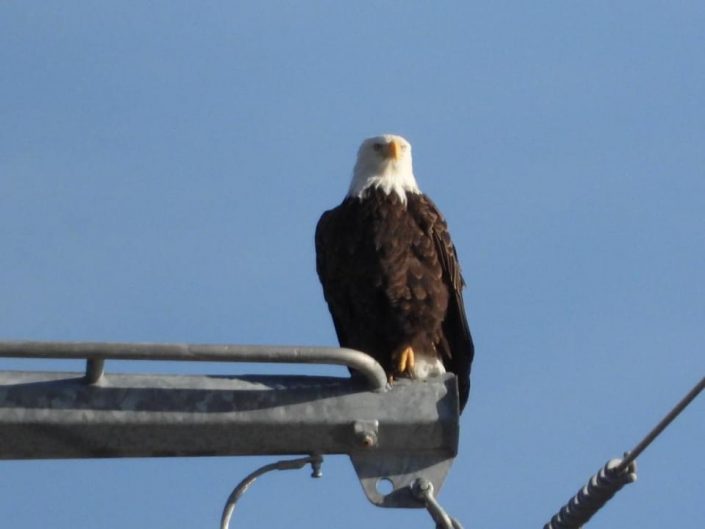
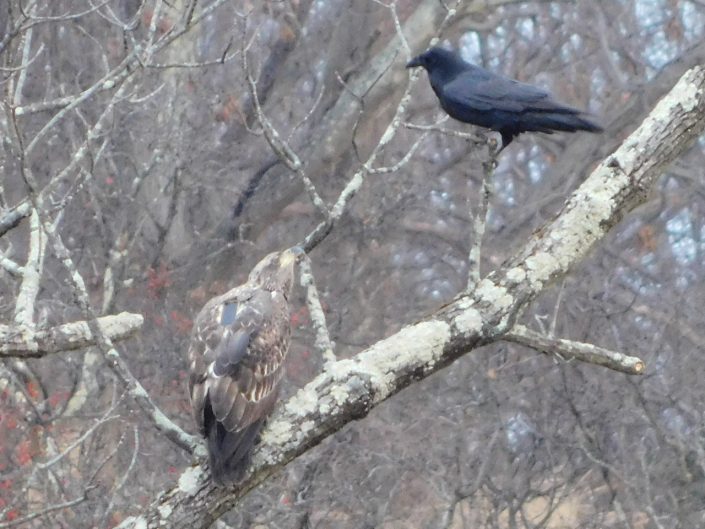
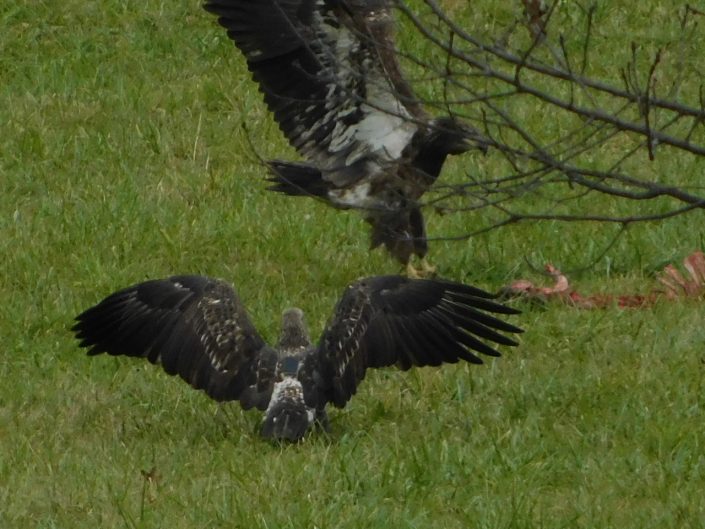
Three Bridges adult perched on tower December 5th 2021 by Lisa Romero
We are happy to announce that the Three Bridges Eagle Cam will go live on December 15th. This fall, the nesting platform atop the transmission tower received some improvements from PSE&G. The perches were moved for a better camera view and replaced with wood to provide better perches for the adults and a second wooden perch was added along one of the sides. A foam baffle was added to the microphone to help buffer wind noise. These improvements will make the platform better for the eagles as well as enhance the viewing experience.
August 1, 2021. It is raining and dreary out. Indoors all day wrapping up my end-of-season raptor time/mileage sheets, I have cabin fever! Tracking Duke for the last nine months has been educational and fun, and right now I know that he is nearby. For the last week he has been perching along the Raritan river–very close to my home and adjacent to his natal home, Duke Farms in Hillsborough. I have been too busy to spend as much time as I would like hiking and biking along the river nearby, while playing “hide and seek” with Duke! I check the internet link for today’s confirmation. Sure enough, Duke is perched in a wide-open field on Duke Farms land that I know well. It is only 4 miles away so I get in the car and head over there. Because it is raining, my chances of spotting him might be pretty good since eagles prefer not to fly in the rain, but rather remain on their perches without moving. He might still be there! I anticipate success. There he is! Right where I thought he would be. In a small grouping of trees in the middle of this large field there is one dead tree front and center, and Duke, fortunately, is perched on the dead tree, easily seen from the road. The photos are shot from about 100 yards away, in a light rain, but it is still a thrill to see him as it has been exactly two months since I last saw him on June 1st. blog post (Playing Hide and Seek with an Eagle)
“Duke” August 1st, 2021 by Barb McKee
On August 2, I learned that Duke had flown from that Duke Farms field back to the Delaware River and to Tohickon Creek where he spent the first week in August. As the second week began, his transmitter skipped 2 consecutive days of downloading data, but and when it finally did download, he had flown back to Duke Farms! In the coming days he seemed restless. He did not hunker down in one area, but appeared to be revisiting all of his haunts and hang-outs in central Jersey from the last nine months. He even went back to Tewksbury, flew very close to his winter “restaurant”, the game fowl pens at Flint Hill Hunting Preserve, and did a huge circle over Bedminster! He checked out Round Valley, the Black/Lamington River, Eagle Bend on the North Branch, and explored that river from Far Hills all the way to route 22. Then on August 30, a travel day again, he flew back to the Delaware! Again his transmitter did not connect with the satellite on the last day in August, but when it finally did connect, it was clear that his restlessness continued.
During the torrential rains of hurricane Ida, Duke finally hunkered down in PA on Neshaminy creek west of Washington Crossing in a rural area of woods and fields. He remained there until Sept. 6 when he flew back to the Delaware River and perched right near my Bulls Island nest. That is where he was on Sept 7. Then….his transmitter skipped three days of downloading! Finally, on Sept. 10, 72 hours of data downloaded and it showed he had been back on Tohickon Creek. This is a wild stream in a wooded gorge. There are some roads and houses here and there, but it is mostly rural–a good place for a young eagle. There would be plenty of places to perch and roost, and fish and small animals in and by the river to eat. But then, after 3:03:08 pm Eastern Daylight Time on September 10, his transmitter went dark!
Duke_Hillsborough November 24, 2020 by Barb McKee
My adventures with Duke started exactly a year ago today! blog post (Duke’s Homecoming) I learned he can hold his own against competition for food, aggressively steal from lesser raptors, find small rodents, reptiles and other prey in the smallest of creeks and valleys, fly beautifully and roost safely during rain, wind and snow. I have watched him thrive as an independent eagle in the wild, and although I sometimes worried about his choice of perches and food sources, I believe he has a great chance of reaching maturity and, in about 2 years, with his head and tail feathers mostly white, find a territory he likes and a mate with whom to build a nest. I miss knowing where he has been and miss our games of hide and seek. It has been 57 days since his last data download. I trust from the information on the site that his solar battery has failed and that Duke himself has not failed! During the coming winter I will be searching all the places I know he preferred. I believe eagles are creatures of habit. As I watched him travel around, sometimes all the way to the Chesapeake and back, I am sure that he used his eagle eyes to spot landmarks which are his “road maps” when he travels. I have plenty of reason to believe that he will return to his favorite roosts and hang out and I will have my eyes open, still searching for him. My sincere hope is that I, or someone else, will someday catch a photo of him with his E/88 band easily readable!
In the meantime, soar safely Duke, fly high and free.
The Coastal Barn Owl Project team is gearing up for another round of nest box installations in coastal southern New Jersey. After a successful fundraising appeal, we can now thank our donors by adding more potential nesting opportunities for barn owls, a species in population decline.
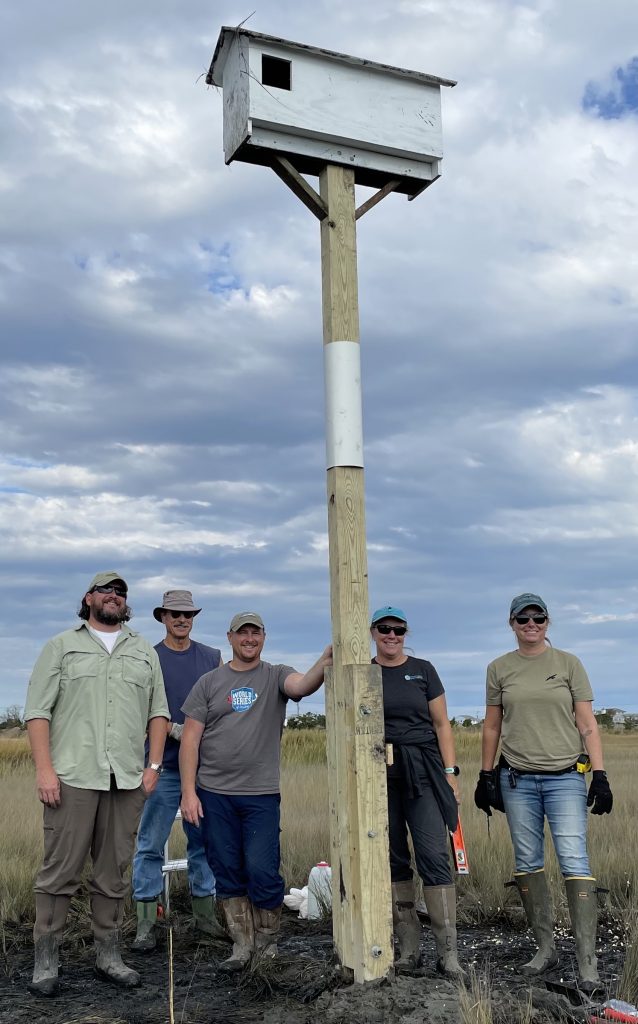
Our fourth and most recent box was just installed on October 22 in the saltmarshes of Cape May County. With each install, the team is becoming more efficient, and we hope to get several more boxes up in key locations before early spring when the owls begin their search for suitable nesting sites.
The newest barn owl nest box with volunteers Kevin Knutsen, Steve Eisenhauer and Mike Lanzone on left. Team leaders Tricia Miller and Meghan Kolk on right. Photo by Lisa Ferguson.
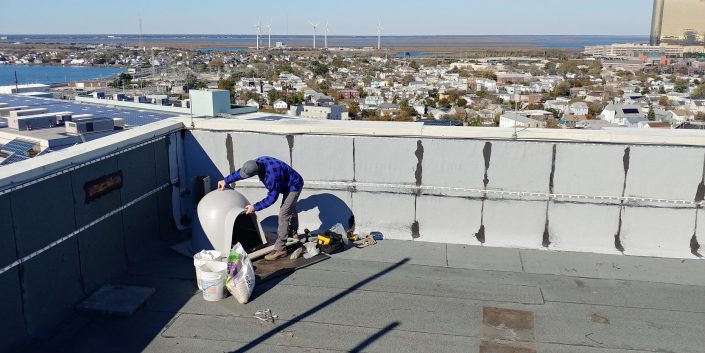
Putting the final touches on a new nestbox for peregrine falcons in Atlantic City, NJ. photo by Kathy Clark/ENSP
This past week I had the pleasure of assisting Supervising Zoologist, Kathy Clark with NJ Fish & Wildlife’s Endangered and Nongame Species Program to install a new nestbox for state endangered peregrine falcons. The new nestbox was installed atop the Sheraton Atlantic City Convention Center Hotel. Peregrine falcons are not new to Atlantic City. They have nested in A.C. since 1987, where the first pair nested on the 23rd floor of the Hilton/Atlantic Club. Since then new pairs have established nests on other tall buildings and structures, like the Hard Rock Casino and A.C. water tower.
The 2021 New Jersey eagle nesting season was another good year for NJ’s eagle population. The final numbers and details will be available in the 2021 Annual Bald Eagle report published in December. There are over 100 eagle project volunteers who monitor eagle nests/s during the season. They are an extremely dedicated group who not only monitor eagle nests but help to protect the nests. Volunteers become familiar with their pairs and get to witness all kinds of eagle (and other wildlife) activity. I asked the volunteers to send me their one favorite photo from this season.
A season of change and hope at the Barnegat Light Osprey Cam.
by Ben Wurst, Habitat Program Manager
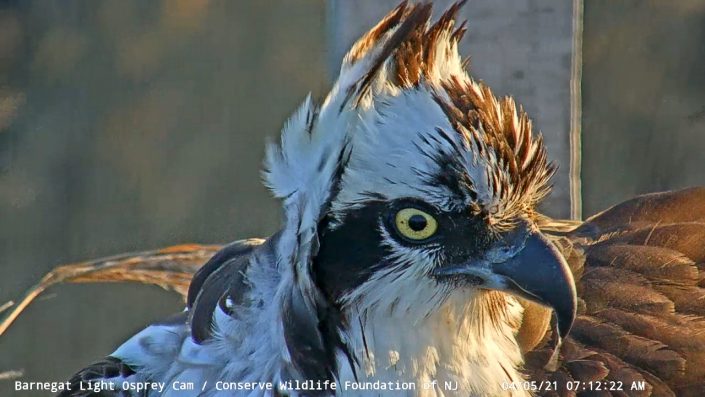
The “new” female at the BL Osprey Cam. April 5, 2021. Note the small dark fleck on her right iris.
By far, this was the most viewed season of the Barnegat Light Osprey Cam, with over 360,000 views and 111,000 hours watched! It was a season of change. Viewers throughout the world watched as the mated pair successfully fledged two healthy young. We witnessed the trials and tribulations of a new pair, especially the female, who we believe attempted reproduction for the first time in her life. We saw that life as a young osprey was not always guaranteed, which is something we rarely get to witness but know is quite common at many nests throughout the world; however, with an experienced male and plentiful prey, the surviving young thrived. As we work on a season long highlight video, here is a brief summary of their nesting season.
A couple weeks ago colleagues with NJ Fish & Wildlife shared a video clip of a dark osprey who landed on a nest platform along the Maurice River near Leesburg, NJ. “Looks like an oiled bird” the text read. Indeed it looked like the bird was exposed to some form of petroleum product, which stained its feathers a dark color. At the time, there was no oil spill reported to NJDEP (this was on May 10) and the video shows that the bird was observed on the nest on May 1, 2021.
During the peak of my field season last year I exchanged emails with a kind man who reported terrapins nesting in his yard. He wanted to do everything he could to ensure their success. A couple weeks later Bobby reached out to say how much him and mom loved the Barnegat Light Osprey Cam and how “the birds generally wake her up before her alarm.” He also mentioned how she delayed gardening because “dad is due with a fish any minute now. I’m just waiting to note the time then I’ll go play.” She was contributing observations of prey deliveries for research we conducted at the BL Osprey Cam last summer.
Eagle Scout candidate Kyle Agudo and Boy Scout Troop 61 give ospreys a boost in the new year
Ben Wurst, Habitat Program Manager
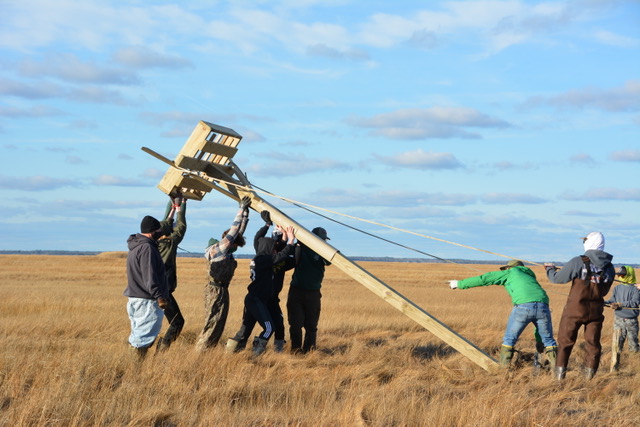
Troop 61 lift an osprey nest platform into place on the coastal saltmarsh. photo by Kathy Agudo.
Humans have played a key role in the recovery and stability of nesting ospreys throughout New Jersey and beyond. Today around 75% of the population, close to 500 pairs, rely on nest platforms designed specifically for them. They provide a stable nest platform, adequate perches, and protection from potential ground predators, aka raccoons. Many platforms are located in very close proximity to people, which make for excellent viewing and educational opportunities. Ospreys are a symbol of a healthy coast and resiliency in a dynamic region.
A ground nest with three young. photo by Ben Wurst
It’s not very common to see ospreys, a large predatory bird, nest on the ground. Despite the rarity of these sightings, it has become more common and acts as a glimpse into the past (and future), before humans dominated the landscape. Today, more and more ospreys are building nests on the ground and snags over water.