Volunteers brave rain and high water to benefit ospreys!
by Ben Wurst, Habitat Program Manager
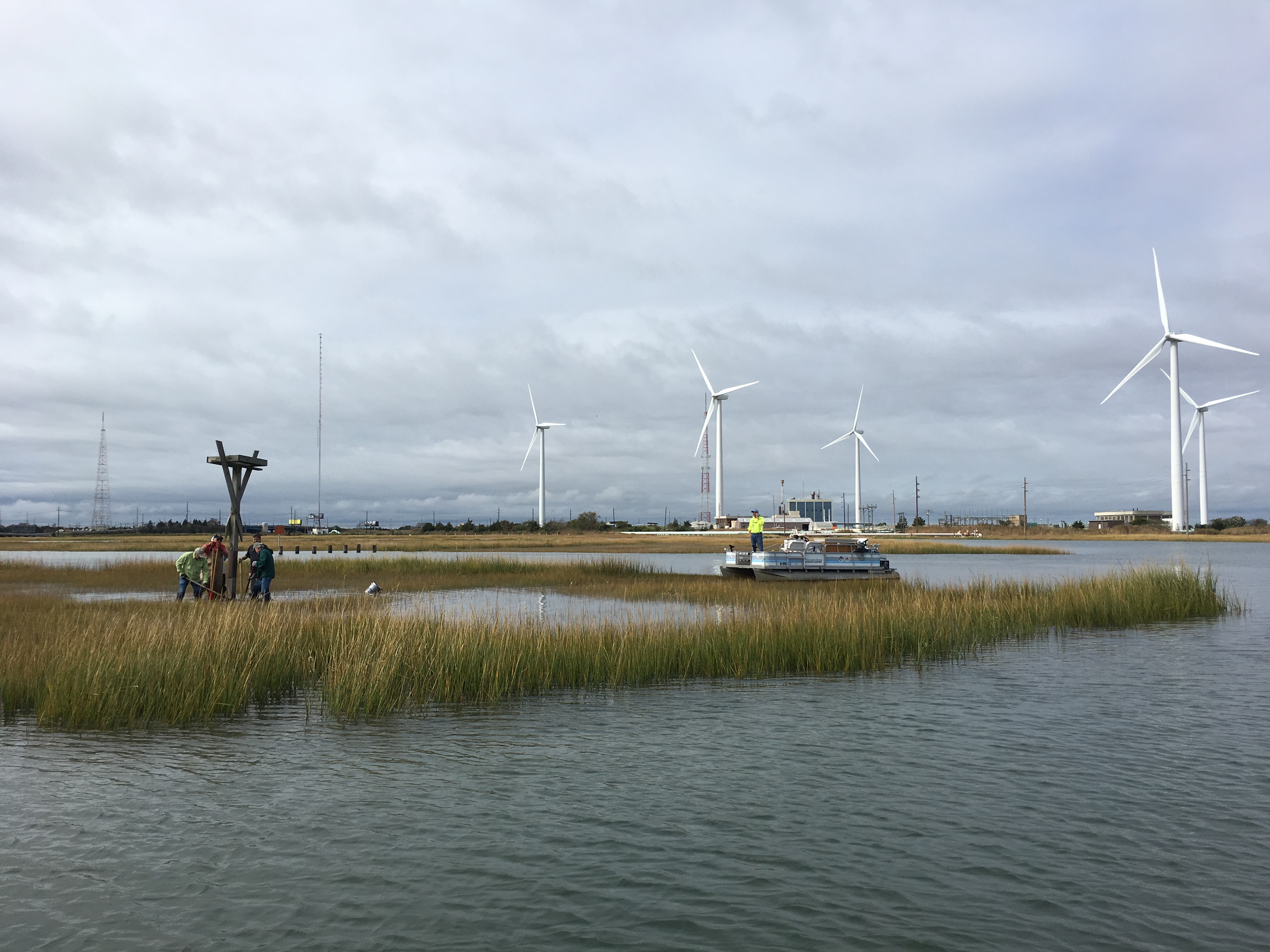
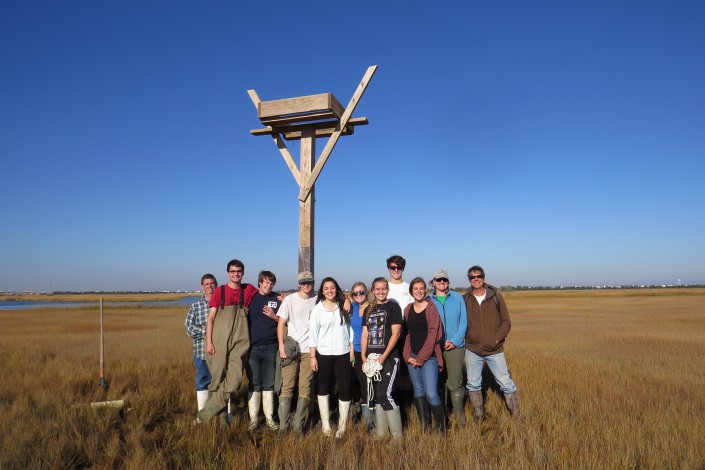
Volunteers work on a flooded saltmarsh to remove an osprey nesting platform in Atlantic City.
I’ve been surveying osprey colony on Absecon Bay since 2008, after I moved to the local area. It’s been an area with a small but slowly growing colony. In 2008 there were a total of 11 active nests. This year there were 23 active nests. Productivity has been good with an average of 1.72 young/active (known-outcome) nest over the past nine years (more than double what’s needed to sustain the population). Many of the nests in this area were installed in 2005 for mitigation for nests that were removed when the ACUA installed large wind turbines off Route 30. But, some platforms that were placed near the turbines, have been slowly abandoned by ospreys. This year only one nest was occupied there and it did not produce any young. Continue reading “Giving Absecon’s ospreys a boost”
Volunteers needed to help maintain and repair osprey nests
by Ben Wurst, Habitat Program Manager
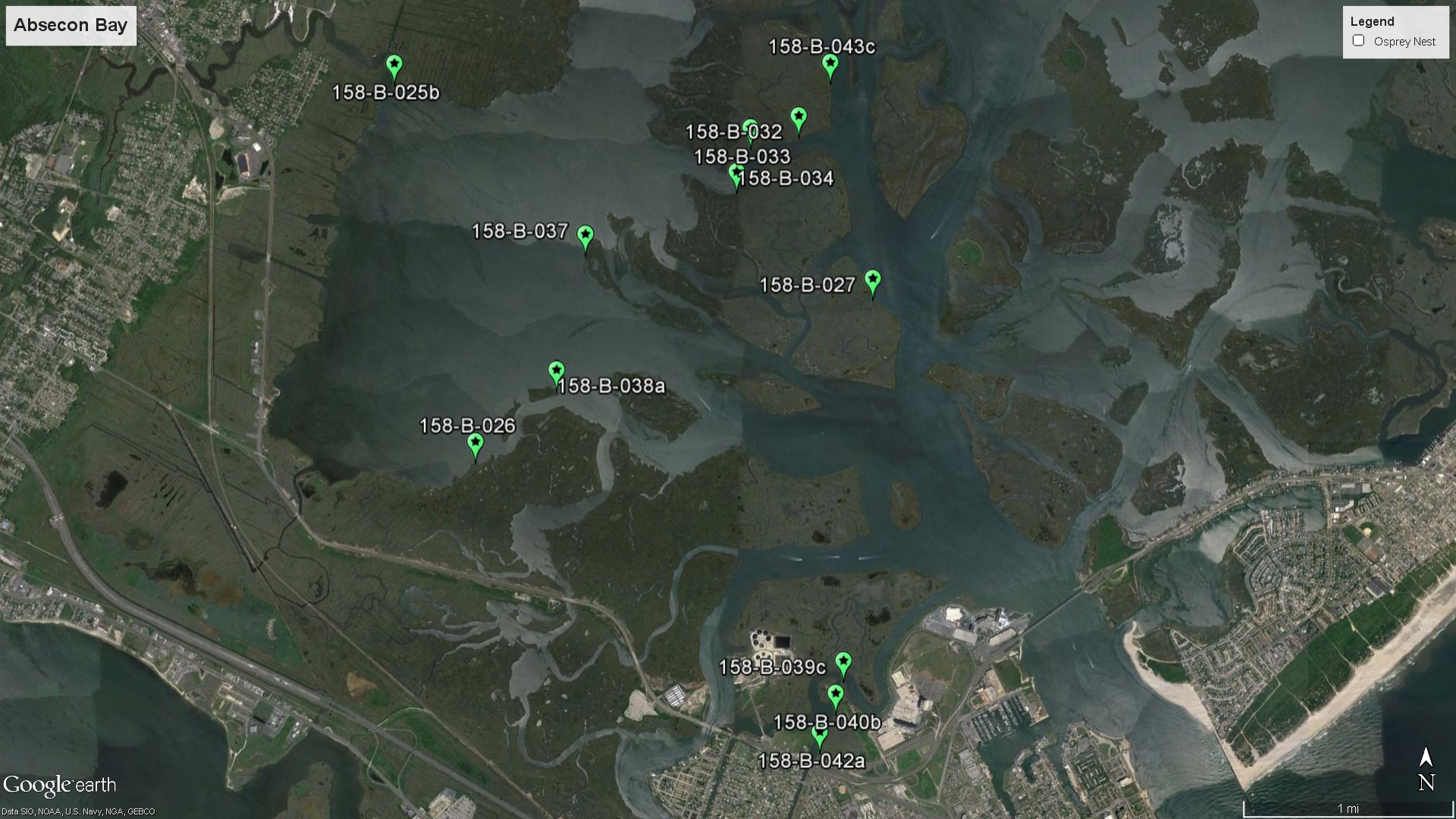
Map of nests that are in need of repairs in Absecon, NJ.
We have an obligation to care for and protect our wildlife, and for me, that’s what drew me into my current position. Osprey nesting platforms have been a focus of my work over the past 10+ years. They are designed specifically for ospreys and if built properly, can withstand the impacts of severe weather, including coastal flooding, high winds, and storm surge. For ospreys these platforms protect their nests from predators and flood tides, but over time the extreme salt marsh environment takes its toll on them. With the added weight of the large, perennial stick nests it can shorten the life span of a properly built platform drastically. Over the years I’ve seen older nests topple, from the weight of the nesting material and aging hardware, during the middle of the nesting season during severe storms. This is hard to prevent at every nest, during every storm, which we know are becoming more and more frequent, but we are adapting and in turn, helping our ospreys become more resilient (and productive) in the end.
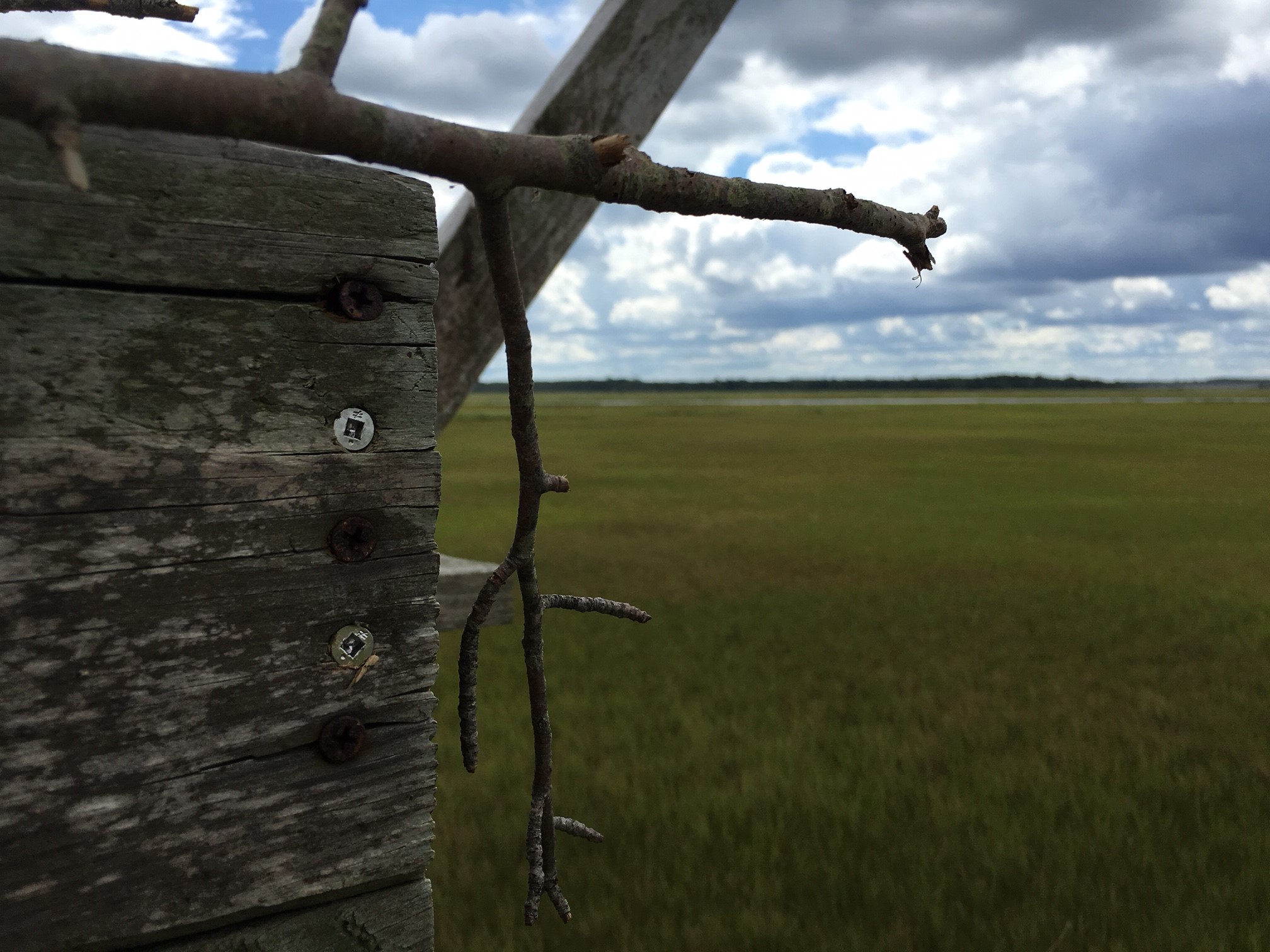
New stainless screws are installed in an existing osprey nest to help prevent future catastrophe.
In the past we (myself and other volunteers who survey ospreys and help maintain platforms) used to visit a nest only once a year, during nesting surveys in late June and early July. At that time we would note the condition of the platform and if repairs were needed, schedule those for the seven month long non-breeding season. Those who have volunteered to help and worked with me, know the task at hand. Most tasks include using hand tools to construct nest platforms and perches and to install them. I always say the hardest part is getting the platform to the saltmarsh where they will be installed.
To help engage and inspire others to help care for our growing osprey population, we are looking for volunteers who live within the watersheds were we are planning to conduct repairs of osprey platforms. Tasks vary by watershed but most are to add new (stainless) screws to existing platforms, install predator guards/perches, clean off excess nesting material, and do any other repairs to platforms (including moving and replacing some). We are hopeful to meet some local baymen and fishermen who are looking to help keep the nesting population stable as it has been over the past 10 years.
The work will occur in mid-late October and will be carried out through these watersheds:
Barnegat Bay (Point Pleasant south to LEHT)
Great Bay – All nests here need new hardware and one nest needs to be replaced.
Absecon Bay – In this area we have four platforms to replace. Three will be moved and one new one installed. Four other nests need critical repairs.
Sea Isle – several nests here need predator guards and a couple need minor repairs.
Wildwood/Cape May – After the strong storms in late June hit this area, many nests need new platform (tops) and others need to be cleaned off.
If you are interested in being notified when these platform construction and repairs occur, please email me. Let me know what you are interested in helping with and if you have a boat (and a ladder!) that can be used.
Loyal Eagle Project Volunteer Contributes to Conservation for over Two Decades
by Dr. Larry Niles, LJ Niles Associates LLC
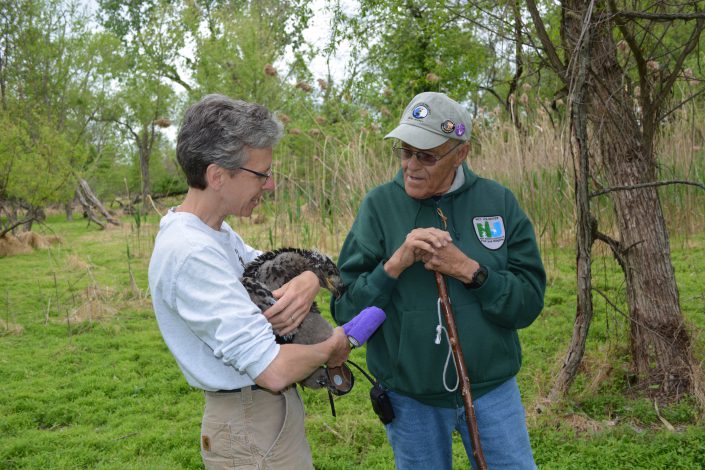
Dr. Erica Miller and Elmer Clegg.
In the early days of the Bald Eagle project, when we really didn’t know whether the species could be restored back to New Jersey, there were a few people that offered their help without reservation to help the birds. Elmer Clegg and his wife Bunny were two and among the most dedicated. Elmer died May 20th at 79 years old. He was a loyal eagle volunteer for more than two decades.
To understand Elmer and Bunny’s contribution its important to remember the circumstances in which the eagles found themselves. The historic population of eagles, about 22 in 1950 but probably much higher in history, had been whittled down to just one unproductive pair by 1981. Biologists at the newly formed Endangered Species Program, including me, worked hard to restore the Delaware Bayshore population with new projects, like hacking young birds into the wild. By the early 2000’s, we had new nests but in places that had not known eagles for decades. In many places they were unwelcome because they thwarted sprawl development or short sighted resource use. They had to be defended, but then we couldn’t afford staff.
Dr. Erica Miller and Elmer and Bunny Clegg.
Into that breach stood Elmer and Bunny and others like them, John and Sheryl Healy and Red and Mary Jane Horner. They were stalwart defenders of wildlife that brooked no insult to the birds by watching the nest throughout the nesting period until the young birds fledged. It was rewarding but difficult work trying to persuade farmers, businessmen, irate suburbanites and many others that the eagles deserved to be where they were. A few times our conservation officers had to step in, or DEP had to drop the regulatory hammer, but mostly it was the calm persuasion of people, like Elmer, who’s true love for these birds spoke convincingly to those against the bird.
Elmer helped me understand that the future of wildlife doesn’t lie in the agencies or their staff, but in the hearts of people who care for wildlife. People like Elmer deserve to return to this earth as the species they loved so much.
Dr. Larry Niles has led conservation efforts for over 30 years.
CWF’s Shorebird Stewards Protect Delaware Bay Shorebirds and Educate the Public
by Larissa Smith, wildlife biologist
Shorebirds at Reed’s Beach Photo by Bob Bocci
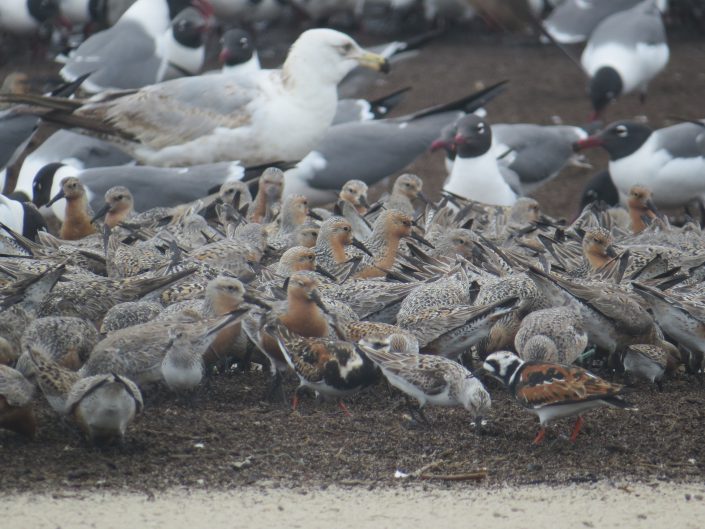
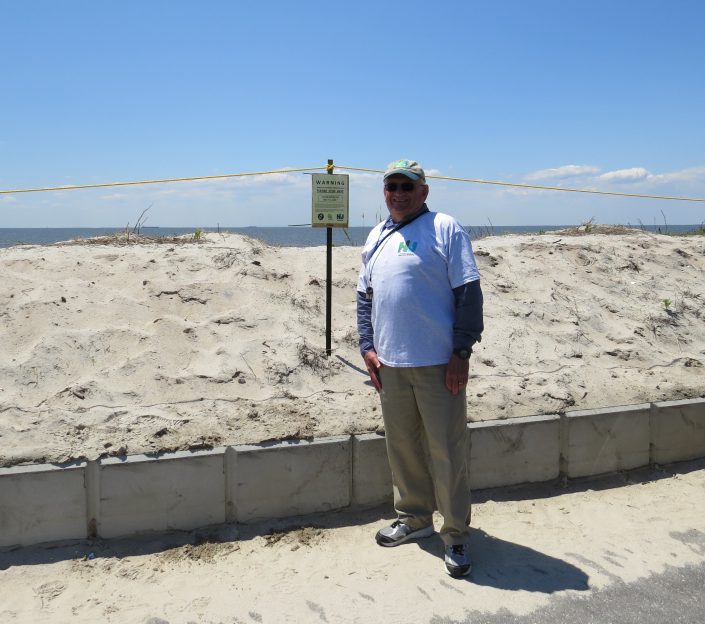
This shorebird season, twenty-one stewards helped to patrol the closed shorebird beaches in Cape May and Cumberland Counties. Stewards not only make sure that no one is entering the closed areas but also educate beach goers about the shorebirds and horseshoe crabs.
Thank you to all Shorebird Stewards!
Steward Bob Bocci at Fortescue Photo by M. TribulskiStewards Dan & Cheryl Alexander at Cook’s Beach
NJDEP’s Barnegat Bay Blitz to Take Place Friday, June 3, 2016
by Lindsay McNamara, Communications Manager
Concerned about the health of the Barnegat Bay ecosystem? Consider participating in a day of action for the Bay! The New Jersey Department of Environmental Protection (DEP) will be hosting its next Barnegat Bay Blitz clean-up day on Friday, June 3.
You can join thousands of volunteers as they fan out across the watershed, which includes all of Ocean County amd parts of Monmouth County, to clean up the Barnegat Bay Watershed and spread awareness about the people pollution impacting the Bay. Clean-up events are happening watershed-wide!
In the middle of Barnegat Bay, there are many small islands called Sedges. These islands are home to a number of species of plants and animals, but unfortunately are impacted by litter that the tide washes in. Volunteers by boat, kayak and standup paddle board will make their way out to many of these islands, including Island Beach State Park, Seaside Heights and Brick to sweep them clean of debris. Get involved!
It’s not just the bayfront communities that impact Barnegat Bay. Communities miles and miles inland also play a role. After all, we are all downstream! That is why at the Barnegat Bay Blitz, volunteers will work to clean up all over the watershed, from inland areas of Plumsted to the barrier islands. In Plumsted, a farming community, volunteers include more than just people! Llamas will also join the crew to help haul out trash and debris that volunteers collect from the Colliers Mills Wildlife Management area. To make friends with llamas, register for the Plumsted clean-up on DEP’s website.
We hope to see you tomorrow, Friday, June 3, for DEP’s next Barnegat Bay Blitz! Here are some of our favorite photos from last year’s event:
Conserve Wildlife Foundation Releases New Amphibian Crossing Story Map
by Kelly Triece, Wildlife Biologist
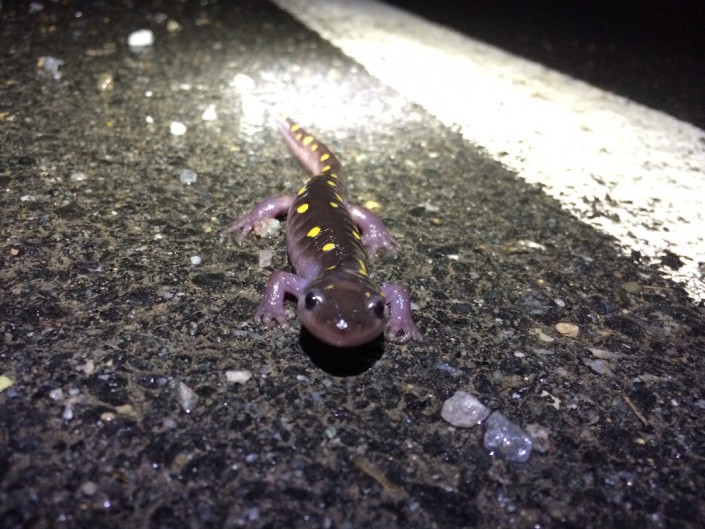
Spotted Salamander Crosses a busy road to reach a nearby breeding pool. Photo by Kelly Triece
Farewell to May — also known as Wetlands Month! As a final ode to Wetlands Month, Conserve Wildlife Foundation would like to share a storyabout a very special wetland! Please check out our latest Story Map: “Connecting Habitat: Waterloo Road.” This story map shares the story about a vernal pool wetland that is located at Waterloo Village History Site in Byram Township, Sussex County, New Jersey.
This vernal pool wetland, as depicted in the Story Map, is a breeding ground for thousands of amphibians. However, each spring these amphibians must cross the heavily trafficked Waterloo Road in order to reach the pool. A single vehicle can crush dozens of the slow-moving animals as they try to cross the road during migration. High enough traffic volumes can wipe out entire populations over time.
Since 2002, Conserve Wildlife Foundation of New Jersey has worked to protect early-spring breeding amphibians like the wood frog, spotted salamander, Jefferson salamander, and spring peeper during their annual migrations through the Amphibian Crossing Project. On peak nights each spring, we work with a fleet of incredible volunteers to hustle amphibians across the road at rescue sites, collect data on the numbers and species seen, measure the impacts of vehicular traffic, and document additional amphibian crossings for future protection.
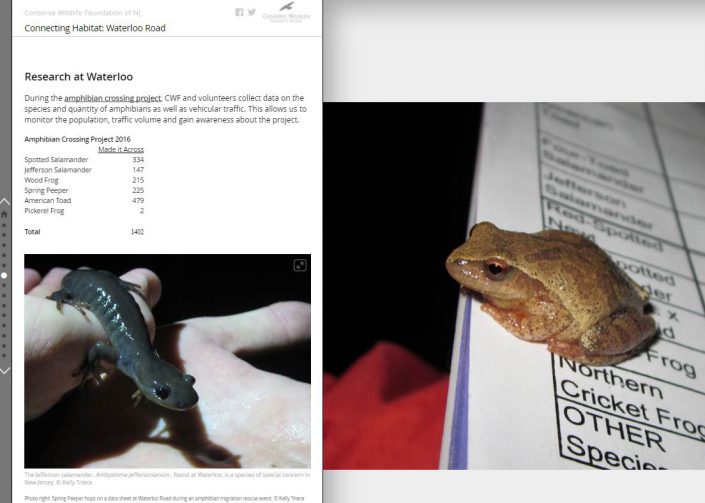
This is our 2016 Waterloo Road Amphibian Crossing Report:
Spotted Salamander: 334
Jefferson Salamander: 147
Wood Frog: 215
Spring Peeper: 255
American Toad: 479
Pickerel Frog: 2
TOTAL Amphibians: 1,432
The Amphibian Crossing Project aims to secure funding for amphibian crossing tunnels at Waterloo Road. This project is part of a larger effort led by the Division of Fish and Wildlife called Connecting Habitat Across New Jersey (CHANJ). CHANJ aims to identify key areas and the actions needed for preserving and restoring habitat connectivity for terrestrial wildlife in New Jersey. CHANJ has the potential to increase the sustainability of New Jersey’s terrestrial wildlife populations and de-list endangered species. #CHANJiscoming #CHANJ
Interested in Helping Amphibians Cross the Road this Spring?
by Kelly Triece, Private Lands Biologist
Spotted Salamander Crosses a busy road to reach a nearby breeding pool. Photo by Kelly Triece
Amphibians, our harbingers of spring, are soon to be calling in the swamps, pools and woodlands of New Jersey. Thousands of salamanders, frogs, and toads make short, stealthy migrations through the forest to breed and lay their eggs in breeding pools every spring.
However, vehicle mortality during amphibian migration season is a big issue for small animals like amphibians. A single vehicle can harm dozens of the slow-moving animals as they try to cross the road during migration. High traffic volumes can wipe out entire populations over time. For Conserve Wildlife Foundation biologists, this means we will be out on the roadways helping secure safe passage for these amphibians.
Since 2002, we have worked to protect early-spring breeding amphibians like the wood frog, spotted salamander, Jefferson salamander, and spring peeper during their annual migrations. Last year at our biggest Amphibian Crossing site, we assisted 2,684 Spring Peepers, 1,100 Spotted Salamanders, 270 American Toads, 139 Wood Frogs, 95 Jefferson Salamanders and 18 Red-spotted newts cross the road!
The Amphibian Crossing Project relies on volunteers like you. Amphibian migration is completely weather-dependent, but usually occurs between March and April, three-five nights a year. We work in evening shifts and scan the road for crossing amphibians, record species, and number of animals crossing.
If you are interested in volunteering with our Amphibian Crossing Project at locations in North Jersey, please contact Kelly Triece. Volunteers must be 18 years or older.
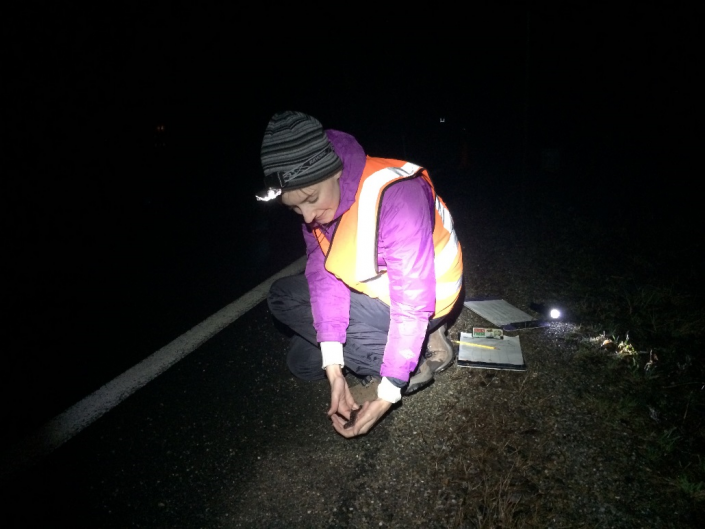
A volunteer assists in CWF Amphibian Crossing Project. Photo by Kelly Triece.
The Amphibian Crossing Project aims to secure funding for amphibian crossing tunnels at two priority sites. This is part of a larger effort led by the Division of Fish and Wildlife called Connecting Habitat Across New Jersey (CHANJ). CHANJ aims to identify key areas and actions needed for preserving and restoring habitat connectivity for terrestrial wildlife in New Jersey. CHANJ has the potential to increase the sustainability of New Jersey’s terrestrial wildlife populations and de-list endangered species. #CHANJiscoming
Stay tuned as the amphibian attempts to cross the road once again!
Biologists and volunteers survey for New Jersey Eastern Tiger Salamanders
by Larissa Smith, biologist/volunteer manager
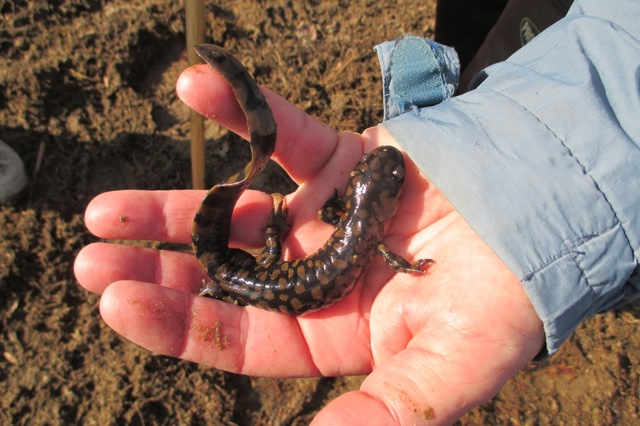
It’s the time of year when Conserve Wildlife Foundation biologists and volunteers along with Endangered and Nongame Species biologists start to survey for New Jersey’s “tigers,” and by tigers I don’t mean the big striped cats, we’re talking about the Eastern Tiger Salamanders. These large mole salamanders spend most of their life burrowed under the ground and in December begin to emerge to migrate to vernal pools and breed. Eastern Tiger Salamanders are endangered in New Jersey and only found in 15 pools in the most southern part of the state.
Last week dedicated volunteers Wayne Russell, John King and myself went out to check on a few known breeding pools. The water level in the ponds was lower than usual due to the lack of rain, but John found an adult male in one of the pools.
Tiger Salamander found 12/9/15 Photo by W. Russell
We were delighted to find a male in the pool so early in December. At another known breeding pool we found the partial remains of two Eastern Tiger Salamanders that had obviously been eaten by a predator. But the good news was that we also found two tiger salamander egg masses in the same pool.
Predation is just one of the challenges that these salamanders face. Tiger Salamanders themselves are targeted by collectors for the pet trade which is why their breeding locations are kept a secret. Their habitat is declining due to habitat loss and fragmentation, development, pollution, changes in hydrology, and climate change.
Volunteers and Students from Cape May County Technical School
One lucky pair of ospreys received a brand new nesting platform due to the effort of volunteers and students from the Cape May County Technical School! Dedicated osprey project volunteer Matt Tribulski reached out to CMC Tech Natural Science teacher Hanna Toft, regarding replacement of an aging platform in the Avalon back bay. Hanna is an osprey project volunteer and bander and incorporates the osprey project into her curriculum. The nest that was replaced was an old four poster that was unstable and not predator proof. The nest was located at the edge of the water causing the birds to get off the nest every time a boat or jet ski went by (which in the summer is quite frequently).
Hanna had a platform available that her students had built last year. We couldn’t have picked a better day for the install, the weather was gorgeous and warm for November. We met Hanna and eight of her students out on the water. The new platform was placed further back from the water and has a predator guard. The students removed the old platform, leaving some posts for the ospreys to perch.
We hope that the birds like their new home when they return in the spring.
Thank you to Matt, Hanna and her students for all of their help!