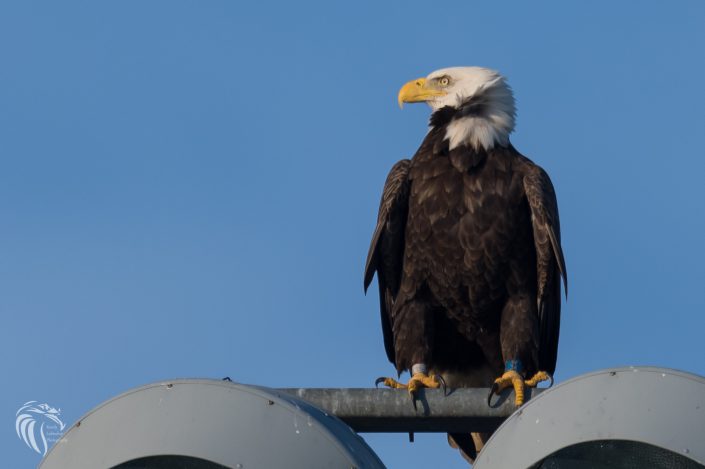
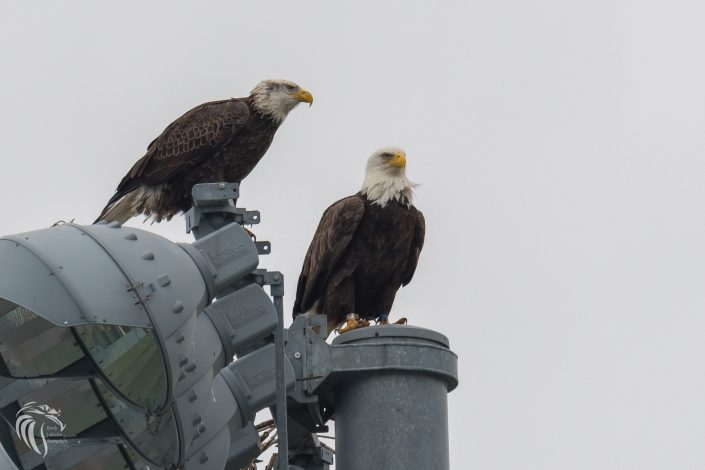
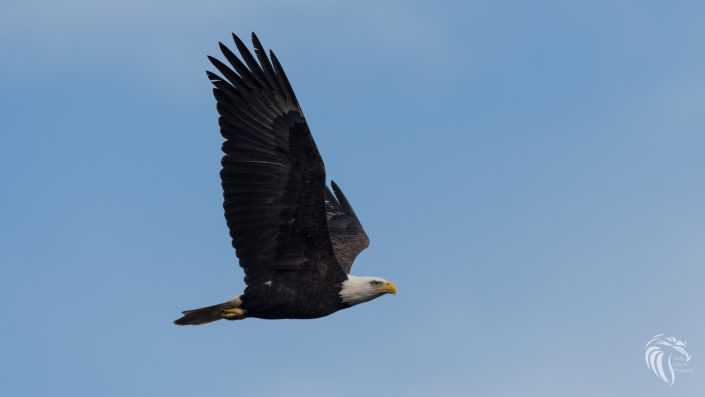
In the end of October, NJ Eagle Project volunteer Randy Lubischer spotted a banded adult bald eagle near his home in Monmouth County. He was able take good photos that showed the bird was banded with a blue (NY) band on the left leg and was able to get a very clear image of the letter and number code on the band. We reached out to the NY Division of Fish, Wildlife and Marine Resources to find out more information on the eagle.
In the fall of 2011, an injured hatch year bird was found on the side of the road in Onondaga County, NY. The bird was rehabbed, banded (NY Blue band W34) and released on October 7, 2011 at the Montezuma NWR. On 11/18/2016, W34 was sighted in Darlington, Maryland and then in in NE Maryland again on 3/1/2017.
W34& mate 11/7/17@Randy Lubischer
W34 looks to be staying in NJ to nest as he has found a mate, a sub-adult female, who still has dark feathers on her head. They have started to build a nest and have been copulating.
We can’t necessarily assume that W34 was hatched in NY. Since he was found injured and not banded he could well be a NJ bird. We have followed NJ recent fledges outfitted with transmitters, take long flights north after leaving their nest areas. We also know that many NJ banded eagles do return to NJ to nest. So we’ll never know the true origin of W34 but we can piece together some of his story and hopefully have more news about him and his mate in the upcoming nesting season.
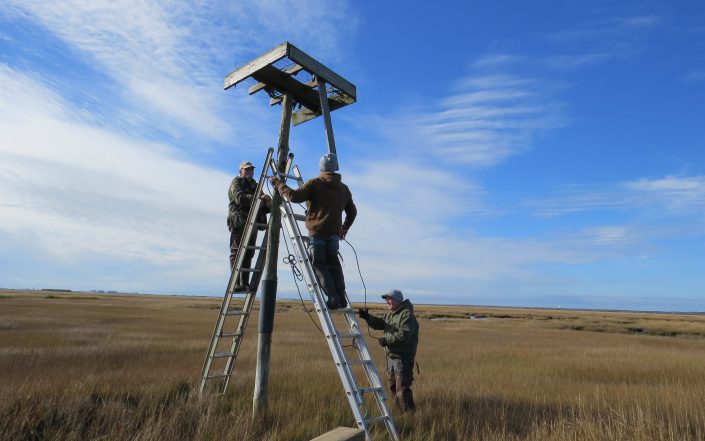
NJ Osprey Project Volunteers Wayne Russell, Matt Tribulski and John King repair an osprey platform.
New Jersey ospreys have headed for warmer climates until their return in the spring. NJ osprey project volunteers are busy repairing and cleaning out nests, adding predator guards and perches in preparation for the nesting season. It’s an endless job as there are 100’s of nesting platforms throughout the state and maintenance is always needed. These repairs keep the nests as safe as possible for the nesting ospreys.
Former Gov. Kean delivers stirring keynote speech before 200 people at Duke Farms event
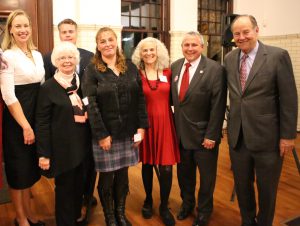
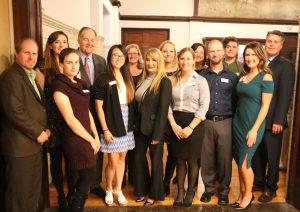
Kelly Mooij, Jeannie Geremia, CWF Executive Director David Wheeler, Hazel England, Amy S. Greene, Honorable Kip Bateman, and Honorable Tom Kean.
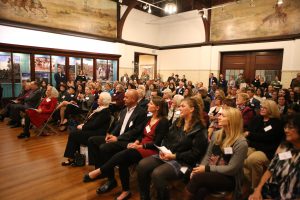
Hillsborough, NJ – The nonprofit Conserve Wildlife Foundation of New Jersey (CWF) celebrated their 12th annual Women & Wildlife Awards on November 1 before over 200 people at Duke Farms in Hillsborough, New Jersey.
The 2017 honorees include Hazel England of the Great Swamp Watershed Association, Jeannie Geremia of the Garden Club of New Jersey, Kelly Mooij of New Jersey Audubon, and Kris Schantz of the New Jersey Endangered and Nongame Species Program.
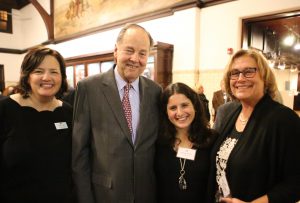
CWF Development Director Liz Silvernail, The Honorable Tom Kean, Yasmine Pessar from Dewberry, and Betty Ann Kelly from Union County Dept. of Parks and Recreation.
“Tonight we are recognizing four great women who have accomplished wonderful things and who have worked in their own way to make this world and this state a better place,” said former New Jersey Governor Tom Kean in his keynote speech. “They have worked to do what is necessary to make sure that when we pass this planet down to our children and our grandchildren, it is not worse than what we received. These four women show us what great things an individual can do for all of us.”
Since 2006, CWF’s Women & Wildlife Awards have recognized special individuals for their achievements on behalf of New Jersey’s wildlife and the advances they have made in professions in which women have long been underrepresented.
“All too often, young girls are turned away from promising careers in the STEM fields – Science, Technology, Engineering, and Mathematics,” said David Wheeler, CWF Executive Director. “Yet here in New Jersey, wildlife conservation efforts benefit from a strong and inspiring core of female scientists, educators, advocates, researchers, and rehabilitators who serve as role models for the next generation. Thanks to our Women & Wildlife honorees, today’s young girls can feel confident in pursuing science and conservation as careers with limitless and exciting possibilities.”
Hazel England, Great Swamp Watershed Association Director of Outreachand Education, was honored for bringing environmental education programs about our local ecosystems and habitats to students and teachers of all ages.
“I am honored to have received the Educator Women & Wildlife Award from Conserve Wildlife Foundation. It was truly humbling to be in the company of such inspirational women who are working in the field of conservation,” said England. “I’m thrilled that my two daughters got to experience this event with me; learning about the great work these other remarkable women are doing, and gaining some very direct political insight from Governor Tom Kean. It was a real privilege to hear him speak and a highlight of the night for me.”
Jeannie Geremia, Great Swamp Watershed Association Director of Outreachand Education, was honored for bringing environmental education programs about our local ecosystems and habitats to students and teachers of all ages.
Service honoree Jeannie Geremia with friends and family.
“Receiving the Conserve Wildlife Foundation’s Women in Wildlife 2017 Award for Service is one of the highlights of my life and I am humbled by the august company of outstanding women who were similarly honored,” said Geremia. “Nature is our passion and working to ensure that our imperiled wildlife species, including our pollinators, survive and thrive is the common goal. Joining dedicated individuals and organizations in a united effort of educating and inspiring people to action will accomplish these mutual goals of a healthy environment for all living creatures. Governor Kean said it all so eloquently as he invoked the spirits of Rachel Carson and Helen Fenske in his heartfelt keynote speech, setting the tone for this memorable event.”
State Senator Kip Bateman presented Jeannie Geremia with her award.
“Jeannie, you really have dedicated your life to making a difference, and it’s so important what you’ve done,” said Senator Bateman. “It’s a real pleasure to be here to honor four outstanding women who have truly made a difference in New Jersey. Each of you is so deserving of this award.”
Kelly Mooij, New Jersey Audubon Vice President of Government Relations, was honored for her strong leadership on a number of successful watershed protection, open space preservation, and wildlife funding campaigns.
“I’m honored to have received this recognition from the Conserve Wildlife Foundation, a wonderful partner in protecting our amazing wildlife throughout the State,” said Mooij. “Educating decision-makers and supporting science-based policy is one of the most effective and efficient ways to protect wildlife and preserve habitat and I’ve been so fortunate in my career to be able to work with amazing non-profit colleagues and to use the powerful tool of advocacy to make NJ a better place for people and wildlife.”
Kris Schantz, principal zoologist with the New Jersey Department of Environmental Protection’s Endangered and Nongame Species Program, was honored for her work protecting the endangered timber rattlesnake and other at-risk reptiles.
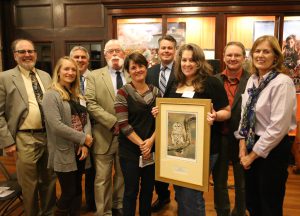
Inspiration honoree Kris Schantz with NJDEP supporters with CWF Executive Director David Wheeler.
“I am truly honored to have received this award from the Conserve Wildlife Foundation, as there are so many deserving women doing invaluable conservation work within New Jersey,” said Schantz. “We must all – women, men, children – continue to strive to make NJ a better place for our citizens and future generations through the protection and nurturing of our natural resources.”
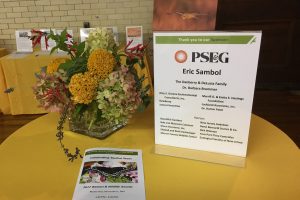
Event sponsors included PSE&G, Eric Sambol, The Danberry and DeLucia Family, Dr. Barbara Brummer, Dewberry, James Fiorentino, Amy S. Greene Environmental Consultants, Inc., Lackland Associates, Inc., Merrill G. & Emita E. Hastings Foundation, Dr. Kumar Patel.
Patrons included Bountiful Gardens, Bob and Maureen Coleman, Glenn Insurance, Inc., Elwood and Ruth Kerkeslager, Mercer County Wildlife Center, New Jersey Audubon, Renzi Bernardi Suarez & Co., Rick Weiman, Your Part-Time Controlled, and Zoological Society of New Jersey.
Conserve Wildlife Foundation staff with former New Jersey Governor Tom Kean.
Hazel England has spent 24 years as an enthusiastic environmental educator and naturalist in New Jersey, bringing education programs about our local ecosystems and habitats to students and teachers of all ages. Since 2004, Ms. England has led educational and stewardship programs at the Great Swamp Watershed Association as the Director of Outreach and Education. She is a state-certified facilitator for many nationally acclaimed environmental education curriculums, including Project WILD, WET, WOW, PLT HWHP, and Bridges to the Natural World.
Ms. England has a Bachelor of Science in Zoology and Botany from the University of Dundee, as well as a Master’s degree in Ecology and Environmental Management from the University of Aberdeen in Scotland. She sets an excellent model for other women to follow by being an accomplished natural scientist who brings her passion to life for people of all ages.
JEANNIE GEREMIA: SERVICE
For the past decade as the Vice President for the Garden Club of New Jersey, Jeannie Geremia has followed her passion for protecting pollinators by leading, inspiring, and educating others on the importance of pollination and wildlife habitat gardens. Ms. Geremia championed the designation of the Black Swallowtail Butterfly as the New Jersey State Butterfly. Her action earned her recognition from both the New Jersey Senate and the General Assembly.
Ms. Geremia created attractive Pollinator Education Signs that are displayed statewide at local plant nurseries, horticulture garden visitor centers, and a variety of education centers. She has also created and presented over 75 Pollinator Education programs, and has written 89 articles – and counting – for Gardener News on wildlife preservation, conservation, and growing our decimated pollinator population.
KELLY MOOIJ: LEADERSHIP
Since 2008, Kelly Mooij has dedicated herself to utilizing the tools of law, policy, and government affairs to protect our state’s wildlife as Vice President of Government Relations at the NJ Audubon.
Ms. Mooij helped lead the formation of the multi-state Coalition for the Delaware River Watershed to protect the watershed that provides drinking water for 16 million people and support hundreds of miles of vital fish and wildlife habitat. In coordinating the Keep It Green Coalition for open space preservation, Ms. Mooij helped lead the passage of two state-wide bond measures totaling $600 million dollars. The 2014 permanent source of open space funding will bring $1 billion to the state every ten years.
Ms. Mooij also leads the annual lobbying efforts of New Jersey’s environmental organizations for the State and Tribal Wildlife Grant Program, which provide an average of $1 million dollars in federal grant funds to state fish and wildlife agencies. Ms. Mooij earned her Juris Doctorate and Master of Studies in Environmental Law, focusing on marine biodiversity and land and water use issues.
KRIS SCHANTZ: INSPIRATION
Kris Schantz works with one of New Jersey’s most underappreciated and persecuted species: the timber rattlesnake. Ms. Schantz developed the Venomous Snake Response team of volunteers and professionals in law enforcement, animal control, and parks management who safely remove venomous snakes from areas where they pose a risk – while also protecting these endangered reptiles.
Her field studies have expanded to include other vulnerable snake species, such as the corn snake, northern pine snake, and scarlet snake. Ms. Schantz has also led the development of the department’s Wildlife Action Plan, transforming and bettering the wildlife conservation agency’s work. She earned her Masters of Science degree from Rutgers University. Ms. Schantz has gained the deep respect of the nearly everyone who works with imperiled snakes in New Jersey, and she serves as an example of passion, enthusiasm, and commitment in her field.
A new pollinator habitat is created in Middle Township
By: Larissa Smith; CWF Wildlife Biologist
The Middle Township Environmental Commission in cooperation with the Conserve Wildlife Foundation of NJ worked to create a pollinator habitat at a recreation site in the township which is located in Cape May County. Commission members had been working to obtain permission to plant a pollinator garden on a township site. The Ockie Wisting Recreation Complex was just officially opened in the end of October. This recreation site will have playing fields, a playground and a wooded trail that leads to a lake and fishing pier.
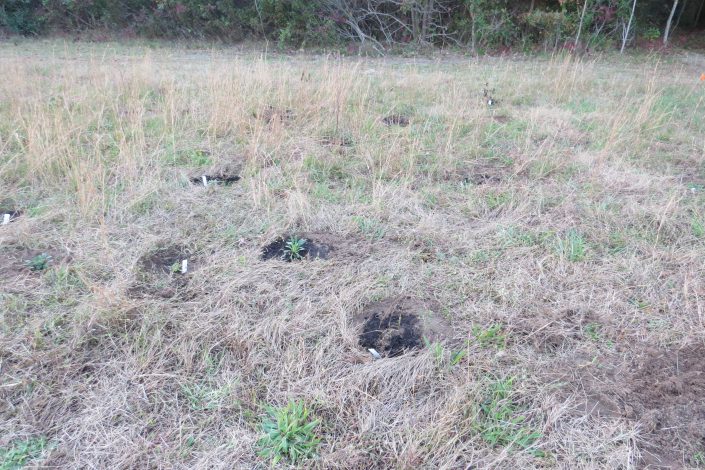
With funding from Atlantic City Electric volunteers with the Middle Township Environmental Commission and Conserve Wildlife Foundation of NJ planted 138 native perennials . While it doesn’t look like much right now, come next spring and summer there will be plants for bees, butterflies and birds to use for food and habitat. Not only will this pollinator meadow be great for wildlife, it won’t have to be mowed. The Environmental Commission will be in charge of maintenance and plans another work day in the spring to remove any non-native plants and trees in the area. We also plan to use this site as a demonstration garden for others interested in planting for pollinators.
Ockie Wisting Pollinator Habitat: List of Plantings – Fall 2017
I would like to take the time to share a noteworthy event from last week, as well as highlight a CWF volunteer who deserves recognition for his dedication to wildlife. CWF received a call last Friday from a concerned citizen about an osprey chick that had fallen from its nest in Avalon. Osprey chicks are extremely vulnerable to summer storms, and are often blown right from their nests in strong winds. The storm that pushed through the area Thursday night had likely blown this chick out of its nest onto the marsh below. This particular nest had just been surveyed on July 6 and had contained three young chicks.
osprey chick down on marsh after severe storms
Often when staff members are not available to respond to calls like this, we rely on our volunteers to represent us. In this case, when CWF volunteer John King got the call, he hooked up his boat and immediately headed out to assess the situation in hopes of making a rescue. When he arrived on the scene, John realized that there were actually three osprey chicks on the ground below the nest; however, two of them were unfortunately already deceased. The parents were also sitting on the ground with the one surviving chick when he arrived. John picked up the chick and examined it for injuries. When he determined it was in good condition, he carried it up a ladder and placed it back into the nest as the parents circled and screamed above him. As he left the site, the parents immediately returned to the nest to check on their chick.
Osprey chick returned to the safety of it’s nest
Even though John was only able to save one of the three chicks, this was still a success story that would not have been possible without the help of a devoted volunteer. The concerned citizens who had called in the emergency watched the whole rescue from across the lagoon and reported back the following day that the chick was sitting up in the nest looking healthy. CWF also greatly appreciates citizens who care enough to observe wildlife responsibly and report wildlife emergencies when necessary.
Adult returns to nesting platform after chick is safely returned to nest.
John King has been volunteering for CWF for many years and has worked on several projects including the Calling Amphibian Project, NJ Tiger Salamander project and the NJ eagle project. He has been very involved with the NJ osprey project, headed by CWF’s Ben Wurst, assisting with osprey surveys during the breeding season and helping to construct and erect nest platforms over the winter. In addition to CWF, John also volunteers with many other conservation organizations and is always happy to lend a hand. Although he is retired, his volunteer work is practically a full time job. I sincerely admire John’s continued enthusiasm and his dedication to wildlife, and I believe the world would be a better place if there were more people like him.
Conserve Wildlife Foundation of NJ thanks you, John!
Thousands of volunteers, many of them students, are joining the New Jersey Department of Environmental Protection (NJDEP) this Wednesday, June 7, for the eighth annual Barnegat Bay Blitz, a day-long cleanup that draws attention to efforts to protect and enhance the bay and its watershed.
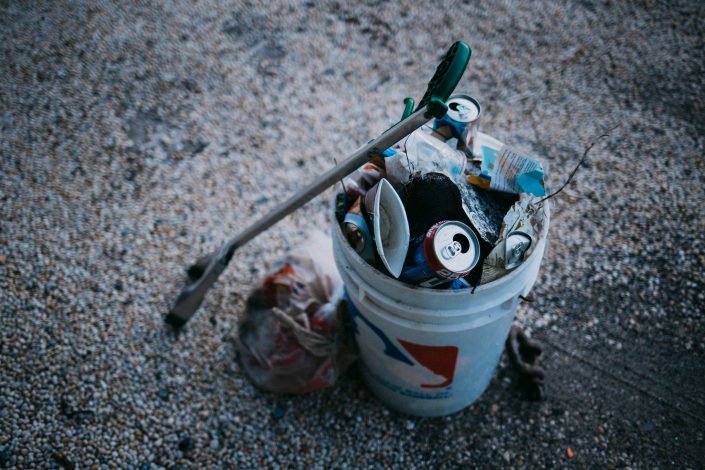
The Blitz highlights the focus of the NJDEP and many organizations to clean up and restore the Barnegat Bay Watershed by enhancing public awareness and stewardship of this natural resource. On Blitz day, thousands of volunteers will work to clear litter, storm debris, and illegal dumpsites from the waterways and land of the bay’s 660-square-mile watershed, which spans all or parts of 37 municipalities in Ocean and Monmouth Counties.
Conserve Wildlife Foundation of New Jersey is one of the event’s long-time sponsors, along with the NJDEP, New Jersey Clean Communities, the New Jersey Environmental Infrastructure Trust, Wawa, Waste Management, TowBoat US, the U.S. Geological Survey, New Jersey Natural Gas, Rowbear, Ocean Spray, Suez-United Water; Ocean County government, PS&S, Firestone, ReClam the Bay, AmeriCorps Watershed Ambassadors, the Barnegat Bay Partnership and the U.S. Coast Guard.
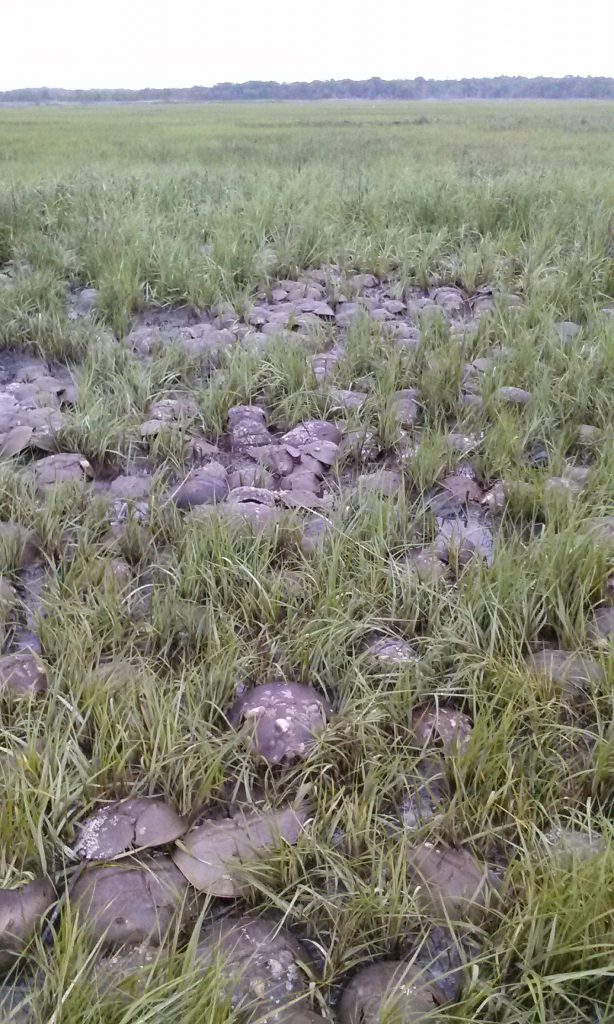
Higher than usual tides last week caused an extraordinary stranding event of Horseshoe crabs all along the Delaware Bay. From Fortesque Cumberland County to beaches in Cape May County horseshoe crabs were washed up into the marshes, tidal flats, roads and other areas where they were unable to get back out to the water. ReTurn the Favor coordinators jumped into action and after an initial survey of the strandings organized rescues at the various beaches. On Saturday a team met at Pierce’s Point at sunset so as not to disturb feeding shorebirds. The group was made up of ReTurn the Favor coordinators from the Wetlands Institute and volunteers including CWF staff. The group was able to move ~3,000 crabs back to the water in a few hours. Over the next few days, rescue efforts continued at Pierce’s Point and other beaches. Allison Anholt from the Wetlands Institute reports that 7,900 crabs total were rescued at Pierce’s Point. Thousands of more crabs were rescued at other beaches over the weekend, due to the dedication and help from the various groups and wonderful volunteers involved.
Efforts like this show that caring, dedicated people can make a difference. Thanks to all involved!
Horseshoe Crabs stranded in marsh behind Pierce’s Point beach 5/27/17
This year marks the 21st year of the Delaware Bay Shorebird Project. As one of the longest running shorebird projects in the world, the only one of its kind in the US, we wanted to memorialize this monumental work. To do so we convened a daylong series of presentations by scientists and managers from all over the world who have worked on the bay. Here are the abstracts. They are worth a look by nearly anyone interested in shorebirds and Delaware Bay.
The participants of the workshop on 20 years of conservation and research on Delaware Bay.
The presentations ranged widely. We heard talks diving deep into the science of shorebird ecology, like Phil Atkinson’s talk on the use of isotopes of carbon and nitrogen locked in feather samples and what they tell us about where knots spend the winter. Or Paul Smith’s talk on how modeled estimates of shorebird numbers compare to numbers counted from an airplane. On the other side of our scientific work were talks like Laura Chamberlin’s describing the role volunteers play in saving stranded horseshoe crabs rolled over by heavy seas or impinged in concrete rubble and derelict wooden bulkheads. In between were talks like those by David Stallneckt on the role of shorebirds in the transmission of flu viruses and how that knowledge might prevent the next pandemic of flu in people.
I liked Joe Smith’s talk on the restoration of Delaware Bay beaches and Ron Porter’s talk on the movement of shorebird tracked by tiny devices called geolocators.
Altogether they spoke loudly of the 20 years of intense study and conservation by our devoted team of scientists, managers and volunteers. In those 20 years of conservation of Delaware Bay we learned basics of protecting any place loved by people who love wildlife.
Dollars on the Beach
As with many places in this divided country of ours, and in many places in the world, we have witnessed on Delaware Bay a sad and wholly preventable natural resource tragedy. It’s now 20 years since the Atlantic Coast fishing industry nearly decimated the horseshoe crabs of Delaware Bay. They didn’t aim to do this of course, but as with any tragedy of the commons, once the crabs gained value as a bait, everyone wanted their share before it was lost. They hauled away millions of crabs, no one really caring about the consequence to the bay or the wildlife that depended on the crabs. It was a race to the bottom, that would not have been stopped if it weren’t for the scientists and managers that stood up to the industry, many of which gave presentations in our workshop.
Shorebirds feeding on eggs while crabs spawn.
The battle gave us several important lessons.
The first revolves around the value of the bay, the crabs and the shorebirds. We biologists, managers and public outreach people often see the natural value of this ecosystem in terms of its meaning to us. We are inspired by the knot’s magnificent journey covering 10,000 miles, often flying 6 days continuously. We are awed by the natural system that responds to change much as our own body fights for life against all the many abuses we cause or suffer. But we often miss the real value. During my time on the bay we have defended this valuable natural resource from many assaults, the winner take all crab harvest, the greedy exploitation of crab blood by medical companies, the overreach of aquaculturists plotting out the use of intertidal zones without regard to impact. Underpinning each of these threats is not esoteric value, but real wealth.
I once had a conversation with Rob Winkle, before he retired as Chief of Law Enforcement for NJ Division of Fish and Wildlife. He said “Larry you’ll never be able to protect these crabs, because to many people, they are dollars on the beach”. In other words, natural wealth is wealth, pure and simple. The question is – do we protect this wealth for our children and grandchildren to make up their own minds about how to spend it?
Protection Requires a Relationship
The real value of natural resources speaks to the second lesson. Protection is not only an action composed research, monitoring and management, it is also a long-term relationship with a place. Those of us working on the bay for 20 years know this very well. The abstracts speak to the relationship and our continuing efforts to understand and improve, to rebuild what was lost, to anticipate what comes next. If in 1997 we started work in the bay to publish a few papers and move on to the next interesting place, the battle to save this vital shorebird stopover and horseshoe crab spawning area would have been lost. The dollars crawling up on the bay beaches means protection doesn’t end with fighting one short-sighted greedy use, because there will be an inevitable successor. It takes a long-term relationship to develop protection and keep it vital and active.
I learned this many times in my career, most recently from my good friend David Santos now a professor at the University of Belem in northern Brazil. We have been doing work in the northern coast, a major wintering areas for Arctic nesting shorebirds. After a passionate discussion on how to best bring greater protection of the area he said “you come here for a few weeks and think you can save this place”. He was right, the truth is we can only help if we commit to work in northern Brazil for enough time to get it right.
And this is my final lesson. There is no easy way to develop a long-term effort to prevent the inevitable series of short sighted use of a natural resource without the help of the people who care.
Clive Minton on Delaware Bay.
When Clive Minton and Humphrey Sitters first came to the bay to start the project that is now 20 years old, I was awed by their experience, skill and knowledge. I thought why are they doing this? Neither were being paid only supported to do the work. I was employed as the Chief of NJ Fish and Wildlife’s Endangered Species Program. Now I know, it is only because they care. They are fascinated by the bird’s natural history, they publish scientific papers on the subject but they come year after year because they care.
There’s more to this than just tree-hugging emotionalism. In the US, we have gradually professionalized conservation, ensuring only paid staff do the work with only minor roles for users. It’s an entirely credible position in times of flush budgets. Its pitfall becomes obvious in the age of Trump, years of budget cuts and increasing influence of resource industries dismantle that achieved in the good years. Overall it ends with natural resources declining in nearly every section of the country.
Clive and Humphrey, come from England and Australia where conservation depends heavily on volunteers. It’s a pastime to research, monitor and conserve birds, not necessarily something that pays. For example, the Royal Society for the Protection of Birds (RSPB) has over a million members, but over 18000 volunteers working at 200 preserves and only 1300 staff. Remember this is in a country that has a population of 53 million. By contrast in the US with a population of over 300 million National Audubon Society half the number of members and staff and nearly the same budget.
In our experience these numbers don’t speak to the reality of how people actually feel in the US, or at least hear on the bay. We can say without reservation that the research, monitoring and conservation on the bay depends on the dedication of many volunteers taking part in our work. We literally could not do the work without their help.
John, upper right in red shirt, is a volunteer steward protecting beach important to Delaware Bay shorebirds. This is he first year. Next to him is Humphrey Sitters, the editor of Wader Study, an international technical journal on shorebirds and a highly trained expert on shorebirds. He has worked on Delaware Bay as a volunteer scientist for 20 years. It is the work of these two and many others that makes the protection of Delaware Bay a success.
And so, this is the final lesson. The best way to overcome this cycle caused by the relentless exploitation of the bay’s natural wealth is building a team of people devoted to it study and conservation. This involves the many professionals who care enough to maintain a focus through the ebb and flow and agency prerogatives, a team of retired professionals and young adults seeking experience for their nascent careers and just as importantly as many people who care enough to put time into the yearly care of this valuable natural systems.
Dr. Larry Niles has led efforts to protect red knots and horseshoe crabs for over 30 years.
Volunteers Survey For This Rare and Elusive NJ Salamander.
by: Larissa Smith, CWF Wildlife Biologist
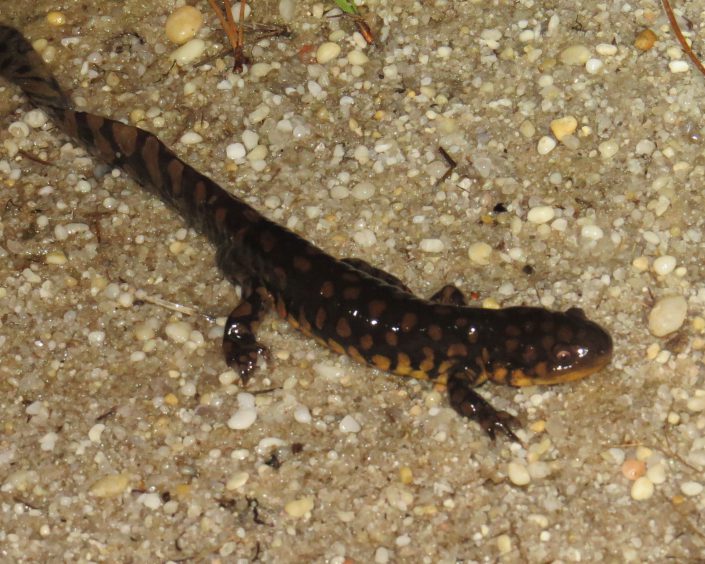
Adult Tiger Salamander @ M. Tribulski
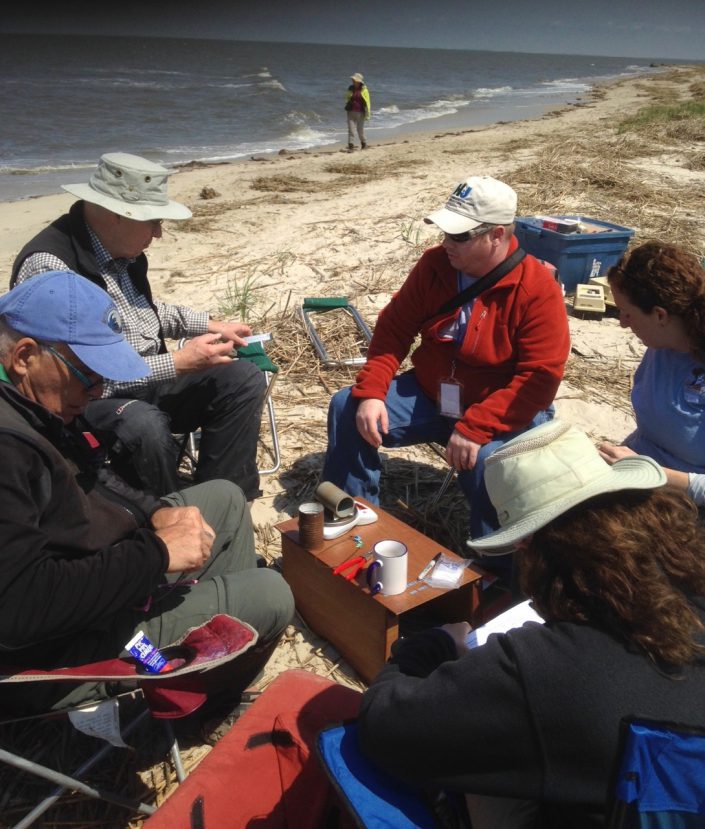
On a cold December evening I met up with ENSP biologists and dedicated Tiger Salamander project volunteers to survey for Eastern Tiger Salamanders. The group had been out surveying all day in Atlantic County without spotting any tiger salamanders and were cold but still raring to go. The pool we surveyed has been a successful tiger salamander breeding pool, within a complex of enhanced vernal pools. We weren’t disappointed as we quickly found adult salamanders in the pool and egg masses.
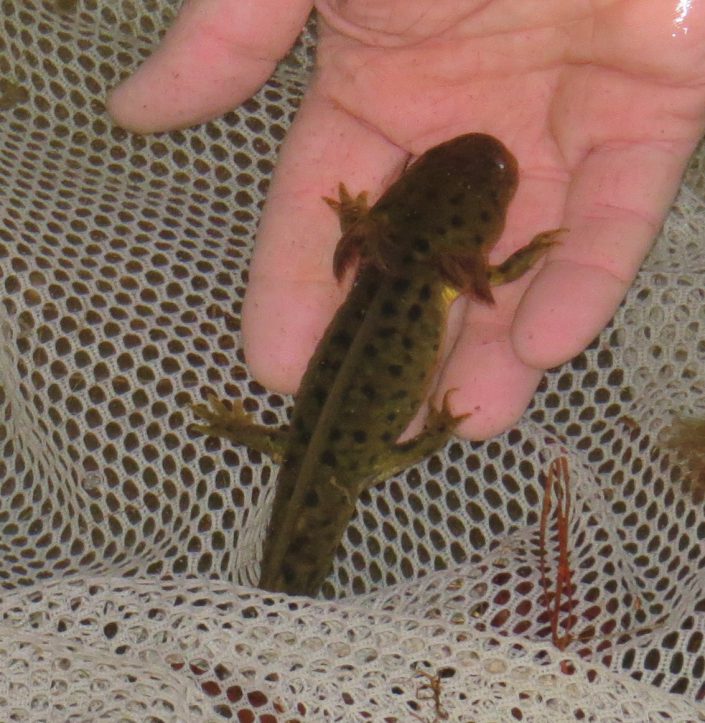
Another great find was a neotenic (gilled adult). This was a larvae, most likely, from last season that didn’t metamorphose and still had external gills. It had not yet left the pool, whereas most larvae metamorphose and leave the pools in June to July of their hatching year.
Neotenic adult @ M. TribulskiSurveying for TS@ M. Tribulski
We surveyed a second pool in the complex, but found no sign of adults or egg masses. We found fish in the pool, which is an indicator that there won’t be salamanders since the fish eat the eggs and larvae.
New Tiger Salamander breeding pools have been found by the TS volunteers, in Cape May and Cumberland Counties. It is encouraging to know that these salamanders continue to live and breed in New Jersey and that gives me hope for the future of all NJ wildlife.