NJ Advance Media reporter Michael Sol Warren highlighted 17 endangered species in an insightful story looking at what can be done to save New Jersey’s rare wildlife. Conserve Wildlife Foundation has long focused on many of these species – from the piping plover and the bobcat to the bog turtle and the Pine Barrens tree frog – through monitoring and surveys, habitat restoration, and public engagement.
Many piping plover and American oystercatcher pairs have been busy laying their eggs over the last few weeks. As beach nesting bird biologists, we invest a lot of time into every pair at our sites. We revel in their successes and feel defeated at their losses. Unfortunately, many nests did not fare well in the April 25th Nor’easter that was coupled with new moon tides. Luckily, it is early enough in the season that all of them have begun, or will soon begin, attempting new nests.
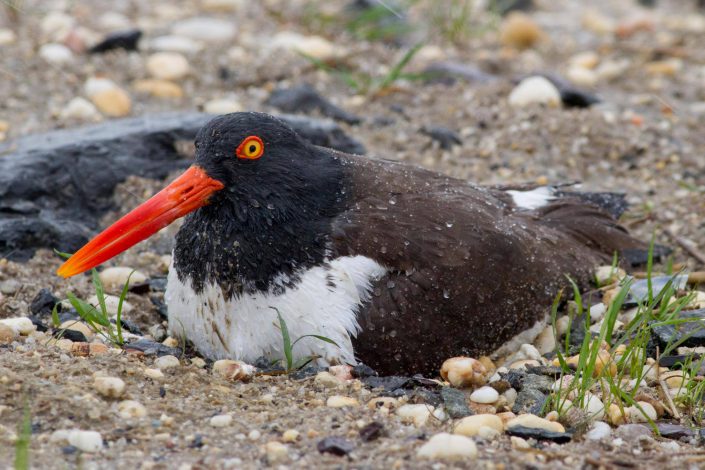
The breeding habitat of the American oystercatcher in New Jersey consists of coastal beaches, inlet systems, and salt marshes. Population estimates in New Jersey suggest 350-400 breeding pairs can be found here from March through August. Much of the monitoring and research done with American oystercatchers in New Jersey takes place on the coastal beaches where other beach nesting birds, such as piping plovers, least terns and black skimmers, are found. In 2016, more than 120 breeding pairs of beach nesting American oystercatchers successfully fledged 83 chicks. This was an especially productive year for those pairs and productivity levels were well above the target goal of .5 chicks per pair.
Photo courtesy of Sam Galick.
Oystercatchers arrive back on their breeding grounds here in New Jersey in early March to set up breeding territories and begin nesting. Once paired up, adults typically lay one to three eggs. Both the male and female will take turns incubating the nest for 28 days. Once chicks hatch, they are semi-precocial, which means they are born in an advanced state, but are still reliant on adults for food and protection. Oystercatcher chicks are fledged (or able to fly) 35 days after hatching. After fledging, most Oystercatchers migrate to the southeast, but a wintering population does remain here in New Jersey.
American oystercatchers are listed as a Species of Special Concern in New Jersey. A “Species of Special Concern” is a status determined by the New Jersey Division of Fish & Wildlife and applies to species that have an inherent threat to their population or have evidence of recent population declines. Since American oystercatchers share the same habitat as other endangered or threatened beach nesting birds (piping plovers, least terns, and black skimmers), they also share the same threats to their nests and young. Human disturbance, a host of predators, and flooding events, such as the one that took place last week, are just some of the many threats beach nesting birds face daily.
The Conserve Wildlife Foundation of New Jersey has long partnered with the New Jersey Division of Fish and Wildlife’s Endangered and Nongame Species program in the monitoring and management of New Jersey’s endangered beach nesting birds. Fencing and signage are placed in nesting areas to alert beachgoers to the presence of nesting American oystercatchers and other beach nesting birds. Throughout the summer, CWFNJ and partners will be out on the beaches monitoring and collecting data that will be used to track population trends and identify threats to oystercatchers and their young.
Emily Heiser is a wildlife biologist for Conserve Wildlife Foundation of New Jersey.
Braving the Caribbean Sea to Survey Turneffe Atoll
Jay T. loads gear into Horace’s boat on Sittee River.
For the final leg of our survey of Ridgway’s ospreys in the northern most part of our study area, we set out for Turneffe Atoll. Turneffe Atoll is an archipelago of mangrove islands and coral reef that’s approximately 20 miles east of Belize City. It’s 30 miles long and 10 miles wide and Belize’s largest coral atoll. Luckily, it was declared a marine reserve in 2012, which protects it from future development. Turneffe is an amazing assemblage of different marine habitats which provide habitat for a variety of many different species of wildlife, including American crocodiles (more on this later!), conch, spiny lobster, manatees, dolphins, sea turtles, and many species of birds, coral and fish. The mangrove islands are large with taller trees on the interior of the island. This is where most, if not all, the ospreys nest. We left on Monday, February 20th. Continue reading “Studying the Ridgway’s Osprey of Belize: Part III”
His sports art long celebrated at Baseball Hall of Fame and other venues, Fiorentino’s wildlife watercolor exhibition arrives in NYC with free reception
Nationally celebrated artist James Fiorentino has been celebrated for his iconic paintings of New York sports icons like Derek Jeter, Yogi Berra, and Odell Beckham, Jr. Now Mr. Fiorentino returns to New York City with a new muse for his prodigious talents – the vulnerable, oft-overlooked wildlife of the metropolitan area.
“Rare Wildlife Revealed: The James Fiorentino Traveling Art Exhibition” will make its New York City debut at the historic Salmagundi Club during the week of April 2-8, 2017. A free reception will be held on Tuesday, April 4 from 6-8 PM at the Salmagundi Art Club Patrons’ Gallery, located at 47 Fifth Ave, New York, NY 10003.
Offered by the nonprofit Conserve Wildlife Foundation, the exhibit is part of a three-year traveling exhibition around the northeastern United States that kicked off this past fall.
February 18: Second Survey of nests surrounding Placencia
Our second survey began from Placencia, a small beach resort town on the southern coast of Belize, which is a beautiful place to visit if you’re planning a trip to Belize. It was flat calm that morning, which made for great boating, but it was extremely hot! Life in the tropics was finally setting in… We headed towards the first nest location, which was last surveyed in 2016 by Paul and his team. Paul and Alan have been surveying osprey nests in Belize since 2014, so all known nests have been mapped and surveyed over the past couple years. Through the continued surveys of these nests we should be able to determine if the low productivity of Ridgway’s (around .3-.4 young/active nest) can sustain the population in Belize (the southern most nesting colony of Ridgway’s throughout their range). The work performed as a part of these surveys is critical to their long term survival in Belize. The first nest we visited was very unkept; however a pair was present. This ended up being quite the common sight during this survey. Continue reading “Studying the Ridgway’s Osprey of Belize: Part II”
CWF contributes to conservation of Belizean ospreys
A male Ridgway’s osprey perched near its nest on a snag off Blue Ground Caye. Photo by Ben Wurst
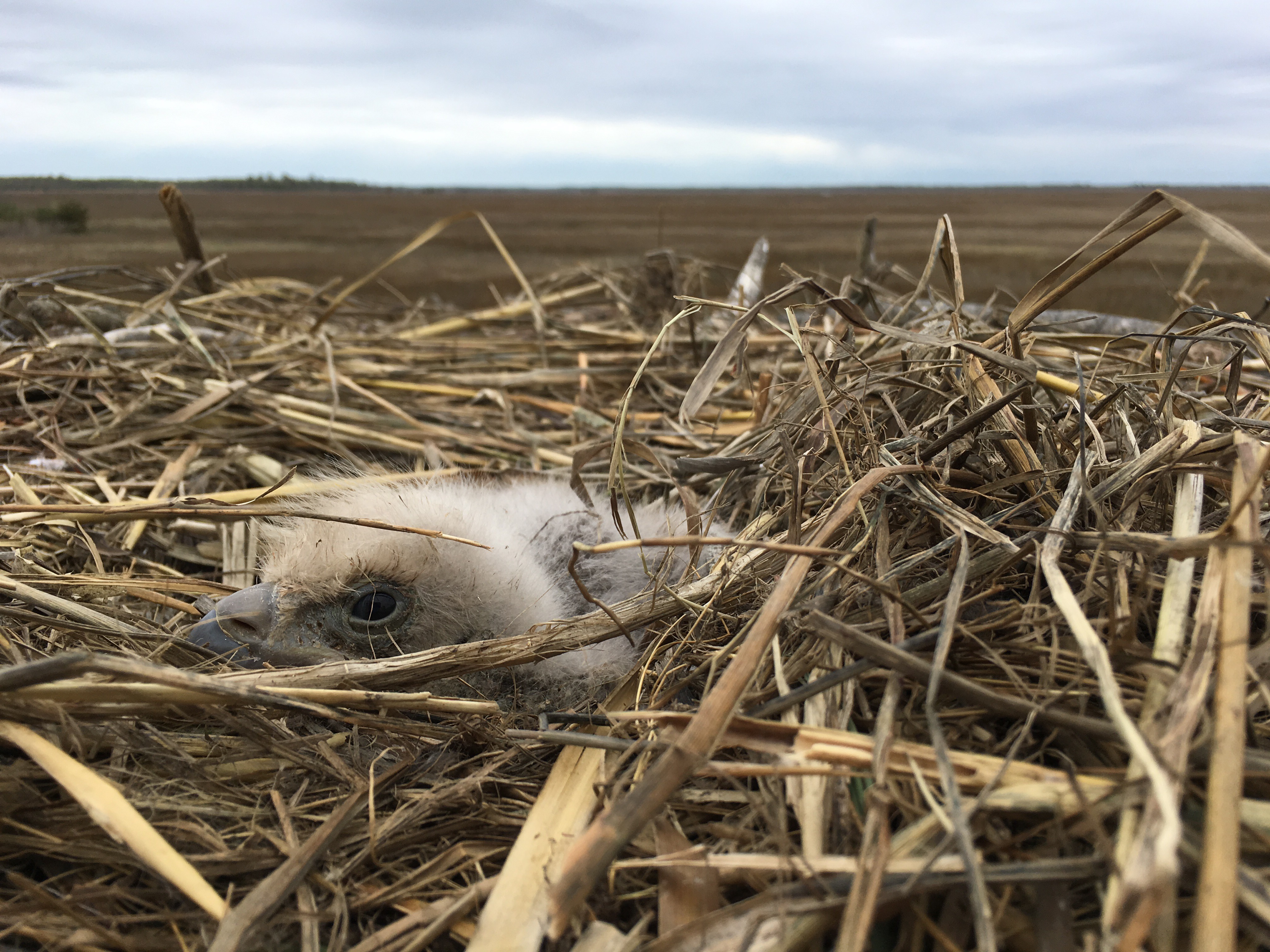
When I first learned of the work being done by Dr. Paul Spitzer and Alan Poole to study the breeding population of Ridgway’s ospreys (Pandion haliaetus ridgwayi) in Belize, I was instantly captivated. I first met Paul at the Raptor Research Foundation Conference in Cape May last October where he explained the study and the need for partners to assist with this years survey. Some of the aspects that immediately drew my attention was the fact that the estimated size of the population there was around 50 pairs, that those pairs nest exclusively on the coastal cayes (mangrove islands), and that their estimated productivity rate was around .3-.4 young/active nest. The coast of Belize is approximately 170 miles long and protected by barrier reefs and these mangrove islands. Continue reading “Studying Ridgway’s Osprey of Belize: Part I”
Over the last few days of our expedition, we left the state of Para and flew to Sao Luis in the adjacent state of Maranhao. There we began the next phase of our work, trapping red knots, ruddy turnstones and other species, as we have done since 2014.
But prior to leaving Para, while we stayed in the village of Apiu Salvatore, the fishermen asked to meet with Max. He hadn’t planned it, so at first, the reason was unknown. The fishermen of the village knew Max represented ICMBio, and that Apiu Salvatore fell within Resex Gurupi-Piria, one of the Brazilian agency’s many extractive or Resex reserves. As I described in the previous post, ICMBio conserves natural resources in each reserve for the benefit of traditional communities, such as this one. So Max had a good idea what the community had on their mind.
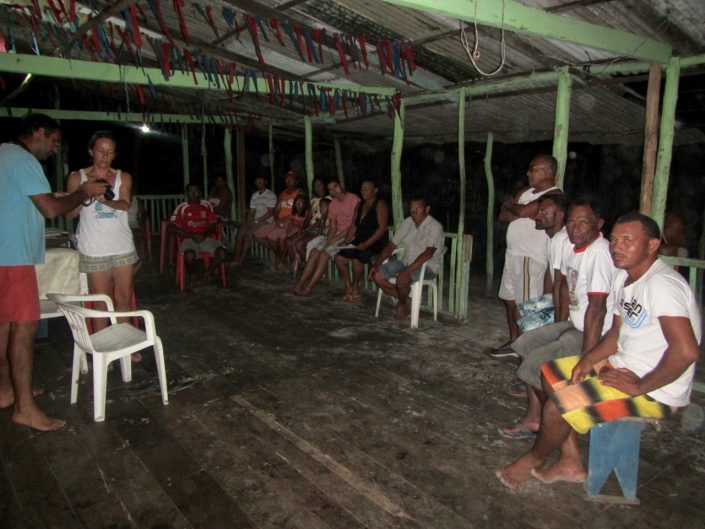
David and Danielle prepare for the meeting with the fishermen of Apiu Salvadori.
We entered the large open meeting space under a thatch roof with a good breeze cooled by a sudden evening downpour. The association leader, Antonio, got down to business. He explained the problem of immense ships lurking offshore, spreading giant purse seines or immense lines of baited hooks, and stealing all the fish. It threatened their own lives, not only their livelihoods but their very existence. One could see very clearly how vital fish were to these fishermen. The community consumed virtually no goods; most of their daily needs came from the sea or their backyards. Chickens, pigs, even lambs filled backyards. Fruit like mangos and avocados literally fell from the trees. I saw no washing machines, microwaves, coffeemakers, or nearly any of the appliances that litter a typical U.S. kitchen.
There was one modern device found in every hut and cabin, no matter how small or dilapidated. All had TVs. How, I imagine, can they fit in this primitive world while gapping at the lives of the rich and famous? These were not people ignorant of the world, but unfortunately, they could be innocent as lambs when faced with the greedy schemers and politicians of Brazil. And as the ongoing corruption scandals here evolve, it seems like nearly every politician serves their own or other greedy interests.
So it is understandable that the fishermen’s first thought was to go to the Catholic Church. But then we came. So they asked for Max’s advice.
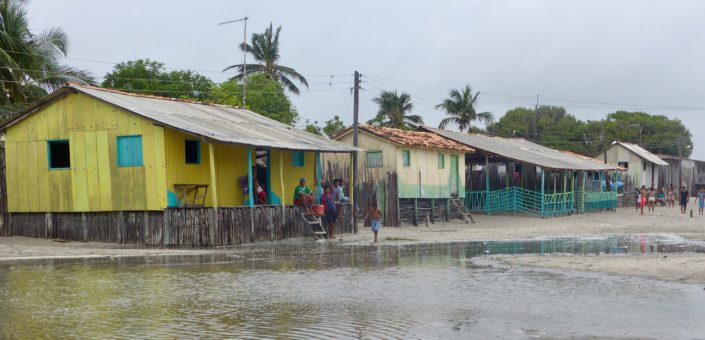
The people of the village live simply with no luxuries except TVs. The town, located on a small island has no electricity except when the community generator is turned on at night. (Photo by C. Buiden.)
He quickly determined the fisherman had no idea they had legal rights to the fishery. He patiently explained the concept of ICMBio reserve system, the system of which they are a part. In theory, they could unify and certify their observations, take it to a judge and get a decision that would force the government to stop the theft by the international fishing fleet, at least in principle. Max and Danielle explained these rights and the group seemed sufficiently inspired. At least they left happy.
Why did they not know their rights? Max explained to me that the reserve manager for this area covered 60 other villages and that ICMBio has suffered 3 years of budget cuts. He reminded me how long it took to get to this village. So it’s the usual story familiar to U.S. agency biologists. Here, as it is in rural U.S., but with a more obvious impact, starving good government often only starves the people who live on the land, the land itself and the wildlife, who depend upon it.
For me, it meant something more. We proposed this project to create better protection for shorebirds. We took the usual approach. First, do the surveys then will create scientifically defensible descriptions of the habitat’s value. Finally, we overlay the threats: shrimp farming, oil spills, human disturbance, predators etc. then develop counter-measures.
I learned that nigh there is only one threat in this, one of the most important shorebird habitats in the world. It looms large above all others – if you erode ICMBio’s system of protection all the other threats will grow and decimate the fragile ecology of the area. Grow the ICMbio system and the traditional communities will enforce their legal right to conserve. They can monitor the threats and work with the agency to stop them. The laws already exist. The monitoring system is already in place. But this meeting pointed out they need more help.
Photos by C. Buiden.
Dr. Larry Niles has led efforts to protect red knots and horseshoe crabs for over 30 years.
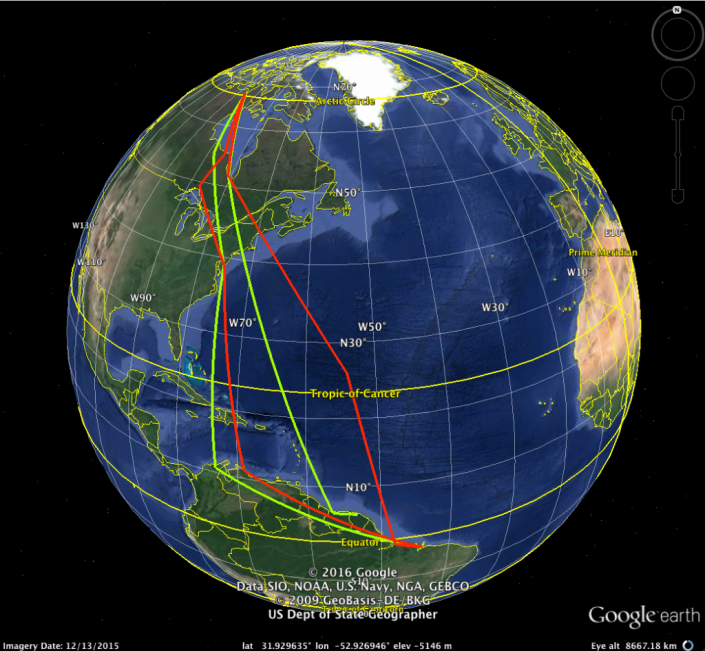
The capture of Arctic nesting shorebirds first brought us to Brazil in 2013. We brought 125 geolocators and caught both ruddy turnstones and red knots, attaching 85 on the former and 30 on the latter. But we also came to create a new perspective on shorebirds in this place, one of the most important shorebird habitats in the world.
For all intents and purposes, shorebird work in this area started in the mid 1980’s, when Canadian biologists, Guy Morrison and Ken Ross surveyed from an airplane, the entire coast of South America. In this monumental and dangerous survey they established an invaluable historic baseline of the number of Arctic nesting shorebirds wintering in South America. This was before shorebirds caught the interest of the public, and way before foundations and agencies devoted significant funding or staff time. They surveyed the entire continent, but on the coast of Maranhao and Para they found the motherlode of shorebirds. They did not, however, get close and personal.
Guy Morrison and Ken Ross about to conduct an aerial survey (also in the photo is Guy’s daughter Clair, Brad Winn, Jorge Jordan and Luis Venegas).
That challenge belonged to a team led by the late Allan Baker of the Royal Ontario Museum and Ines Serrano, then with CEMAVE, the Brazilian counterpart of USGS. They also flew the coast but followed up with a ground survey and the capture of a small group of red knots. Along with Guy and Ken, their work cemented the hemispheric importance of this area.
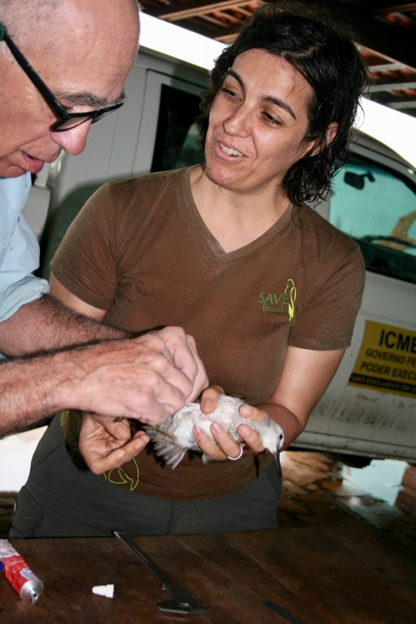
Juliana holds one of the two birds caught in our second day of trapping. (Photo by C. Buiden)
Over the last 4 years we captured knots, turnstones, sanderlings, whimbrels, collared plovers, semi-palmated sandpipers, semi-palmated plovers as well as South American terns and other species. Last year we recaptured 20 geolocators in a catch of over a hundred ruddy turnstones. But only in 2013 were we able to catch red knots. Although abundant in the region, populations are estimated at 10 to 15K, they are remote and elusive.
So we were happy to find on our first day of surveillance this year over 400 red knots. They roosted within a flock of about 1000 shorebirds located at the west end of a small working class beach resort called Panaquatira, about an hour out of Sao Luis. The flock including black bellied plovers, semi-palmated sandpipers and plovers, collared plovers, South American terns, Black Skimmers and a few whimbrels. We readied that night for an early morning attempt.
First we needed to figure out the tide. It rises and falls 13 feet in northern Brazil, twice that in Delaware Bay. The spring tide or full and new moon tide increases the range to 18 feet. Consequently, the high tide line moves every day and catching birds with a cannon net depends on placing the net near the predicted tide line, because birds move with it to stay as far from the dangers lurking on dry land. Wind speed and direction changes the high tide line, and so does barometric pressure.
So much rides on where we place the net. On our first two attempts, we missed by just a few yards, but it could have been a mile. The birds moved with the tide and stood just outside the 30 by 100-foot area within which the birds must be to be caught. We tried moving them but they spooked and most gradually left the area altogether. Ultimately, we fired but caught only two knots and two whimbrels.
We were blessed on the third day. We arrived near dawn, over four hours before high tide so we had plenty of time to measure elevations. We knew the morning’s high would be about four inches lower than the previous night’s high, which snaked along the sandy peninsula used by the birds to roost. Standing on the tide line we used a method borrowed from Clive Minton to determine the location on the beach four inches lower.
Laying my head flat on the sand I trained my eye towards the horizon. This establishes a level line. Using her hand, Stephanie marks four inches on her leg than moves until the four inch mark lines up with the level line. Her location depends on the slope of the beach. In this way we determined the location of the tide line four hours hence. We dug in the net.
Larry Niles and Mandy Dey take training on measuring elevation from Clive Minton in Australia.
At about an hour before high tide, shorebirds started crowding into the area around the net. At first, oystercatchers, black bellies, short-billed dowitchers and a small flock of skimmers. Most of the knots hung back on an adjacent sand bar. With a little push, they too piled in right into the catch area.
We fired and caught 175 knots, 30 sanderlings, 20 short-billed dowitchers and 5 black-bellied plovers. Among the knots were 3 with geolocators. We flagged, banded and measured 145 birds, all the while releasing unprocessed birds that appeared stressed by the heat. By late afternoon we were back at the house cracking open beers. We completed all our objectives with one day to spare.
CWF Biologist Stephanie Feigin moves birds closer to the net. (Photo by Yann Rochepault.)
Stephanie and Julianna begin taking birds out of the cannon net. (Photo by Yann Rochepault)
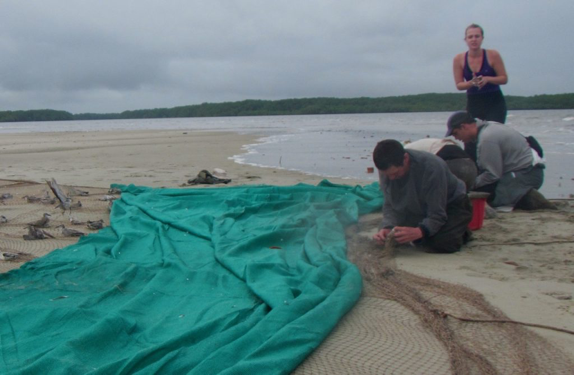
We must cover birds with a light shade cloth to calm birds while they are extracted and placed into keeping cages. (Photo by Yann Rochepault.)
Processing our catch. (Photo by Yann Rochepault.)
One of the many values of catching shorebirds is examining their condition and molt. Here we compare two knots, an adult on the right and a second year or sub adult on the left. The latter molts its flight feathers much earlier than adults and it shows in the fading to brown. (Photo by C. Buiden).
Our team includes Carla Meneguin, Paulo Siqueira, Ana Paula Sousa, Larry Niles, Juliana Almeida, Carmem Fedrizzi Joe Smith, Stephanie Feigin, Yann Rochepault, Laura Reis and Christophe Buiden. (Photo by Juliana Almeida).
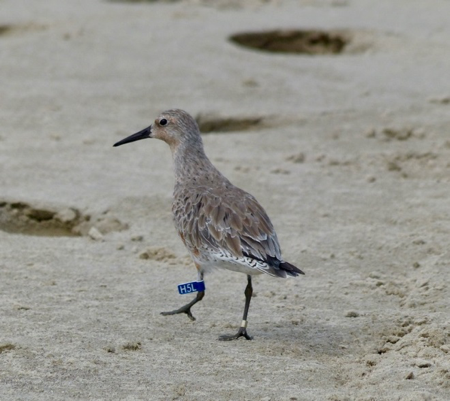
A red knot after banding and processing. (Photo by Y. Rochepault).
Dr. Larry Niles has led efforts to protect red knots and horseshoe crabs for over 30 years.
Hundreds of red knots found to cap long day’s journey
By Larry Niles, LJ Niles Associates LLC
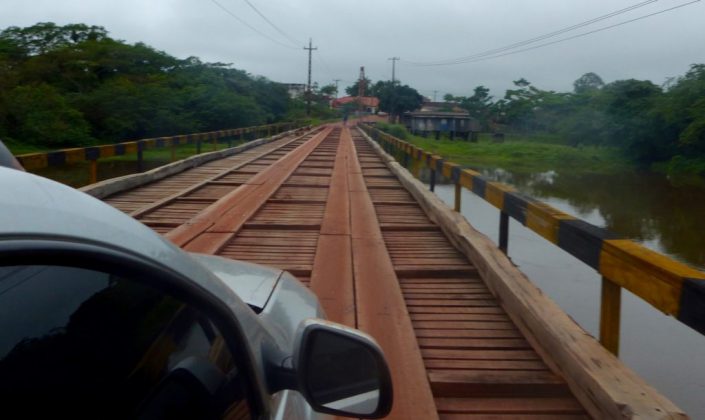
It took us long into the night to reach our next port. We went from the relatively populated area of Braganza to the dark heart of this coastal region of Viseu. In three trucks, we caravanned through a maze of remnant tropical rainforests, cattle pastures, and impenetrable second-growth woodlands. Along the rain-slicked, red clay road, small and desperate looking towns popped out of nowhere always looking like the past was a better day. The road cut through countless mangrove forests that define this region. We reached Viseu too late to do anything but find a place to stay the night.
A bridge across the many rivers from Braganca to Visiu, Brazil. Photo by Christophe Buiden.
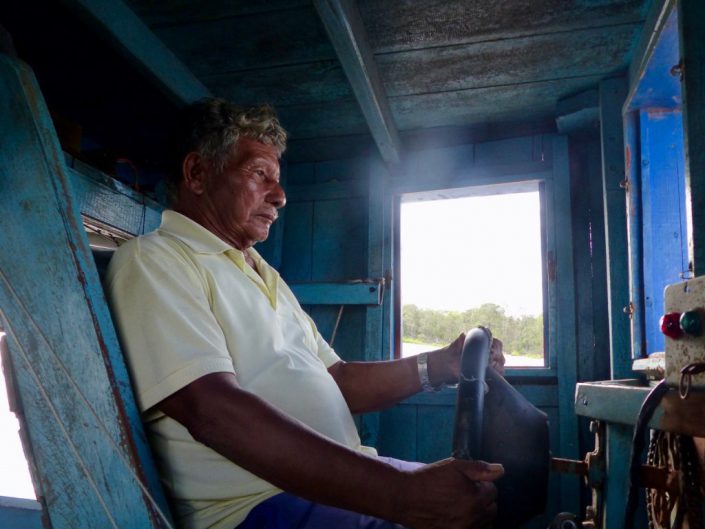
By noon the next day, we boarded a Lancha boat named Garota Viseu (Viseu Girl). Local shipwrights craft these two-decker boats of about 50 feet in length, primarily to carry cargo and people from port to port. Today it will carry us into one of the most remote estuaries in the 250-mile coastline of this enormous mangrove and beach landscape. Our captain, 78-year-old Benedicto, with one crew navigated the coffee- colored Gurupi, a long river that cuts deep into the tropical coastline.
A nearly completed boat in a ship yard in Viseu.
Bene took his craft down the Gurupi within sight of the wind-tossed Atlantic Ocean. The trade winds blow constantly here, almost always at near gale levels. But then he turned into a small channel directly into the steamy mangrove forest. At first the path was wide, lined with a dense tangle of mangrove on either side. Whimbrels, scarlet ibis, semi-palmated sandpipers clung to tangles of roots as the high tide flooded the soft mud.
Captain Benedicto piloting his Lacho boat, the Garota Viseu.
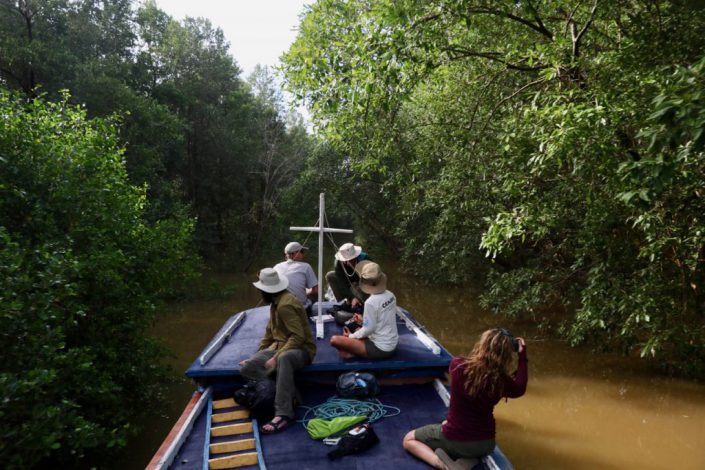
Then he took the boat in a channel so narrow, the crew had to duck the whipsaw of mangrove branches. We slowly snaked our way through a tunnel of green until we reached another wide channel. Within a few minutes, we entered another narrow channel ultimately reaching the next bay. Here we felt the full force of the stiff winds and deep rolling swell of the Atlantic. An hour later we weighed anchor at the small community of Apiu Salvadore.
The Garota Viseu weaves its way through the narrow mangrove passage. Stephanie Feigin, Danille Paluto, Christophe Buiden and Yann Rochepault watch from the top deck of the boat.
Few people from the outside world come to this community of about 50 ramshackle huts and cabins and about 150 people. As the boat neared the shore with most of the team standing on the roof of the boat, scattered groups of the town’s people stood on the sandy bluffs overlooking the harbor as though we just landed from space. Ultimately, we found them welcoming but wary. Little good comes from the outside to these communities.
Over the next two days, we plied our craft of field biology. We needed to find small boats to take teams to the various shorebird habitats previously determined on our maps. Local craftsmen build these boats. Running about 20 feet in length, they use 10 to 20 horse power engines meant for something like a lawn tractor. Instead of driving a blade, the craftsmen power a long shaft that ends in a 8-inch propeller. The skipper can lift the engine and propeller according to the water’s depth. They suited our needs perfectly.
We fielded five teams in three in boats while Mandy, David Santos, Carmem and I surveyed Lombo Branco Island, about two miles from the Apiu Salvador. The sea shapes this island into a crescent, the inside protected from the restless waves. Nestled within, one could see in miniature, the whole ecological system that creates resources for shorebirds.
At the heart of the island grows a small and stunted mangrove forest and an apicum, or wetland that only floods during lunar tides or spring tides. These are the highest of the monthly cycle of tides but only occur on the full and new moon. Every day the tide moves in and out of this small system. Twice a month the tide floods the apicum for several days at a time.
We arrived on the day of a waxing moon, near full. The very high-high tides reached well within the small drainage flooding habitats that have not been flooded in a few weeks. Shorebirds carpeted the wet mud, searching for all the invertebrate life that flourishes in this habitat. But the productivity only starts there. Here the tidal flow is gentle because the island shields it from the wind tossed Atlantic from all sides except the leeward quarter of the island. This gentle tidal flow flushes sediments from the mangrove swamp, the nutrients of the apicum and the normal productivity of a sediment-rich sandy substrate, forming the base layer of a productive food chain that nurtures small clams and other invertebrate – all prey for shorebirds.
We found whimbrels, semi-palmated sandpipers, ruddy turnstones, short-billed dowitchers, black belly plovers, willets, semi-palmated plovers, sanderlings and collared plovers. In the lower reaches, we found 337 knots, a glorious find that will help our mapping model enormously.
Red knots, sanderlings, short billed dowitchers and other shorebird forage in the inter-tidal estuary of Morro Branco.
The following day we surveyed a second island, Coroa Criminosa. Why the sinister name we cannot say, but it supported a very similar esturary giving us another successful day. When the tide went out the small island of about 6 kilometers grew to over 20 kilometers. Intertidal sand flats spread out of sight in nearly all directions.
We left the island that night and arrived in Viseu just before dark. Once again we suffered the sway of the Atlantic. After weaving our way back through the mangrove and up the Gurupi River, we landed too late to go on. We were thankful for the modest rooms with showers, a good meal and beer!