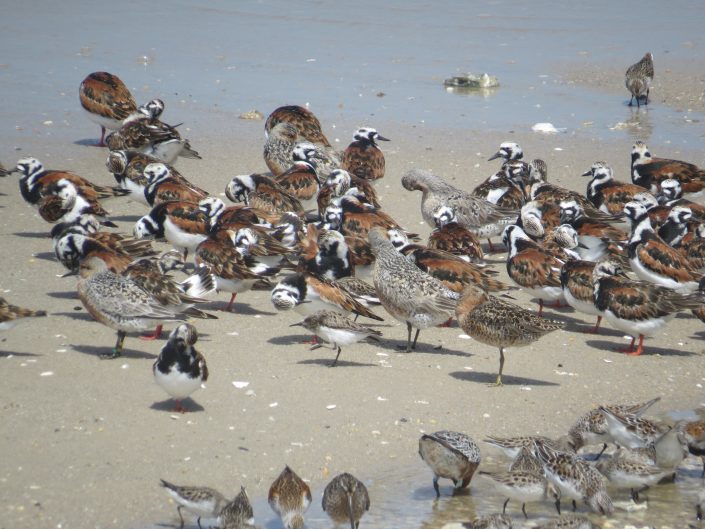
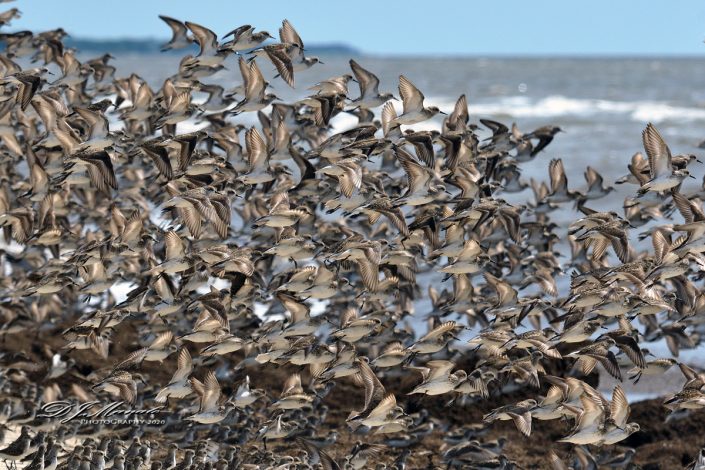
Shorebirds along Delaware Bay: photo by Shorebird Steward Bob Bocci
May is wonderful time of year at the Delaware Bay. Horseshoe crabs are spawning and shorebirds stopping over on their migration to feed on the eggs. One of these shorebirds the red-knot, is a federally threatened species. Beaches along the Delaware Bay in New Jersey are extremely important stops in their migration. Many of these beaches have been restricted from May 7th to June 7th to allow the shorebirds to feed undisturbed. They need to gain enough weight to be able to fly non-stop to their breeding grounds in the artic.
photo by Shorebird Steward Dom Manalo
People come from all over to view this natural phenomenon and the Delaware bay is a popular tourist destination. It’s important to have Shorebird stewards on these restricted beaches to educate the public about the crabs and shorebirds. Shorebird stewards support beach restrictions by being present at closed beaches during shorebird season to ensure that resting and foraging shorebirds are not disturbed. This job includes educating beach visitors as to why the beaches are closed and the importance of the beaches to horseshoe crabs and migrating shorebirds.
Stewards are needed short term in May at beaches along the Delaware Bay in Cape May County from the Villas north to Reed’s Beach and beaches in Cumberland.
Please contact Larissa Smith at Larissa.Smith@conservewildlifenj.org for more details.
The 2021 nesting season was another successful one for New Jersey’s bald eagles, with the statewide population remaining stable at 247 nest sites. Of these nests, 222 were active (with eggs) with 296 young produced. Twenty-seven new eagle pairs were found.
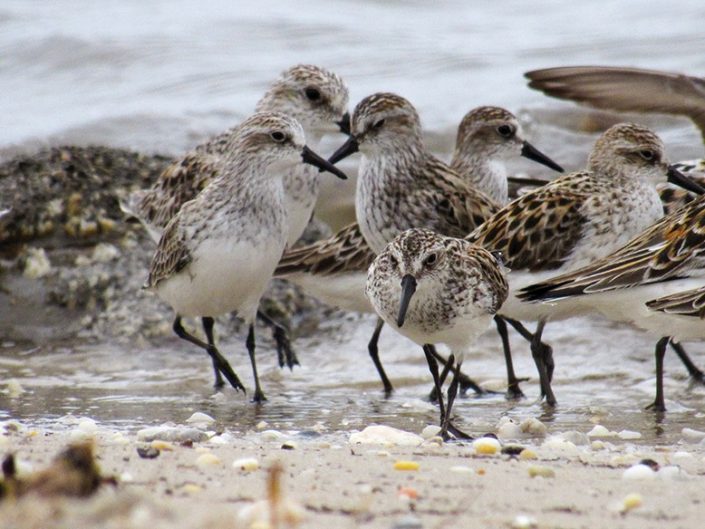
Congratulations to Luke Tan for having his photo Semipalmated Sandpipers Feeding win Runner Up in the Student Category for NJ Monthly’s Cover Search Competition. Luke volunteers as a CWF Shorebird Steward on the Delaware Bay during the spring shorebird migration. He captured this photo while on Reed’s Beach, Cape May County.
CWF Biologists (left to right) Sherry Tirgrath, Christine Healy, and Ethan Gilardiplant new greenery in the Trailside Nature Center Garden.
This fall CWF worked with the staff at the Trailside Nature and Science Center at Watchung Reservation in Union County, New Jersey to restore their Certified Wildlife Habitat. A Certified Wildlife Habitat must include sources of food, water, cover and places to raise young, and must be maintained using sustainable practices. Their garden had suffered from years of neglect and had become overgrown and choked out by weeds.
The first task was to tackle the major cleanup with the goals of opening the garden up to more sunlight, making room for new plantings, and giving the garden a fresh and clean appearance. CWF staff, interns and volunteers joined the Trailside Center’s staff and spent a day pulling weeds, digging up unwanted and overgrown plants, trimming shrubs and trees, clearing vines from trees, and raking and blowing leaves. Dead, dying, or damaged trees and shrubs were cut down. We left the healthy and beneficial trees, shrubs and herbaceous plants that will be the backbone of the refreshed garden. At the end of the day, the result of cleanup was remarkable. Sunlight can now reach the ground, and the garden became a clean slate to add new plantings that will benefit birds, bees, butterflies, and other wildlife.
Trailside garden before and after cleanup.
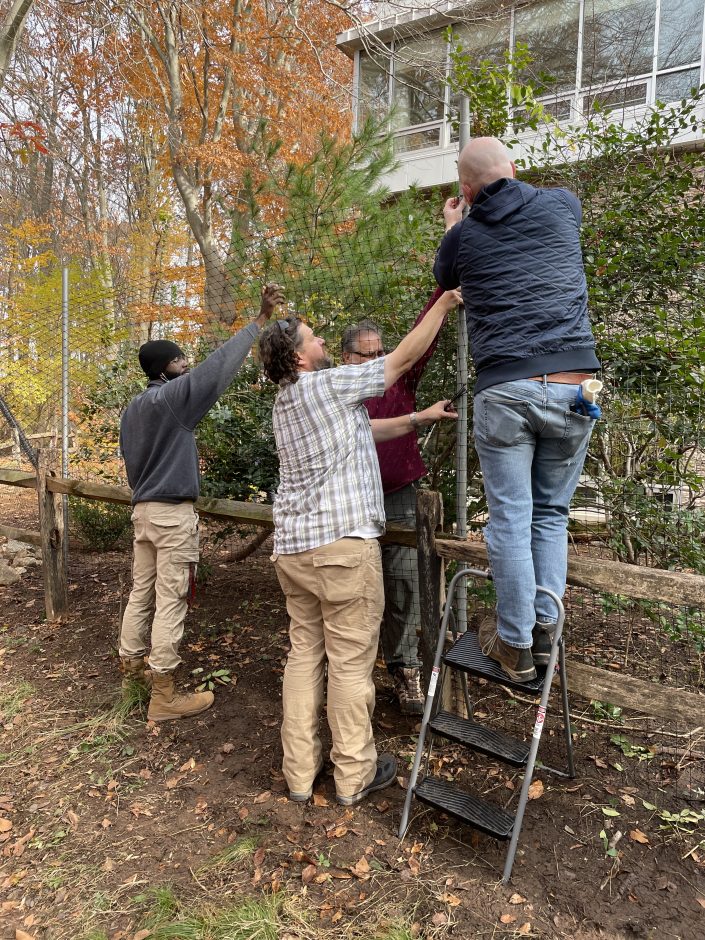
The next step was to install a new deer fence around the garden. The Trailside Center lies within a wooded area and deer are drawn to the garden to munch on the shrubs and plants. In order to keep deer from destroying the garden, while allowing birds and other wildlife to utilize it, we installed a new eight-foot-high deer fence around the garden to replace one that had fallen down years ago. At the same time, we planted some new trees and shrubs in the garden that will be able to grow without the pressure of deer browse. We planted only native species that will attract birds, hummingbirds, bees, and butterflies to the garden.
In the spring, we will return to plant native herbaceous perennial plants that will also benefit birds, hummingbirds, bees, and butterflies. We will be sure to plant some host species for native butterflies, such as milkweed for monarchs. We plan to make a corner of the garden that caters specifically to hummingbirds. The garden is already home to a beautiful man-made creek flowing into a pond that draws birds and frogs. Several types of bird feeders, squirrel feeders and nest boxes are scattered throughout the garden as well. The restored garden will be unveiled this spring for visitors to observe through the viewing windows inside the Trailside Center.
Trailside staff install deer fencing around the garden with help from CWF staff, interns, and volunteers.
August 1, 2021. It is raining and dreary out. Indoors all day wrapping up my end-of-season raptor time/mileage sheets, I have cabin fever! Tracking Duke for the last nine months has been educational and fun, and right now I know that he is nearby. For the last week he has been perching along the Raritan river–very close to my home and adjacent to his natal home, Duke Farms in Hillsborough. I have been too busy to spend as much time as I would like hiking and biking along the river nearby, while playing “hide and seek” with Duke! I check the internet link for today’s confirmation. Sure enough, Duke is perched in a wide-open field on Duke Farms land that I know well. It is only 4 miles away so I get in the car and head over there. Because it is raining, my chances of spotting him might be pretty good since eagles prefer not to fly in the rain, but rather remain on their perches without moving. He might still be there! I anticipate success. There he is! Right where I thought he would be. In a small grouping of trees in the middle of this large field there is one dead tree front and center, and Duke, fortunately, is perched on the dead tree, easily seen from the road. The photos are shot from about 100 yards away, in a light rain, but it is still a thrill to see him as it has been exactly two months since I last saw him on June 1st. blog post (Playing Hide and Seek with an Eagle)
“Duke” August 1st, 2021 by Barb McKee
On August 2, I learned that Duke had flown from that Duke Farms field back to the Delaware River and to Tohickon Creek where he spent the first week in August. As the second week began, his transmitter skipped 2 consecutive days of downloading data, but and when it finally did download, he had flown back to Duke Farms! In the coming days he seemed restless. He did not hunker down in one area, but appeared to be revisiting all of his haunts and hang-outs in central Jersey from the last nine months. He even went back to Tewksbury, flew very close to his winter “restaurant”, the game fowl pens at Flint Hill Hunting Preserve, and did a huge circle over Bedminster! He checked out Round Valley, the Black/Lamington River, Eagle Bend on the North Branch, and explored that river from Far Hills all the way to route 22. Then on August 30, a travel day again, he flew back to the Delaware! Again his transmitter did not connect with the satellite on the last day in August, but when it finally did connect, it was clear that his restlessness continued.
During the torrential rains of hurricane Ida, Duke finally hunkered down in PA on Neshaminy creek west of Washington Crossing in a rural area of woods and fields. He remained there until Sept. 6 when he flew back to the Delaware River and perched right near my Bulls Island nest. That is where he was on Sept 7. Then….his transmitter skipped three days of downloading! Finally, on Sept. 10, 72 hours of data downloaded and it showed he had been back on Tohickon Creek. This is a wild stream in a wooded gorge. There are some roads and houses here and there, but it is mostly rural–a good place for a young eagle. There would be plenty of places to perch and roost, and fish and small animals in and by the river to eat. But then, after 3:03:08 pm Eastern Daylight Time on September 10, his transmitter went dark!
Duke_Hillsborough November 24, 2020 by Barb McKee
My adventures with Duke started exactly a year ago today! blog post (Duke’s Homecoming) I learned he can hold his own against competition for food, aggressively steal from lesser raptors, find small rodents, reptiles and other prey in the smallest of creeks and valleys, fly beautifully and roost safely during rain, wind and snow. I have watched him thrive as an independent eagle in the wild, and although I sometimes worried about his choice of perches and food sources, I believe he has a great chance of reaching maturity and, in about 2 years, with his head and tail feathers mostly white, find a territory he likes and a mate with whom to build a nest. I miss knowing where he has been and miss our games of hide and seek. It has been 57 days since his last data download. I trust from the information on the site that his solar battery has failed and that Duke himself has not failed! During the coming winter I will be searching all the places I know he preferred. I believe eagles are creatures of habit. As I watched him travel around, sometimes all the way to the Chesapeake and back, I am sure that he used his eagle eyes to spot landmarks which are his “road maps” when he travels. I have plenty of reason to believe that he will return to his favorite roosts and hang out and I will have my eyes open, still searching for him. My sincere hope is that I, or someone else, will someday catch a photo of him with his E/88 band easily readable!
In the meantime, soar safely Duke, fly high and free.
The 2021 New Jersey eagle nesting season was another good year for NJ’s eagle population. The final numbers and details will be available in the 2021 Annual Bald Eagle report published in December. There are over 100 eagle project volunteers who monitor eagle nests/s during the season. They are an extremely dedicated group who not only monitor eagle nests but help to protect the nests. Volunteers become familiar with their pairs and get to witness all kinds of eagle (and other wildlife) activity. I asked the volunteers to send me their one favorite photo from this season.
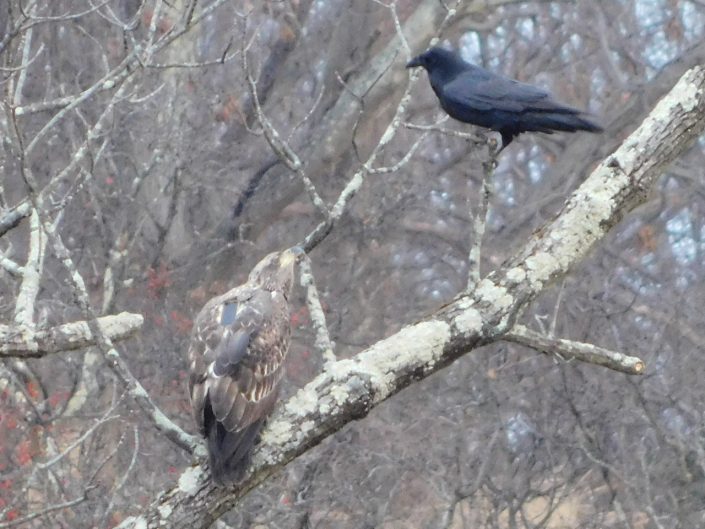
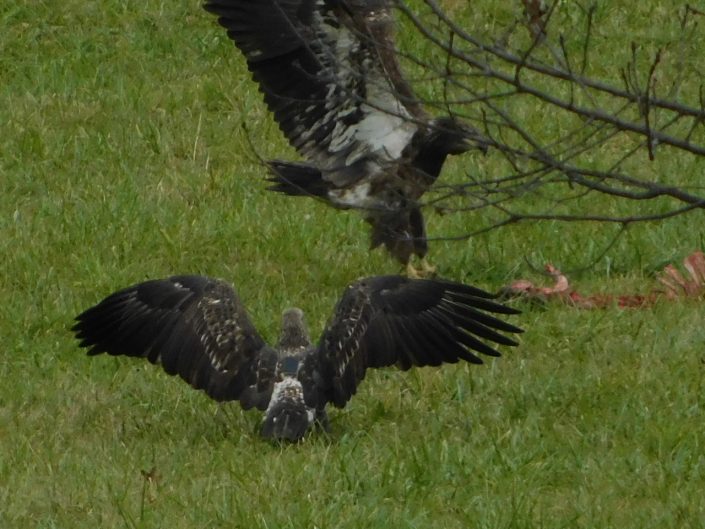
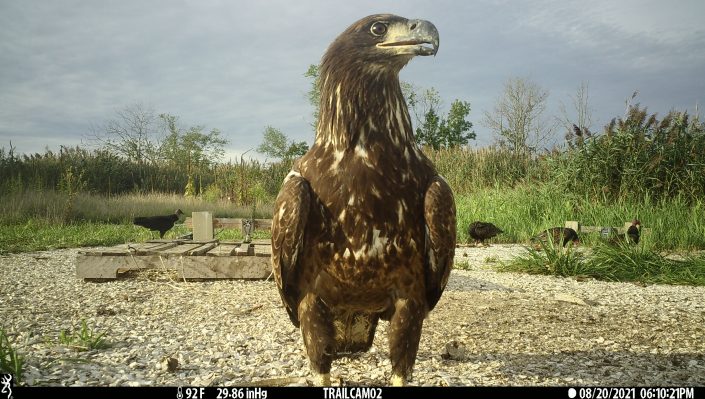
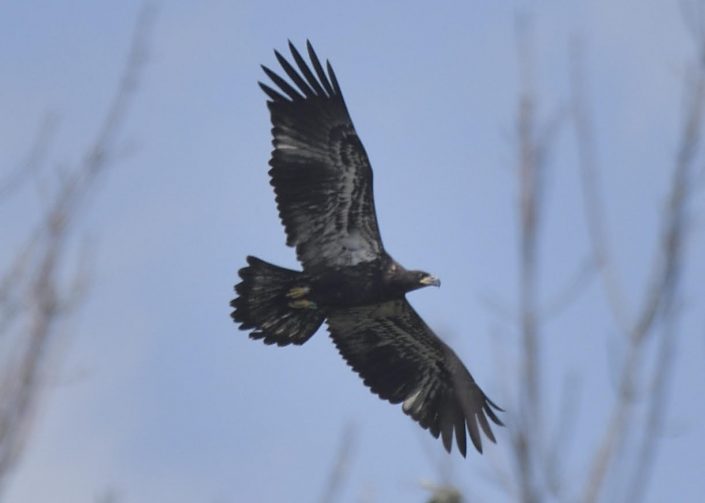
This is the second year that the NJ Endangered & Nongame Species program along with the Conserve Wildlife Foundation of NJ have set up a “soft release” area for juvenile eagles that were found grounded and cared for at Rehabilitation centers. The site is in a remote area of Cumberland County where staff and volunteers provide supplemental food (fish and road-killed mammals) in a safe place, and where other juvenile and sub-adult eagles would provide the social learning they needed. Trail cameras were installed to document eagle use.
This eagle nesting season we have been following the story of the Three Bridges eagle pair in a blog series. A camera on the nest allowed viewers to get an up-close view of the nesting activities. The pair successfully raised two chicks, who biologists banded (green bands H/04 & H/05), and they fledged the end of June.
On July 4th, eagle H/05, was found injured near the nest. He was taken to The Raptor Trust where he was treated for a fracture of the left coracoid bone, which supports powered flight in the wing. He remained in the care of The Raptor Trust until he was fully healed and had regained some of his flight strength.
Three Bridges nest monitors continued to observe the nest area and determined that the adults and H/04 were still around the nest platform. In a very quick and quiet manner, H/05 was released back at the nest site last past week. It was necessary to have adults in the area, so he can continue his post-fledging period with them, learning to hunt and survive on his own.
H/05, August 12, 2021@ Mary Ellen Hill
Since his release, H/05 has been seen flying and perching in the nest area. It is very important for people to view the nest platform from a distance and not approach the nest tower or any eagles perched in the area. We all need to keep this nest area “eagle-safe” for the next month, giving H/05 and his family time to reacquaint and re-learn eagle skills! We thank everyone who has supported this eagle family.
There are many aspects to the Delaware Bay Shorebird Project. During the month of May researchers survey, re-sight and band shorebirds as well as conduct horseshoe crab egg counts. Nine beaches in Cape May and Cumberland Counties have restricted access during May, which allows the shorebirds to feed on the horseshoe crab eggs.
Shorebird Steward Bill Reinert@ Dom Manalo
Shorebird stewards are out on the beaches in all types of weather and insect seasons making sure that the restricted areas are respected. They do this through education and explaining to beach goers the importance of allowing shorebirds to have these undisturbed areas to feed. Stewards really make a big difference in shorebird protection on the bay and we thank them for all of their efforts this shorebird season. This season there were plenty of horseshoe crabs spawning with eggs in abundance, but unfortunately the shorebird numbers were down this season. For more details on the 2021 Shorebird season can be found in the article ,Red knot numbers plummet, pushing shorebird closer to extinction.
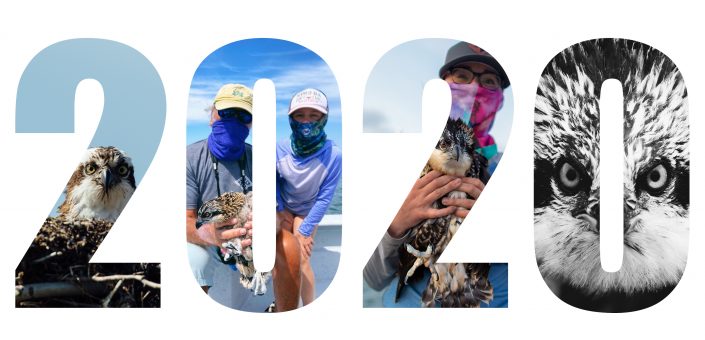
For every dark day there was always hope for a brighter future. Results from the 2020 New Jersey Osprey Project.
Ben Wurst, Habitat Program Manager
This was likely one of the most challenging, at least in recent years, in the history of the New Jersey Osprey Monitoring Project. From social distancing and working from home (with children) to severe wind events and dealing with the impacts of humans on ospreys, 2020 turned out to be quite the year. Overall, our work was largely unaffected by the global covid-19 pandemic. Most of our work is conducted outdoors and away from mass gatherings of people. It was important for us to ensure the safety of our volunteers and the general public safe.