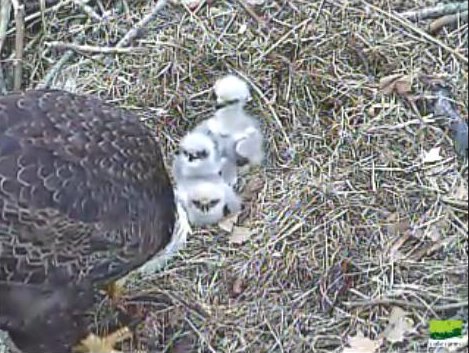
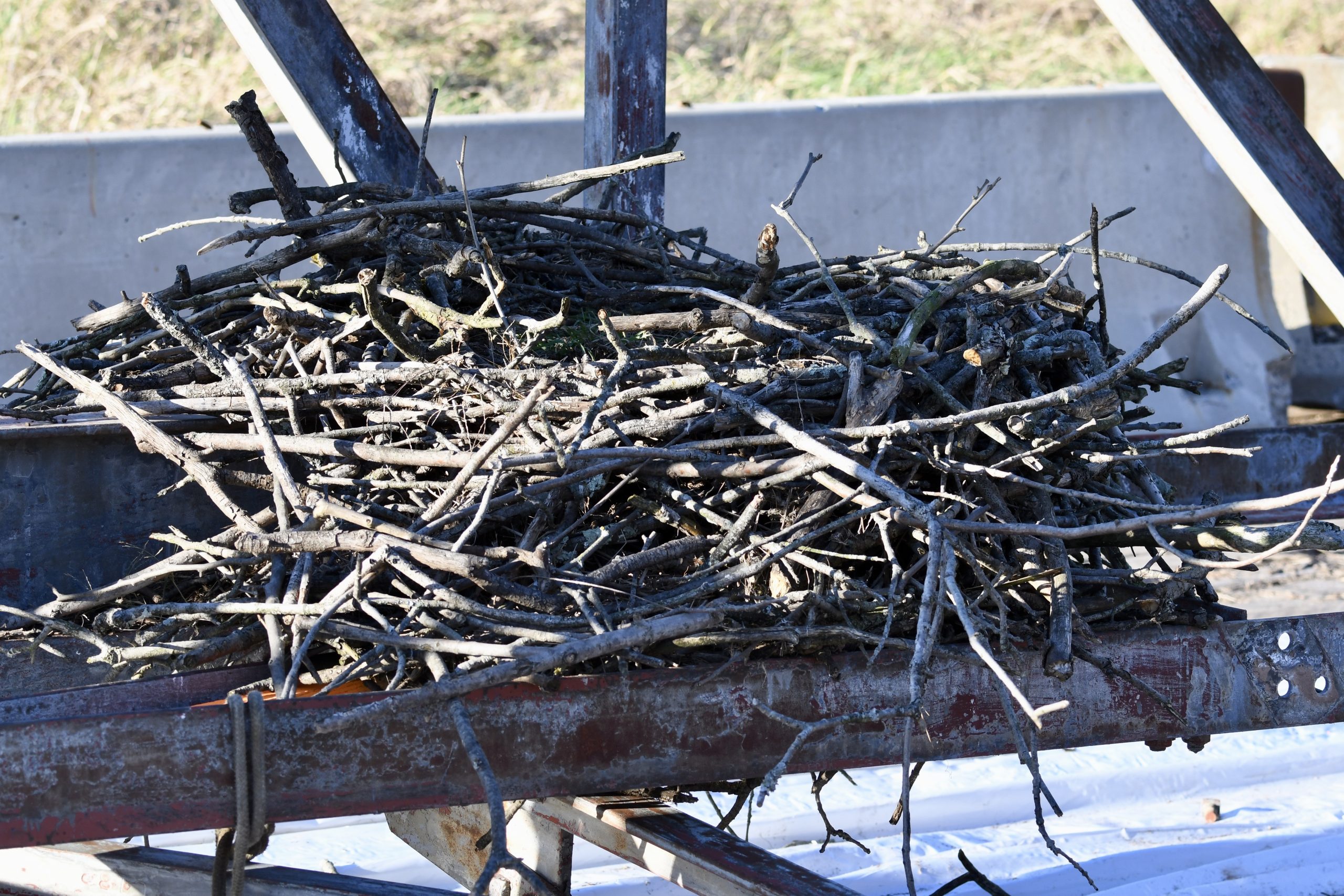
This eagle nesting season we have been following the story of the Three Bridges eagle pair in a blog series. A camera on the nest allowed viewers to get an up-close view of the nesting activities. The pair successfully raised two chicks, who biologists banded (green bands H/04 & H/05), and they fledged the end of June.
On July 4th, eagle H/05, was found injured near the nest. He was taken to The Raptor Trust where he was treated for a fracture of the left coracoid bone, which supports powered flight in the wing. He remained in the care of The Raptor Trust until he was fully healed and had regained some of his flight strength.
Three Bridges nest monitors continued to observe the nest area and determined that the adults and H/04 were still around the nest platform. In a very quick and quiet manner, H/05 was released back at the nest site last past week. It was necessary to have adults in the area, so he can continue his post-fledging period with them, learning to hunt and survive on his own.
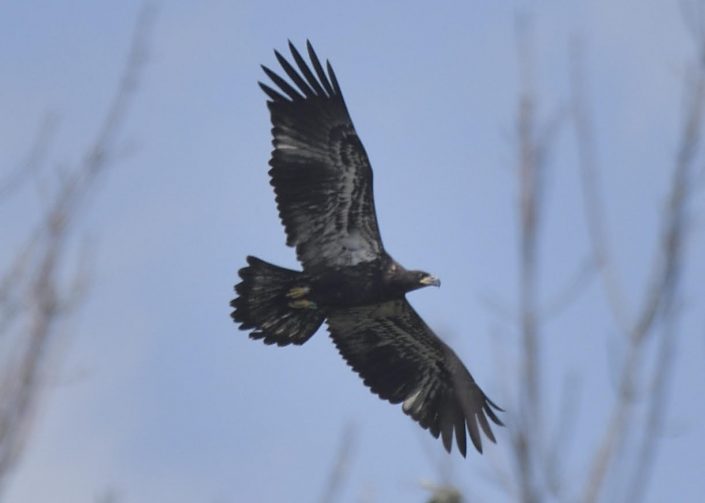
H/05, August 12, 2021@ Mary Ellen Hill
Since his release, H/05 has been seen flying and perching in the nest area. It is very important for people to view the nest platform from a distance and not approach the nest tower or any eagles perched in the area. We all need to keep this nest area “eagle-safe” for the next month, giving H/05 and his family time to reacquaint and re-learn eagle skills! We thank everyone who has supported this eagle family.
There are many aspects to the Delaware Bay Shorebird Project. During the month of May researchers survey, re-sight and band shorebirds as well as conduct horseshoe crab egg counts. Nine beaches in Cape May and Cumberland Counties have restricted access during May, which allows the shorebirds to feed on the horseshoe crab eggs.
Shorebird Steward Bill Reinert@ Dom Manalo
Shorebird stewards are out on the beaches in all types of weather and insect seasons making sure that the restricted areas are respected. They do this through education and explaining to beach goers the importance of allowing shorebirds to have these undisturbed areas to feed. Stewards really make a big difference in shorebird protection on the bay and we thank them for all of their efforts this shorebird season. This season there were plenty of horseshoe crabs spawning with eggs in abundance, but unfortunately the shorebird numbers were down this season. For more details on the 2021 Shorebird season can be found in the article ,Red knot numbers plummet, pushing shorebird closer to extinction.
For every dark day there was always hope for a brighter future. Results from the 2020 New Jersey Osprey Project.
Ben Wurst, Habitat Program Manager
This was likely one of the most challenging, at least in recent years, in the history of the New Jersey Osprey Monitoring Project. From social distancing and working from home (with children) to severe wind events and dealing with the impacts of humans on ospreys, 2020 turned out to be quite the year. Overall, our work was largely unaffected by the global covid-19 pandemic. Most of our work is conducted outdoors and away from mass gatherings of people. It was important for us to ensure the safety of our volunteers and the general public safe.
As a volunteer nest observer working for New Jersey’s Bald Eagle Project under the guidance of Kathy Clark and Larissa Smith, I watch and report on six nests in central and northern NJ. When the Duke Farms eagle cam first went online in 2008, I loved watching the adult pair and their nestlings whenever I was at home on my computer! Web cams give us an intimate look into the lives of eagles. By observing close up, so much can be learned about eagle behavior, and this nest was only five miles from my home in Hillsborough. These were my eagle neighbors! In May of 2019, during the annual banding of the two eaglets at the Duke Farms nest, the younger male (banded E/88), was outfitted with a satellite transmitter and became part of the research program “Eagle Trax” to discover where fledglings go when they leave the nest.
Duke first went online Sept 17, 2019, after he had left the nest area, beginning his journey to adulthood as an independent eagle. Although Duke has made short trips over to PA and even a couple times returned briefly to NJ, to his natal nest area, he spent most of his time in Maryland on the lower Susquehanna River and upper Chesapeake Bay.
“Duke” 11/24/20 @ Barb McKee
Then, early last November, I got an email from Kathy Clark. Duke had once again returned to NJ and was in Hillsborough, very close to our home on the Millstone River. I hustled right out with my scope and camera to see if I could spot him. If I was ever going to see Duke “in the wild” it would be now, with no foliage to block the views, while he was just a few miles away! As I searched the small patch of woods that corresponded to the last tracker location, I realized how challenging it would be to find this “eagle in the hay-stack”! Even with experience in spotting eagles, and having some ideas about the behavior of juveniles, where they might perch and what sorts of terrain they might be attracted to, actually seeing Duke would take a lot of patience and persistence, but most of all luck! To find him with good light in a spot where photos are possible, would take even more luck—what were the odds? Although through his transmitter he is being tracked, the data downloads only once every 24 hours, so I only knew where he had been, not where he was in real time!
“Duke” and an immature female feeding on a deer carcass 11/24/20 @ Barb McKee
I have been blessed to have seen Duke about a dozen times in the last eleven weeks. There have been many other times when I was probably looking right at him without seeing him and this is supported by the information from the tracker! A human playing “hide and seek” with an eagle is definitely at a visual disadvantage! I have learned that young eagles prefer wooded cover, small valleys with tiny streams where they might find a rodent or reptile. They tend to perch near water, not large rivers, but rather small creeks in narrow gorges or beside farm ponds. In winter, the best find for a hungry young eagle is a road-killed deer or other animal in a farm field that is fresh, but already immobile. A find like this keeps Duke perched and roosting close by until the food is consumed. I have seen many competitors for this precious winter commodity: vultures, other eagles, pesky crows, and at one site, even a coyote!
“Duke” perched in author’s backyard on Millstone River 11/25/21 @ Barb McKee
I also realized early on that Duke is just as likely to perch low and be almost invisible as he is to perch in a high tree top silhouetted against a light sky. Twice I flushed him off his perch because I was looking up not down. I learned that Duke has a favorite roosting spot where he has spent almost half of the nights he has been in central Jersey, but also discovered that he spent two nights within 100 yards of his natal nest in a small wooded area at Duke Farms!
“Duke” perched on Duke Farms property 1/5/21 @ Barb McKee
I have taken hundreds of photos of Duke. The light isn’t always the best, and Duke is usually quite far away, but my photos and videos have shown a healthy and thriving almost-two-year-old who has learned to hunt and to defend his prey! He has also learned to be patient and careful, and to wait his turn, most notably when “sharing” a meal with much larger and thus more assertive young female juveniles! I have seen him scatter and chase the competition off his food on fields. I saw him try to “steal” something from a hawk in the air. I have seen him in flight, a sight I never tire of! I even saw him perched over the Millstone River in my own back yard, probably searching for fish! That was truly memorable!
“Duke” in flight 1/19/21 @ Barb McKee
Will Duke decide to stay here in central NJ? Will he eventually mate, build a nest, and have nestlings of his own here? I hope so! Evidence suggests that eagles do return to an area not that far from the area where they fledged and began the challenging journey from fledging to maturity. I hope to share Duke’s adventures for many years to come.
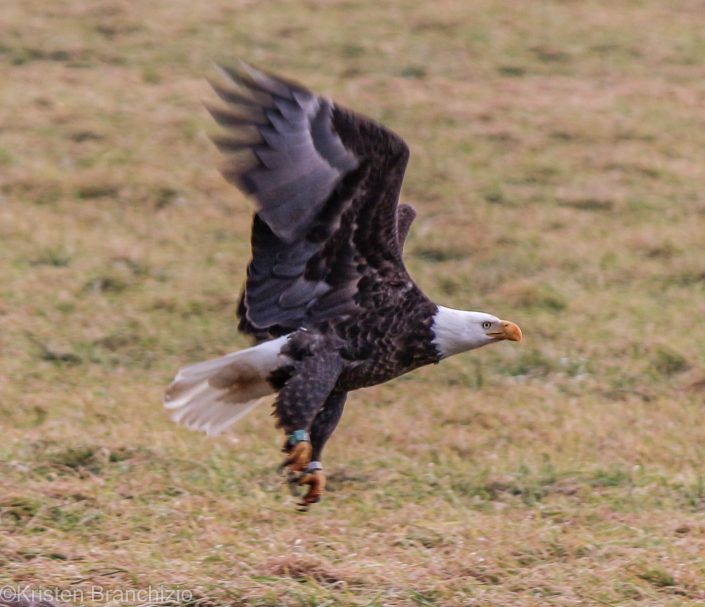
It is always exciting to receive a report of a New Jersey banded eagle, especially when it is from Duke Farms eagle cam. D/99 was resighted two years ago during the winter of 2019. The blog post Duke Farms Alumni D/99: All Grown Up, has all the details of those sightings.
D/99, January 2021 @ Kristen Branchizio
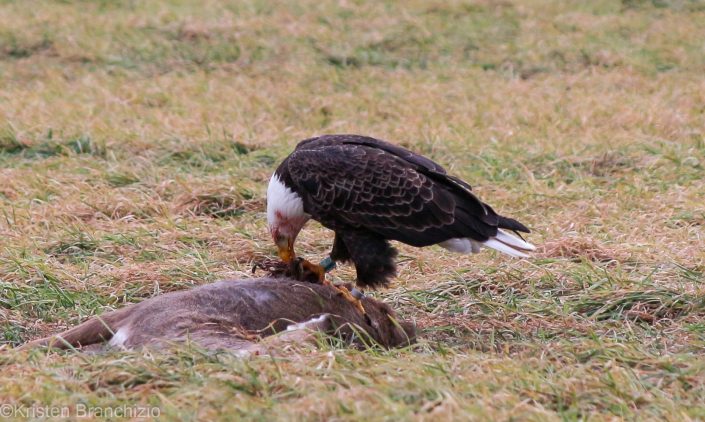
D/99 has been sighted again, this time in Freehold, Monmouth County. He was seen for several days feeding on a deer carcass along with a few other eagles.
D/99 was the youngest of three chicks in the 2014 Duke Farms nest. It’s amazing to see the “before” and “after” photos. The little fuzzy wobbling chick is now a full grown majestic adult.
D/99 and siblings, April 2nd, 2014
D/99 is now seven years old and could possibly have a mate and be nesting in the area. We hope to get more resightings of D/99 in the future to know that he is doing well and raising his own family.
In part one and two of this blog series we followed the Three Bridges eagle pair. The transmission tower where they had previously nested was replaced and a new nesting platform installed. The question was: would the pair return and use the new nesting platform? Eagle Project volunteers have been closely monitoring the tower and surrounding areas for the eagle pair. The eagles have not been seen at their old nesting tower. At one point it looked like they were building a nest on an adjacent tower, but the amount of sticks never increased. Then a new eagle nest was found in a tree about a mile away from the tower location.
eagle bringing stick back to nest in tree 1/14/21 @ Joe Mish
After many observations by nest monitors it is believed that this is the Three Bridges pair. While we can’t be 100 percent certain, the fact that they haven’t been seen at their old nest location and that this new nest is close enough to be in their territory. It is not uncommon for eagle pairs to relocate their nest if there is disturbance to the nest site. While it is disappointing, the new nest platform might not go to waste. Nest monitors have seen immature eagles perched on the newly installed tower and nest platform.
sub-adult & immature on new tower @ Mary Ellen Hill
immature on nest platform 1/9/21@ Barb Mckee
As the number of eagles’s nesting in NJ continues to increase, it only makes sense that a pair will eventually use the nesting platform in the future.
‘Tis the season for osprey nest platform repairs — and being thankful for the volunteers who make it happen!
by Ben Wurst, Habitat Program Manager
AmeriCorps Watershed Ambassadors clean out nesting material from a 20-30 year old nest platform.
After migratory birds depart, leaves fall and northwest winds prevail, a small group of dedicated volunteers descend on our coastal saltmarshes. They’re there to maintain osprey nest platforms. Around 75% of our nesting ospreys rely on these wooden structures to reproduce. They were used to help jumpstart the early recovery efforts of ospreys in coastal New Jersey, where much of their native habitat was lost to development in the 1950-60s. Today many of these platforms are reaching their life span or are very close.
April 21, 2020, Three Bridges adult with 2 chicks@ Daniel Kroon
The following was written by NJ Eagle Project volunteer, Daniel Kroon. He monitors this nest along with several other dedicated volunteers whose photos are featured in this blog.
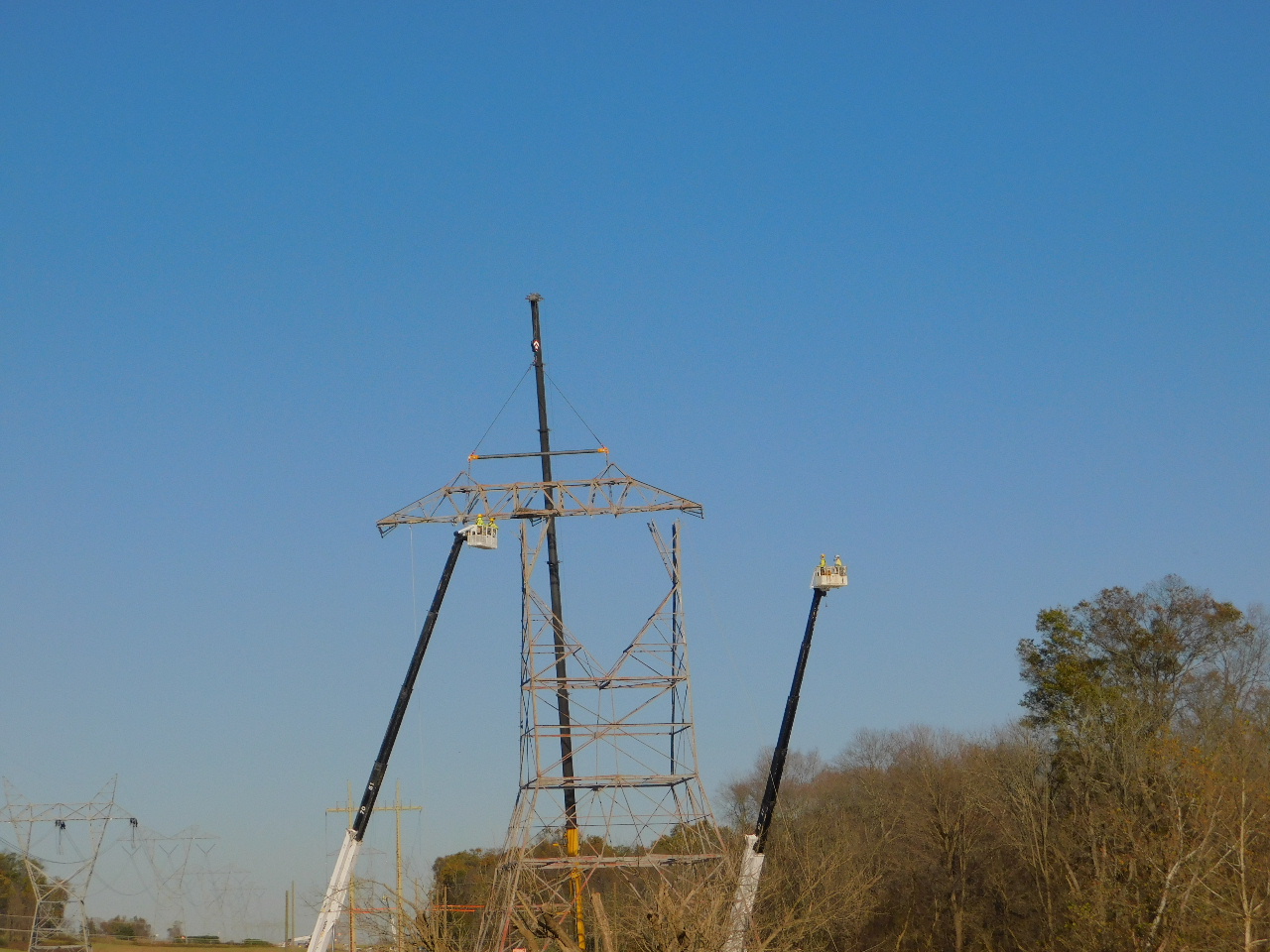
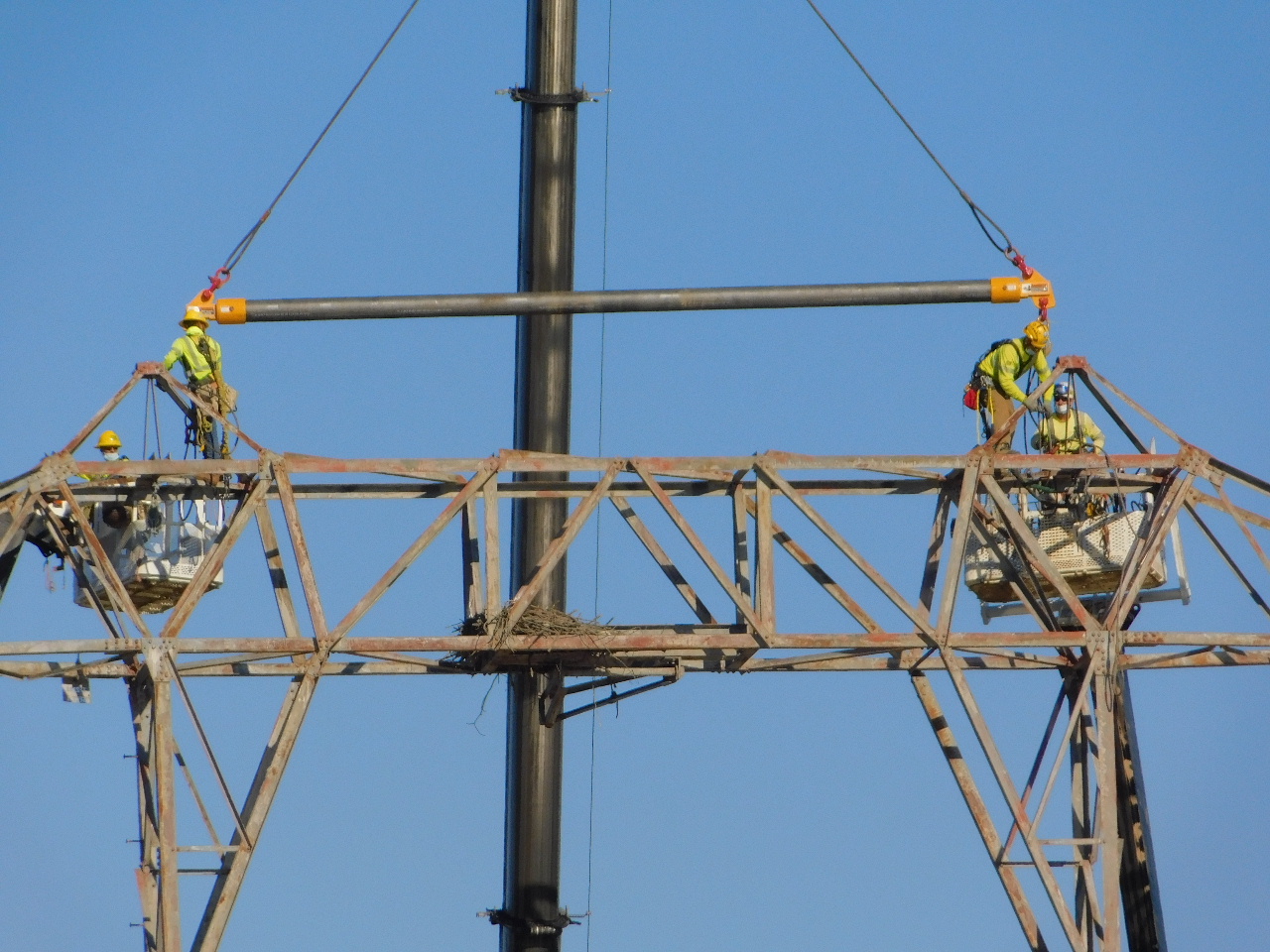
The Three Bridges (Hunterdon County) eagle nest is located on the top arm of an electric transmission tower. This pair has successfully nested on the tower for the past five years. This line of towers is scheduled to be replaced with new monopoles and the work on it has recently begun. PSE&G is cooperating with the NJ Bald Eagle program to move this nest to a new pole platform. Unfortunately, the pair is already on territory and have been observed bringing a stick to the old nest. It is an interesting story of how these eagles are adapting to the human-created environment and how we are trying to accommodate them.
The pair at nest October 17, 2020 before work begins @ Mary Ellen Hill
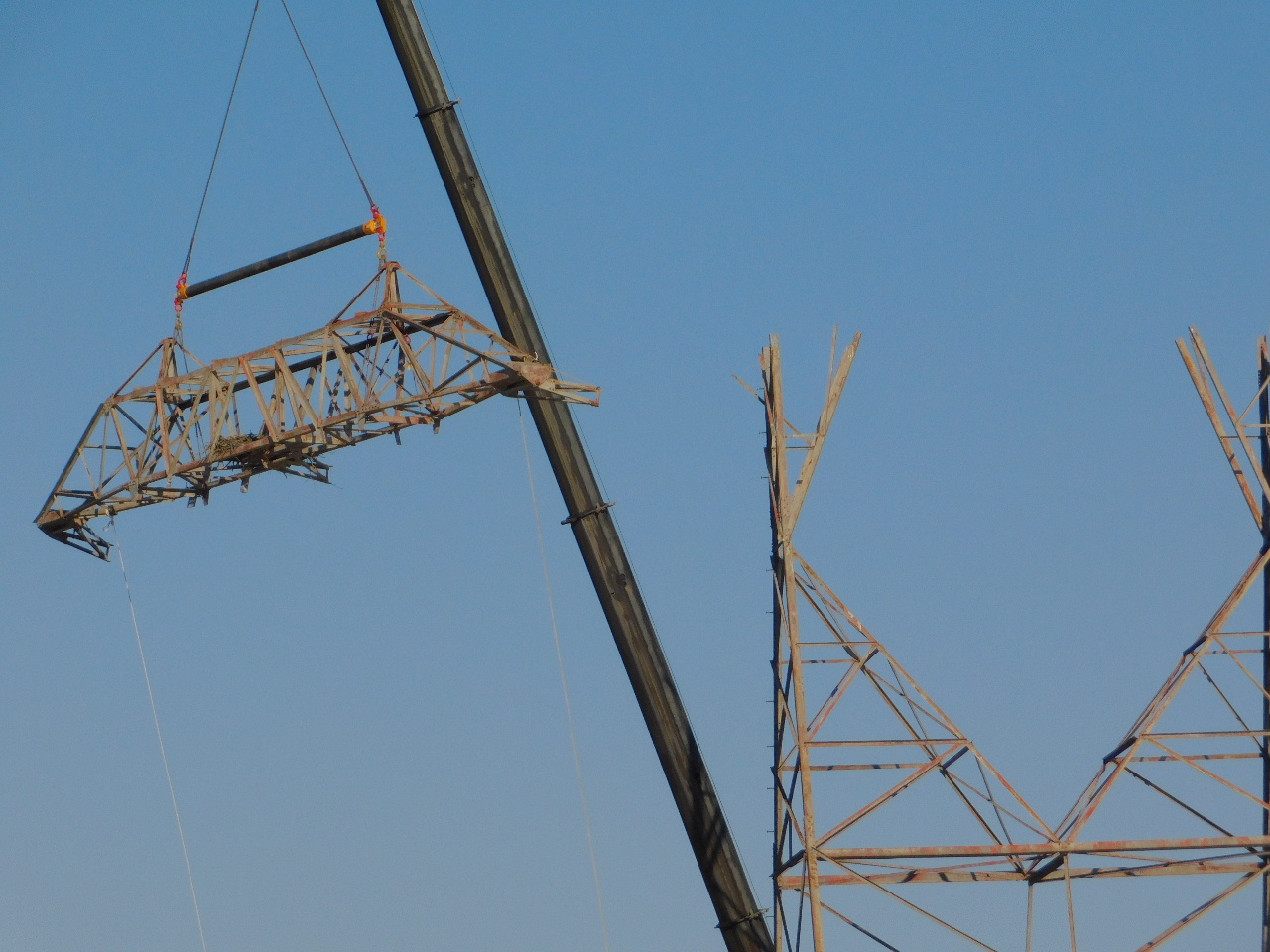
On November 4, PSE&G removed the top of the tower, keeping the nest intact, and lowered it to the ground where they carefully removed the nest from the tower structure. The nest is stored in a shed and will be re-installed on a platform affixed to the new tower when it is erected. We hope the eagle pair accept their remodeled home.
@Barb McKee
@Barb McKee
@Barb Mckee
nest@ Diane Cook
The evening of the nest removal, volunteer Mary Ellen Hill observed the pair sitting together on the adjacent tower.
November 4th, 2020 @ Mary Ellen HillNovember 4th, 2020, pair on adjacent tower after nest removal@ Mary Ellen Hill
We will follow up with part two of this story once the new monopole tower is installed and the nest is placed back up on the platform. We thank all the nest monitors, PSE&G and everyone involved to make this as successful as possible.
Blog written by Eagle Project volunteer, Frank Budney
On June 15th, 2020 a juvenile Bald Eagle was rescued in a most unlikely location; on a major highway, located in an industrial area of Union County. At first glance stories like this usually have an unfortunate ending, considering the location, but the timely arrival of a local Police Officer on patrol saved the day.
This is only part of the story. The eagle in question was one of two nestlings that hatched from a nearby nest back on March 24. Its sibling fledged sometime in late May or early June while this individual remained on nest, branching next to it but never attempting to fly. By June 14, the juvenile in question was still perched next to the nest with no indication that it was about to fly until the following morning when it was rescued.
Some of the species (super) volunteer John King has helped.
When I retired from teaching, one of my first tasks was to search for local organizations that encouraged volunteers, especially in areas of wildlife conservation. Luckily, I found Conserve Wildlife Foundation. I have to say that over the past few years, my volunteer service with CWF has been both rewarding and inspiring!