About the author: Annabel is a sophomore at Indian Hills High School in Oakland, New Jersey. When not helping amphibians cross the road she enjoys photography, the beach and badminton. Thank you for volunteering and sharing your experience Annabel!
Please note: the Amphibian Crossing Project activity described here occurred before restrictions for COVID-19 were in place. At this time CWF is only performing essential wildlife monitoring and conservation duties while practicing social distancing and following all state and CDC guidelines.
In early March, my dad Rick got an email from wildlife biologist Allegra Mitchell of the Conserve Wildlife Foundation of NJ (CWF) saying tonight was the night. My dad came home from work excited, got the flashlights and rain coats out, and called my Aunt June and cousin Sarah asking if they wanted to go with us. We had all signed up to be CWF amphibian crossing volunteers.
Many of our projects have depended on the hard work and dedication of volunteers for years. While some activities have been scaled back this year to keep everyone safe and comply with COVID 19 restrictions, our appreciation is stronger than ever.
Results from 2019 Osprey Nest Surveys highlight another productive year.
by Ben Wurst, Habitat Program Manager
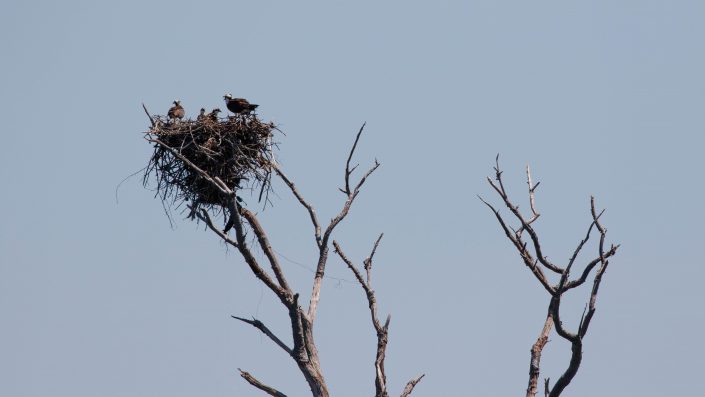
An osprey nest in a snag on Barnegat Bay. July 2019.
Surveys of osprey nests in New Jersey have occurred annually for the past forty five years. They are conducted to help determine the overall size and health of the population. The first aerial survey over Barnegat Bay counted only five active nests. Ten years earlier there had been over 50. The combined effects of DDT and habitat loss had taken their toll. No osprey nests were productive and the population at risk of being extirpated from the state.
“In 1974 there were only five active osprey nests on Barnegat Bay. Today there are approximately one hundred and fifty.”
After ospreys were listed as endangered an innovative effort to transplant viable eggs from the Chesapeake Bay to Barnegat Bay began. In addition, to help replace natural nest sites that were lost to development, man-made nest platforms were designed and installed away from human disturbance. Slowly osprey pairs became productive thanks to the die hard effort of State biologists like Pete McLain, Kathy Clark and many volunteers and partners. It’s encouraging for us to look back to see how far we’ve come in the statewide recovery of ospreys in New Jersey.
Greater Newark community invited to January 16 training with Ridge Street School students to locate Atlantic Coast Leopard Frogs
The Atlantic Coast Leopard Frog Photo by Brian R Curry
Conserve Wildlife Foundation is excited to extend an invitation to the Greater Newark community to train as citizen scientists and help a newly discovered frog species.
reTURN the Favor Honored with 2019 New Jersey Governor’s Excellence Award
By: Meghan Kolk, Wildlife Biologist
Volunteers making piles of rubble at Seabreeze. Photo by Meghan Kolk.
Conserve Wildlife Foundation has been a partner in the reTURN the Favor (RTF) program since its establishment in 2013. This multi-partner program organizes a large group of trained and dedicated volunteers who collectively spend thousands of hours covering miles of Delaware Bay beaches to rescue stranded horseshoe crabs.
This year RTF was honored with a New Jersey’s Governor’s Environmental Excellence Award, New Jersey’s premier awards program for recognizing outstanding environmental performance, programs and projects throughout the state, in the Healthy Ecosystems & Habitats Category.
Atlantic Coast Leopard Frog. Photo by Brian R. Curry.
Amphibians are among the most vulnerable and rapidly declining wildlife groups in the world. Do you want to get out in the field and help frogs here in New Jersey?
Join CWF biologist Allegra Mitchell and be a part of the Kauffeld’s Calling Frogs Citizen Science Monitoring Project.
by Marissa Murdock, 2019 NJ Osprey Project Intern; Rider University ’21
Marissa holds osprey 83/K who was banded after pre-maturely fledging and landing on the ground.
This past summer I was lucky enough to work with Conserve Wildlife Foundation as a volunteer student intern. I worked alongside Ben Wurst, CWF’s Habitat Program Manager, helping with the New Jersey Osprey Project. My internship consisted of assisting with osprey surveys, banding young, and recording data so that we can estimate the health of the population in New Jersey.
January 13, 2019, Mercer County Park. NJ D/99banded at Duke Farms in 2014 @Bob Cook
Conserve Wildlife Foundation of NJ in partnership with the
NJ Division of Fish and Wildlife’s Endangered & Nongame Species Program, is
releasing results of the 2019 NJ Bald Eagle nesting season.
2019 was a record year for NJ eagles with the highest number
of active nests and young fledged in the history of the project. This year, 238 eagle nests were monitored, of
which 189 were active (laid eggs) and 248 young fledged. This is the highest number of fledges ever,
surpassing the previous high of 216 in 2016.
Bald eagle nesting population and young produced in New Jersey, 1982-2019.
We owe the incredible amount of information about NJ eagle success
to the NJ Eagle Project nest watchers. An
extremely dedicated group of approximately 85 volunteers monitor nests during
the season, recording the important dates and watching for possible issues at
nest sites.
This season two eagle cams were available to watch on the CWF website: one at Duke Farms and another at Mercer County Parks. The Duke Farms nest produced two chicks, and one was outfitted with a satellite transmitter; the movements of this eagle are on CWF’s Eagletrax website .
More details on the 2019 nesting season will be available in
the annual eagle report to be posted by December. The report will include individual nest data, state
totals, and eagle recoveries and resightings.
CWF partners with PSEG, the Mercer County Park Commission, Mercer County Wildlife Center, and Wildlife Center Friends and Duke Farms to protect bald eagles in New Jersey. Thank you to the Wakefern Food Corp./ShopRite Markets, Wells Fargo, Chemours and the American Eagle Foundation for additional eagle program funding.
There is a hole in my heart this week after hearing about the passing of my friend Pete Bacinski. I met Pete many years ago when he used to lead NJ Audubon Sussex County weekends jointly with the Weis Ecology Center.