You don’t have to travel far to see amazing wildlife. Our Backyard Safari video series will show you stunning perspectives on wildlife living right in your neighborhood.
Join producer Matt Wozniak for a new adventure each week. This week, Cricket Combat will have you on the edge of your seat. You might not know it, but crickets are fierce fighters! Their pitched one-on-one battles can take place just steps from your back door.
Adventure awaits just outside your door on a backyard safari!
You don’t have to travel far to see amazing wildlife. Our new Backyard Safari video series will show you stunning perspectives on wildlife living right in your neighborhood.
Join producer Matt Wozniak for a new adventure each week. First up, The Antlion’s Trap gives you an up-close-and-personal look at a mighty predator relentlessly trapping its prey, in a dramatic scene that could take place just about anywhere in New Jersey. Thankfully, that predator happens to be only an inch long!
Bats are one of nature’s most misunderstood species. They strike fear in the hearts of many people but in reality they are incredibly beneficial to us. Bats face a multitude of threats and it is up to us to learn to understand and coexist with them if they are to have a future in our state.
The fifth episode of our podcast, State of Change, “The Bat’s Misunderstood Identity” features MacKenzie Hall, biologist at the New Jersey Division of Fish and Wildlife and Ethan Gilardi, assistant biologist with Conserve Wildlife Foundation (CWF).
If lucky, I might cross paths with this terrapin in another decade (if it’s a female) and she overcomes the odds and returns to nest here as an adult.
While out inspecting our newly created terrapin habitat enhancement site in Little Egg Harbor, I found several terrapin hatchlings who were traversing the 36″ high pile of sand. I was expecting to see some hatchlings, since many arise from the protection of nest cavities on warm spring days in April, but not on top of our enhancement site. The moment I spotted one of these half dollar sized turtles, I looked into the distance and saw another.
Congratulations to the winners of Conserve Wildlife Foundation’s Species on the Edge 2.0 social media contest for New Jersey high school students.
Students from all over the state took part in the contest by creating a series of social media posts focusing on one of New Jersey’s vulnerable species. The contest gives students the chance to use their social media skills, and knowledge of wildlife biology, to help imperiled species.
The diamondback terrapin is one of the most beloved species of New Jersey’s coastal salt marshes. Their popularity has not protected them from the rapid development of our coast however, and climate change is calling their future into question.
Terrapin and human interaction has been fraught with peril for the turtles for a long time. They used to be considered a delicacy and were almost wiped by the 1920s when, in an odd turn of events, they were saved by prohibition. Turns out that once terrapin stew no longer featured copious amounts of alcohol, people noticed they did not, in fact, taste very good.
The fourth episode of our podcast, State of Change, “The Terrapin’s Troubles” features John Wnek, Project Terrapin coordinator and supervisor and researcher at the Marine Academy of Technology and Environmental Science (MATES), and Ben Wurst, Conserve Wildlife Foundation (CWF) habitat program manager.
Results from 2019 Osprey Nest Surveys highlight another productive year.
by Ben Wurst, Habitat Program Manager
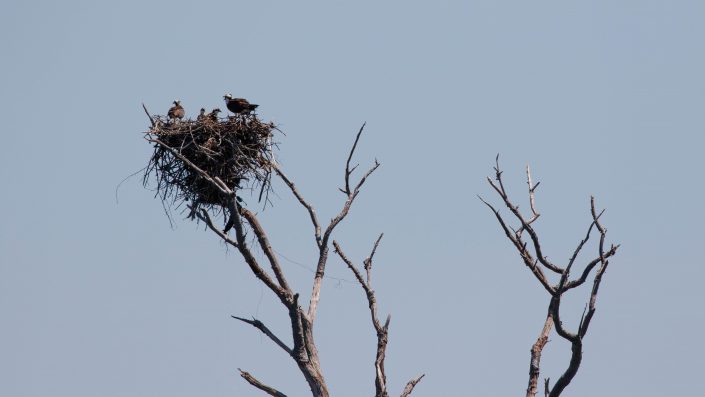
An osprey nest in a snag on Barnegat Bay. July 2019.
Surveys of osprey nests in New Jersey have occurred annually for the past forty five years. They are conducted to help determine the overall size and health of the population. The first aerial survey over Barnegat Bay counted only five active nests. Ten years earlier there had been over 50. The combined effects of DDT and habitat loss had taken their toll. No osprey nests were productive and the population at risk of being extirpated from the state.
“In 1974 there were only five active osprey nests on Barnegat Bay. Today there are approximately one hundred and fifty.”
After ospreys were listed as endangered an innovative effort to transplant viable eggs from the Chesapeake Bay to Barnegat Bay began. In addition, to help replace natural nest sites that were lost to development, man-made nest platforms were designed and installed away from human disturbance. Slowly osprey pairs became productive thanks to the die hard effort of State biologists like Pete McLain, Kathy Clark and many volunteers and partners. It’s encouraging for us to look back to see how far we’ve come in the statewide recovery of ospreys in New Jersey.
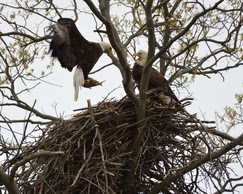
Nesting bald eagles return to the capital county. Photo by Kevin Buynie.
Join the Mercer County Park Commission, Conserve Wildlife Foundation of New Jersey (CWF), PSE&G and the Wildlife Center Friends for the the second year of “Eyes on Eagles” programming to celebrate the four pairs of bald eagles that nest in Mercer County, including two pairs that have chosen County parks for nest sites.