Conserve Wildlife Foundation is excited to release Pollinators in Peril, the third episode of ‘State of Change’, our podcast exploring the impacts of climate change on New Jersey’s wildlife.
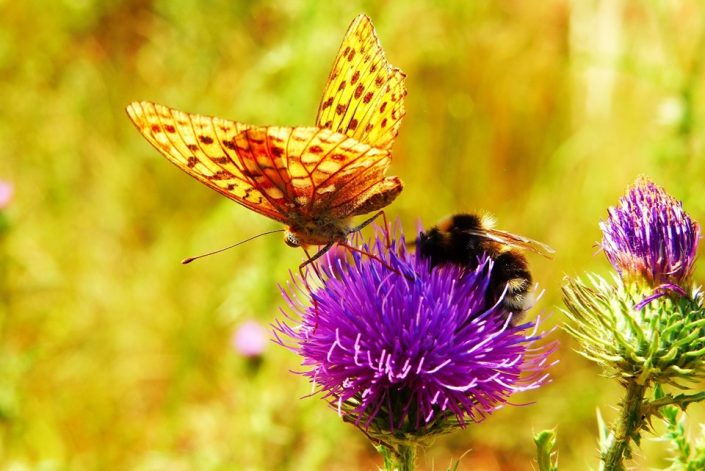
Pollinators like bees, butterflies, flies, beetles, moths and other insects are facing perilous times due to pesticides, habitat loss and climate change. Photo by Krzysztof Niewolny from Pixabay.
The New Jersey conservation community lost a great champion with the passing of Diane Soucy of The Raptor Trust this month. Diane was a tireless advocate for New Jersey’s wildlife, and a co-founder and driving force behind the Trust’s amazing success in caring for over 150,000 songbirds, wading birds, waterfowl, hummingbirds, and – of course – raptors.
Diane Soucy feeding a songbird at The Raptor Trust using a formula she perfected over the years. Photo courtesy of The Raptor Trust.
Greater Newark community invited to January 16 training with Ridge Street School students to locate Atlantic Coast Leopard Frogs
The Atlantic Coast Leopard Frog Photo by Brian R Curry
Conserve Wildlife Foundation is excited to extend an invitation to the Greater Newark community to train as citizen scientists and help a newly discovered frog species.
Conserve Wildlife Foundation is excited to release The Red Knot’s Journey, the second episode of ‘State of Change’, our podcast exploring how climate change is affecting wildlife in New Jersey.
New Jersey has more people per square mile than any other state by far. It’s not an easy place for wildlife to survive. Yet countless wildlife species from bald eagles to bobcats are doing just that.
But what happens when you inject climate change into the mix? Superstorms and sea level rise, coastal erosion and salt water intrusion, invasive species, disrupted life cycles and wildlife disease.
Conserve Wildlife Foundation is excited to introduce the ‘State of Change’ podcast that explores how climate change is affecting wildlife in our state. Hosted by CWF executive director David Wheeler and produced by Matt Wozniak, each episode highlights a different climate change issue – and every story helps paint a portion of the big picture of our changing world.
Atlantic Coast Leopard Frog. Photo by Brian R. Curry.
Amphibians are among the most vulnerable and rapidly declining wildlife groups in the world. Do you want to get out in the field and help frogs here in New Jersey?
Join CWF biologist Allegra Mitchell and be a part of the Kauffeld’s Calling Frogs Citizen Science Monitoring Project.
CWF partners with NJ Fish & Wildlife to enhance habitat for terrapins in Little Egg Harbor
by Ben Wurst, Habitat Program Manager
A female terrapin nesting along Great Bay Blvd.
Northern diamondback terrapins are a coast hugging, saltmarsh living, shellfish eating, aquatic turtle. Their ultimate survival depends on the ability of adult females to safely access nesting areas during summer months. Since 2010 CWF has worked to document and reduce roadkills of terrapins on roads in southern Ocean and northern Atlantic Counties.
A piping plover chick tests out its wings. Photo courtesy of Bill Dalton.
A new report from Conserve Wildlife Foundation and the New Jersey Division of Fish and Wildlife shows that the state’s piping plover population increased in 2019, leading to cautious optimism for the birds’ long term prospects. The piping plover is listed as threatened federally and endangered in New Jersey.
One hundred fourteen pairs of piping plovers nested in New Jersey in 2019, a 19% increase over 2018’s 96 pairs. The 2019 population is slightly below the long-term average of 117 pairs and well below the peak of 144 pairs in 2003.
Piping plover productivity, measured by the number of chicks who survive until their first flight (or fledging), dropped from 1.51 in 2018 to 1.24 in 2019, and was the lowest seen in the last six years, but remains above the long-term average of 1.3.
New Jersey’s conservation community came together on November 13, 2019 to celebrate five extraordinary women and their accomplishments in wildlife conservation.
The 14th annual Women & Wildlife Awards were held on November 13, 2019 at Duke Farms. Photo by Bryan Duggan Photography.
by Marissa Murdock, 2019 NJ Osprey Project Intern; Rider University ’21
Marissa holds osprey 83/K who was banded after pre-maturely fledging and landing on the ground.
This past summer I was lucky enough to work with Conserve Wildlife Foundation as a volunteer student intern. I worked alongside Ben Wurst, CWF’s Habitat Program Manager, helping with the New Jersey Osprey Project. My internship consisted of assisting with osprey surveys, banding young, and recording data so that we can estimate the health of the population in New Jersey.