Last week, Conserve Wildlife joined the American Littoral Society at their annual Parade of Boats event in conjunction with the Operation Oyster program.
Conserve Wildlife, through funding from NOAA’s Marine Debris Program, has spent the last several years in a related effort to clean up Barnegat Bay. Removing derelict crab traps or ghost pots from the bay has been an ongoing initiative. Ghost pots are lost in a variety of ways including improper rigging to buoys and buoy lines cut by passing boat traffic.
The issue spans not only the commercial crabbing industry, but the recreational industry as well. The longer the pots sit on the bottom of the bay the more likely they are to serve as a deathtrap for a variety of marine species. The more marine life that becomes trapped the more the pots continue to attract other marine life. This is of particular concern for Northern Diamondback Terrapins that frequently investigate these pots looking for a quick meal only to be trapped and quickly drown. Continue reading “Helping oysters recover in Barnegat Bay through our crab pot recycling program”
Thanks to dedicated Conserve Wildlife Foundation of NJ staff and volunteers three osprey chicks were saved from what could have been an unhappy fate.
NJ Osprey Project Volunteers Matt Tribulski, Wayne Russell and John King were surveying osprey nests in the Wildwood back bay area this past weekend. They checked on a nest with three chicks and found that the platform top was broken and a strong possibility it could collapse, especially with any heavy rains or winds. The chicks weren’t old enough to fly and would have fallen to the marsh and died. Continue reading “Osprey Chicks Get A Necessary “Home” Upgrade”
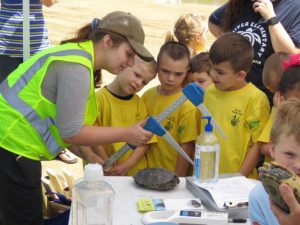
ESTIMATING AGE: Marissa Thomasen shows Bass River School children how she measures the carapace of a terrapin for her data log. Photo by Pat Johnson, The Sandpaper
Giving kids a head start in learning about nature is the point of Head Start Terrapins, a school course started by the Ocean County MATES program and Conserve Wildlife Foundation of New Jersey. Last October, Ben Wurst, CWFNJ project manager for Bass River and Balanger Creek, picked up seven quarter-sized baby diamondback terrapins from the roadside on Great Bay Boulevard, Little Egg Harbor Township.
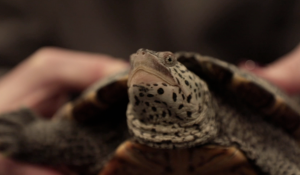
Crabbing has been an annual tradition of residents and visitors to the Barnegat Bay region. Yet when those crab pots are abandoned or adrift, they can become death traps for local wildlife, including at-risk species like diamondback terrapin.
Conserve Wildlife Foundation’s new video “Fishing for a Cleaner Barnegat Bay” details this complex ecological challenge. Produced by Citizen Racecar, the video is now available to the public here.
Due to a passing boat, a storm, or simply forgetfulness, abandoned “ghost” crab pots litter Barnegat Bay, continuing to catch crabs and fish. Worst of all is that when animals get stuck in a crab pot, they attract more animals, which in turn also are trapped. Each animal caught acts as bait for new animals to come along.
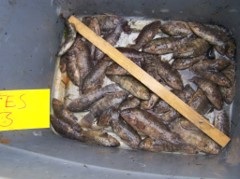
Some fish species that get caught are blackfish and sea bass. And since the crab pots are just lying at the bottom of the Bay, they do not get emptied out. As a result, any fish that get caught in the crab pots can’t escape and end up starving to death.
Some bycatch findings in retrieved crab pots
Fish are not the only victims of the crab pot death traps – the famous diamondback terrapin, a turtle species that is currently experiencing an alarming population decline rate, also is a common victim of being trapped by abandoned crab pots. One crab trap has even been found to contain 17 dead terrapins.
Fortunately, there is a solution to this problem, as described in the video. Conserve Wildlife Foundation, supported by the National Oceanic and Atmospheric Association’s Marine Debris Removal Program, is tackling the problem directly by finding and removing abandoned crab pots from the water. GPS grid and SONAR imagery from Stockton State University allows recovery teams to find exactly where the crab pots are located. Low-cost SONAR devices can even be used by well-trained fishermen to find their own crab pots merely days after losing them.
Over 1,300 abandoned crab traps were picked up by the program in Barnegat Bay over the past two winters. Ultimately, the metal used in the crab traps is either recycled or used to create energy by corporate partners Covanta and Schnitzer Steel.
“This is a true environmental success story because it addresses a serious ecological problem by creating ecological and economic benefits for the good of the greater Barnegat Bay community,” says CWF Executive Director David Wheeler. “Thanks to local fishermen and volunteer students, removing these death traps has prevented countless at-risk diamondback terrapins and other species from drowning unnecessarily. It also has strengthened public safety by removing navigational hazards from the bay.”
In addition to NOAA’s support for the project, the video was made possible by funding from the New Jersey Corporate Wetlands Restoration Partnership. Other project partners and supporters include the Marine Academy of Technology and Environmental Science – Ocean County Vocational Technical School, Stockton University, Monmouth University, American Littoral Society, Covanta, and ReClam the Bay.
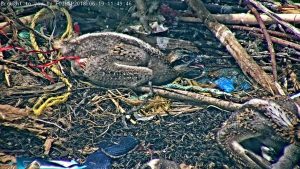
An osprey with a balloon ribbon around its leg at Island Beach State Park. Volunteers from the Conserve Wildlife Foundation of New Jersey removed the ribbon and cleaned the osprey’s nest on Tuesday afternoon. Photo by Jeff Goldman, NJ.com
Two volunteer groups and the Seaside Heights public works department teamed to help a baby osprey that had a balloon ribbon tangled around its leg in a nest at Island Beach State Park.
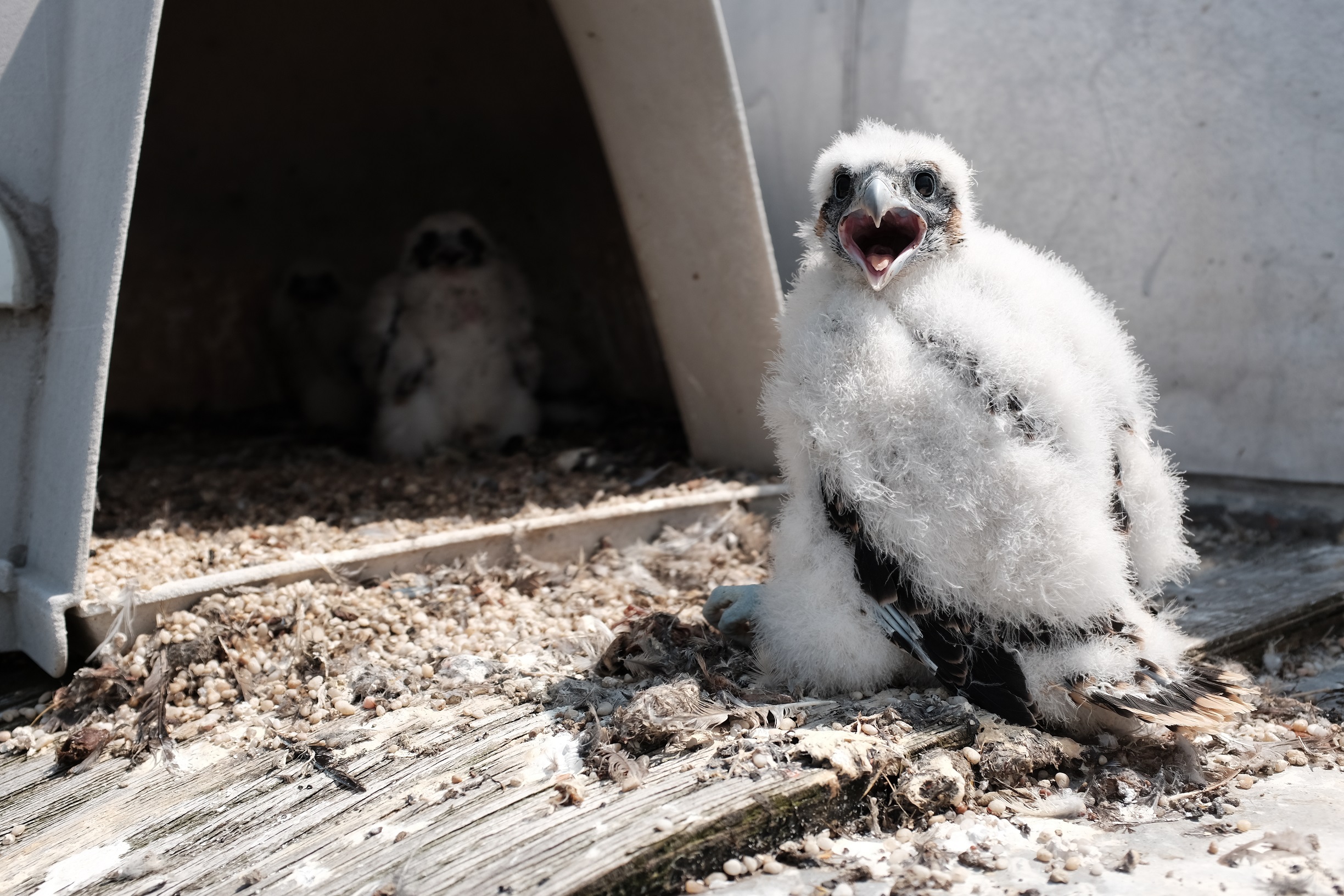
Earlier this week we visited two urban falcon eyries to band young for future tracking. Both bandings were streamed live on our Facebook page. Here at the Elizabeth eyrie, BD/73 showed us who rules the roost! We have a feeling that we’ll be seeing her again sometime in the future!
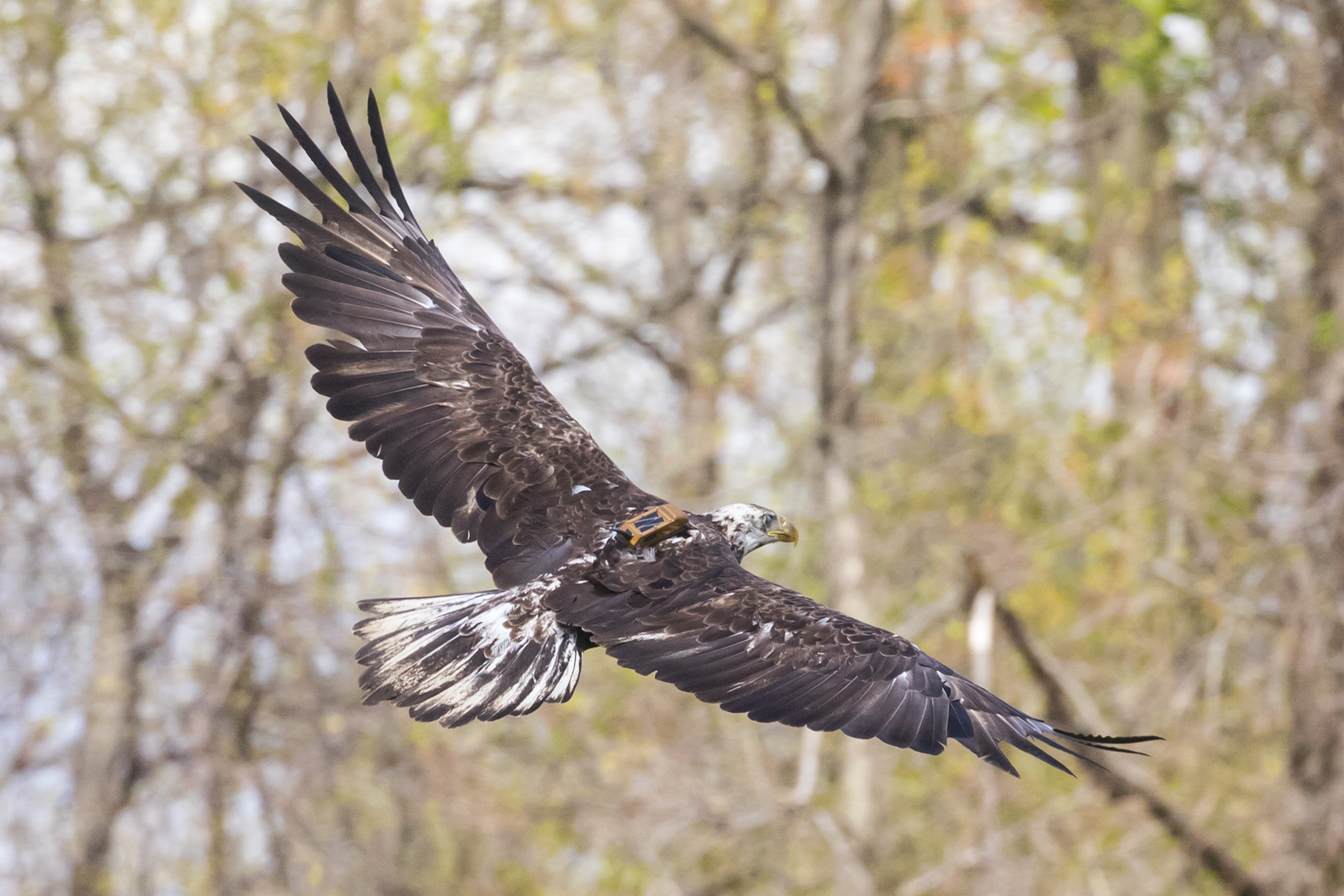
Bald eagle rescued, rehabilitated and released with satellite transmitter to track movements
by Kathy Clark, Endangered & Nongame Species Program, NJ Division of Fish & Wildlife
Pedro takes flight! photo by Marian Quinn.
On Sunday, April 15th, I got a call that three bald eagleswere spotted in a farm field. Not too unusual in rural Salem County, but this good neighbor was rightly concerned that something was wrong. Pedricktown resident Steve Wilson approached the eagles and not only did they not fly away from him, but two could barely sit upright and a third was stumbling away. Steve made phone calls and, at 7:30 at night, couldn’t reach any of the wildlife centers or offices. Persisting, he made a connection with Dr. Erica Miller, a wildlife veterinarian who for over 20 years was both clinician and surgeon atTri-State Bird Rescue & Research in Newark, Delaware. Erica is also a long-time partner on the NJ Bald Eagle Project, and called me about 7:45 that evening. Continue reading “Quick Action Ensures Survival of Poisoned Eagles”
Horseshoe Crabs Just Beginning To Breed as Shorebirds Arrive
Delaware Bay horseshoe crab eggs reach sufficient levels to give red knots and other shorebirds a good start on the fat they need to fuel the last leg of their yearly journey in the first week of the stopover ( May 12-19). Knots need at least 180 grams to fly to the Arctic and breed successfully. This week we caught birds that weighed 93 grams which is 30 grams below fat-free weight. These birds had just arrived from a long flight, probably from Tierra del Fuego, Chile or Maranhão, Brazil. In the same catch, we weighed red knots as high as 176 grams or only 5 grams from the 180-gram threshold. These birds are probably from Florida or the Caribbean wintering areas and so arrive earlier, resulting in them having more time to gain weight. All together it looks like a normal early migration and a modest horseshoe crab spawn, just barely enough for the birds in the bay.
Our team prepares a catch of knots turnstones and semipalmated sandpipers for extraction to keeping cages. The birds will be covered to prevent feather abrasion before extraction (Photo by Stephanie Feigin)
However, we are still short of about half the population. Our bay wide count won’t take place until next week on May 22 and 26. At this point it looks like we have about 14,000 knots in the bay, of which 8,000 are in New Jersey. In the last 5 years we have had a bay wide population of about 24,000 red knots. The situation is similar for ruddy turnstones and sanderlings. The southernly winds of the next few days will almost certainly bring in the rest of the flock by mid-week.
The Stopover Habitat is Growing
The condition of the stopover is mixed.
The work of Niles & Smith Conservation Services, Conserve Wildlife Foundation of NJ, and American Littoral Society continues to supply high-quality habitat for horseshoe crabs. We have developed an efficient system for maintaining the essential requirements of a good spawning beach, deep and large grain sand with berm heights that prevent over washing in a way that keeps cost down. First, by creating low oyster reefs to break waves in lower tides, thus protecting beaches from wind waves at low and mid tides. Second, by placing sand on beaches that typically erode fast losing sands to adjacent creek inlets and the next beach south. This way we can use one restoration to restore three different places. For example, Cooks Beach loses sand to South Reeds.
Thompsons beach before and after restoration by American Littoral Society and partners. (Photo by Larry Niles)
Oddly these successes may be contributing to the next big problem for the birds. The state of Delaware has been carrying out much larger scale beach replenishment projects that have added significant new sandy beach for crabs spawning. At the same time the Atlantic States Marine Fish Commission has failed to deliver on its promise to increase the number of crabs. The population is still 1/3 below carrying capacity or the number that existed 20 years ago. The same number of crab divided by more beach equals decreasing crab densities. Decreasing densities means fewer eggs reaching the surface because crabs are not digging up existing eggs to lay their own.
In other words, we need more crabs.
The Industry Finds New Ways around the ARM Quota
But the resource agencies seem perfectly happy to keep killing adult crabs for both bait and bleeding at near historically high numbers. Bait harvests recorded as coming from the bay have stayed the same, however other states such as NY are still taking and landing large numbers of crabs despite having no known crab historic population of their own. Additionally, Virginia states that a crab population still exists in the state, even though most field biologists consider them lost. The truth is they are very likely taking Delaware Bay crabs and landing them as their own.
The Conservation groups are no longer satisfied with this loose regulation and are calling for regulations similar to those used for Striped Bass. The Delaware Bay harvest should be restricted to just the quota agreed upon by everyone through the Adaptive Resource Management system. All other landed crabs should be genetically linked to a source population, and if they do in fact come from Delaware Bay they should be taken out of the ARM quota. No one should be allowed to get away with killing our crabs outside the quota.
This graph compares the finding of Botton et al 1994 from horsesoe crab egg surveys done in 1990 and recent counts done in 2017
The same goes for the killing of crabs by the companies bleeding crabs. The industry makes untold millions (the numbers are hidden from the public) but does virtually nothing to conserve the crabs while killing thousands. Their own estimate is well over 65,000 a year, but independent estimates double that. This killing could also stop because a new synthetic lysate is available and can be used now, potentially cutting the need for natural lysate by 90%.
An Ecosystem Collapse and the Need for More Crabs
Why kill such a valuable animal? It all started because the fishing industries saw little value and figured why not destroy the population until they are no longer economically viable. Its called economic extinction and sadly it’s a tradition amongst Delaware Bay fishers still carried out this to this day on eels, conch, and other species. But they didn’t know back in the early 90’s they would wrecking the entire ecosystem.
In 1991, we counted an average of 80,000 horseshoe crabs/meter squared. Now we count 8,000. Then the eggs stayed at that level for all of May and June then hatched young at similar densities. In other words, the horseshoe crab was a keystone producer of an abundant resource that maintained the bay ecosystem. It was not just chance that at the same time the bay has one of the most productive weakfish and blue claw crab fisheries in the Atlantic coast. Fish populations blossomed with the flush of horseshoe crab eggs and hatched young each year.
Now we must bring it back. For the birds, for the fish, and for the people who love to bird and fish.
A storm looms over Delaware Bay. The last 4 days have been rain, some intense and cold. The water temperature needs to be 59 degrees or so for Crabs to spawn. On Saturday the 19th the water temperature fell below and the spawn virtually stopped in many places. It should resume with the warmer temperatures of Saturday and Sunday.
We are grateful to the National Fish and Wildlife Foundation and other donors who make this project possible.
Dr. Larry Niles has led efforts to protect red knots and horseshoe crabs for over 30 years.
Human Interaction and Quick Action Ensure Survival of Young Falcons in Urban Areas
by Ben Wurst, Habitat Program Manager
Yesterday NJ Fish & Wildlife Zoologist Kathy Clark and I visited 101 Hudson St. after watching the Jersey City Falcon Cam for several days since the first and only egg hatched on Wednesday evening, we became more and more concerned for the health of the 5 day old eyas. We also came upon a brood of three young (and healthy) falcons who were displaced (we’ve called them orphans) from the old Goethals Bridge, which is currently being deconstructed. Knowing that the orphans needed a home, we decided to visit JC and assess the health of the lone eyas, collect the unhatched eggs, and possibly foster in the orphans here. Continue reading “Management of Urban Nesting Falcons in New Jersey”
 Last week, Conserve Wildlife joined the American Littoral Society at their annual Parade of Boats event in conjunction with the Operation Oyster program.
 Crabbing has been an annual tradition of residents and visitors to the Barnegat Bay region. Yet when those crab pots are abandoned or adrift, they can become death traps for local wildlife, including at-risk species like diamondback terrapin.