Support New Jersey’s ospreys with donations matching a $12,500 challenge to help Conserve Wildlife Foundation purchase a boat.
by Ben Wurst, Habitat Program Manager
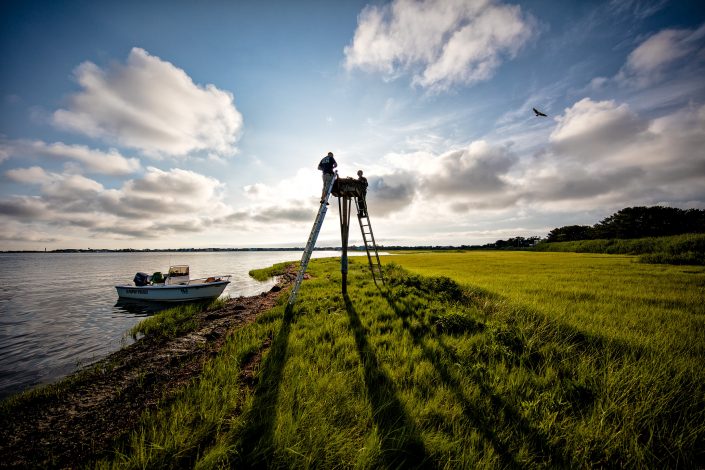
Surveying a nest on Long Beach Island in 2017, the last year we were able to utilize a state owned boat. photo by Northside Jim.
Ospreys are living barometers. They symbolize the resilience of life along the New Jersey coast. As a top tier predator who feeds exclusively on fish, their collective health is a direct link to the health of our coastal waters. Anyone can tell you that a healthy coast is essential to life at the shore. Clean water with abundant and healthy wildlife equals a booming shore economy. We have all benefited from actions and policy that have protected our air, land and water since the 1970s. Ospreys are no exception.
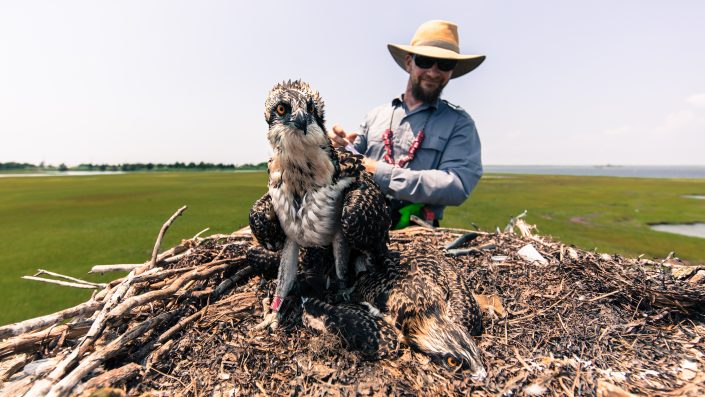
Banding osprey nestlings with red auxiliary bands at a nest off LBI. photo by Northside Jim.
If you live along or visit the coast, then it’s no surprise that ospreys continue to thrive in New Jersey. 2018 was yet another banner year for these coastal nesting raptors. Their large stick nests depict our rivers and estuaries while they indicate that we’re doing a good job of protecting our local environment along the coast. Today we’ve published results from last year’s nesting season in the 2018 New Jersey Osprey Project Report.
On a brisk November morning, a couple dedicated NJ Osprey Project volunteers joined myself and CWF Biologist Larissa Smith to install an osprey platform on the coastal saltmarsh of New Jersey. The new platform was installed to replace a very old and unstable platform that fell this summer. The new structure is more than twice the size of the old one and will give the nesting pair, who return in the spring, a much more resilient nest site. As you can see from the video above, it takes a bit of strength to raise up a 16′ tall wood nest platform. We decided to slow it down when WCC Volunteer, Wayne R. gives it a final push. Continue reading “Video from the Field: Osprey Platform Install”
The threats are real and these photos should alarm you!
by Ben Wurst, Habitat Program Manager
U.S. Coast Guard assists NJ Fish & Wildlife with recovering an entangled osprey on a channel marker in Cape May Harbor, Summer 2018. photo by Kathy Clark/ENSP
Andrew Drummond captured this image of “Harmony 2” on Memorial Day in Marlboro, VT. She was banded as D/64 and outfitted with a transmitter May 29th, 2012 at Merrill Creek, Warren County. We have since been following her movements on Eagle Trax. She fledged in 2012 and spent her first winter on the lower Chesapeake Bay before traveling to Maine. She has spent the last five years in a 100-mile swath of western Connecticut and Massachusetts, and now into southern Vermont. She is of breeding age so we suspect that she will be nesting in the area next season.
The Amazing History of a Breeding Adult Male Osprey at Island Beach State Park
by Ben Wurst, Habitat Program Manager
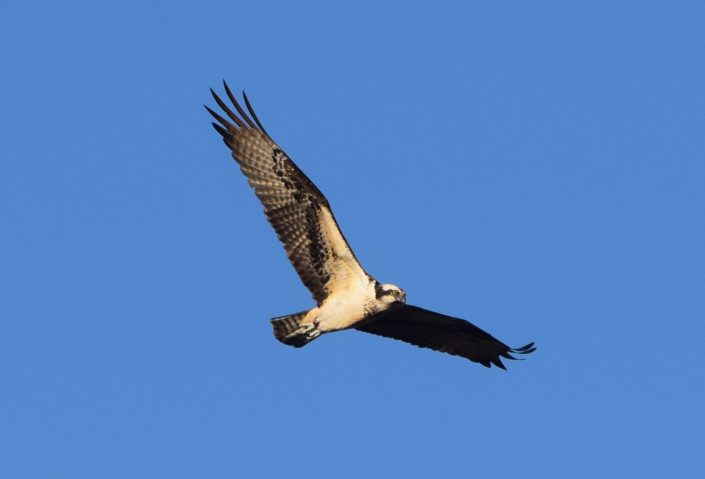
Bandit in flight while carrying nesting material. He has been nesting at the Pete McLain Osprey Cam nest since 2013. photo by Karl Soehnlein.
Around 3% of ospreys who were banded with USGS aluminum bird bands as nestlings in New Jersey are re-sighted after fledging or leaving their nest. Most of those recoveries or resightings are centered around mortality based events where a bird is injured or killed and the band is then close enough to read. Since the numbers on the leg bands are so small, it is often hard to read when they are still alive. However, when enough photos are obtained or a camera is installed on a nest then the likelihood of reading the band on a live bird increases. Continue reading “Identifying “Bandit” at Pete McLain Osprey Cam Nest”
Barnegat Bay Osprey Returns to New Jersey After Two Year Vacation
by Ben Wurst, Habitat Program Manager
04/D was photographed in Allendale at the Celery Farm by Barbara Dilger on Monday, April 23.
North American ospreys migrate long distances to and from their breeding and wintering grounds in the southern U.S., Central America, Caribbean Islands, and N. South America. For the past four years we have been banding young ospreys who originate from nests on Barnegat Bay with an auxiliary band to help determine their movements after fledging. Project RedBand was designed to help track the migration, dispersal, life span, and foraging habits of ospreys from Barnegat Bay, a unique estuary along the Atlantic Coast of New Jersey. The project was also designed to help engage the public in osprey management and conservation. Since the red bands are highly visible and readable with optics, it allows the public the ability to identify the individual and then learn about their past. Lastly, we now rely heavily on citizen scientists who report nesting activity on Osprey Watch. Continue reading “Osprey 04/D Back in Jersey!”
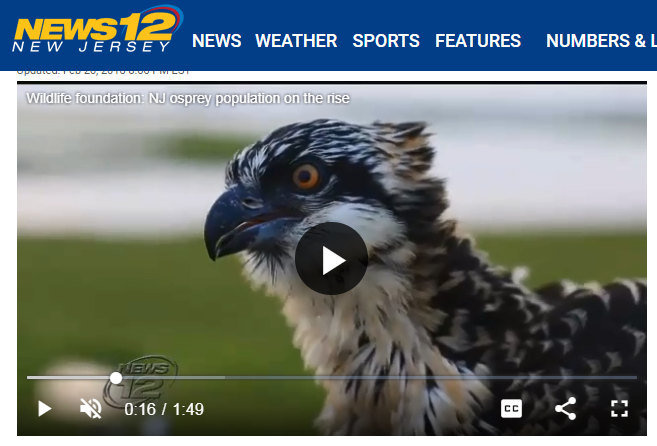
On a cool and cloudy Monday morning, CWF Habitat Program Manager, Ben Wurst was joined by News 12 New Jersey reporter, Tony Caputo to highlight the osprey’s triumphant recovery in the Garden State. Ben was working in the field to repair a few osprey nests and complete the first of several nest checks at a nearby peregrine falcon nest. We work tirelessly to ensure that when ospreys return from their wintering areas that their nesting platform are in good condition.