The 2020 nesting season is off to a good start for New Jersey’s bald eagles. As of early March, eagles all over the state are incubating eggs, and a handful of nests have already successfully hatched chicks. The eagle cam at Duke Farms broadcast the first chick there hatching on February 26, and the second chick made its appearance on March 1st.
The diamondback terrapin is one of the most beloved species of New Jersey’s coastal salt marshes. Their popularity has not protected them from the rapid development of our coast however, and climate change is calling their future into question.
Terrapin and human interaction has been fraught with peril for the turtles for a long time. They used to be considered a delicacy and were almost wiped by the 1920s when, in an odd turn of events, they were saved by prohibition. Turns out that once terrapin stew no longer featured copious amounts of alcohol, people noticed they did not, in fact, taste very good.
The fourth episode of our podcast, State of Change, “The Terrapin’s Troubles” features John Wnek, Project Terrapin coordinator and supervisor and researcher at the Marine Academy of Technology and Environmental Science (MATES), and Ben Wurst, Conserve Wildlife Foundation (CWF) habitat program manager.
Results from 2019 Osprey Nest Surveys highlight another productive year.
by Ben Wurst, Habitat Program Manager
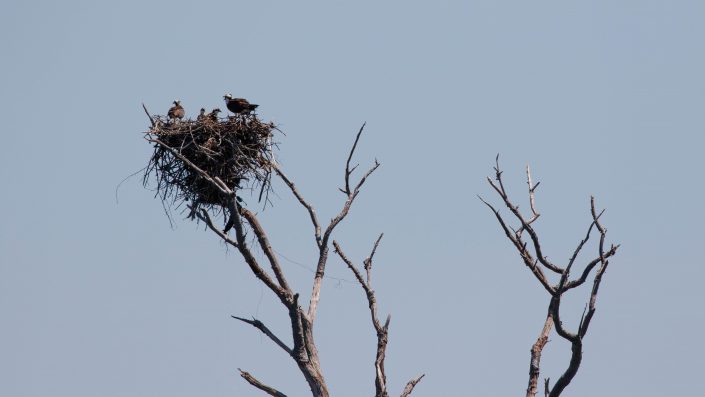
An osprey nest in a snag on Barnegat Bay. July 2019.
Surveys of osprey nests in New Jersey have occurred annually for the past forty five years. They are conducted to help determine the overall size and health of the population. The first aerial survey over Barnegat Bay counted only five active nests. Ten years earlier there had been over 50. The combined effects of DDT and habitat loss had taken their toll. No osprey nests were productive and the population at risk of being extirpated from the state.
“In 1974 there were only five active osprey nests on Barnegat Bay. Today there are approximately one hundred and fifty.”
After ospreys were listed as endangered an innovative effort to transplant viable eggs from the Chesapeake Bay to Barnegat Bay began. In addition, to help replace natural nest sites that were lost to development, man-made nest platforms were designed and installed away from human disturbance. Slowly osprey pairs became productive thanks to the die hard effort of State biologists like Pete McLain, Kathy Clark and many volunteers and partners. It’s encouraging for us to look back to see how far we’ve come in the statewide recovery of ospreys in New Jersey.
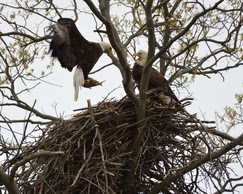
Nesting bald eagles return to the capital county. Photo by Kevin Buynie.
Join the Mercer County Park Commission, Conserve Wildlife Foundation of New Jersey (CWF), PSE&G and the Wildlife Center Friends for the the second year of “Eyes on Eagles” programming to celebrate the four pairs of bald eagles that nest in Mercer County, including two pairs that have chosen County parks for nest sites.
Ben Wurst, Conserve Wildlife Foundation Biologist, with peregrine falcon.
The peregrine falcon’s New Jersey comeback story continued in 2019. The number of young produced rose slightly to 78 in 2019, as compared to 75 in 2018. The adult population was slightly lower at 38 known pairs, as compared to 40 known pairs in 2018.
Peregrine falcon populations had plummeted across much of the United States due to widespread use of the pesticide DDT before it was banned in 1972. Since the early 1980’s, peregrine falcons have been recovering at a slow but steady pace in New Jersey. While population numbers continue to increase, peregrine falcons still face a number of serious threats in New Jersey, particularly contaminants like pesticides, PCBs, and heavy metals in the food web.
Conserve Wildlife Foundation (CWF) and our partner New Jersey Division of Fish and Wildlife’s Endangered and Nongame Species Program (ENSP) recently released the 2019 New Jersey Peregrine Falcon Research and Management Program Report highlighting the continued recovery of the peregrine falcon in New Jersey.
Conserve Wildlife Foundation is excited to release Pollinators in Peril, the third episode of ‘State of Change’, our podcast exploring the impacts of climate change on New Jersey’s wildlife.
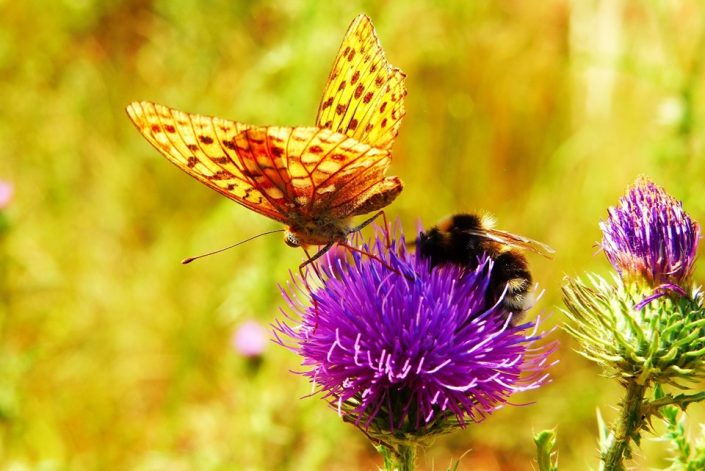
Pollinators like bees, butterflies, flies, beetles, moths and other insects are facing perilous times due to pesticides, habitat loss and climate change. Photo by Krzysztof Niewolny from Pixabay.
The New Jersey conservation community lost a great champion with the passing of Diane Soucy of The Raptor Trust this month. Diane was a tireless advocate for New Jersey’s wildlife, and a co-founder and driving force behind the Trust’s amazing success in caring for over 150,000 songbirds, wading birds, waterfowl, hummingbirds, and – of course – raptors.
Diane Soucy feeding a songbird at The Raptor Trust using a formula she perfected over the years. Photo courtesy of The Raptor Trust.
The Division of NJ Fish and Wildlife along with the Conserve Wildlife Foundation of NJ, released the 2019 New Jersey Bald Eagle Project Report. 2019 was a good year for eagles as a record high of 249 eagles fledged from nests. Two hundred eleven nest sites were monitored of which 190 were active (with eggs) and 21 were territorial or housekeeping pairs. The success of the eagle project is due to the dedication of the NJ Eagle Project volunteers who monitor and protect eagle nests throughout the state.
Conserve Wildlife Foundation is excited to release The Red Knot’s Journey, the second episode of ‘State of Change’, our podcast exploring how climate change is affecting wildlife in New Jersey.
reTURN the Favor Honored with 2019 New Jersey Governor’s Excellence Award
By: Meghan Kolk, Wildlife Biologist
Volunteers making piles of rubble at Seabreeze. Photo by Meghan Kolk.
Conserve Wildlife Foundation has been a partner in the reTURN the Favor (RTF) program since its establishment in 2013. This multi-partner program organizes a large group of trained and dedicated volunteers who collectively spend thousands of hours covering miles of Delaware Bay beaches to rescue stranded horseshoe crabs.
This year RTF was honored with a New Jersey’s Governor’s Environmental Excellence Award, New Jersey’s premier awards program for recognizing outstanding environmental performance, programs and projects throughout the state, in the Healthy Ecosystems & Habitats Category.