NEW, WEEKLY UPDATES FROM NEW JERSEY’S BEACH NESTING BIRD PROJECT TEAM
by Todd Pover, Beach Nesting Bird Project Manager
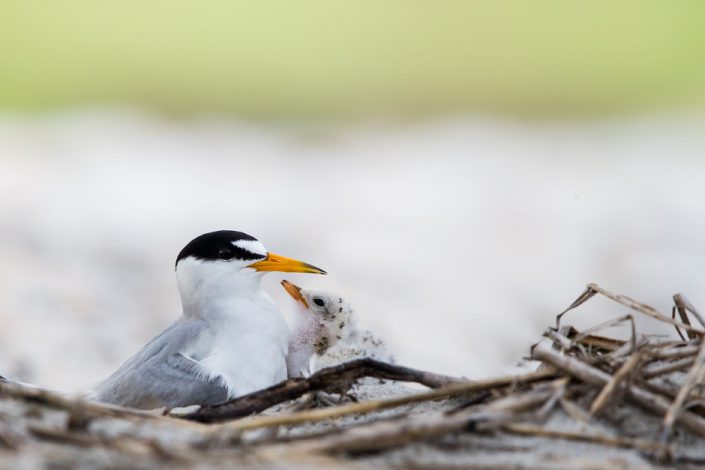
Least tern photo by Northside Jim.
The beach nesting bird field staff is firing on all cylinders now, frantically trying to keep up with nesting activity. In some regions of the New Jersey coast, piping plovers and American oystercatchers are still laying eggs, while at other sites there are chicks on the beach, even one site (Barnegat Light) where the chicks are already approaching their “fledgling” stage when they will be able to fly.
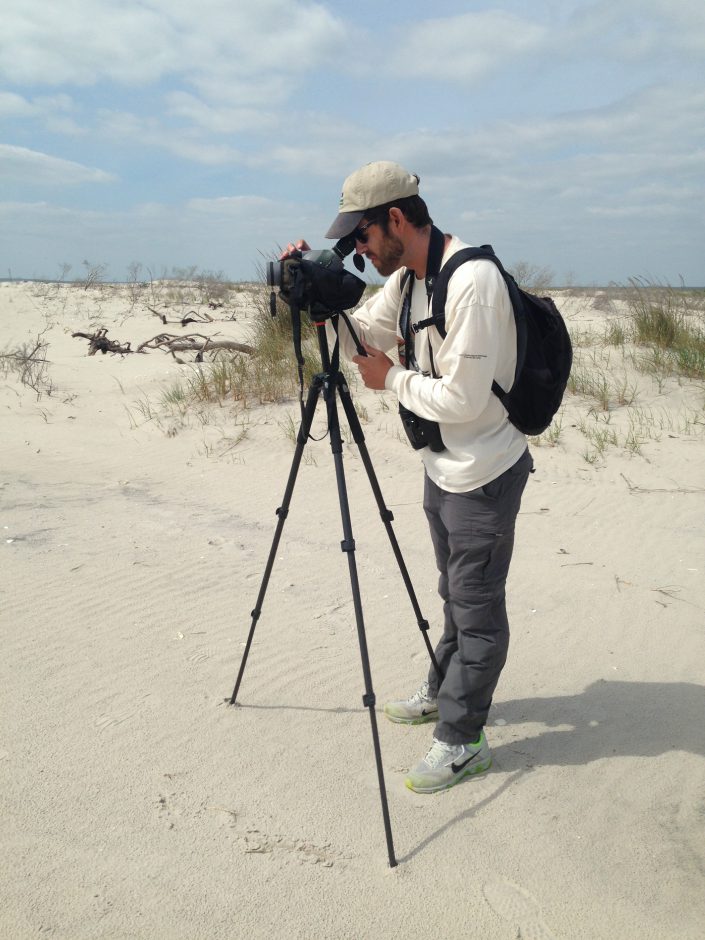
CWF Field Technician Jesse Amesbury busy conducting annual piping plover census at Edwin B. Forsythe NWR.
Most of the least tern and black skimmer colonies are now established, with least terns starting to hatch chicks and black skimmers just laying eggs. Counting the colonies is one of the most challenging parts of the job, imagine trying to count 1,000-1,500 birds at a time in some instances!
After helping with the winter segment of the International Piping Plover Census in the Bahamas, CWF switched gears this week to help conduct the breeding portion in New Jersey.
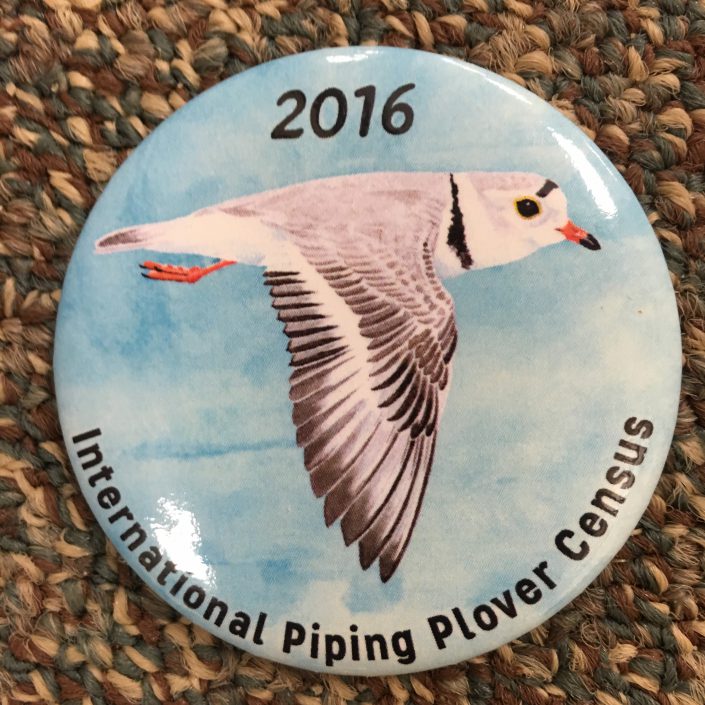
All the normal beachnester tasks are keeping us busy, but the main focus this past week was the annual piping plover “window” census, where field biologists all along the Atlantic coast count the number of birds present between June 1-9, so we can get a range-wide breeding population estimate. As for New Jersey, it looks like our population will go up, at least slightly, for the second year in a row. Although this is still a very preliminary estimate, it looks like we have weathered the statewide low in breeding pairs we recorded in 2014, thanks to good productivity the past two years.
Of special note is a spike in Monmouth County (outside Sandy Hook), where we have gone from 2 pairs the past several years to 12 pairs this year. Although a smaller bump, we also went from 1 pair to 4 pairs within Barnegat Inlet, an area we have long hoped for more pairs. It takes a tremendous effort to realize even small gains in our piping plover recovery effort, so we are especially excited about this news!
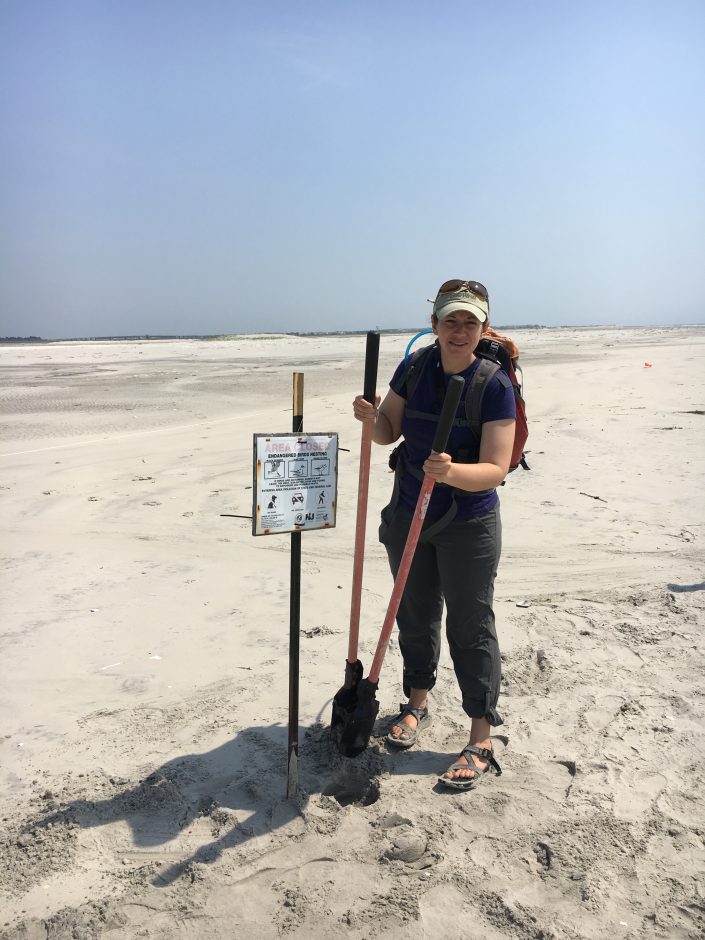
Our work is never done…CWF Wildlife Biologist Emily Heiser posting a new nesting area for endangered least terns.
Technology has proven to be vital to Conserve Wildlife Foundation’s work protecting rare wildlife species over the years. Our biologists depend greatly on modern technologies to band, track, and share online the journeys of wildlife. Our webcams broadcast the most intimate behaviors of nesting birds and bats across the web. And we seek out ever-evolving communications technologies to spread the word about the inspiring stories of wildlife, from social media and infographs to e-books and Story Maps. These technologies offer newfound abilities to share complex data on multiple levels, while still incorporating the awe-inspiring photography and videos that bring wildlife’s stories to life.
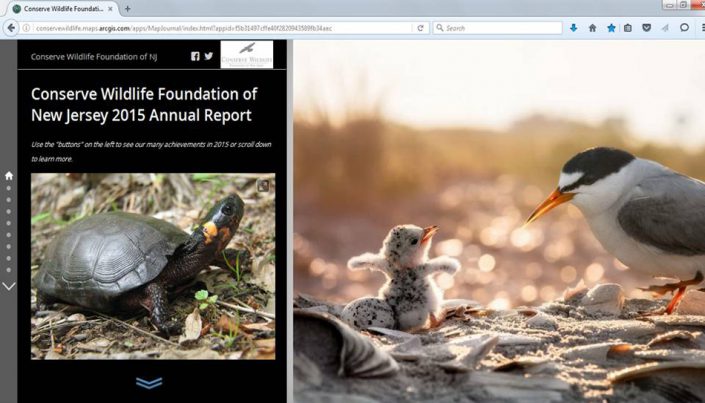
Conserve Wildlife Foundation of New Jersey is excited to offer our 2015 Annual Report in a unique format that utilizes one of those technologies – Story Maps. In the past year, we have explored the lives of seals, eagles, and freshwater mussels with Story Maps – and the annual report allows all of our projects to be highlighted in this interactive format as well.
Visit the multiple pages within this Story Map to learn about Conserve Wildlife Foundation’s many projects and partnerships in 2015, and the imperiled wildlife species in need of our help. Find examples of the innovative and dedicated leadership of our biologists and volunteers. And take an online journey across the state to learn how our projects made a difference in all corners of New Jersey in 2015 – a great year for wildlife in the Garden State!
Loyal Eagle Project Volunteer Contributes to Conservation for over Two Decades
by Dr. Larry Niles, LJ Niles Associates LLC
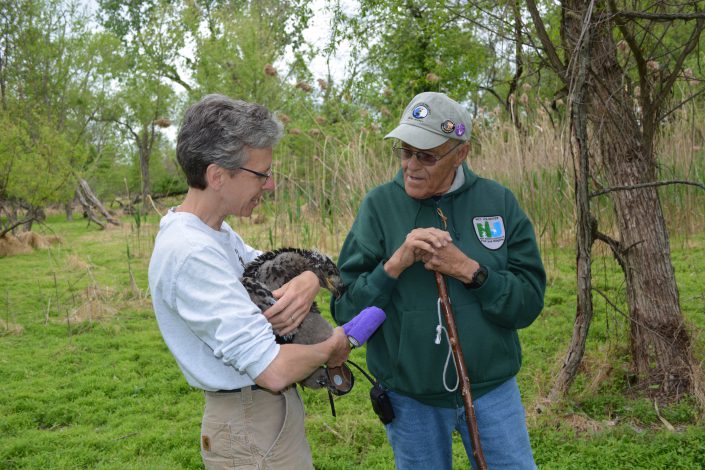
Dr. Erica Miller and Elmer Clegg.
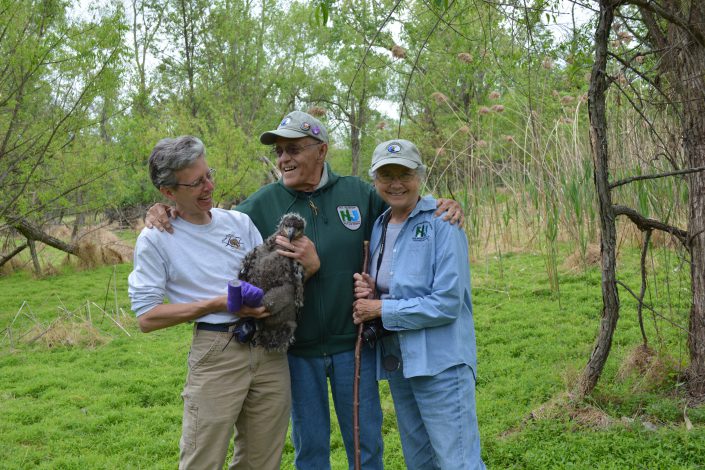
In the early days of the Bald Eagle project, when we really didn’t know whether the species could be restored back to New Jersey, there were a few people that offered their help without reservation to help the birds. Elmer Clegg and his wife Bunny were two and among the most dedicated. Elmer died May 20th at 79 years old. He was a loyal eagle volunteer for more than two decades.
To understand Elmer and Bunny’s contribution its important to remember the circumstances in which the eagles found themselves. The historic population of eagles, about 22 in 1950 but probably much higher in history, had been whittled down to just one unproductive pair by 1981. Biologists at the newly formed Endangered Species Program, including me, worked hard to restore the Delaware Bayshore population with new projects, like hacking young birds into the wild. By the early 2000’s, we had new nests but in places that had not known eagles for decades. In many places they were unwelcome because they thwarted sprawl development or short sighted resource use. They had to be defended, but then we couldn’t afford staff.
Dr. Erica Miller and Elmer and Bunny Clegg.
Into that breach stood Elmer and Bunny and others like them, John and Sheryl Healy and Red and Mary Jane Horner. They were stalwart defenders of wildlife that brooked no insult to the birds by watching the nest throughout the nesting period until the young birds fledged. It was rewarding but difficult work trying to persuade farmers, businessmen, irate suburbanites and many others that the eagles deserved to be where they were. A few times our conservation officers had to step in, or DEP had to drop the regulatory hammer, but mostly it was the calm persuasion of people, like Elmer, who’s true love for these birds spoke convincingly to those against the bird.
Elmer helped me understand that the future of wildlife doesn’t lie in the agencies or their staff, but in the hearts of people who care for wildlife. People like Elmer deserve to return to this earth as the species they loved so much.
Dr. Larry Niles has led conservation efforts for over 30 years.
CWF’s Shorebird Stewards Protect Delaware Bay Shorebirds and Educate the Public
by Larissa Smith, wildlife biologist
Shorebirds at Reed’s Beach Photo by Bob Bocci
This shorebird season, twenty-one stewards helped to patrol the closed shorebird beaches in Cape May and Cumberland Counties. Stewards not only make sure that no one is entering the closed areas but also educate beach goers about the shorebirds and horseshoe crabs.
Thank you to all Shorebird Stewards!
Steward Bob Bocci at Fortescue Photo by M. TribulskiStewards Dan & Cheryl Alexander at Cook’s Beach
Horseshoe crabs may be one of the most unusual animals in the world, but they’re also one of the most extraordinary. They’ve been around for hundreds of millions of years, and we’re only now starting to understand just how important they are – not just to the natural world, but also to the world of medicine. Discover the real value of horseshoe crabs, found throughout New Jersey’s Hidden Coast – the Delaware Bayshore.
A new episode of our video series “New Jersey’s Hidden Coast” will air every two weeks throughout the summer! Catch a glimpse of the bay, the horseshoe crab at the center of the bay’s system, and the incredible relationship between horseshoe crabs and migratory birds, like the red knot. We will reveal the real value of horseshoe crabs, the challenges to the ecosystem, and the potential for a thriving regional economy along the Bayshore. We will show Hurricane Sandy as a catalyst for decisive action and the work being done to rebuild the area for both people and wildlife.
Over the next several weeks, we will explore the use of “living shorelines” instead of bulkheads and the central importance of marshes to the marine ecosystem. We will discover the on-the-ground, grassroots efforts of the community to build oyster reefs alongside veterans. And we will examine the future of the Bay and the work that needs to be done to preserve our conservation successes thus far.
One in a Series of Updates on the 20th Year of the Delaware Bay Shorebird Project
by Dr. Larry Niles, LJ Niles Associates LLC
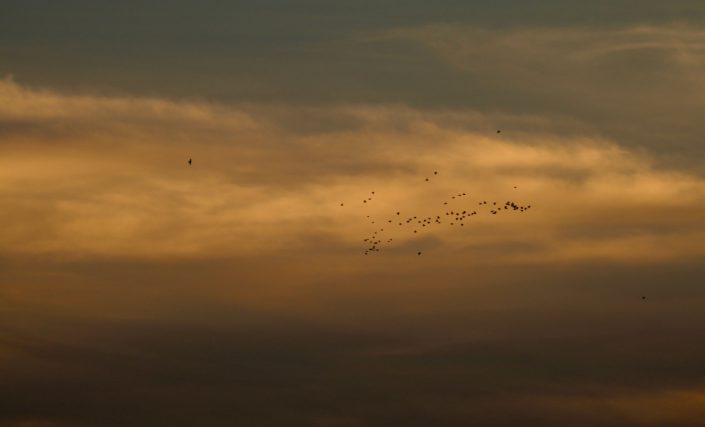
On our final effort to trap shorebirds on Delaware Bay, we had the remarkable opportunity to watch sanderling and ruddy turnstones lift off for the Arctic. We first saw them feeding on the wave-tossed shoreline within the protected area in Villas; 1500 birds weaving as a single thread 5 deep with the contours of the wave, acting like a flying flock on the ground. Then a disturbance, a crow flying low down the shoreline and 2000 birds fill the sky. Most settled again but one group of about 300 flew more with greater determination than the rest. Still low but gaining altitude the flock wavered, and a mutinous band peeled away deciding against the departure returned to the safety and abundant crab eggs on the shore just north of us. The other 150 grew more determined, more structured and rose slowly as they powered their way north. Then they disappeared into the Northern sky.
A flock of shorebirds seen from Reeds Beach venture into the northern horizon for a nonstop flight to the Canadian Arctic.
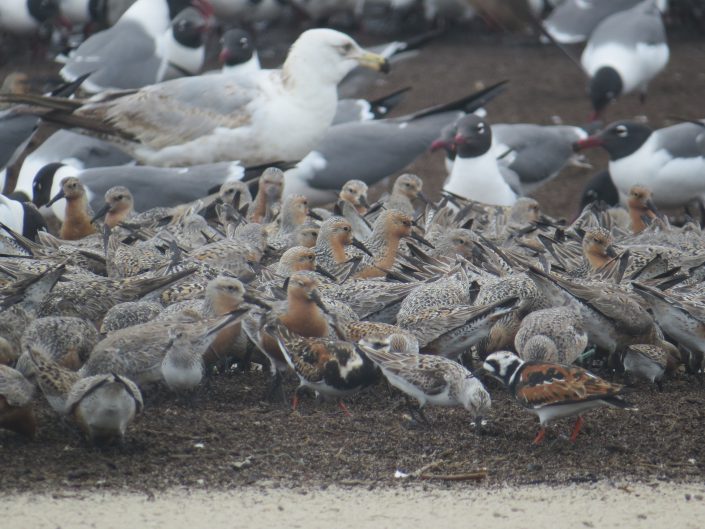
Shorebirds departing Delaware Bay for their Arctic home, 2500 miles away stand as one of the most awe-inspiring and rewarding parts of our stopover project. They usually start in the early evening under a blue sky drenched with the glow of the setting sun and continue until near dark. They almost always go with a favorable southerly breeze and at least a clear sky in the north. Thousands of all the species after getting fat on the Bay’s bounty of horseshoe crab eggs – red knots, ruddy turnstones, sanderling, semipalmated sandpipers, short-billed dowitchers and dunlin – lift slowly as they fly along the Cape May peninsula coast towards Dennisville and beyond.
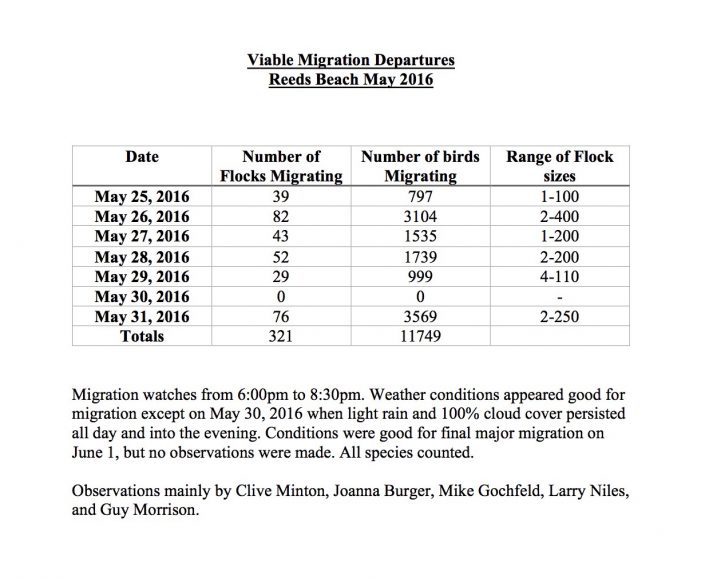
Led by Clive Minton, the team counts the number of flocks and flock size from our porch on Reeds Beach. This is only an index, as birds leave after daylight and from other places in the bay.
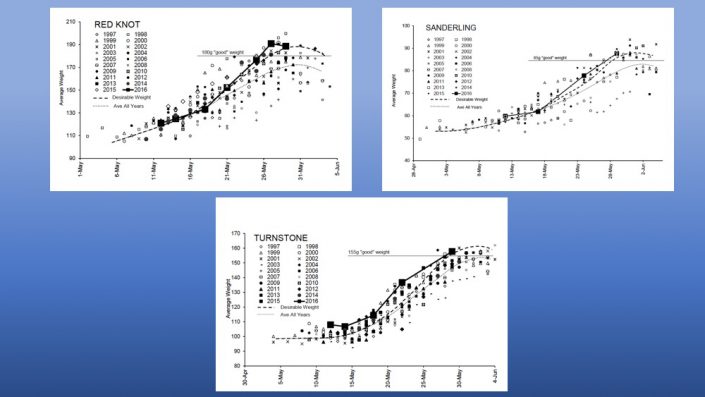
They are dangerously overloaded with fat. Two birds highlighted the importance of this. On May 30 we caught 97 knots, 168 sanderlings and 75 ruddy turnstones. Among each species were individuals of extraordinary weight. One bird weighed 242 grams, fully 120 grams higher than the fat free weight! They cart this load, like a plane with extra gas tanks, to fly two days to the Arctic islands of Canada. Imagine for a moment – you weigh 150 pounds and gain an extra hundred and fifty, then try to go anywhere, especially for 2000 miles.
In this video one can see all the different body shapes – and weights – of red knots and other species on Cooks Beach shoal. It’s easy to see many birds are ready to leave.
The fact that they can do this is a marvel of flight bio-engineering. While building weight they prepare like weight lifters, increasing muscle mass, heart size, and lung capacity. Close to leaving, they decrease the organs of digestion just to squeeze in the last few grams of fat. Then they wait for good weather, lumber into the sky and go forth into the vast north.
2016 was a good year for the shorebirds stopping over on the New Jersey coast. Most came in better-than-average condition, so they had a head start. The early spawn was strangled by cold water which seemed to hover around the temperature threshold for spawning- 59 degrees F. Tellingly however, the crabs spawned with gusto on the beaches from northern Reeds to Pierce’s Point. There the five inter-tidal creeks and inter-tidal flats warm the water that washes over spawn-inviting shoals and newly restored beaches. Throughout the stopover a majority of the bay’s population foraged on the eggs laid by vigorously spawning horseshoe crabs. On one day we saw a 10,000 red knot flocks on North Reeds Beach happily roosting and feeding on the abundant eggs.
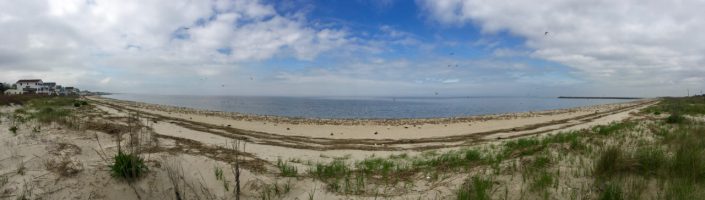
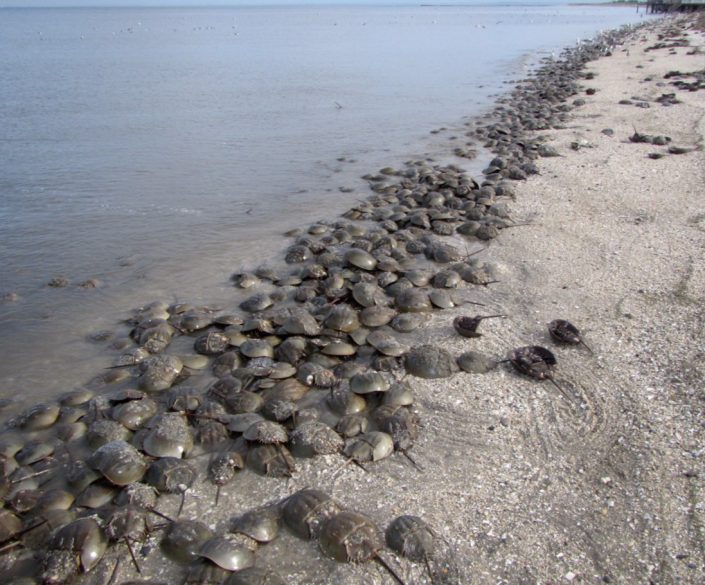
In this iPhone panorama of north reeds beach one could see over 8000 red knots feeding on abundant crab eggs.Spawning crabs on Villas beach
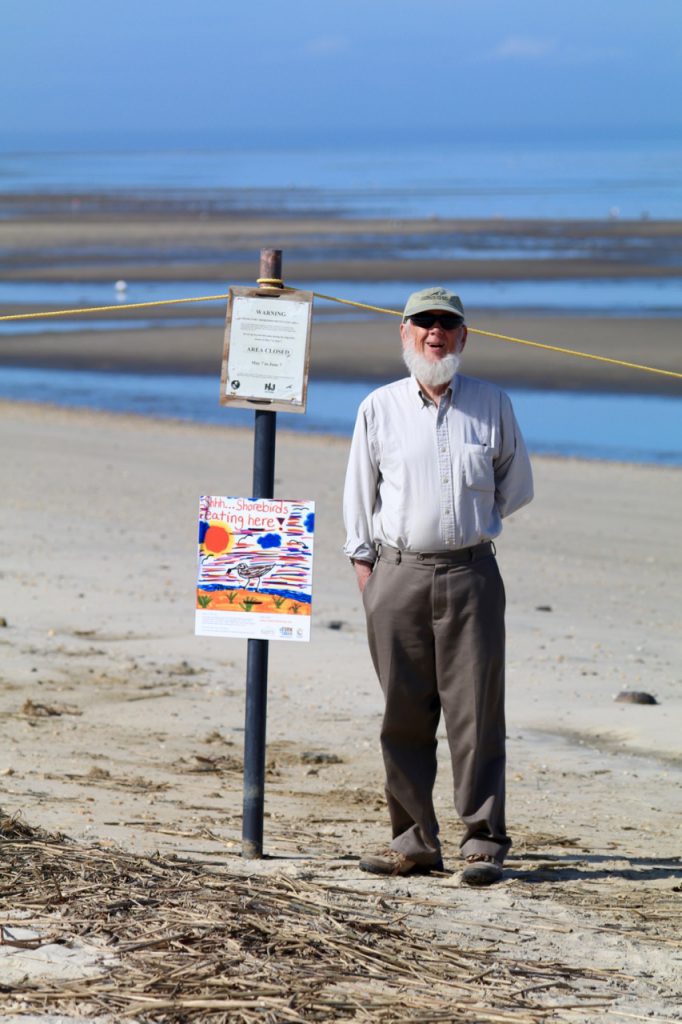
Eventually the spawn accelerated and expanded but the birds still needed to get to the eggs. If constantly disturbed by people, they will move endlessly often to lesser habitat if only to avoid disturbance. In New Jersey we prevent this. Each year for the last 15 years, the New Jersey Division of Fish and Wildlife in collaboration with Conserve Wildlife Foundation of New Jersey, close the beaches important to crabs while leaving small observation areas open to the public. The impact is non-intuitive but positive.
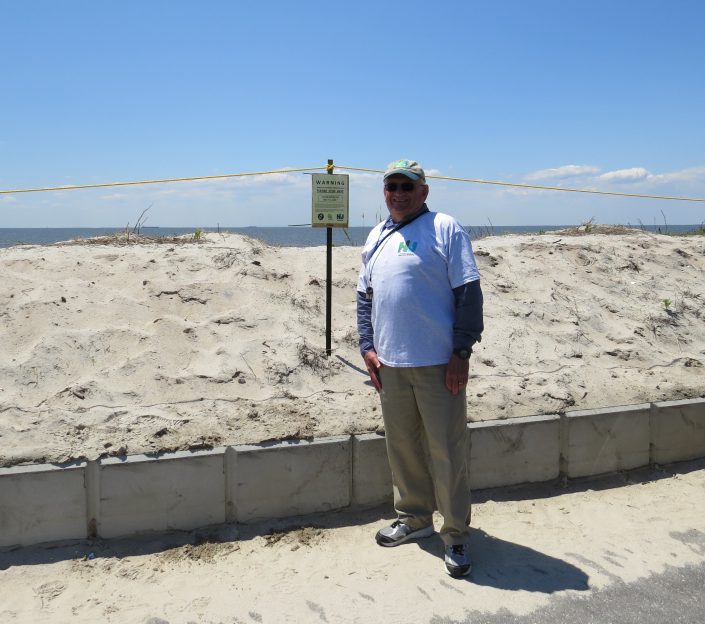
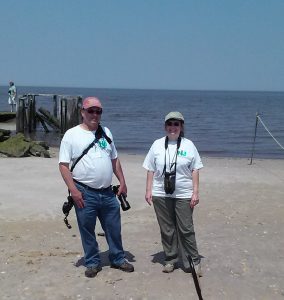
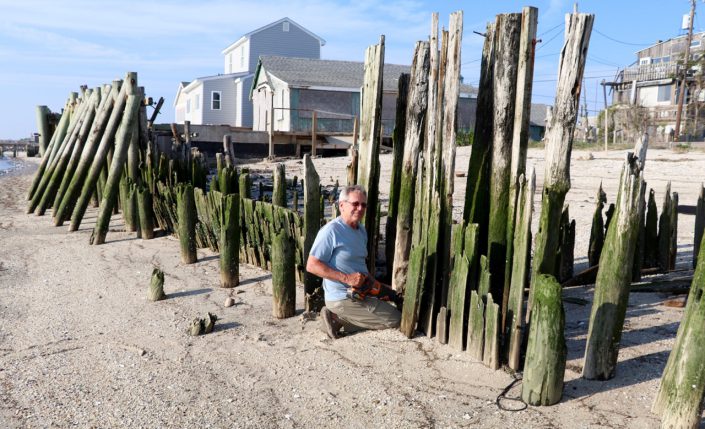
Jim May (first photo) and Niel Olafson (second photo) have been stewarding beaches for over 10 years. Stewards not only defend beaches from the few people determined to breach the rope barriers, but bring their own outreach materials to educate people on the importance of stewardship. They also rescue stranded crabs in tough spots like abandoned bulkheads.
The closed beaches allow shorebirds to gorge on eggs unmolested by people: photographers and birders wanting to get one step closer for the perfect picture, compassionate people wanting to overturn crabs left stranded by the tide, or fishermen wanting to cast for the stripers that run in May. All with good intentions they scatter birds and force them to fly to other less suitable and less accessible beaches losing valuable gained weight in the process. The closures allow the birds to stay in the best places and eat like kings. Paradoxically the bird photographers and watchers end up with even better views because the birds adapt to the settled threat. Even fishermen find enough space to fish from the observation areas.
This person is unaware that her impact has cleared the area of shorebird leaving all the eggs to laughing gulls, who as we all know fear no human.
At the height of the season people could come to one of the five observation areas in the Reeds, Pierce’s Cove and see flocks of nearly 30,000 shorebirds including 14,000 red knots – two thirds of the whole population in the bay this year (as determined by air and ground counts). Photographers, birders and inquisitive people had a wonderful experience and the birds got fat.
Despite the difficulties caused by the unusually cold spring, most birds of the three species we follow reached good departure weights and by May 26th they started to leave. By June 1st most were gone and by June 2nd we advised reopening the beaches, 5 days earlier than the usual June 7th opening.
Our team of scientists, managers, students, volunteers, and stewards deserve praise for all the various projects and research conducted throughout the season, from cannon netting and bird study, resightings of previously banded birds, research on shorebird movement, research on oyster reefs and structural aquaculture, monitoring of horseshoe crabs, monitoring crab egg densities, volunteer efforts to rescue stranded crabs, to steward protected areas and tag crabs. Also, the volunteers of Citizens United to Protect the Maurice River deserve a special thanks for their logistical support for our team, they prepared over 20 dinners for 30 plus people every night of our project. Birds and Scientists all gain weight in May!
They all deserve gratitude, from the birds and horseshoe crabs, the people who love birds and horseshoe crabs and the people who love Delaware Bay.
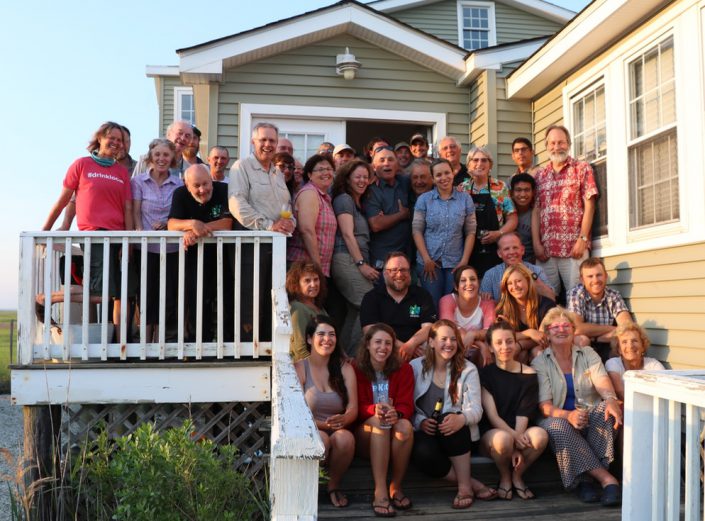
The 2016 shorebird team
Dr. Larry Niles has led efforts to protect red knots and horseshoe crabs for over 30 years.
Through CWF’s contest, high school students created videos to promote New Jersey’s wildlife
by Lindsay McNamara, Communications Manager
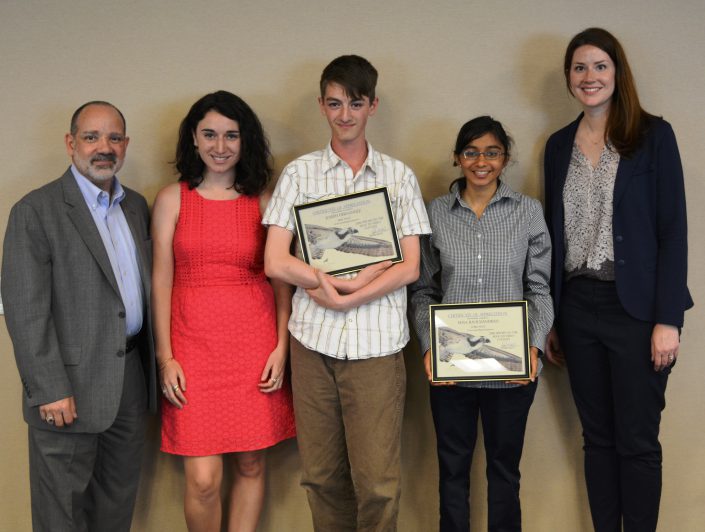
From left to right: CWF board member, PSEG manager Russ Furnari, CWF communications Manager Lindsay McNamara, first place winner Joseph Hernandez, third place winner Maya Ravichandran and PSEG Program Officer Lisa Gleason. Not pictured: second place winner Spencer Monhollen.
On Wednesday, June 1, Conserve Wildlife Foundation of New Jersey and sponsor PSEG celebrated and recognized the winners of the 2016 Species on the Edge 2.0 Video Contest, a statewide educational contest with a S.T.E.M. (Science, Technology, Engineering, and Mathematics) focus for New Jersey high school students.
The Species on the Edge 2.0 Video Contest invited students to submit an original video showing why wildlife protection is important in New Jersey. The contest showcased high school students’ interest in new media technologies, as well as their talent, creativity, and love of nature.
CWF’s 2016 first place winner and recipient of a $1,000 scholarship is Joseph Hernandez a senior in high school in Great Meadows, New Jersey. For the contest, Joseph created an impressive, captivating and informative video titled ‘The Secrets of Vernal Pools.’
Spencer Monhollen, CWF’s 2016 second place winner and $500 scholarship recipient is a sophomore at Oakcrest High School in Mays Landing, New Jersey. For the contest, Spencer produced an excellent video focusing on New Jersey’s bog turtles.
CWF’s 2016 third place winner and $250 scholarship recipient Maya Ravichandran is a junior at High Technology High School in Lincroft, New Jersey. For the contest, she created a video which showcases a number of bird species throughout the Garden State and threats to their survival.
To learn more about our impressive and talented winners, visit our website.
The Species on the Edge 2.0 Video Contest scholarships were made possible by sponsor PSEG.
Since 2003, over 10,000 children from across New Jersey have entered Conserve Wildlife Foundation’s Species on the Edge educational contests. The contests are a great way to engage and excite students into learning about New Jersey’s over 80 endangered and threatened wildlife species.
2016 Species on the Edge Art & Essay Contest Winners honored at Awards Ceremony
by Lindsay McNamara, Communications Manager
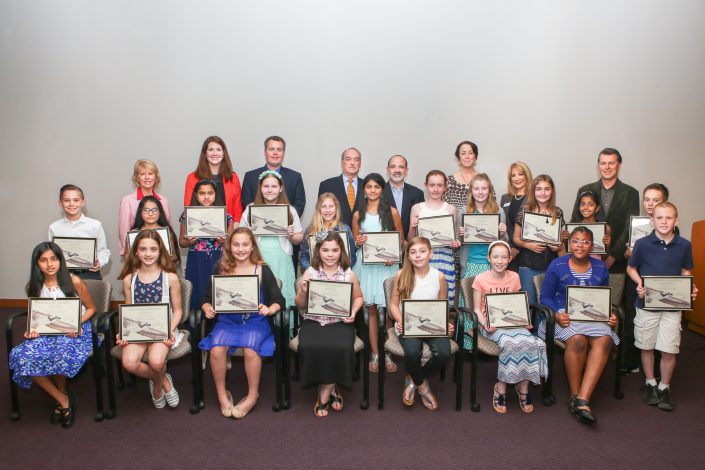
2016 Species on the Edge Winners with representatives from CWF, Wakefern, PSEG and GAF.
On Tuesday, May 24, 2016, Conserve Wildlife Foundation of New Jersey celebrated and recognized the winners of the 2016 Species on the Edge Art & Essay Contest, a statewide educational contest open to all fifth-graders. The 14th annual contest encourages students to become wildlife biologists through their research and artwork on the endangered and threatened wildlife species in New Jersey.
“These talented children poured their hearts into the Species on the Edge contest, creating vibrant artwork and passionate essays about these rare wildlife species,” said David Wheeler, Conserve Wildlife Foundation Executive Director. “We are inspired to help connect the next generation of New Jersey conservation leaders with the natural world around them. Their art and essays illustrate the wonders of nature – and reveal many of the challenges we must overcome to help vulnerable wildlife survive in our densely populated state.”
Students were asked to draw a picture of one of New Jersey’s over 80 endangered and threatened wildlife species and compose an essay about how the animal became endangered and what can be done to help protect it. The Species on the Edge Art & Essay Contest encourages students to learn about local environmental issues, express their concerns for the world around them, think creatively about ways to improve it, and to consider how their actions impact the natural world.
This year’s ingenious group of winners was honored at an awards ceremony which was hosted at the New Jersey Education Association, in Trenton, New Jersey. The contest was sponsored by PSEG, NJEA, GAF, Atlantic City Electric, Church & Dwight and ShopRite.
The statewide contest drew over 2,000 entries from across the state. Since 2003, over 10,000 children from across New Jersey have entered the Species on the Edge Art & Essay Contest.
Conserve Wildlife Foundation Releases New Amphibian Crossing Story Map
by Kelly Triece, Wildlife Biologist
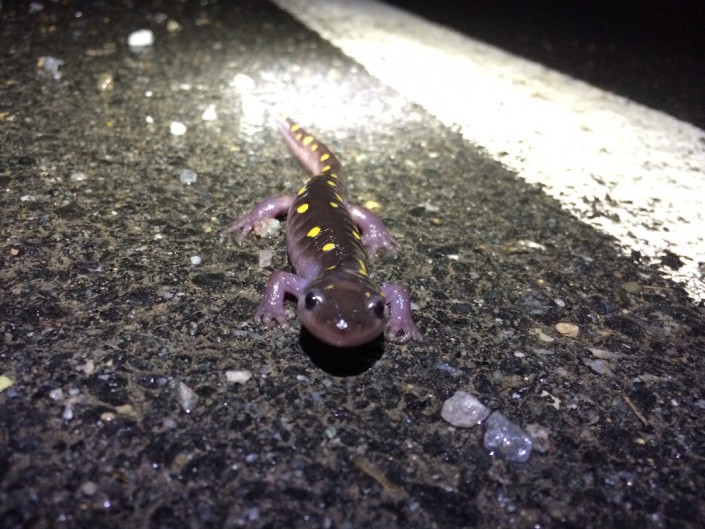
Spotted Salamander Crosses a busy road to reach a nearby breeding pool. Photo by Kelly Triece
Farewell to May — also known as Wetlands Month! As a final ode to Wetlands Month, Conserve Wildlife Foundation would like to share a storyabout a very special wetland! Please check out our latest Story Map: “Connecting Habitat: Waterloo Road.” This story map shares the story about a vernal pool wetland that is located at Waterloo Village History Site in Byram Township, Sussex County, New Jersey.
This vernal pool wetland, as depicted in the Story Map, is a breeding ground for thousands of amphibians. However, each spring these amphibians must cross the heavily trafficked Waterloo Road in order to reach the pool. A single vehicle can crush dozens of the slow-moving animals as they try to cross the road during migration. High enough traffic volumes can wipe out entire populations over time.
Since 2002, Conserve Wildlife Foundation of New Jersey has worked to protect early-spring breeding amphibians like the wood frog, spotted salamander, Jefferson salamander, and spring peeper during their annual migrations through the Amphibian Crossing Project. On peak nights each spring, we work with a fleet of incredible volunteers to hustle amphibians across the road at rescue sites, collect data on the numbers and species seen, measure the impacts of vehicular traffic, and document additional amphibian crossings for future protection.
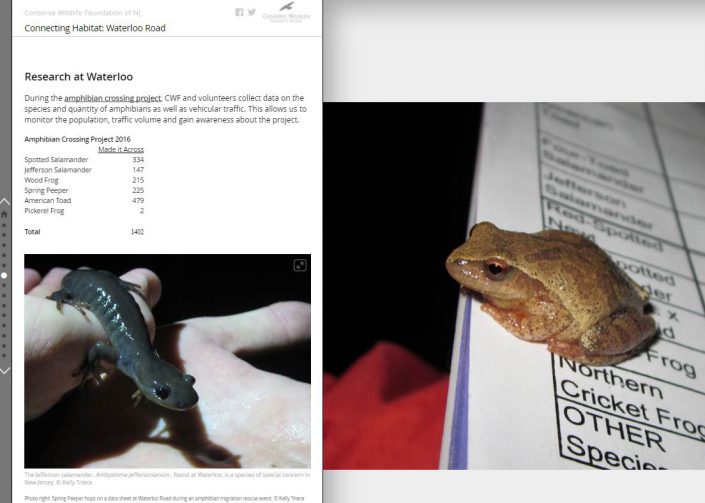
This is our 2016 Waterloo Road Amphibian Crossing Report:
Spotted Salamander: 334
Jefferson Salamander: 147
Wood Frog: 215
Spring Peeper: 255
American Toad: 479
Pickerel Frog: 2
TOTAL Amphibians: 1,432
The Amphibian Crossing Project aims to secure funding for amphibian crossing tunnels at Waterloo Road. This project is part of a larger effort led by the Division of Fish and Wildlife called Connecting Habitat Across New Jersey (CHANJ). CHANJ aims to identify key areas and the actions needed for preserving and restoring habitat connectivity for terrestrial wildlife in New Jersey. CHANJ has the potential to increase the sustainability of New Jersey’s terrestrial wildlife populations and de-list endangered species. #CHANJiscoming #CHANJ
New, exciting programs at Island Beach State Park this summer
by Lindsay McNamara, Communications Manager
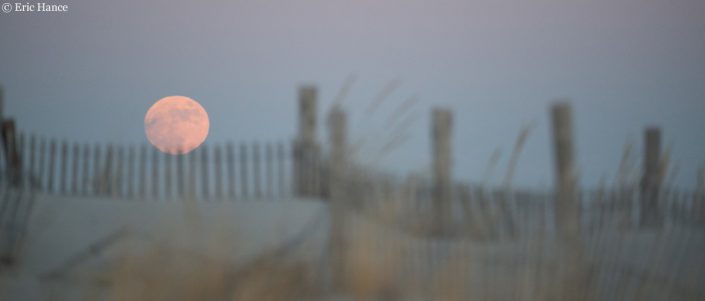
Full moon on the beach by Eric Hance.
The Jersey Shore has changed immeasurably over the past century. But one place gives you the chance to recapture the beauty and wild feeling that once encompassed the entire coast – Island Beach State Park.
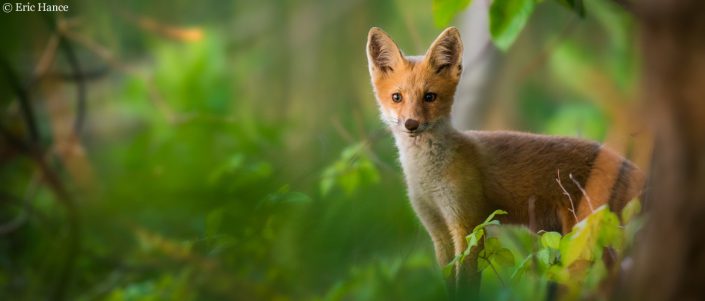
At Island Beach State Park, you can still find hands-on adventures along the Atlantic Coast and the Barnegat Bay. You can still be immersed in the nature of coastal beach dunes, maritime forest, and vast saltmarsh. You can still find wildlife like osprey, red fox, diamondback terrapins, piping plover, sea turtles, and an incredible array of fish and shellfish.
Red fox by Eric Hance.
We are excited to partner once again with New Jersey State Parks and offer incredible programsabout New Jersey’s natural world at Island Beach State Park.
A new feature has been added to the Moonlight Hikes this year. The hike will start in parking lot A13, through the thicket, over the dunes, onto the beach and the bonfire will be in front of the judges shack. A representative will be there to talk more about the shack’s history. The astronomers will be with us again this year too.
The Kayak Eco-Tour and the Sedge Islands Then & Now Tour have been merged into one program. The program is now called the Sedge Islands Eco-Tour and will be an all-encompassing kayak tour of the area.
Also new this year, Island Beach State Park has partnered with the Marine Mammal Stranding Center to offer Mock Stranding events. There will be four this year, two mock dolphin strandings and two mock sea turtle strandings.
Make sure to point your browser to the new, Island Beach Nature Programs website. Check out the list of programs. Bookmark the site and share it with your friends! Make sure to include some awesome, educational outdoor recreational plans for your summer vacation along the Jersey Shore!
Photo by Ray Hennessy.
Lindsay McNamara is the Communications Manager for Conserve Wildlife Foundation of New Jersey.