Results from the 2016 nesting season show very positive results. Statewide census planned for this year.
by Ben Wurst, Habitat Program Manager
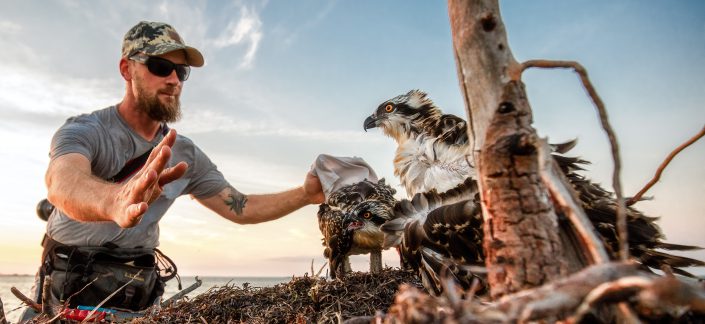
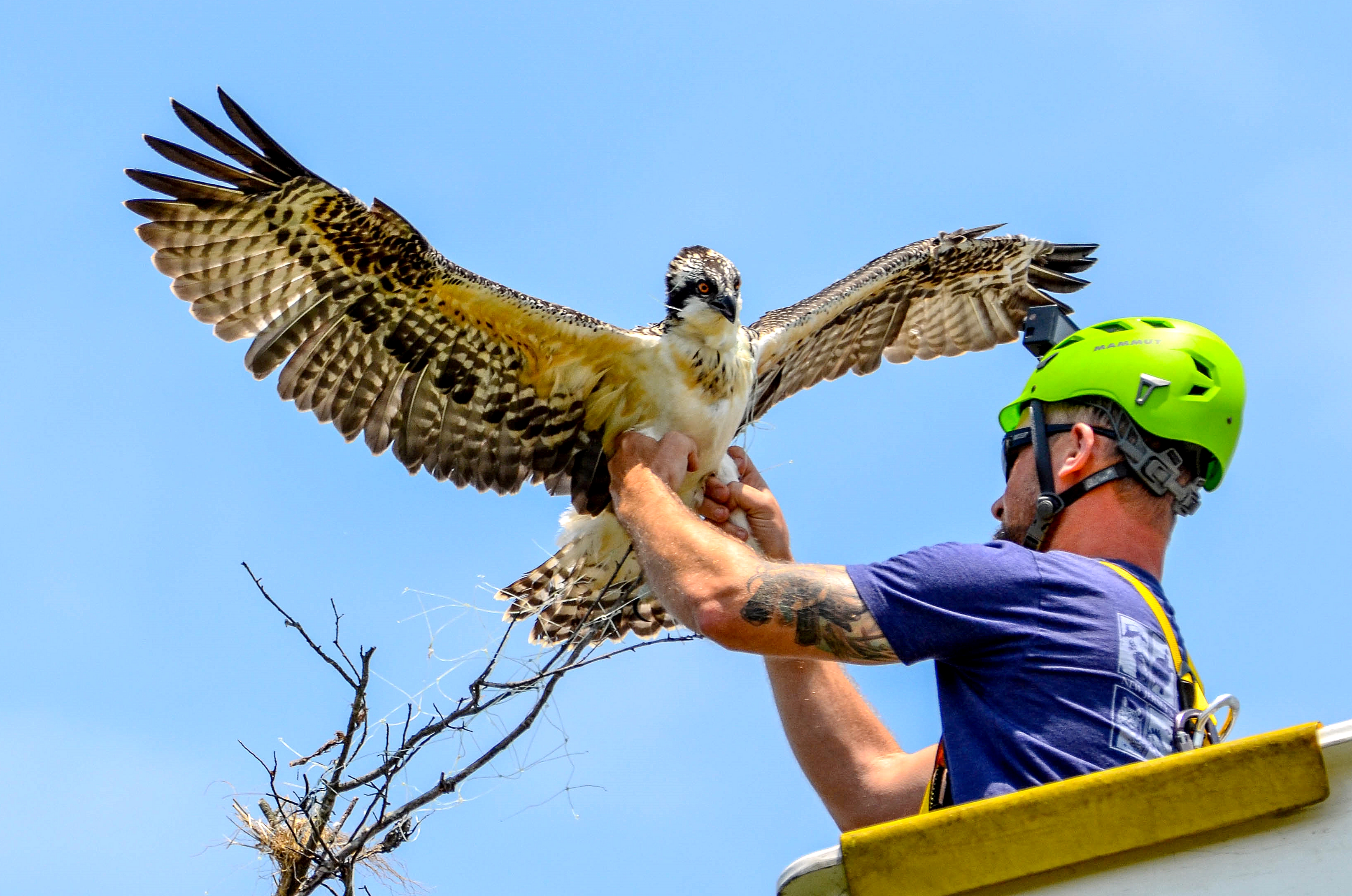
Ben Wurst prepares to band two young ospreys. Photo by Northside Jim
New Jersey’s ospreys continue to defy my expectations. Since being tasked with coordinating the NJ Fish & Wildlife’s Osprey Project, I have witnessed the population grow from around 400 nesting pairs to an estimated 600. That’s a 30% increase in the overall state population. In addition, the productivity rate (a measure of the health for the population) has remained at level consistent with an increasing population. The results from last year were positive throughout almost all major nesting colonies that were surveyed. I’ve never been more amazed by the shear resiliency and adaptability of a species.
Conserve Wildlife Foundation brought three conservation-themed summer learning experiences to the New Jersey coast.
By: Kendall Miller
I went back to “camp” this summer, seeing schoolkids learn first-hand about wildlife and what biologists do. CWF offered three summer learning experiences for the first time, each with a different theme, content, and location.
Observing the kids’ excitement and enthusiasm for nature was uplifting, and I was also impressed with how knowledgeable they all were. Offering hands-on opportunities – to learn about wildlife while experiencing these habitats – is so important in fostering an appreciation in the younger generations.
“Education is a major goal of CWF’s mission. Through project-based, experiential learning, we hope that camps like these leave impressions with children,” said CWF Director of Education Stephanie DAlessio, who developed the new program. “While we are out having fun, we are also learning about the importance of protecting and preserving wildlife and their habitats in New Jersey.”
This summer was a great start, and CWF is excited for the years to come!
Bayshore Adventure at Leonardo Marina Seining, special wildlife guests and sandcastles along the Raritan Bayshore!
Located in the harbor, across from Sandy Hook, noisy terns and gulls fight over their catches as kids arrive in the morning to spend the part of their day learning about the bayshore environment. Sunny, sand-filled learning about marine and coastal wildlife and habitats, seining for coastal creatures, mini-science activities and special guests were balanced with a healthy dose of wiffleball games and sandcastle-building contests.
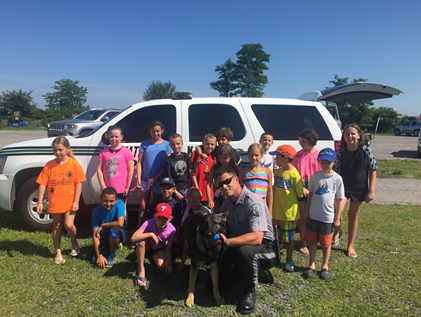
Kids met biologist and beach nesting bird manager Todd Pover. He talked about – of course – the piping plover, and issues with conserving threatened and endangered beach nesting birds.NJ State Park police officer Karl Mott and K9 Kelly, a police dog who finds lost cellphones, wallets, and even people. Campers were able to see her in action and participate in hiding drills.
Wildlife Explorer Program at Duke Farms Raptors, art and orchids on a North Jersey nature oasis!
Set in the lovely Duke Farms in Hillsborough, every day of this week-long camp was a new and exciting experience featuring different types of wildlife! Kids spent time exploring the grounds at Duke, played games and explored their creativity through art projects alongside famed artist James Fiorentino, met real life biologists and best of all – got up close and personal with all kinds of raptors (like the red-tailed hawk below), amphibians and reptiles. These memorable experiences will hopefully cement in their minds the importance of being stewards to their environment.
Campers explored the Orchid Range and saw a collection of plants from all over the world.Bill Streeter of Delaware Valley Raptor Center visited to talk about amazing birds of prey, bringing with him their resident educational birds. Campers sat in awe of these raptors like this red-tailed hawk.
Beach.Birds.Biology A day afield with a beach nesting birds biologist!
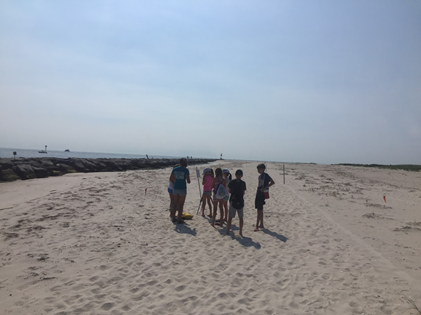
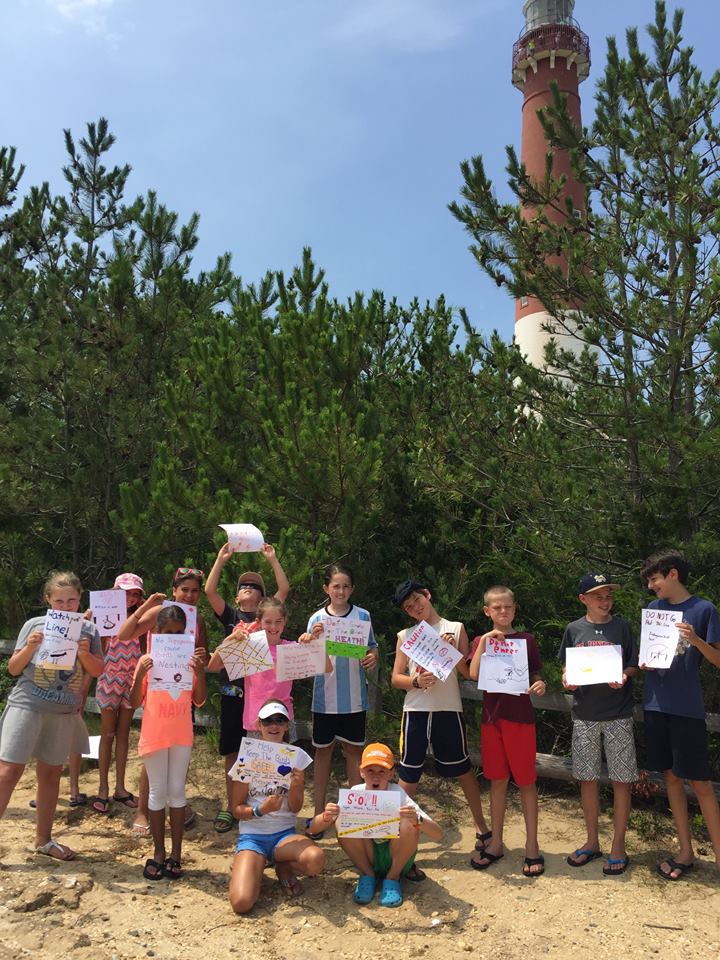
Shorebird biologists know the importance of educating people about the plight of beach nesting birds in New Jersey, who rely on the beaches that people flock to in the summertime. So on three different occasions, parents signed their kids up to spend a day on the beach learning about these birds with CWF biologist, Emily Heiser – like the piping plover, American oystercatcher, black skimmer and least tern. Kids got to practice being wildlife biologists. They used spotting scopes to read tags on decoy birds and searched for camouflaged eggs in the sand. The day was also filled with games, beach scavenger hunts, and a fun poster drawing project to be put on display.
Campers spot some plovers and oystercatchers feeding in vernal pools along the inlet at Barnegat Light.After learning about the plight of beach nesting birds, the kids got creative by drawing signs to be posted near nesting and feeding sites.
For more information about these educational programs, please visit our website at www.ConserveWildlifeNJ.org , or contact our Director of Education Stephanie DAlessio at (609) 292-9451.
Kendall Miller is a Program Coordinator at Conserve Wildlife Foundation.
Volunteers needed to help maintain and repair osprey nests
by Ben Wurst, Habitat Program Manager
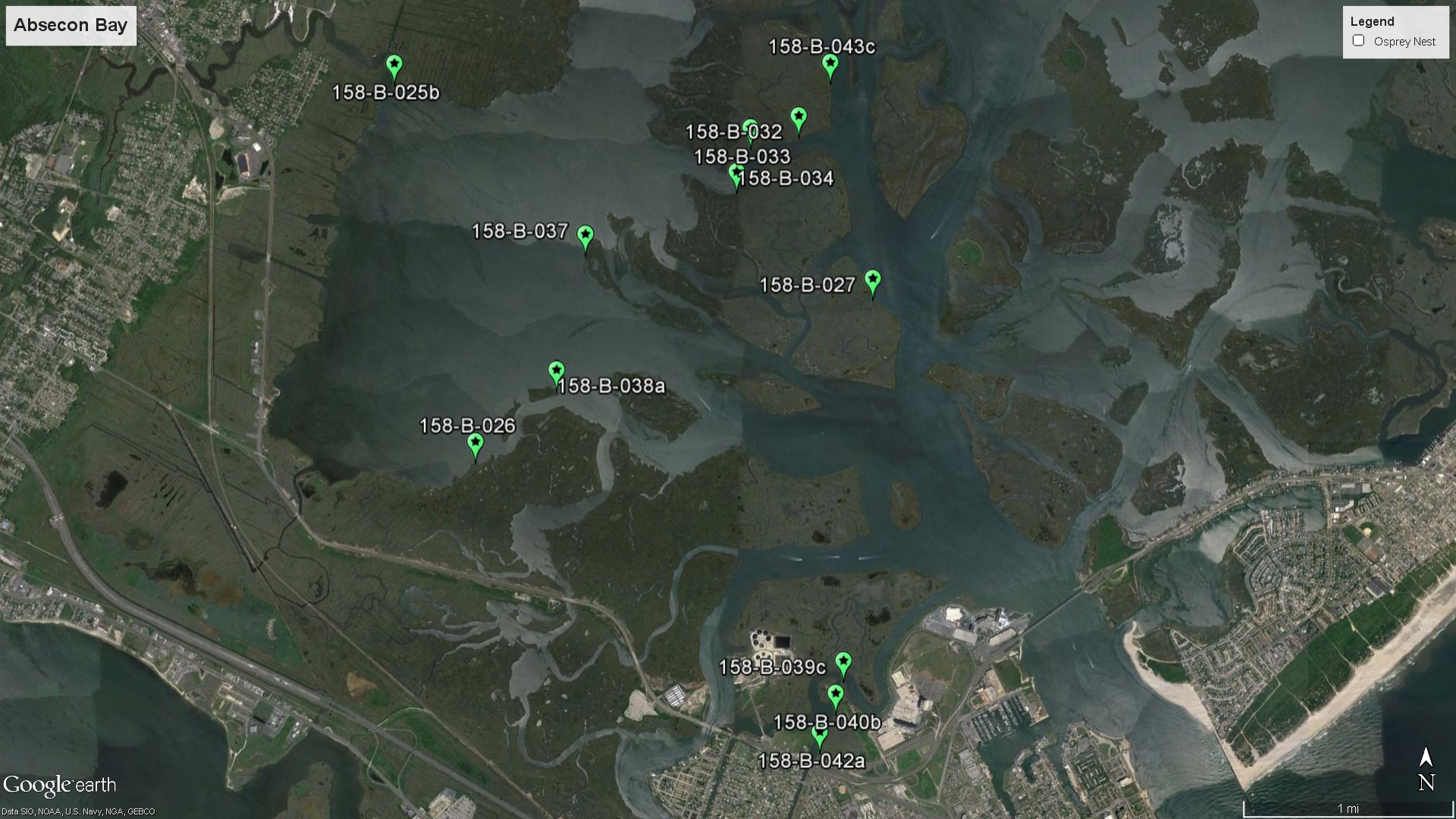
Map of nests that are in need of repairs in Absecon, NJ.
We have an obligation to care for and protect our wildlife, and for me, that’s what drew me into my current position. Osprey nesting platforms have been a focus of my work over the past 10+ years. They are designed specifically for ospreys and if built properly, can withstand the impacts of severe weather, including coastal flooding, high winds, and storm surge. For ospreys these platforms protect their nests from predators and flood tides, but over time the extreme salt marsh environment takes its toll on them. With the added weight of the large, perennial stick nests it can shorten the life span of a properly built platform drastically. Over the years I’ve seen older nests topple, from the weight of the nesting material and aging hardware, during the middle of the nesting season during severe storms. This is hard to prevent at every nest, during every storm, which we know are becoming more and more frequent, but we are adapting and in turn, helping our ospreys become more resilient (and productive) in the end.
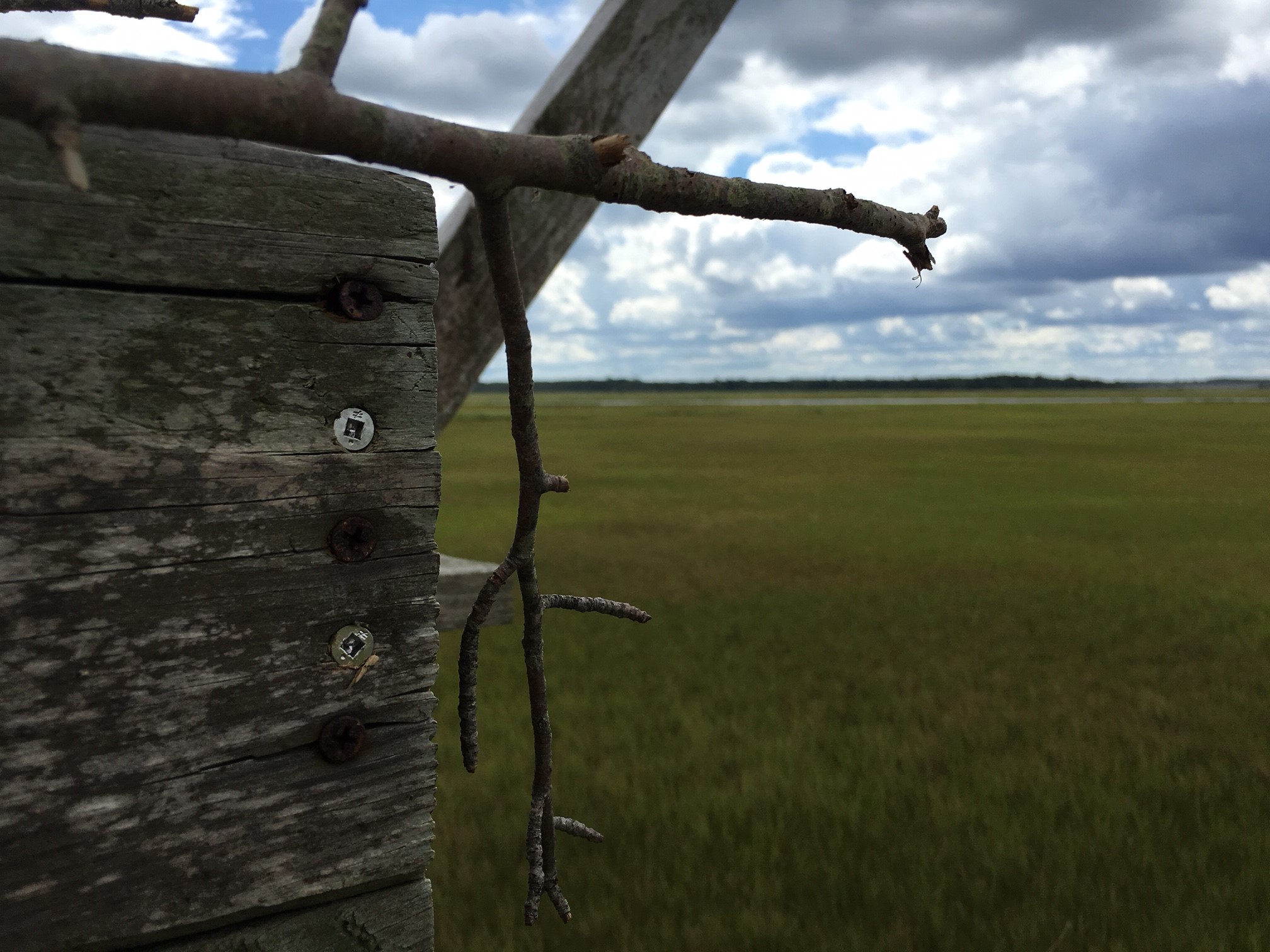
New stainless screws are installed in an existing osprey nest to help prevent future catastrophe.
In the past we (myself and other volunteers who survey ospreys and help maintain platforms) used to visit a nest only once a year, during nesting surveys in late June and early July. At that time we would note the condition of the platform and if repairs were needed, schedule those for the seven month long non-breeding season. Those who have volunteered to help and worked with me, know the task at hand. Most tasks include using hand tools to construct nest platforms and perches and to install them. I always say the hardest part is getting the platform to the saltmarsh where they will be installed.
To help engage and inspire others to help care for our growing osprey population, we are looking for volunteers who live within the watersheds were we are planning to conduct repairs of osprey platforms. Tasks vary by watershed but most are to add new (stainless) screws to existing platforms, install predator guards/perches, clean off excess nesting material, and do any other repairs to platforms (including moving and replacing some). We are hopeful to meet some local baymen and fishermen who are looking to help keep the nesting population stable as it has been over the past 10 years.
The work will occur in mid-late October and will be carried out through these watersheds:
Barnegat Bay (Point Pleasant south to LEHT)
Great Bay – All nests here need new hardware and one nest needs to be replaced.
Absecon Bay – In this area we have four platforms to replace. Three will be moved and one new one installed. Four other nests need critical repairs.
Sea Isle – several nests here need predator guards and a couple need minor repairs.
Wildwood/Cape May – After the strong storms in late June hit this area, many nests need new platform (tops) and others need to be cleaned off.
If you are interested in being notified when these platform construction and repairs occur, please email me. Let me know what you are interested in helping with and if you have a boat (and a ladder!) that can be used.
NEW, WEEKLY UPDATES FROM NEW JERSEY’S BEACH NESTING BIRD PROJECT TEAM
by Todd Pover, Beach Nesting Bird Project Manager
There are many ways to gauge success for our beachnesting bird project. We look at how well our management tools work, the effectiveness of our partnerships, and how well our educational efforts work, to name a few qualitative measures we use. At some point, however, it comes down to cold hard numbers, how well did the birds do in a particular season and over the long-term. We are at that point in the season, and for the most part, I am happy to report it has been an excellent breeding year. I will caution that these are still preliminary figures, some quality checking of the data needs to be done before they are final, but the trends are clear.
One of a “bumper crop” of piping plover fledglings produced in New Jersey in 2016. Photo courtesy of Kevin Knutsen.
First up are piping plovers. We will come in at ~115 pairs statewide, up modestly from the 108 pairs in 2015, and the second consecutive year of an increase after hitting our historic low of just 92 pairs in 2014. So, we have climbed back closer to our long-term average, but there is still room to improve. The really good news is our productivity this year – close to a statewide record at 1.37 chicks fledged per pairs – puts us in the position to continue our population increase. If trends hold, because piping plovers demonstrate high site (or region) fidelity, when we produce a lot of fledglings, our breeding population rises in the next year or two. With three straight years of well above average fledgling rates for New Jersey now in the books, our prospects look good in the short term for our breeding population levels.
Least terns and black skimmers, which nest in colonies, sometimes numbering hundreds (or even thousands), are more challenging to count and assess, but we had at least modest success this year for both species. As is typical, our least tern colonies were variable, with some completely failing and others being highly productive. The Monmouth County region, one of our strongholds for least terns in New Jersey, didn’t have one colony that was a standout but most of them had at least some success. In South Jersey, our two largest colonies at Holgate (EB Forsythe NWR) and Seaview Harbor were very successful and helped make up for losses and failures at other colonies. The majority of our state’s black skimmers are concentrated in one large colony at Seaview Harbor, and although skimmers are our latest nesters (so the season isn’t quite over for them), they appear to have been very successful there, which means a good season overall for the state.
We also track American oystercatchers, although only for the portion that nest on the barrier beaches and spits. Because the biggest percentage of oystercatchers in the state nest on back bay and marsh islands, we cannot determine true statewide population or productivity levels, but the population on the beach habitat appears to be rising in recent years. Typically breeding success is lower for oystercatchers on the beach habitat due to high levels of human disturbance and predators, but productivity has been relative high the past two years. Of particular note this year was Stone Harbor Point, where a record number of 27 pairs nested and produced over 30 fledglings.
The reality is our beachnester staff works just as hard in years when the birds do poorly, as when they do well like this year, but it is SO much more rewarding when we have a good season. So as we wrap up the season, we are all feeling in a bit of a celebratory mode now!
NEW, WEEKLY UPDATES FROM NEW JERSEY’S BEACH NESTING BIRD PROJECT TEAM
by Todd Pover, Beach Nesting Bird Project Manager
For this week’s installment, I thought it would be fun to have you tag along with me on a day in the field, so you can get a sampling of what goes into our beach nesting bird program. Let’s call it, “A Day in the Life of a Beachnester.”
Black skimmer and chicks at our Belmar colony where we recently banded the young before they could fly. Photo courtesy of Jersey Shore Photography.
Today it is an early 4 am rise to beat the beach crowds and heat, as we are banding black skimmers at our Belmar colony. This is the first time our program has banded skimmers – it is a collaborative effort with other organizations/agencies in both New York and New Jersey – we hope to find out more about their survival, longevity, and movement, both local and long distance. Everything goes well, we are able to corral and band about 35 chicks in less than an hour. This part of the day represents the science portion of the beach nesting bird project, science for the sake of study and a better understanding of our birds, but more importantly to gather information to help us manage and recover endangered species.
With no time to spare, it is now off to Leonardo along Sandy Hook Bay where CWF is hosting a summer wildlife experience for kids. No surprise, I am the guest today to teach the kids about beach nesting birds. I explain why piping plovers and American oystercatchers are at risk, and then give them a chance to use a high powered birding scope to try to read bands I have placed on decoy birds. We definitely have some budding biologists in the mix. Education is key to our project, unlike other endangered species that mostly live out of sight or reach, beachnesters spend the breeding season on the same beaches visited by millions of tourists and residents. If they are going to learn to “share the shore” with our endangered birds, outreach is essential.
Sea beach amaranth, a rare plant, that shares the beach with our nesting shorebirds and also is protected.
Next up is a stop at Seven Presidents Oceanfront Park, one of our important nesting areas in Monmouth County. For most of the season we are erecting and adjusting fence to protect nesting areas, but today we are working with the park to reduce the fence, as many of our birds have successfully nested and started to leave the area. First we count and locate any remaining least terns – these surveys are the base of our project – we need this data to track population trends and seasonal productivity as metrics of progress towards recovery. Before we remove any fence at this site, we also conduct surveys of sea beach amaranth, an endangered plant that shares the beach with our nesting birds. We locate a few plants and that dictates how we readjust the fence, the plants need protection from trampling by beachgoers or vehicles used by the park to maintain their beach.
Coordination with municipalities or other land owners that host beach nesting birds is a critical part of our project, as their activities can impact nesting success as much as beachgoer’s recreational use of the beach. So there is one more stop today to assess whether a maintenance request can be granted in a way that won’t put birds at risk. That done, it is time to start the two hour drive back to our office in Cape May County. I am ready for a nap, but no luck, as the truck becomes a mobile office to take care of other unattended business (while someone else drives of course). There are calls with several other towns, check-ins with our seasonal staff members that are spread out all along the coast, and finally dealing with a broken down vehicle (not ours fortunately) and a person who refused to take their dog off a nesting site.
Back at the office, it is one last check of email, entering a little bit of the data we collected today, and finally time to head home. Every day is a little different, but this day has been a good cross-section of the range of things we do on the project. It is tempting to think we just pop up fence and signs and hope the birds do well, but protection and recovery of our endangered beach nesting birds requires a comprehensive strategy addressing all the factors that impact nesting success.
by Emily Hofmann, Assistant Communications Manager
Todd Pover, CWF’s Beach Nesting Bird Project Manager, recently sat down with NJTV’s Mary Alice Williams to discuss piping plover conservation on the anniversary of 30 years of federal listing. Listen in to what he had to say.
by Emily Hofmann, Assistant Communications Manager
“Our work on the bayshore is not just about wildlife, it’s about people, and how keeping nature strong keeps us all strong in the face of disasters like hurricanes.”
We want to ensure that New Jersey’s Hidden Coast remains a vital part of our livelihood for generations to come.
This is the final episode to our video series, “New Jersey’s Hidden Coast.” Catch a glimpse of the Bay, the horseshoe crab at the center of the bay’s system, and the incredible relationship between horseshoe crabs and migratory birds, like the red knot. We reveal the real value of horseshoe crabs, the challenges to the ecosystem, and the potential for thriving regional economy along the bayshore. We will show Hurricane Sandy as a catalyst for decisive action and the work being done to rebuild the area for both people and wildlife.
Catch up on the previous episodes, here on our blog or on YouTube. Explore the use of “living shorelines” instead of bulkheads and the importance of marshes to the marine ecosystem. Discover the on-the-ground, grassroots efforts of the community to build oyster reeds alongside veterans. And examine the future of the Bay and the work that needs to be done to preserve our conservation successes year after year.
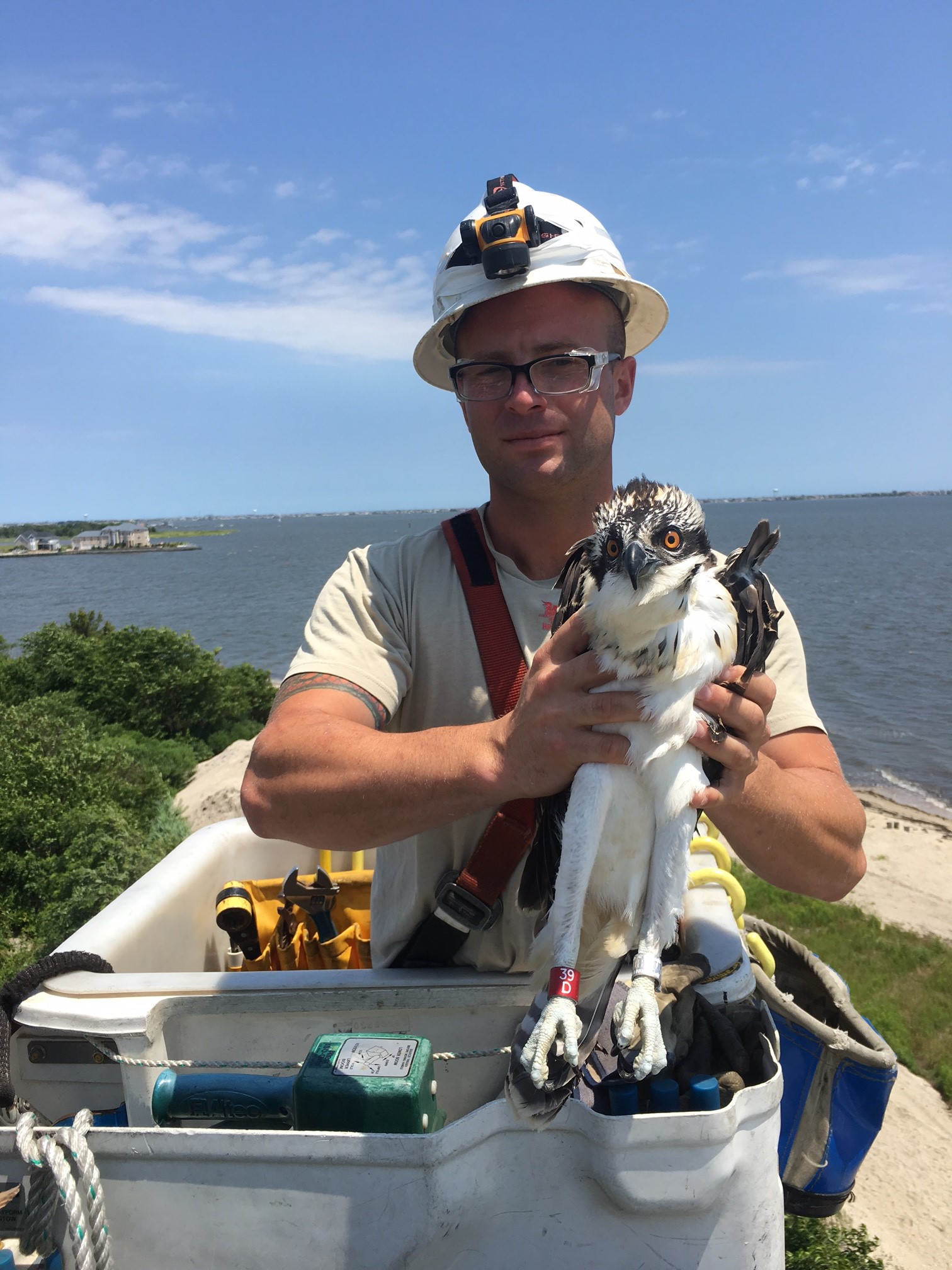
39/D being rescued on July 13, 2016. Photo by Bonni Myszka.
Ospreys are in the news again. This time it is not so pleasant news, or at least news that is hard to swallow for some, where an adult bald eagle predated a young osprey at Hog Island in Bremen, Maine. While it can be a traumatic thing to witness firsthand, it is pretty common where the range of ospreys and bald eagles overlap. We are only witnessing it because of technology. It can and has happened right here in New Jersey too. Last year, I found an adult female who had lost her wing. With no other way for that to happen (on the open saltmarsh, and her wing was gone), the only suspect is an attack by a bald eagle. As both the eagle and osprey population continue to grow, there will only be more interaction between the two species as they are competitors for food and bald eagles are opportunistic scavengers.
GETTING A CLOSE-UP LOOK AT A BEAUTIFUL BUT ENDANGERED SONGBIRD
by Kathleen Wadiak, CWF Intern
Interning for CWF allows me to take part in a variety of projects and learn from different professionals working throughout the state. One example of this is the morning I was able to learn about golden-winged warblers through a mist netting survey. Honestly, I did not know much about this little bird until we were driving to a power line right-of-way early one morning, and I was given a quick summary of why it’s causing a stir in our home state.
The golden-winged warbler (Vermivora chrysoptera) is a striking little gray bird with black eye and throat markings, sporting a bright yellow head with matching wing patches. New Jersey serves as part of its breeding grounds throughout the summer, when it migrates north from its winter habitat in Central and South America. Unfortunately, its populations have been in decline, resulting in its classification as a state endangered species.
A male golden-winged warbler. Photo by Kelly Triece.
There are a few possible reasons for the decline in golden-winged warbler populations, including a decrease in their habitat, early-successional sites which consist of shrubby and herbaceous ground cover instead of mature forest. To the golden-winged warbler’s disadvantage, much of its New Jersey forest was cut at the same time, resulting in even-aged stands that are now too old to provide the nesting sites necessary for survival. Currently, golden-winged warblers occupy regenerating clear cuts, wetlands, or utility right-of-ways in northwestern New Jersey, where they can still find the resources that they need.
In addition to habitat loss, interactions with the closely related blue-winged warbler (Vermivora cyanoptera) are impacting the golden-wings’ numbers. It is thought that as climate change causes shifts in the geographic range of both species, more overlap between the two occurs. This results in increased competition for food, nesting sites, and even mates, as the two birds are closely related.
Walking through the high grass under the powerlines, we stopped now and then to listen to birds singing and look for golden-wings. While my untrained ears had trouble differentiating between all of the different calls, a biologist with NJ Audubon confidently told us where to begin setting up each net. After the net was raised, different recordings meant to attract the warblers played while we stepped back and waited hopefully for the right birds to come.
Golden-winged warbler habitat. Photo by Kelly Triece.
It was exciting to see the first birds fly into the net and to have the opportunity to view them up close, even if they weren’t always the ones we were looking for. While we set up three nets throughout the morning, our first attempt was most successful as it resulted in the capture of one of the rare golden-winged warblers! Its banded leg told us that this wasn’t its first time in a net, and that it had been to this site in the past, a good sign for this particular stretch of habitat. Its dramatic markings and flashes of gold feathers made it a beautiful bird, and it struck me what a shame it would be if they disappeared completely from our state.
While things are tough for golden-winged warblers in New Jersey, hope is not lost as many organizations, including CWF, the Natural Resources Conservation Service, NJ Audubon, and NJ Division of Fish and Wildlife are working to keep these birds in the Garden State. Mist netting and banding the Golden-wings allow biologists to track the number and location of these warblers throughout their breeding grounds and aid in the creation of management strategy. In addition, there is an effort to educate private landowners about golden-wings and to help them manage their property in a way that attracts the birds. Hopefully, as this work continues, more land will be suited to their habitat preferences, and golden-winged warblers will return to their summer homes in New Jersey.
NEW, WEEKLY UPDATES FROM NEW JERSEY’S BEACH NESTING BIRD PROJECT TEAM
by Todd Pover, Beach Nesting Bird Project Manager
Up until now the focus of our weekly reports has been on breeding activities – for good reason as that is the main purpose of our beachnesting bird management and recovery program here in New Jersey. However, the past two weeks have been a good reminder that piping plover migration is already well under way.
The idea of “fall” migration is a bit of a misnomer for piping plovers and other shorebirds since they begin moving south for the “winter” as soon as nesting is complete. For piping plovers that can be in early July. In fact, last week we had our first report of piping plovers already back on their wintering grounds in the Bahamas. And yesterday we received word of 164 piping plovers in Ocracoke, North Carolina, many of them individuals that had bred in states further north. We know that from the bands and flags placed on the birds as part of various research projects.
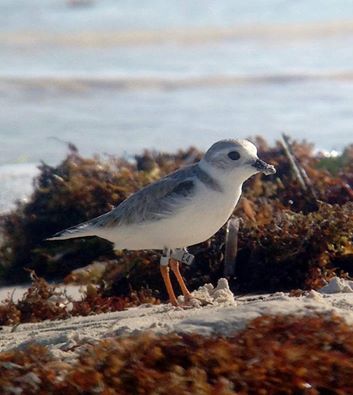
Piping Plover E4, spotted by CWF staff in the Bahamas and Canada, and last week it made a stop in New Jersey during migration. Photo courtesy of Stephanie Egger.
Meanwhile, back in New Jersey we resighted our first Canadian piping plover on July 12. Then last week we had another very exciting visitor from Canada – a flagged bird with the alpha/numeric code of E4. CWF’s very own Todd Pover had spotted this bird on its wintering ground in January 2014 in Spanish Wells, Eleuthera, the Bahamas. In the spring of 2014 Todd traveled up to this bird’s breeding location at White Point Resort in Nova Scotia, Canada, where he was able to spy the bird with its mate as they started to set up their nest. Having it now show up during migration in New Jersey completed the circle.
Although Todd didn’t see it himself in New Jersey this time, there is some pretty amazing “dots being connected” with this individual bird. One of the important issues brought up by the resightings of E4 is just how connected the sites are all along the flyway. It is important that we focus on breeding success here in New Jersey, but we also play an important role in protecting shorebirds during different phases of their lives as well. Long term survival and recovery of piping plovers depends on full life cycle conservation, not just during the breeding season. And with many shorebirds moving thousands of miles annually, that is an effort that needs to reach across partners and even countries.