By Emily Hofmann, Assistant Communications Manager
Like all ecosystems, Delaware Bay is amazingly complex, and there’s no one way to fix it. Between climate change, sea level rise, and the growing risk of major storms, there’s a lot to consider.
We’ve learned that restoring healthy marsh habitat is a key component in rebuilding Delaware Bay beaches; however, we’re also trying to further strengthen bayshore beaches by building reefs – living underwater infrastructure. By creating some reef structures we can keep the sand where we’re putting it.
A new episode of our video series “New Jersey’s Hidden Coast” will air every two weeks throughout the summer! Catch a glimpse of the bay, the horseshoe crab at the center of the bay’s system, and the incredible relationship between horseshoe crabs and migratory birds, like the red knot. We will reveal the real value of horseshoe crabs, the challenges to the ecosystem, and the potential for a thriving regional economy along the Bayshore. We will show Hurricane Sandy as a catalyst for decisive action and the work being done to rebuild the area for both people and wildlife.
Over the next several weeks, we will explore the use of “living shorelines” instead of bulkheads and the central importance of marshes to the marine ecosystem. We will discover the on-the-ground, grassroots efforts of the community to build oyster reefs alongside veterans. And we will examine the future of the Bay and the work that needs to be done to preserve our conservation successes thus far.
NEW, WEEKLY UPDATES FROM NEW JERSEY’S BEACH NESTING BIRD PROJECT TEAM
by Todd Pover, Beach Nesting Bird Project Manager
Meet Bob, Avalon’s “famed” long-time breeding piping plover, easily identifiable by his color bands. Photo courtesy of Tom Reed.
Meet Bob. He is a piping plover who received this nickname while being banded by CWF Wildlife Biologist Emily Heiser in 2012 as part of a SUNY-ESF research project in New Jersey. This past weekend was a big day for Bob. Three of his chicks reached the fledgling state – this milestone of flight is the metric for a successful breeding season.
Things have not always gone so well for Bob. In 2012 his mate was killed by a predator and he couldn’t incubate their eggs alone, so the nest was abandoned and he didn’t find a new mate. In 2013 Bob and his new mate (Kelly) were down to their last remaining chick when a ghost crab snatched and dragged it down its burrow. We dug the chick out, but it died soon after in rehab. In 2014 Bob and Kelly’s chicks died quickly at the hands of an unknown predator. In 2015 a nest camera painfully showed Bob’s chicks being eaten by a fox just after they hatched and were still lying in the nest bowl.
Flash forward to this year and Bob was part of the last piping plover pair left nesting in Avalon, once a thriving breeding site with as many as eight pairs. His long-time mate Kelly left him for another male at Stone Harbor Point, but he found a new mate and finally they have met success. Given all that has happened to Bob, you can see why we are happy for him (and Emily) today!
Sadly, this five year “drama” is not an especially unusual story for piping plovers. Their existence, especially here in New Jersey, is seemingly “against all odds”. In addition to the predators, they face a multitude of threats, direct and indirect, such as human disturbance as a result of heavy recreational use of beaches, habitat loss and degradation, and flooding, to name a few. Each year CWF and a host of partners throughout coastal New Jersey mount an extensive effort to protect piping plovers and other endangered beach nesting birds such as least terns and black skimmers. Without this active protection and management these birds would probably disappear from most of our state’s beaches.
Yesterday evening, while conducting an osprey nest survey at Sedge Island Wildlife Management Area, I received a message from a local wildlife photographer about an osprey nestling that was entangled. I talked to the photographer, Rich Nicol and got detailed information about the situation, the nest, and started to formulate a plan to address the situation. After learning that the nest was on a 35-40’ high pole, I knew that I wouldn’t be able to get up there without some help. Yes – a large ladder would suffice, but it would be tricky to handle the situation (with the bird being entangled). You see, after seeing photos of the young osprey, I knew it was RTF (Ready To Fly). Ospreys fledge or take their first flight at around 7-8 weeks of age. The entangled osprey was around 7 weeks old. I knew we had to act quickly to catch the bird and untangle it before it tried to fledge. This morning I saw the photos that Rich took and it clearly showed that the young osprey had monofilament or a net around its neck… Continue reading “The Inspiring Story of Osprey 39/D”
NEW, WEEKLY UPDATES FROM NEW JERSEY’S BEACH NESTING BIRD PROJECT TEAM
by Todd Pover, Beach Nesting Bird Project Manager
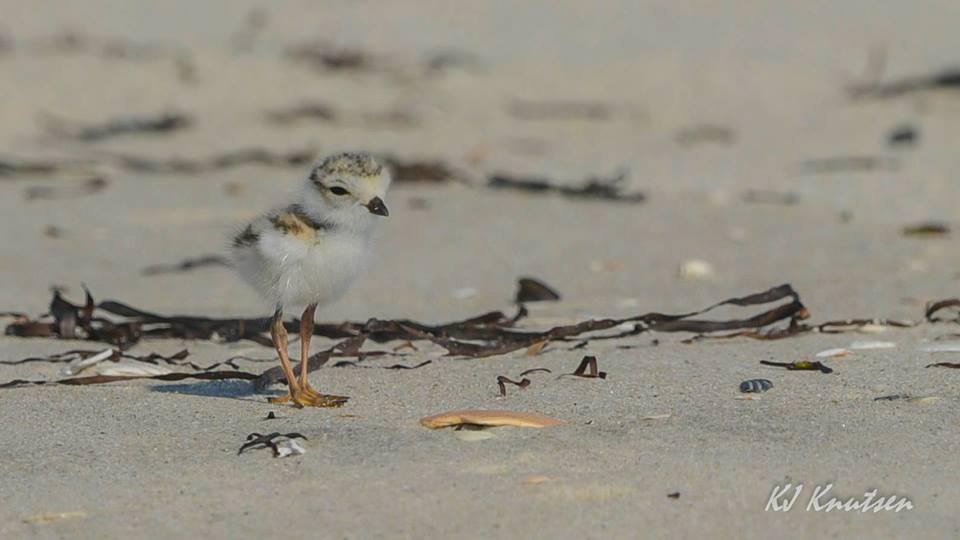
One of four recently hatched “itty-bitty” piping plover chicks at Island Beach State Park. Photo courtesy of Kevin Knutsen.
So far our weekly beach nesting bird updates have focused on statewide trends, but this week we are going to feature one special pair of piping plovers.
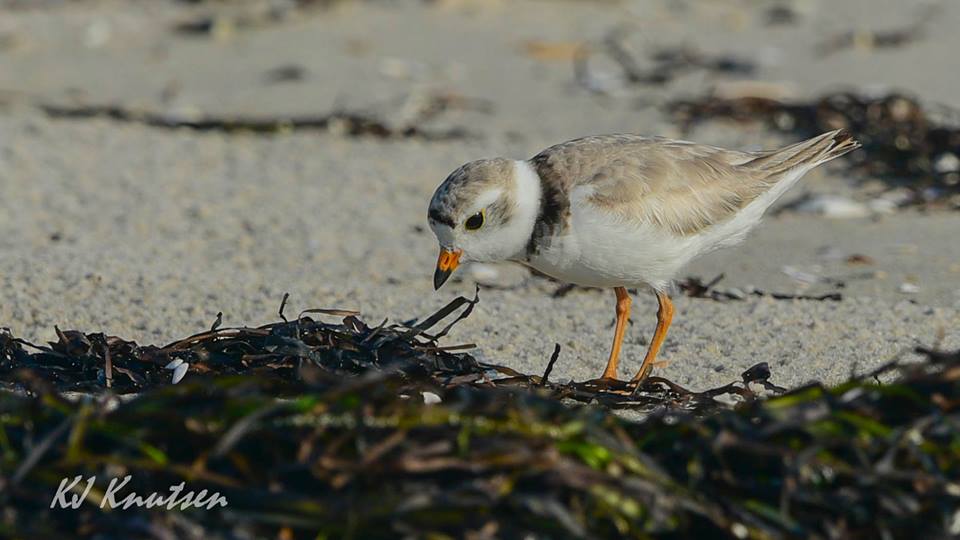
The story actually starts in the summer 1989…Ronald Reagan had just left the White House and the Berlin Wall would fall a few months later. It was also the last time a piping plover nested on the miles of oceanfront beaches at Island Beach State Park. That all changed in May of this year, when a pair of plovers was observed exhibiting breeding behavior at the southern portion of the park close to the inlet jetty. Eventually they laid four eggs, a cage was erected around the nest to protect it from predators, and right on schedule over the July 4th weekend, four itty-bitty chicks emerged. A week later, three chicks have survived the daily battles with predators (i.e. fox, crows, gulls) and a heat wave. The story isn’t over yet, we won’t know for another 3 weeks or so if they survive to the stage where they can fly, which is our metric for success.
Regardless of the outcome, this pair being at Island Beach State Park symbolizes an interesting point in New Jersey’s conservation efforts to recover this federally threatened and state endangered species. 2016 marks the 30th anniversary of federal listing for the Atlantic coast population of piping plovers, and with it extensive management to aid recovery. Those management efforts have led to varying results in New Jersey; our population has swung from a low of 92 pairs to a high of 144 pairs, but mostly settling in around 120 pairs. We are currently in a slight upswing, but the bottom line is New Jersey is a tough place for piping plovers to successfully breed – it represents a convergence of all the significant threats the birds face.
Why did piping plovers suddenly show up at Island Beach State Park again this year? Well, we may never know for sure, but we do think Hurricane Sandy probably had a part in it. While it was wrecking destruction up and down the Jersey Coast, Hurricane Sandy was also creating the kind of sparse, open habitat where piping plovers prefer to nest. Some of that was created at Island Beach, and soon after Sandy, we noted some “prospecting” plovers at the park. Nothing came of that, but meanwhile piping plover action was heating up just a little bit south on LBI at the Holgate Unit of the Edwin B. Forsythe NWR and just across the inlet at Barnegat Light. The storm created especially good conditions for piping plovers in those locations, including a giant “overwash” at Holgate, which in turn attracted more and more plovers, which produced a “bumper crop” of young fledglings. Barnegat Light only had one remaining plover, but it produced well above average numbers of fledglings for several years in a row.
One of the newest “residents” of Island Beach State Park, an adult breeding piping plover. Photo courtesy of Kevin Knutsen.
Quick biology lesson…piping plovers exhibit very strong site fidelity, so the adults tend to come back to the same site year after year, often the same patch of beach. That includes their young, but they have to forge their own territory as existing pairs fiercely defend their established territory. This year we have seen a bump from one to four pairs in the Barnegat Inlet area and one of the new breeding birds was born last year at Holgate (we know that from bands now being placed on the birds by researchers). With Holgate reaching capacity, the returning young are looking nearby for other places to nest. The Island Beach plovers are not banded, but the banding in this area is new in our state, so they might also be young from previous successful nests at Barnegat Light.
At the moment New Jersey has high concentrations of piping plovers at Sandy Hook and the Forsythe NWR, over three-quarters of the state population occurs at these federal properties. They are performing well at these sites for now, but habitat conditions change quickly along the coast and real recovery has to happen over a wider geographic area. For any significant population rebound to occur, new sites need to be colonized, so the piping plovers at Island Beach State Park this year may be a small sign of that starting to happen.
Osprey 44/C re-sighted at Island Beach State Park!
by Ben Wurst, Habitat Program Manager
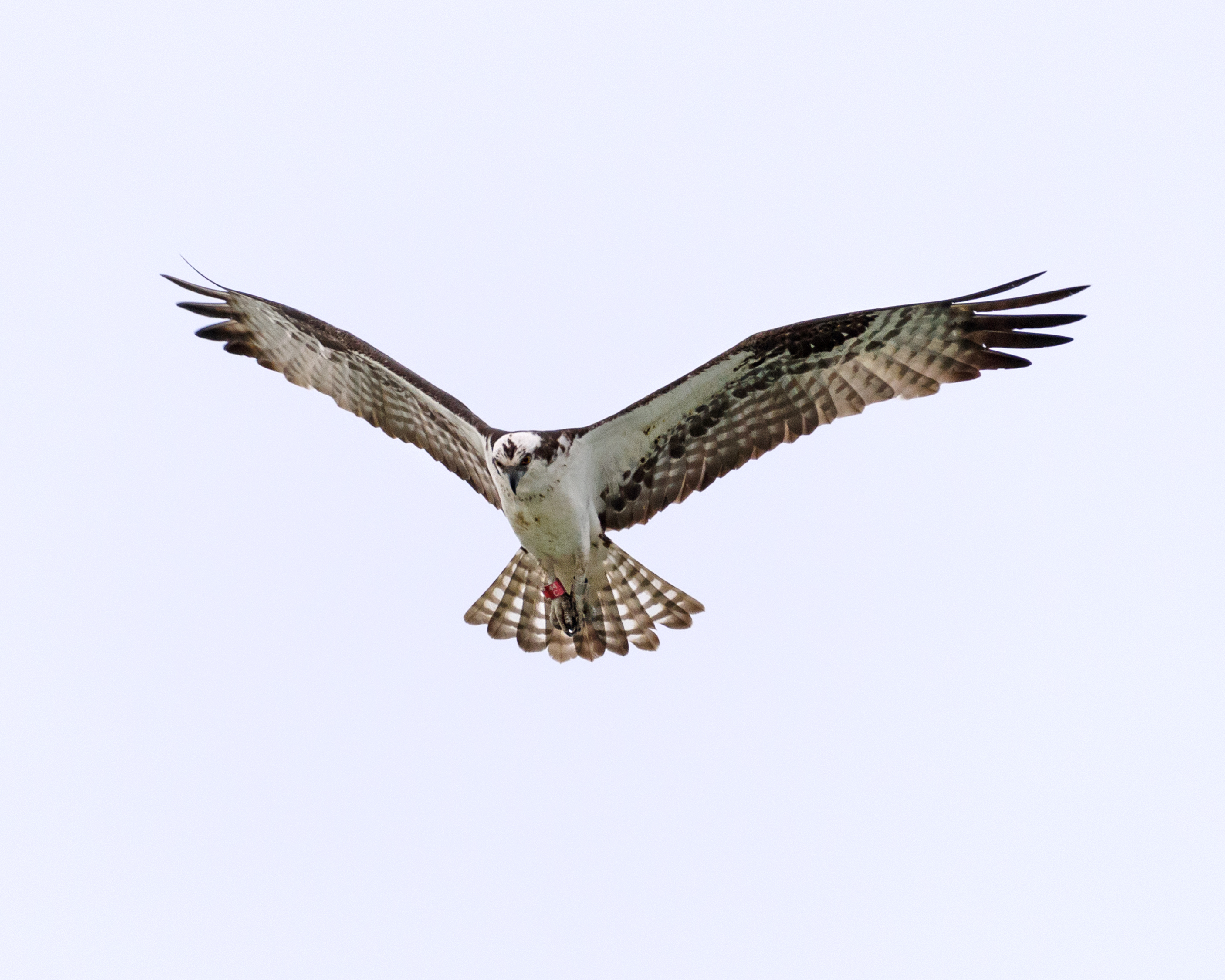
Project RedBand Osprey 44/C was re-sighted by Shayna Marchese on Island Beach State Park on July 3, 2016.
Really exciting news. For the first time this year, a (live and well) red banded osprey was re-sighted! 44/C was banded as a nestling on July 12, 2014 and photographed by Shayna Marchese on July 3, 2016 at Island Beach State Park. Young ospreys spend two years on their wintering grounds before returning to their natal areas. This is the first year that 44/C has returned to New Jersey. 44/C appears to be a male, and males have a higher level of site fidelity than females do, so they are more likely to return to the same area that they originated from. We aren’t surprised that one of our first red banded birds to be re-sighted in New Jersey was at Island Beach State Park, just outside Sedge Island Wildlife Management Area. For anyone who is not familiar with Sedge, it is the state’s most densely populated osprey colony in New Jersey. Around 30 pairs of ospreys nest at Sedge which is less than 3 square miles. Continue reading “Project RedBand Alumni Update!”
By Emily Hofmann, Assistant Communications Manager
Periodic storms are an unavoidable fact of life when you live along the coast. In rebuilding after Hurricane Sandy, we realized we needed a new way of thinking about beach restoration on New Jersey’s Hidden Coast – the Delaware Bayshore. Storms like Sandy and Katrina have shown us that the most effective way to control storm surge is to follow Mother Nature’s lead. The restoration of tidal wetlands, or marshes, will help absorb the brunt of coastal storms, acting as a buffer between the beaches and the mainland.
Learn more about marsh restoration – one of the key components to rebuilding coastal beaches – in the fourth episode of our video series.
A new episode of our video series “New Jersey’s Hidden Coast” will air every two weeks throughout the summer! Catch a glimpse of the bay, the horseshoe crab at the center of the bay’s system, and the incredible relationship between horseshoe crabs and migratory birds, like the red knot. We will reveal the real value of horseshoe crabs, the challenges to the ecosystem, and the potential for a thriving regional economy along the Bayshore. We will show Hurricane Sandy as a catalyst for decisive action and the work being done to rebuild the area for both people and wildlife.
Over the next several weeks, we will explore the use of “living shorelines” instead of bulkheads and the central importance of marshes to the marine ecosystem. We will discover the on-the-ground, grassroots efforts of the community to build oyster reefs alongside veterans. And we will examine the future of the Bay and the work that needs to be done to preserve our conservation successes thus far.
At 8:00 PM on October 29th, 2012, Hurricane Sandy made landfall in Brigantine, New Jersey, only about 30 miles from New Jersey’s Hidden Coast – the Delaware Bayshore. The storm was devastating for the people of the area, many of whom lost their homes and livelihoods. It was equally hard on the area’s wildlife, bringing many species, including the famous horseshoe crab and red knot, perilously close to extinction.
A new episode of our video series “New Jersey’s Hidden Coast” will air every two weeks throughout the summer! Catch a glimpse of the bay, the horseshoe crab at the center of the bay’s system, and the incredible relationship between horseshoe crabs and migratory birds, like the red knot. We will reveal the real value of horseshoe crabs, the challenges to the ecosystem, and the potential for a thriving regional economy along the Bayshore. We will show Hurricane Sandy as a catalyst for decisive action and the work being done to rebuild the area for both people and wildlife.
Over the next several weeks, we will explore the use of “living shorelines” instead of bulkheads and the central importance of marshes to the marine ecosystem. We will discover the on-the-ground, grassroots efforts of the community to build oyster reefs alongside veterans. And we will examine the future of the Bay and the work that needs to be done to preserve our conservation successes thus far.
Boaters urged to not approach active osprey nest inside Barnegat Inlet
by Ben Wurst, Habitat Program Manager
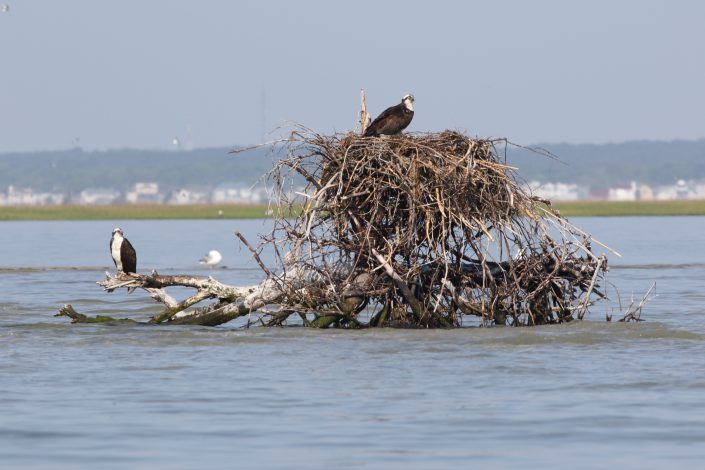
Osprey Nest #3591
Yesterday, while working on Barnegat Bay, we visited this natural nest that is behind the dyke inside Barnegat Lighthouse State Park. This is the third time we’ve passed by to monitor their success. So far, so good and it looks like they now have young in the nest. As you can see the nest is built in a precarious location on a sandbar. When the sandbar is exposed people can walk right up to the nest. Last year the pair did not raise young but people did still walk up to the nest. With young, the adults will be more defensive of their nest to protect their young.
Horseshoe crabs may be one of the most unusual animals in the world, but they’re also one of the most extraordinary. They’ve been around for hundreds of millions of years, and we’re only now starting to understand just how important they are – not just to the natural world, but also to the world of medicine. Discover the real value of horseshoe crabs, found throughout New Jersey’s Hidden Coast – the Delaware Bayshore.
A new episode of our video series “New Jersey’s Hidden Coast” will air every two weeks throughout the summer! Catch a glimpse of the bay, the horseshoe crab at the center of the bay’s system, and the incredible relationship between horseshoe crabs and migratory birds, like the red knot. We will reveal the real value of horseshoe crabs, the challenges to the ecosystem, and the potential for a thriving regional economy along the Bayshore. We will show Hurricane Sandy as a catalyst for decisive action and the work being done to rebuild the area for both people and wildlife.
Over the next several weeks, we will explore the use of “living shorelines” instead of bulkheads and the central importance of marshes to the marine ecosystem. We will discover the on-the-ground, grassroots efforts of the community to build oyster reefs alongside veterans. And we will examine the future of the Bay and the work that needs to be done to preserve our conservation successes thus far.
One in a Series of Updates on the 20th Year of the Delaware Bay Shorebird Project
by Dr. Larry Niles, LJ Niles Associates LLC
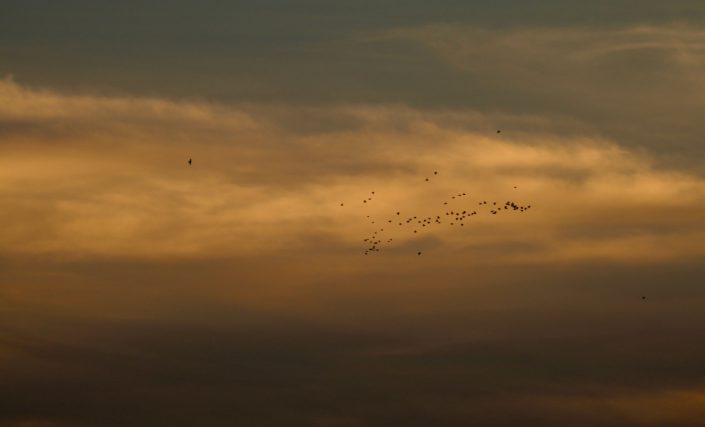
On our final effort to trap shorebirds on Delaware Bay, we had the remarkable opportunity to watch sanderling and ruddy turnstones lift off for the Arctic. We first saw them feeding on the wave-tossed shoreline within the protected area in Villas; 1500 birds weaving as a single thread 5 deep with the contours of the wave, acting like a flying flock on the ground. Then a disturbance, a crow flying low down the shoreline and 2000 birds fill the sky. Most settled again but one group of about 300 flew more with greater determination than the rest. Still low but gaining altitude the flock wavered, and a mutinous band peeled away deciding against the departure returned to the safety and abundant crab eggs on the shore just north of us. The other 150 grew more determined, more structured and rose slowly as they powered their way north. Then they disappeared into the Northern sky.
A flock of shorebirds seen from Reeds Beach venture into the northern horizon for a nonstop flight to the Canadian Arctic.
Shorebirds departing Delaware Bay for their Arctic home, 2500 miles away stand as one of the most awe-inspiring and rewarding parts of our stopover project. They usually start in the early evening under a blue sky drenched with the glow of the setting sun and continue until near dark. They almost always go with a favorable southerly breeze and at least a clear sky in the north. Thousands of all the species after getting fat on the Bay’s bounty of horseshoe crab eggs – red knots, ruddy turnstones, sanderling, semipalmated sandpipers, short-billed dowitchers and dunlin – lift slowly as they fly along the Cape May peninsula coast towards Dennisville and beyond.
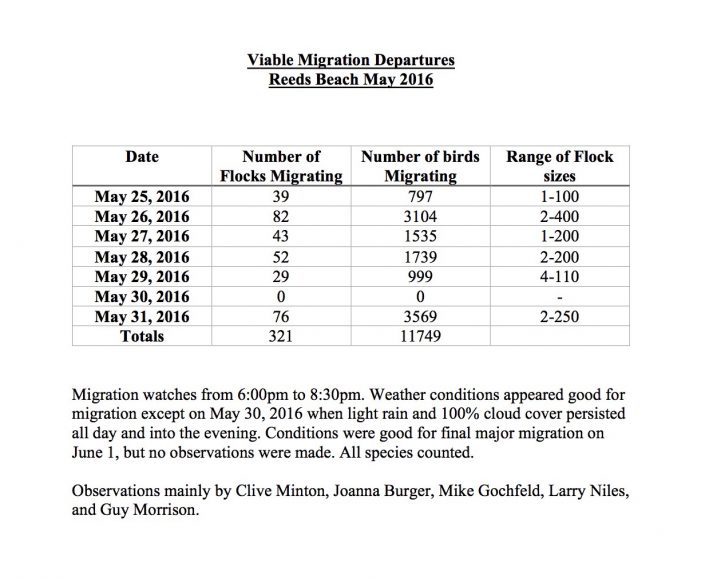
Led by Clive Minton, the team counts the number of flocks and flock size from our porch on Reeds Beach. This is only an index, as birds leave after daylight and from other places in the bay.
They are dangerously overloaded with fat. Two birds highlighted the importance of this. On May 30 we caught 97 knots, 168 sanderlings and 75 ruddy turnstones. Among each species were individuals of extraordinary weight. One bird weighed 242 grams, fully 120 grams higher than the fat free weight! They cart this load, like a plane with extra gas tanks, to fly two days to the Arctic islands of Canada. Imagine for a moment – you weigh 150 pounds and gain an extra hundred and fifty, then try to go anywhere, especially for 2000 miles.
In this video one can see all the different body shapes – and weights – of red knots and other species on Cooks Beach shoal. It’s easy to see many birds are ready to leave.
The fact that they can do this is a marvel of flight bio-engineering. While building weight they prepare like weight lifters, increasing muscle mass, heart size, and lung capacity. Close to leaving, they decrease the organs of digestion just to squeeze in the last few grams of fat. Then they wait for good weather, lumber into the sky and go forth into the vast north.
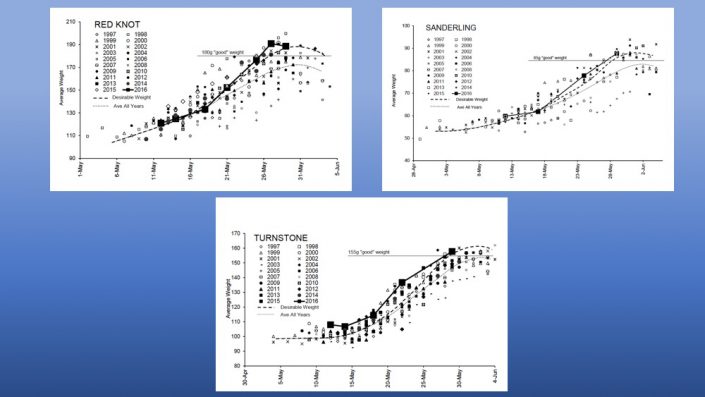
2016 was a good year for the shorebirds stopping over on the New Jersey coast. Most came in better-than-average condition, so they had a head start. The early spawn was strangled by cold water which seemed to hover around the temperature threshold for spawning- 59 degrees F. Tellingly however, the crabs spawned with gusto on the beaches from northern Reeds to Pierce’s Point. There the five inter-tidal creeks and inter-tidal flats warm the water that washes over spawn-inviting shoals and newly restored beaches. Throughout the stopover a majority of the bay’s population foraged on the eggs laid by vigorously spawning horseshoe crabs. On one day we saw a 10,000 red knot flocks on North Reeds Beach happily roosting and feeding on the abundant eggs.
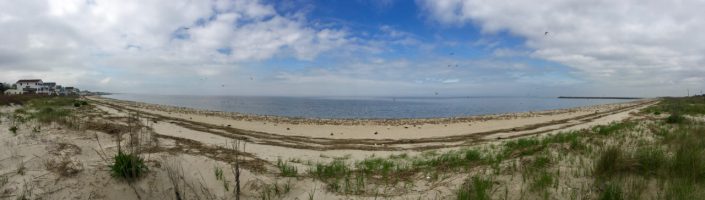
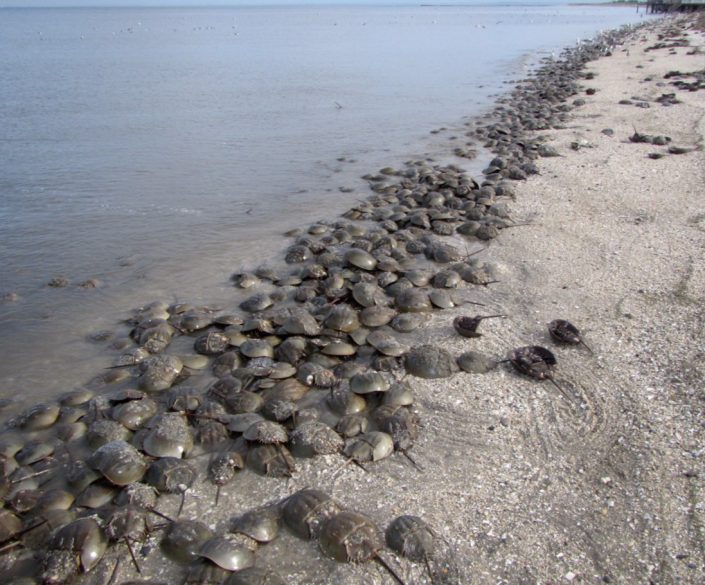
In this iPhone panorama of north reeds beach one could see over 8000 red knots feeding on abundant crab eggs.Spawning crabs on Villas beach
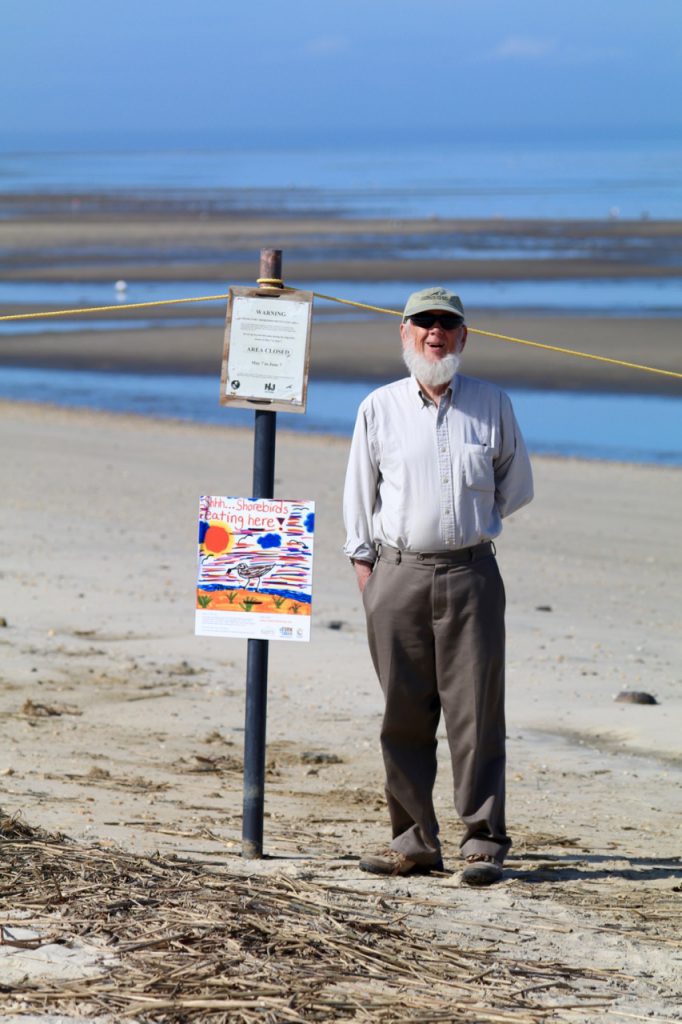
Eventually the spawn accelerated and expanded but the birds still needed to get to the eggs. If constantly disturbed by people, they will move endlessly often to lesser habitat if only to avoid disturbance. In New Jersey we prevent this. Each year for the last 15 years, the New Jersey Division of Fish and Wildlife in collaboration with Conserve Wildlife Foundation of New Jersey, close the beaches important to crabs while leaving small observation areas open to the public. The impact is non-intuitive but positive.
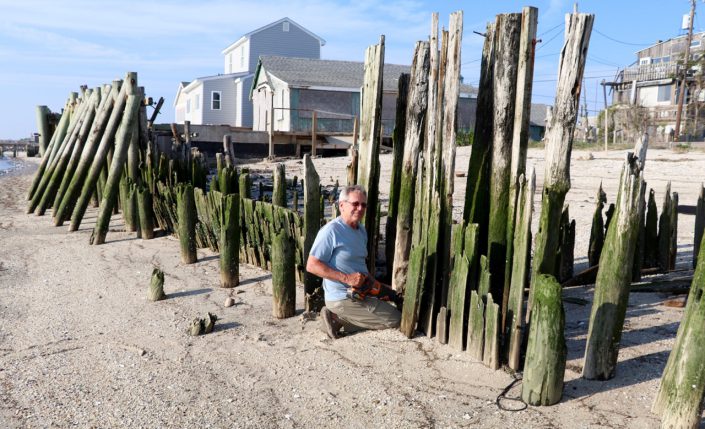
Jim May (first photo) and Niel Olafson (second photo) have been stewarding beaches for over 10 years. Stewards not only defend beaches from the few people determined to breach the rope barriers, but bring their own outreach materials to educate people on the importance of stewardship. They also rescue stranded crabs in tough spots like abandoned bulkheads.
The closed beaches allow shorebirds to gorge on eggs unmolested by people: photographers and birders wanting to get one step closer for the perfect picture, compassionate people wanting to overturn crabs left stranded by the tide, or fishermen wanting to cast for the stripers that run in May. All with good intentions they scatter birds and force them to fly to other less suitable and less accessible beaches losing valuable gained weight in the process. The closures allow the birds to stay in the best places and eat like kings. Paradoxically the bird photographers and watchers end up with even better views because the birds adapt to the settled threat. Even fishermen find enough space to fish from the observation areas.
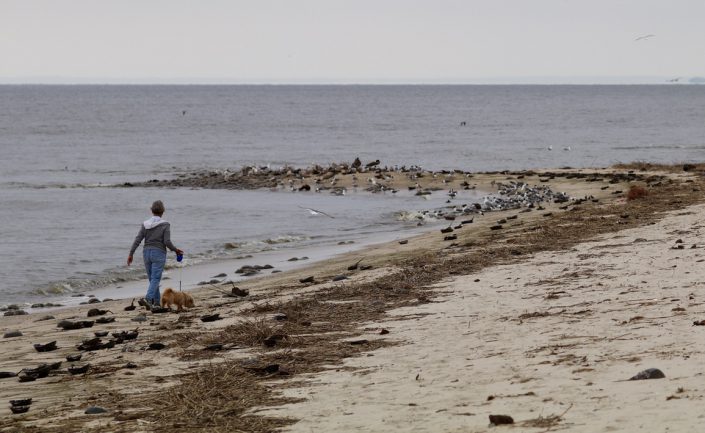
This person is unaware that her impact has cleared the area of shorebird leaving all the eggs to laughing gulls, who as we all know fear no human.
At the height of the season people could come to one of the five observation areas in the Reeds, Pierce’s Cove and see flocks of nearly 30,000 shorebirds including 14,000 red knots – two thirds of the whole population in the bay this year (as determined by air and ground counts). Photographers, birders and inquisitive people had a wonderful experience and the birds got fat.
Despite the difficulties caused by the unusually cold spring, most birds of the three species we follow reached good departure weights and by May 26th they started to leave. By June 1st most were gone and by June 2nd we advised reopening the beaches, 5 days earlier than the usual June 7th opening.
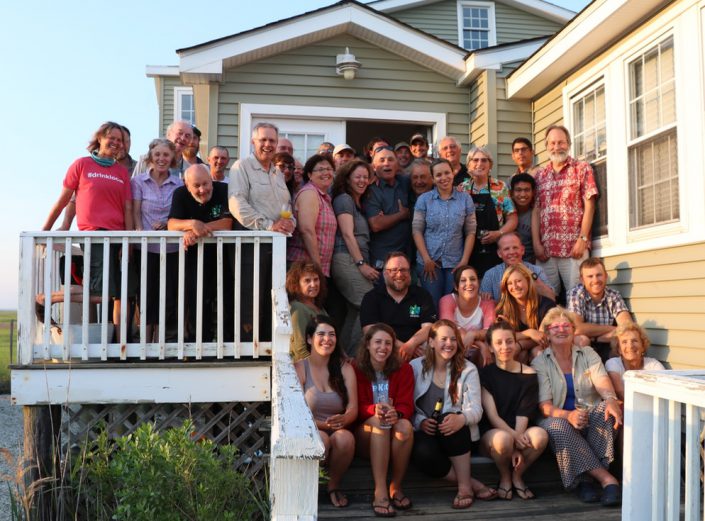
Our team of scientists, managers, students, volunteers, and stewards deserve praise for all the various projects and research conducted throughout the season, from cannon netting and bird study, resightings of previously banded birds, research on shorebird movement, research on oyster reefs and structural aquaculture, monitoring of horseshoe crabs, monitoring crab egg densities, volunteer efforts to rescue stranded crabs, to steward protected areas and tag crabs. Also, the volunteers of Citizens United to Protect the Maurice River deserve a special thanks for their logistical support for our team, they prepared over 20 dinners for 30 plus people every night of our project. Birds and Scientists all gain weight in May!
They all deserve gratitude, from the birds and horseshoe crabs, the people who love birds and horseshoe crabs and the people who love Delaware Bay.
The 2016 shorebird team
Dr. Larry Niles has led efforts to protect red knots and horseshoe crabs for over 30 years.