International Migratory Bird Day Series: Red Knot

CWF is Celebrating International Migratory Bird Day all Week Long

by Lindsay McNamara, Communications Manager

CWF’s blog on the red knot is the third in a series of five to be posted this week in celebration of International Migratory Bird Day (IMBD). IMBD 2016 is Saturday, May 14. This #birdyear, we are honoring 100 years of the Migratory Bird Treaty. This landmark treat has protected nearly all migratory bird species in the U.S. and Canada for the last century.

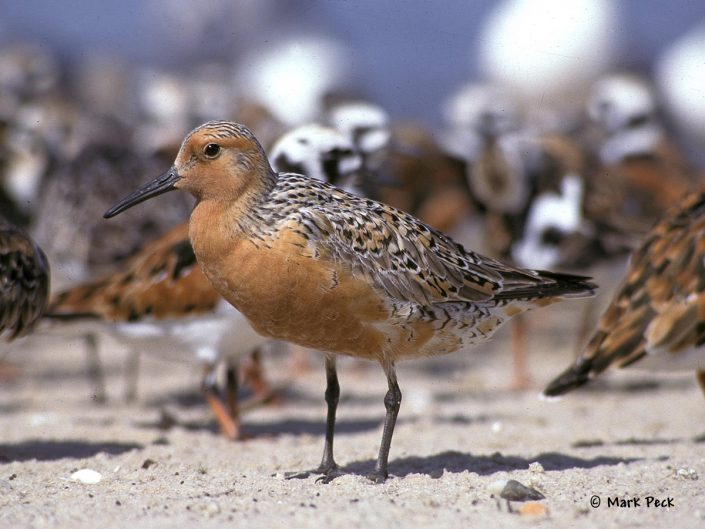
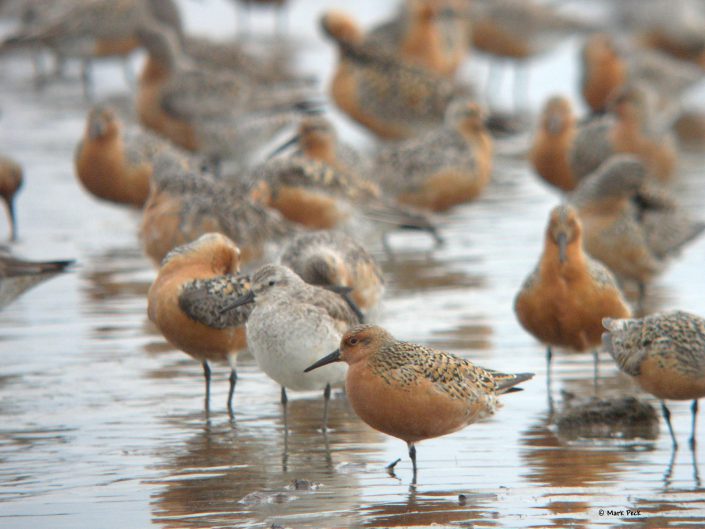
Red Knot photo by Mark Peck.

The iconic red knots have returned to New Jersey! These famous, mid-sized shorebirds are state endangered and now federally threatened — the first bird ever listed under the Endangered Species Act with climate change cited as a “primary threat.”


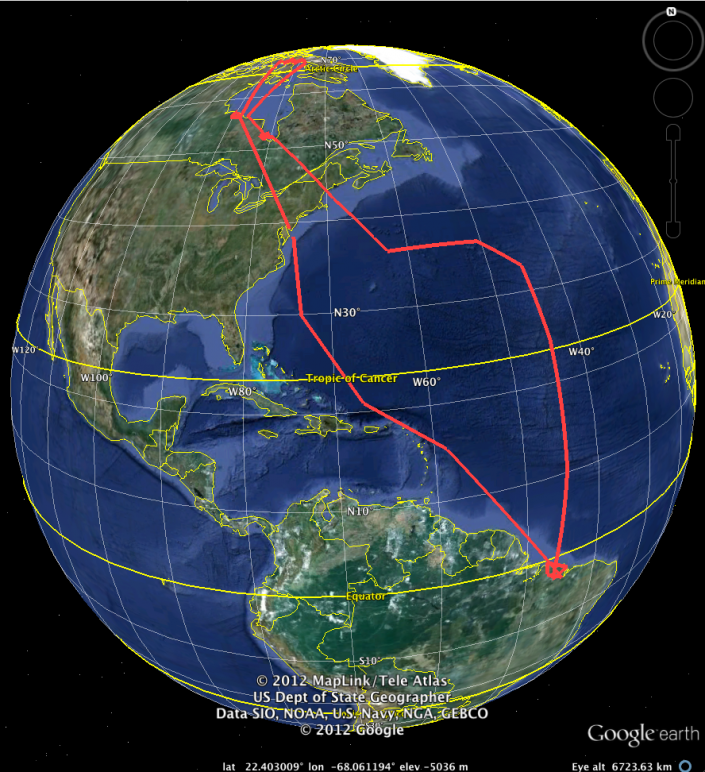
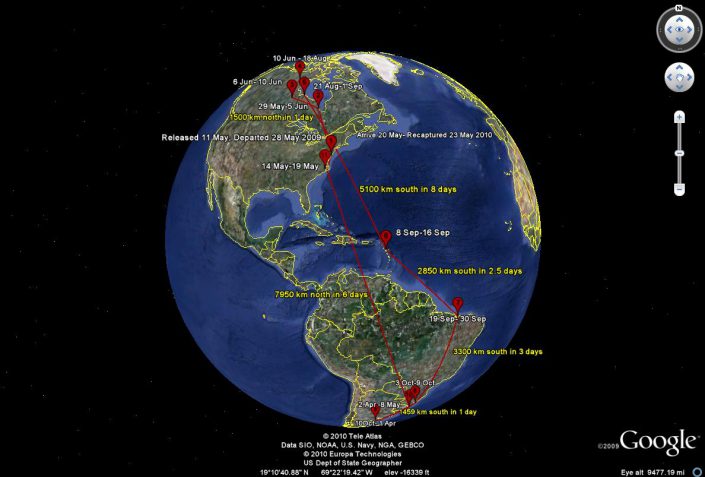
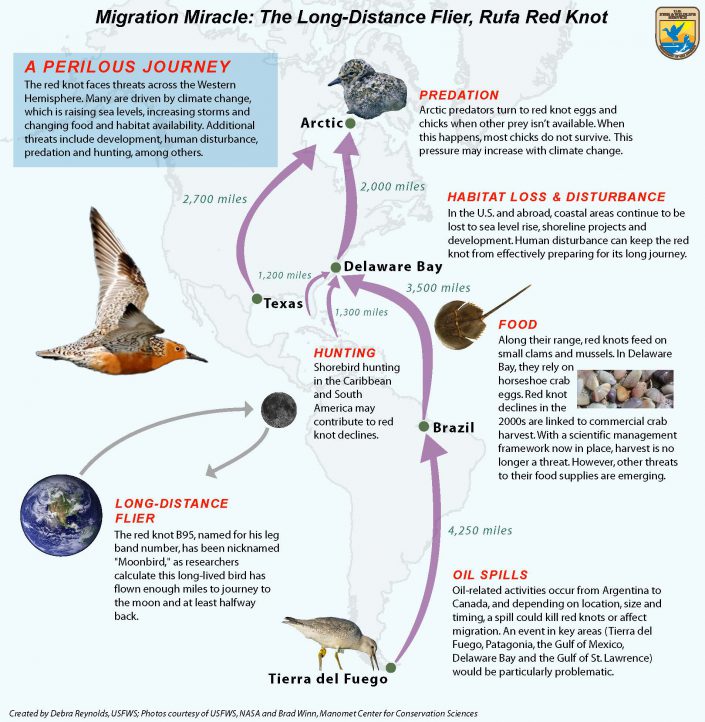
Red knots are only 10 inches long but are among the world’s most extreme long distance flyers  traveling vast distances  some over 18,000 miles in the course of their annual migration from Tierra del Fuego, Argentina all the way up to the Canadian Arctic (and back again). During their trip, the red knots make a vital stop at New Jersey’s Delaware Bay.

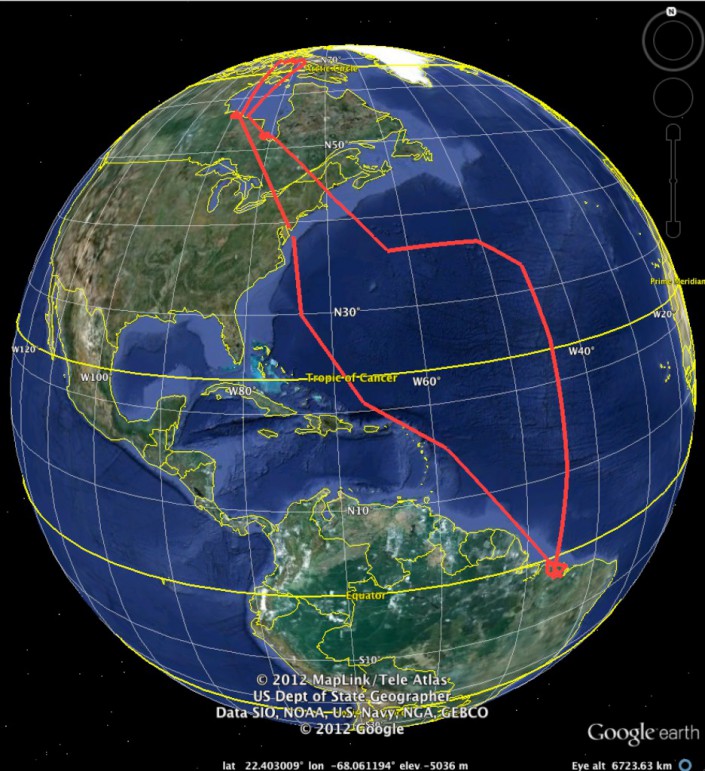
This map shows the flight path of a red knot that was banded and fitted with a geolocator along New Jersey's Delaware Bay.
This map shows the flight path of a red knot that was banded and fitted with a geolocator along New Jersey’s Delaware Bay.

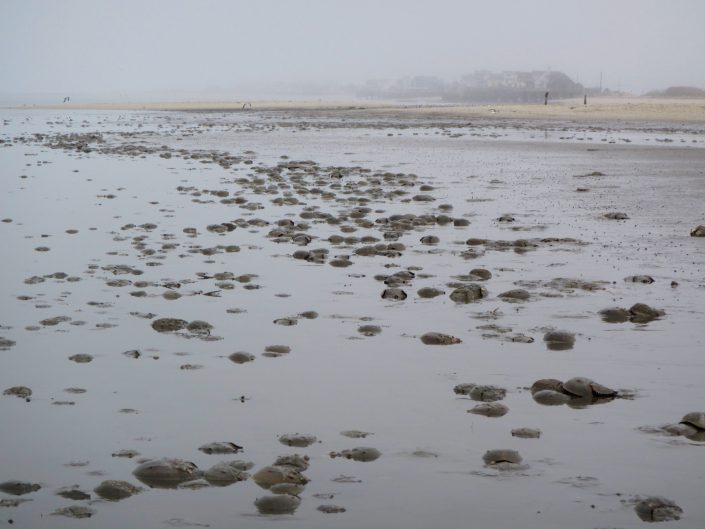
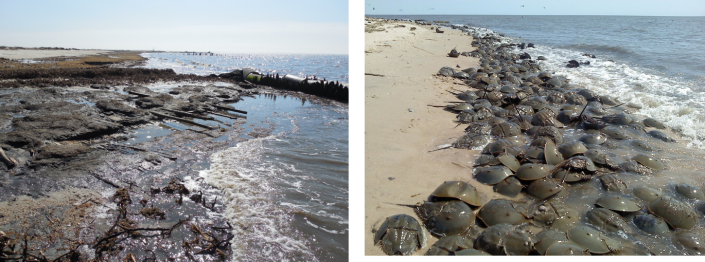
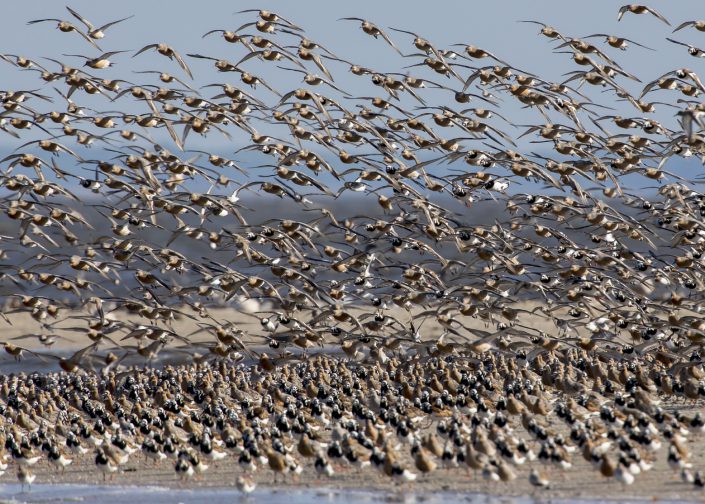
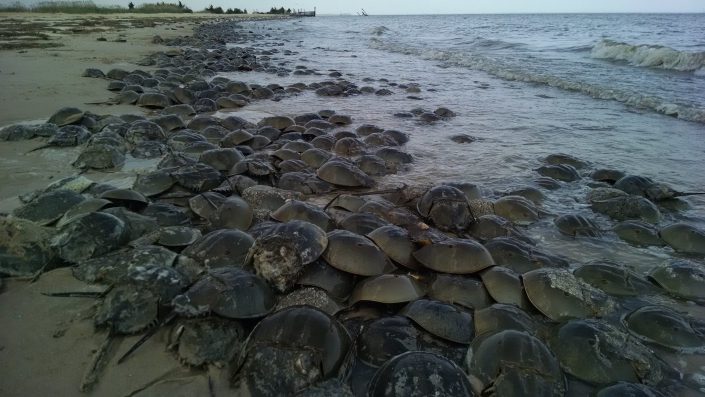
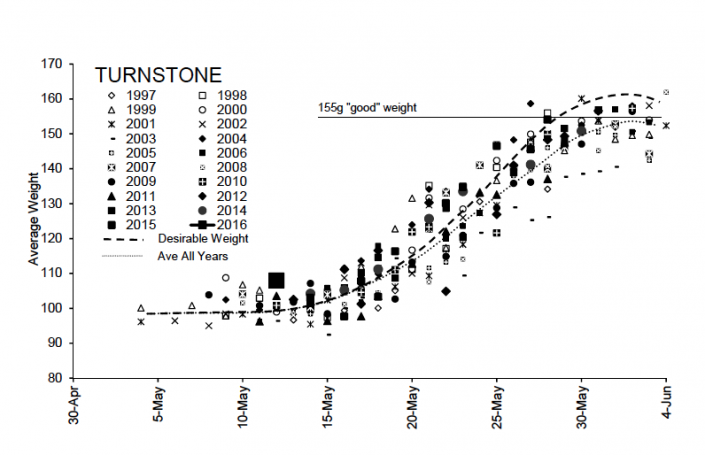
Each spring in Delaware Bay, throughout the month of May, the largest concentration of horseshoe crabs in the world comes onshore to spawn. At the same time, tens of thousands of shorebirds arrive at the Bay, thin and spent from what has been a non-stop, four-day flight from South America. They are en route on a remarkable round-trip journey from southern wintering grounds to Arctic breeding territory, and Delaware Bay is their most critical stopover on this 8,000-mile trip. The shorebirds need to quickly double their weight to complete their migration north and breed successfully. To refuel at such capacities and in only a ten-day window, high-energy horseshoe crab eggs provide essential nourishment. In recent years, countless horseshoe crab eggs have been lost because of the devastating storms that swept away the beaches they depend on.


In the wake of Hurricane Sandy, Conserve Wildlife Foundation and American Littoral Society worked with the U.S. Fish and Wildlife Service, the New Jersey Division of Fish and Wildlife and the New Jersey Recovery Fund to remove 8,000 tons of debris and added 45,000 tons of sand to the beaches just before the annual spring arrival of the red knot in 2013. Additional work after 2012 restored another mile of shoreline, including two new beaches of poor quality even before Sandy. To date, the groups have placed over 85,000 cubic yards of sand and restored seven beaches along New Jersey’s Delaware Bayshore.


To restore one of the beaches, Thompsons Beach, our team removed debris from the area, removed rubble from the road leading to the beach, and placed over 40,000 cubic yards of sand onto the beach. We were delighted to learn that in the spring of 2015, Thompsons Beach had the highest abundance of horseshoe crab egg clusters out of all the beaches that our team monitors on Delaware Bay.

Horseshoe crabs spawning at Thompsons Beach in May 2015. Photo by Joe Smith.

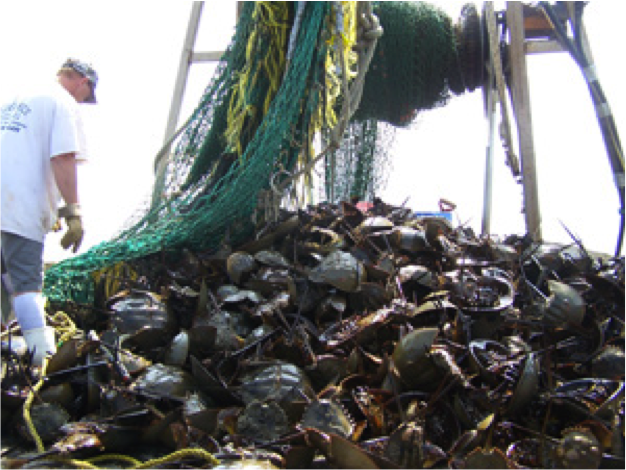
But since the early 1990s, there have been major declines in both the number of adult horseshoe crabs and their eggs. The cause is an exploding crab harvest that grew from only tens of thousands in 1990 to over 2 million in 1996. With the decline of their critical food source, shorebird numbers also plummeted  the Delaware Bay shorebird populations remain around 26% of its historic population size. Over 25,500 red knots were seen in 2015 versus over 90,000 in 1989.


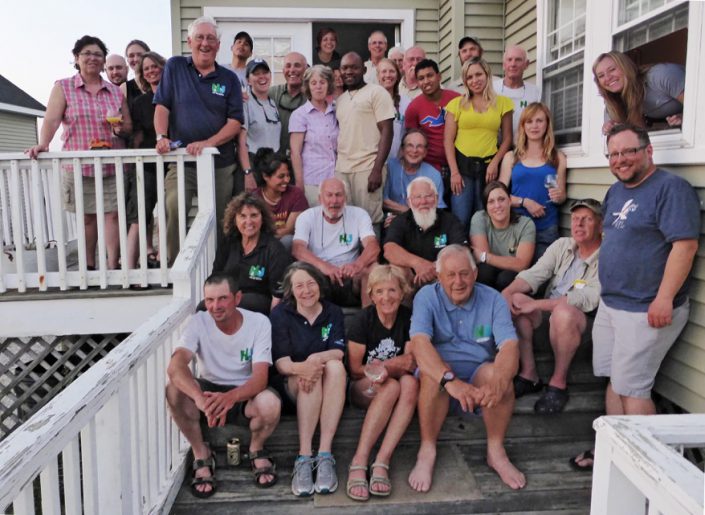
Conserve Wildlife Foundation and the Endangered and Nongame Species Program (ENSP) of the New Jersey Department of Environmental Protection’s Division of Fish & Wildlife have partnered for 20 years, working to conduct research on Delaware Bay shorebirds in order to prevent further decline. Each year, CWF’s Larry Niles and ENSP’s Amanda Dey lead a team of shorebird experts from around the world – from countries as far as Argentina and New Zealand – to conduct research on shorebirds during their stopover. These experts also follow shorebirds to other locations along their migration, including South America and the Arctic. With scientific research and concerted conservation efforts, our hopes are that someday Delaware Bay’s skies will be once again filled with shorebirds.

Red Knot photo by Mark Peck.

Last year, nearly every red knot left the bay in good condition, with over 77% reaching weights exceeding 180 grams, the threshold weight required for a successful flight to the Arctic breeding areas. The improvement in the number of red knots reaching 180 grams is a milestone for our shorebird project. The birds left in the best condition recorded since 1998, just as horseshoe crabs were being overharvested. This good news must be tempered by the continued low numbers of birds and horseshoe crabs. We report no improvement in horseshoe crab numbers, so the improvement in the number of red knots making weight is likely a consequence of the restoration of horseshoe crab habitat on Delaware Bay beaches.


Because shorebirds don’t only spend their time in Delaware Bay, shorebird scientists must study them throughout the Atlantic Flyway to get the best understanding of their unique ecology. This year, shorebird project team was awarded a 2-year grant to create detailed shorebird habitat maps in the states of Maranhão and Pará, Brazil. This project will set the foundation for conservation planning and action for decades to come at a shorebird wintering site of hemispheric importance that has received little conservation and research attention with regard to shorebirds thus far.


Over the last 6 years, CWF also has partnered with the USFWS Monomoy Refuge to develop a better understanding of migratory shorebird use on Cape Cod and at the Refuge. Cape Cod, like Stone Harbor and Brigantine, New Jersey, is an important southbound stopover for red knots. At each location, red knots come from their Arctic breeding areas and either build up weight for a flight to South America, or remain to molt and replace vital primary feathers before moving onto shorter distance wintering areas in Florida and Cuba.

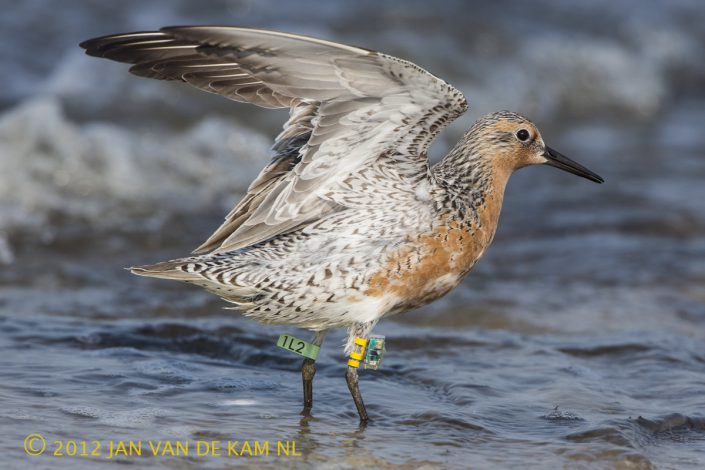
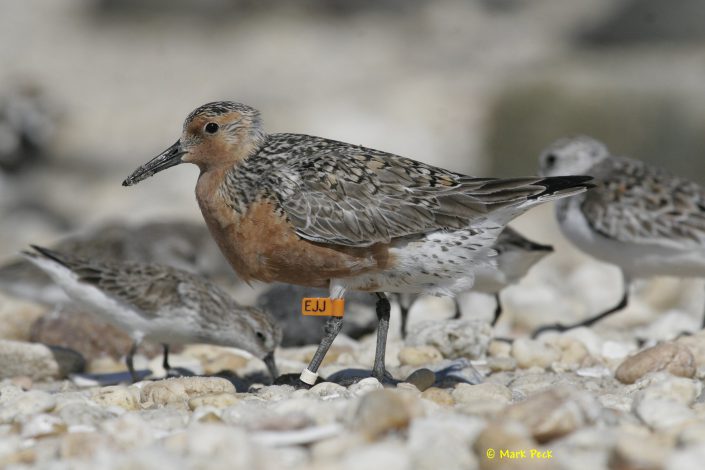
Banded Red Knot photo by Mark Peck.

Another important piece of CWF’s shorebird research has been the attachment and recovery of geolocators, small devices that track movements through one to two years of battery life. The migratory tracks from recovered geolocators have greatly expanded our understanding of red knot migratory behavior. In CWF’s last two years of research, we focused on capturing juveniles, which move through the Cape in early September. Red knot juvenile #254 was a recapture two years after release on Delaware Bay. It first left Cape Cod and wintered in North Carolina. In their first year, juvenile red knots don’t go to the Arctic to breed and so #254 flew back to Cape Cod to summer. The following fall, it flew to Cuba to winter, then to North Carolina, then to the Arctic. This was the first known track of a juvenile red knot and one of only a few of any avian species! CWF is continuing our geolocator project this year, so follow along on our blog and social media channels to receive updates on cutting-edge red knot research!


Learn More:


Lindsay McNamara is the Communications Manager for Conserve Wildlife Foundation of New Jersey.

International Migratory Bird Day Series: Piping Plover

CWF is Celebrating International Migratory Bird Day all Week Long

by Lindsay McNamara, Communications Manager

CWF’s blog on the piping plover is the second in a series of five to be posted this week in celebration of International Migratory Bird Day (IMBD). IMBD 2016 is Saturday, May 14. This #birdyear, we are honoring 100 years of the Migratory Bird Treaty. This landmark treat has protected nearly all migratory bird species in the U.S. and Canada for the last century.

Piping plover. © Steve Byland
Piping plover photo by Steve Byland

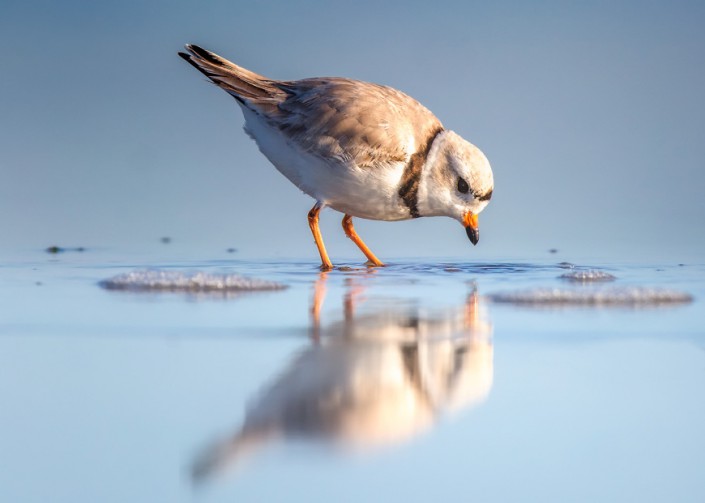
The piping plover – a small sand-colored shorebird that nests in New Jersey as part of its Atlantic Coast range from North Carolina up to Eastern Canada –weighs only one to two ounces and is about six to six and a half inches long. These tiny shorebirds migrate all the way to their wintering grounds along the coast of eastern Mexico and on Caribbean islands from Barbados to Cuba and the Bahamas.


Migrants can be seen in New Jersey from early March to late April and again from mid-July to the end of October. Females are the first to leave the breeding grounds, followed by males, then juveniles. Breeding plover “hot spots” in each coastal county of New Jersey are Gateway National Recreation Area – Sandy Hook Unit, Barnegat Light, North Brigantine Natural Area and Stone Harbor Point.


We see a number of migratory piping plovers in New Jersey because the Garden State is roughly in the middle of their breeding range. Todd Pover, CWF’s beach nesting bird project manager, reasons that we have a high number of Eastern/Atlantic Coast Canadian breeders that stop in New Jersey — based on band resights — albeit usually for just a day on their way north to breeding grounds. Therefore, New Jersey may play an important role in the piping plover life cycle not just for breeding, but for migration as well, which emphasizes the importance of protecting shorebirds in all phase of their lives or “full life-cycle conservation”.


Piping plovers face a number of threats, including intensive human recreational activity on beaches where they nest, high density of predators, and a shortage of highly suitable habitat due to development of barrier islands and extreme habitat alteration.  Sea level rise and increased storm activity related to climate change will also likely lead to more flooding of nests.


Federally listed as a threatened species in 1986, piping plovers have since recovered in some areas of the breeding range. Yet piping plovers continue to struggle in New Jersey, where they are listed by the state as endangered. For more information about piping plover nesting results in New Jersey, please read Conserve Wildlife Foundation’s 2015 report.

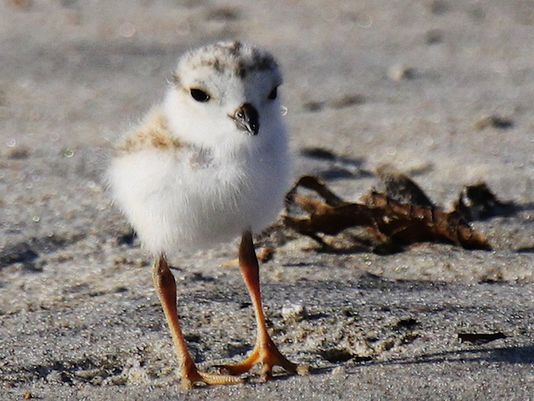
Piping plover chick, photo credit: Asbury Park Press/Nancy A. Smith

CWF, in close coordination with NJDFW’s Endangered and Nongame Species Program, oversees piping plover conservation throughout New Jersey. Staff and volunteers help erect fence and signage to protect nesting sites, monitor breeding pairs frequently throughout the entire nesting season from March to August, and work with public and municipalities to educate them on ways to minimize impacts. Although conservation efforts on the breeding ground remain the primary focus, in recent years, CWF has also begun to work with partners all along the flyway, in particular on the winter grounds in the Bahamas, to better protect the at-risk species during its entire life-cycle.


We are working hard to link students across the piping plover’s flyway through our Shorebird Sister School Network, where we pair up schools in New Jersey and the Bahamas, one of the most important wintering areas for Atlantic Coast piping plovers. Now, we are hopefully recruiting some Canadian students as well.


Conserve Wildlife Foundation will continue to find innovative ways to save the small migratory shorebird. In 2015, 108 pairs of piping plovers nested in New Jersey, a 17% increase from 2014. What will 2016 bring? Follow us on social media to learn more about the tireless efforts of a team of passionate, dedicated biologists working to save the iconic coastal species.


Learn More:


Lindsay McNamara is the Communications Manager for Conserve Wildlife Foundation of New Jersey.

Shorebirds Arrive in New Jersey’s Delaware Bay

The Birds are Back – Red Knots Arrive Along the Bayshore

by David Wheeler, Executive Director

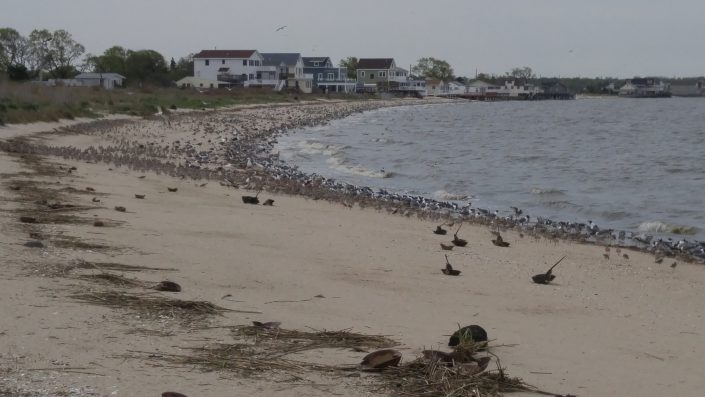
Photo by David Wheeler.

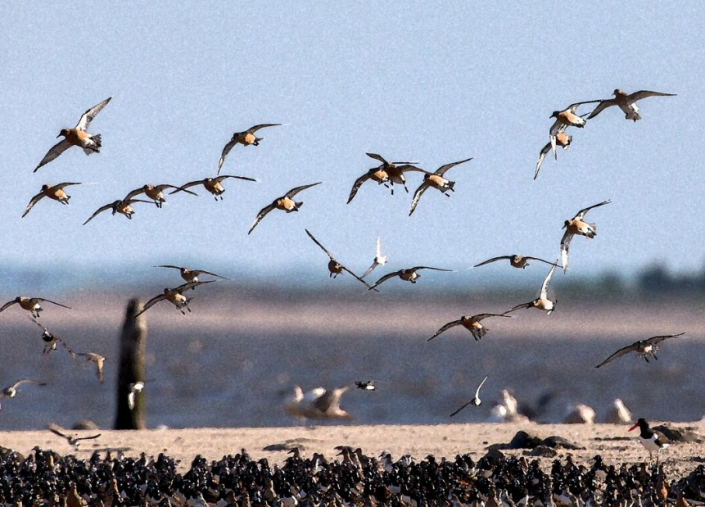
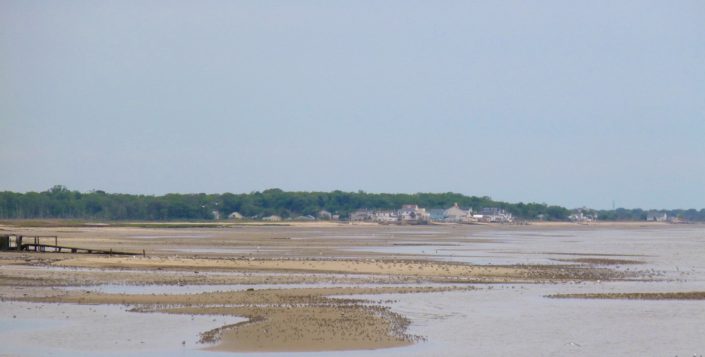
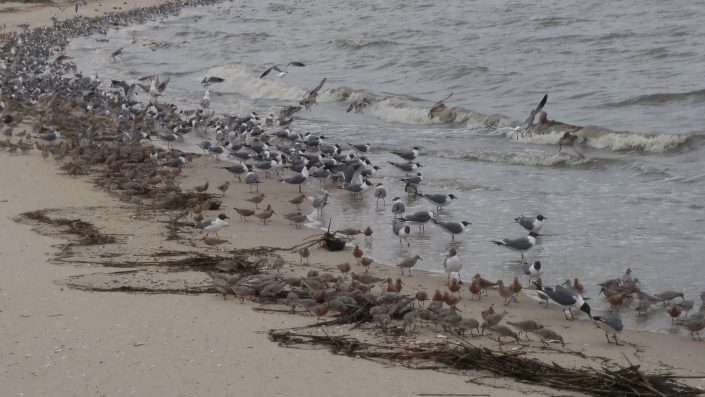
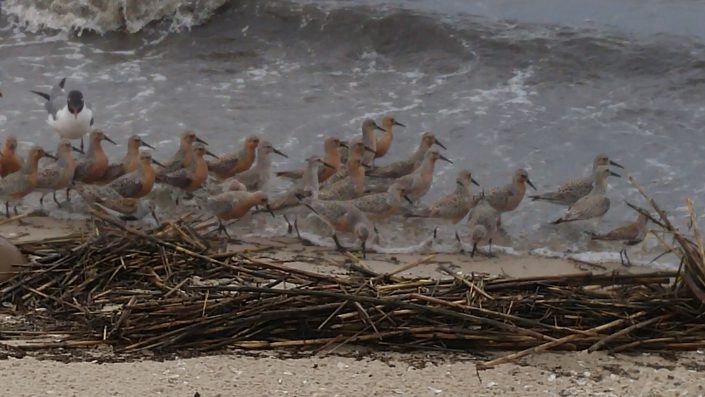
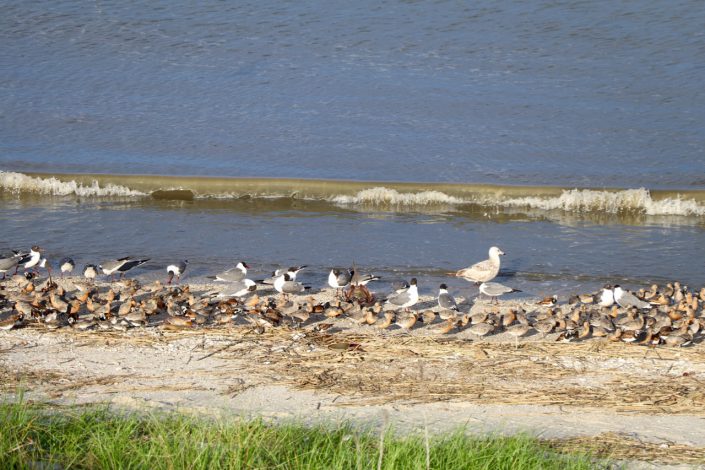
The 2016 mass shorebird migration is officially underway, with the thrilling spectacle of over 1,100 red knots spotted today at North Reeds Beach in Cape May County, New Jersey. A host of other shorebirds, including ruddy turnstones, dunlins, semipalmated sandpipers, and sanderlings, accompanied the red knots at this Delaware Bay hotspot.


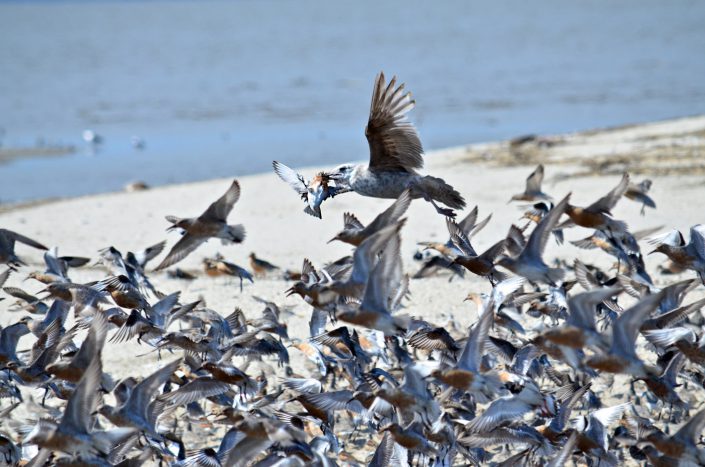
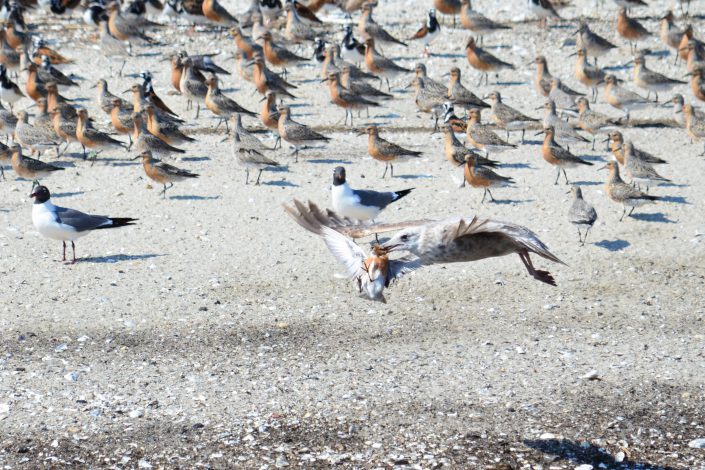
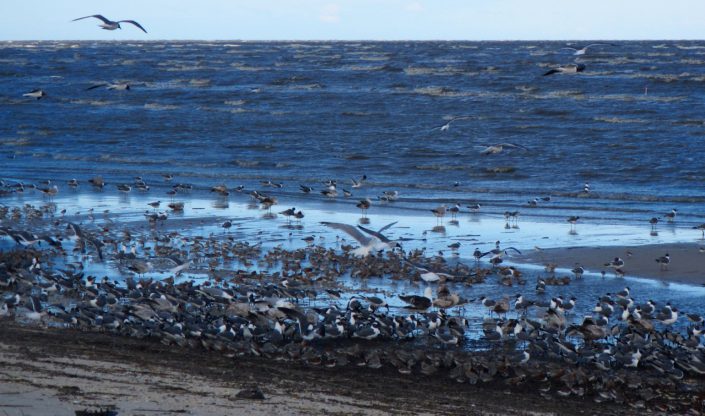
The famished flocks fed on horseshoe crab eggs, while much larger laughing gulls congregated along the shoreline and a few crabs used the incoming waves to flip themselves over and return to the bay.

Photo by David Wheeler.

Researchers began seeing a large number of shorebirds arriving over the weekend, and today’s sightings are high for such an early date. A number of the red knots wear leg bands, with a few indicating departure points as far south as Argentina and Chile. Such lengthy migrations for those individual birds only add to the intrigue of their early-season arrivals in New Jersey.


Some red knots fly over 18,000 miles each year in their migrations from southern South America to the Canadian Arctic, with Delaware Bay serving as an irreplaceable stopover.

Photo by David Wheeler.

Yet these migratory shorebirds have suffered a sharp decline over the past few decades, with red knots dropping by around 75%. The U.S. Fish and Wildlife Service designated the red knot as a federally protected threatened species under the Endangered Species Act in December 2014.


A team of international researchers and trained volunteers, led by Dr. Larry Niles, Conserve Wildlife Foundation, and the State Endangered and Nongame Species Program will spend the next month surveying and studying the at-risk shorebirds during their stay in New Jersey.

Infographic used from http://www.fws.gov/northeast/redknot/.


Learn More:


David Wheeler is Executive Director of Conserve Wildlife Foundation.

Plover Power

Reflections Three Years into the Shorebird Sister School Network Program

by Stephanie Egger, Wildlife Biologist

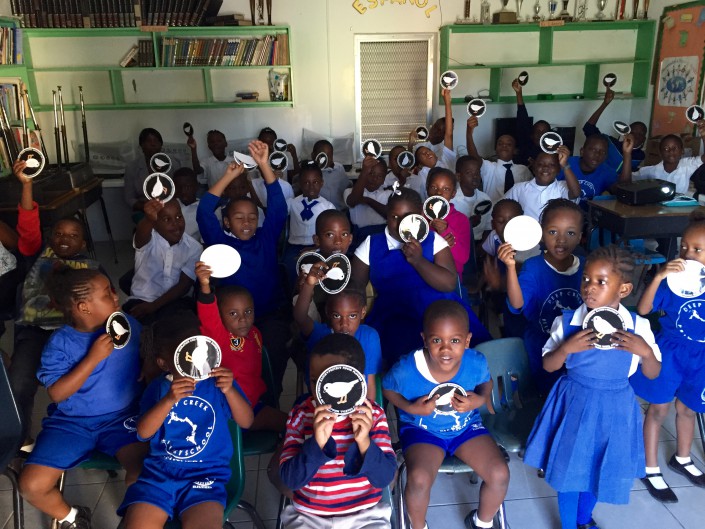
Deep Creek Primary students with the migratory and wintering Piping Plover decal.

As we begin to wrap up our third year of the Shorebird Sister School Network, we are able to reflect on how far we have come in just a short time. In our first year, we started with just one class at Amy Roberts Primary School (Green Turtle Cay, Abaco, The Bahamas), led by teacher Jan Russell, which was paired up with a class at Ocean City Intermediate School (Ocean City, New Jersey), led by teacher Deb Rosander. We presented the students with information on the full life cycle of the Piping Plover, commonly referred to as “our birds” in New Jersey. Really they are residents of The Bahamas, spending over half their life on the warm sandy beaches surrounded by turquoise water. Piping Plovers in The Bahamas,  in most cases, see less disturbance than what is experienced by plovers on their breeding grounds in the United States and Canada.


We not only focus on breeding, migration, and wintering of the plovers, but the importance of their habitat to a suite of species. In The Bahamas, the tidal flats used by the Piping Plovers are of huge importance to the ecological value and economy of The Bahamas, as the flats are also used by bonefish, conch, and shark species. We had both classes conduct similar projects  interpretive signs placed on the breeding and wintering grounds  using their writing skills and original artwork. The students also participated in field trips where they learned how to use spotting scopes and binoculars to find and identify shorebirds.

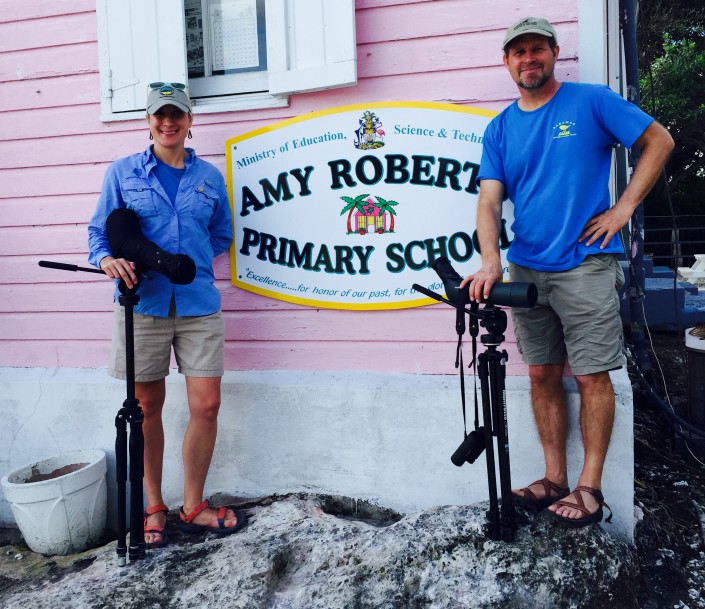
Shorebird Sister School Network leaders and CWF biologists, Stephanie Egger and Todd Pover at Amy Roberts Primary School, one of the first sister schools in the program.

Three years later, we still are teaching our core lessons, but have vastly expanded on the curriculum and projects, as well as extending the program onto another island, Eleuthera, which is just south of Abaco. We now are working with Cherokee Primary in the settlement of Cherokee Sound (Abaco) and Deep Creek Primary (Deep Creek, Eleuthera). We have continued working for the last three years with Amy Roberts Primary School and Ocean City Intermediate School. Back in the United States, we have added a second class from Ocean City, as well as the Leeds Avenue Elementary School Environmental Club (Pleasantville, New Jersey) led by Mary Lenahan. We’ve added new components to the curriculum such as bird anatomy, foraging differences between species of shorebirds, invasive species, habitat assessments (including macroinvertebrates) and marine debris.


We continue to implement interpretive signs as a project with classes that are in their first year of the program, but have come up with new and exciting projects to keep the students (and teachers) motivated and engaged to continue participating as a sister school. For example, during the second year we worked with Amy Roberts, we removed 1,500 Australian pine (Casuarina spp.) from Green Turtle Cay as it degrades the habitat for piping plovers and other species. We created a Piping Plover activity book complete with crossword puzzles, word searches, and mapping activities designed mainly by the students at Ocean City Intermediate School, Leeds Avenue Elementary School, and Amy Roberts Primary School. Because Cherokee Primary and Deep Creek Primary are new to the program this year we hope to have their students create interpretive signs, while the second and third year students in the Program may develop PSA-type videos this year and pen pal letters to their respective sister schools in the United States.


Throughout the year, each class receives one or two classroom lessons and a field trip. We keep busy during the few short weeks we have in The Bahamas; coordinating the field trips, conducting surveys, presentations, and working to continue to build and strengthen our existing relationships with partners, such as Friends of the Environment and local citizen scientists. This year, we’ve reached over 120 students in the program, both from the Bahamas and in the United States.

Official Shorebird Sister School Network Logo


One of the most rewarding aspects of the Shorebird Sister School Network is that we are able to provide lessons to the some of the same children throughout multiple years in the program, which strengthens the conservation messages we are trying to instill in the upcoming generations. We hope to foster a greater appreciation for wildlife, especially for the Piping Plover and its habitat, and inspire students to help now and later on in their lives as adults ensure the recovery and survival of the bird for years to come.


Learn More:


Stephanie Egger is a wildlife biologist for Conserve Wildlife Foundation of New Jersey.


Science in the Mangroves

Update from Brazil: “We are Going to Have to Science the ‘Heck’ Out of This”

by Dr. Larry Niles, LJ Niles Associates LLC
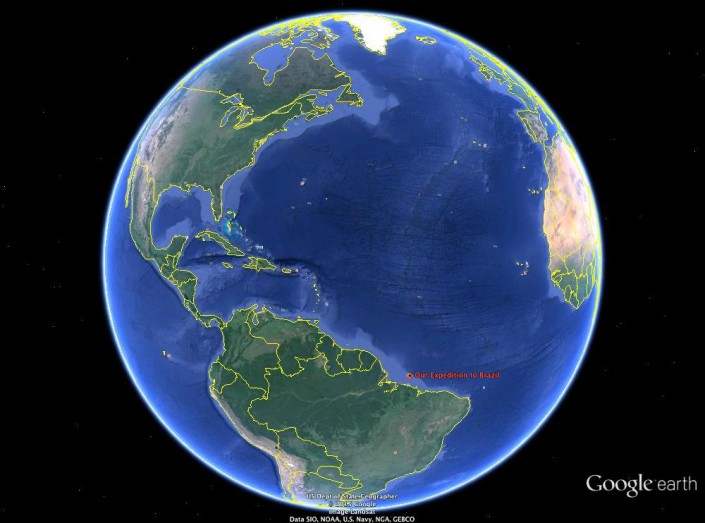
larger view of brazil


We came to Brazil to conduct a rigorous scientific study of the wintering population of shorebirds in a place where the land and sea act against any rigorous protocol. It would be easier to just go out and count birds and identify their habitats and prey, but our charge is more difficult.


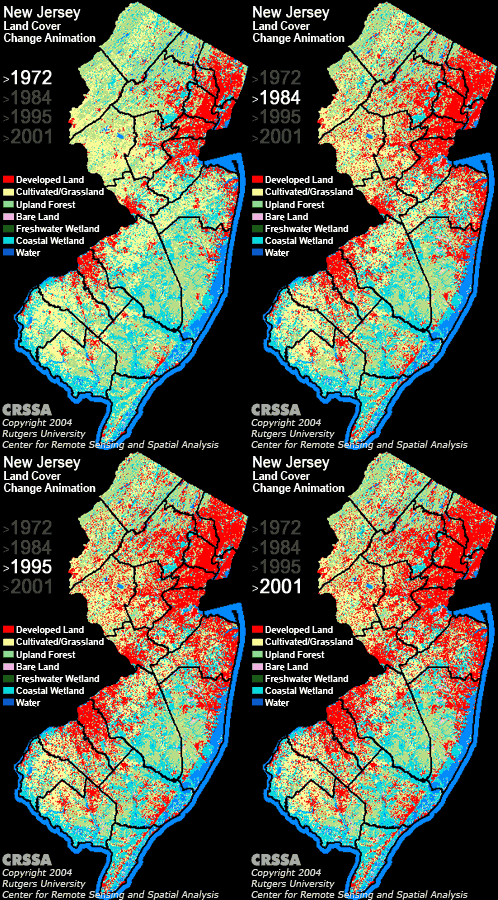
The survey wraps around satellite imagery, strange unintelligible wavelength data coming from satellites hovering over the earth that can be transformed into brilliant and useful maps in the right hands. Those hands belong to Professor Rick Lathrop and his post doc Dan Merchant. Rick leads the Center for Remote Sensing at Rutgers and he and I have collaborated on projects ranging from municipal habitat conservation planning to Arctic red knot habitat mapping. He has created one of the most alarming maps that every person from New Jersey should know about.

nj_landchange450

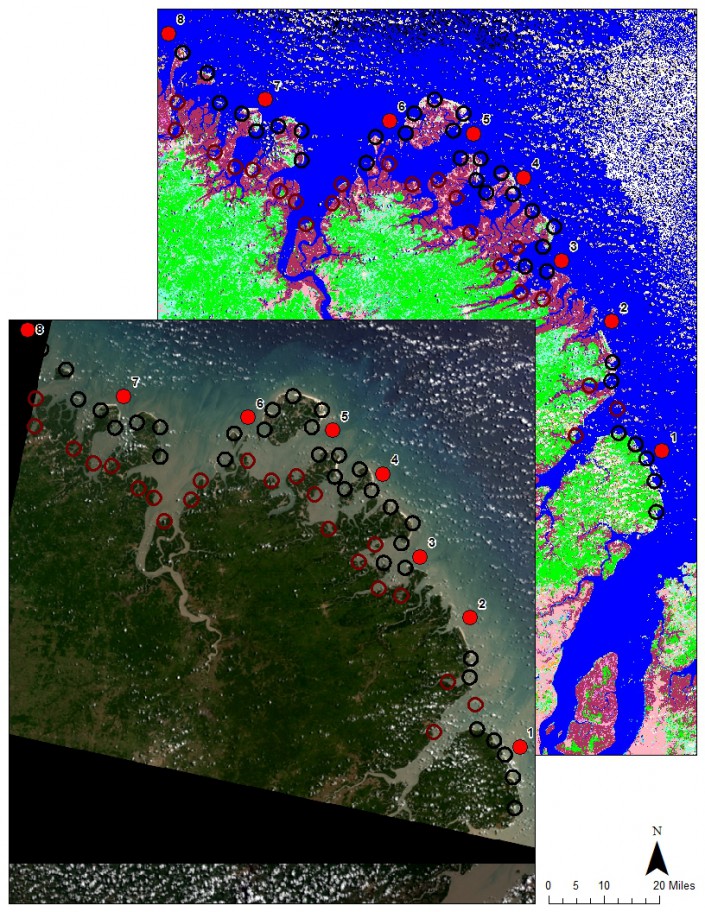
The mapping of Reentrancias Maranhenses, an internationally recognized site of ecological importance is especially tricky. Our research platform is a 50-foot boat and we will be out of cell and internet contact for much of the time. Our method of collecting data for the mapping was devised by the whole team, but especially with the help Professor David Santos of the University of Maranhao, my colleague Dr. Joe Smith and Humphrey Sitters of the International Wader Study Group.

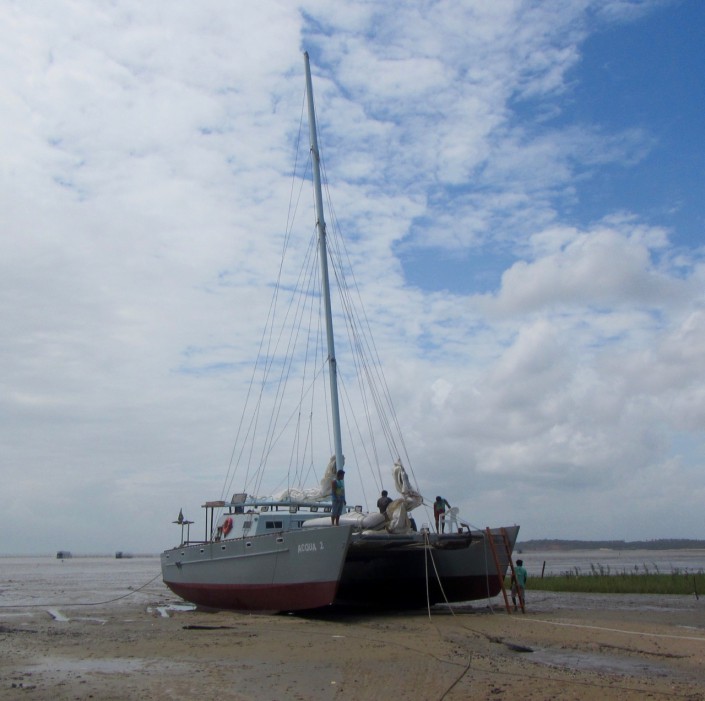
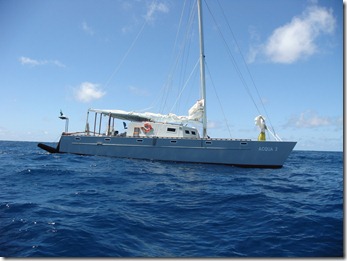
Our 50-foot catamaran

It focuses on collecting bird and habitat information using randomly selected survey points. In other words, we will try to pick places at random to survey so that when we combine them we will have a sample that represents the entire area, not just the places we surveyed. It’s like trying to figure how many different kinds of chocolates are in a valentine. If you take them all from one side then you might have sampled the chocolate covered cherry section leading to believe they are all one kind. But if you choose chocolates at random than you will find the box includes other kinds,  caramel or fruit or nutty chocolates. This is making me hungry, but you get the point.


The area  of our box we is very large, bigger than New Jersey, and it grows and shrinks every day with the tides. So, sampling is tricky business because a sample at low tide, when the tide is out exposing vast areas of intertidal mud and sand flat, is very different than when the tide is high. So we will be classifying habitat, or stratifying it, so we  can focus on limited survey time to get the best sample.


Once collected we can start making maps.  All data will be geo referenced – or located precisely  with GPS units – so it can be accurately mapped. With this, we will train the satellite maps to outline the habitat best for shorebirds.


All this while exploring areas that have received little scientific scrutiny and under tropical conditions, almost daily rain, a persistent 20 mph wind and summer heat.  Add parasites, mosquitoes and diseases like malaria and one can see this a rugged undertaking.


Our crew is up to it.  Besides those mentioned above Mark Peck from Royal Ontario Museum, Danielle Paluto from the Brazilian CEMAVE (a counterpart to our USFWS), Steve Gates a veteran of expedition on other SA trips, shorebird expert Dr. Mandy Dey, Stephanie Feigin from Conserve Wildlife Foundation of New Jersey and the author round out a dream team of bird study in difficult places.

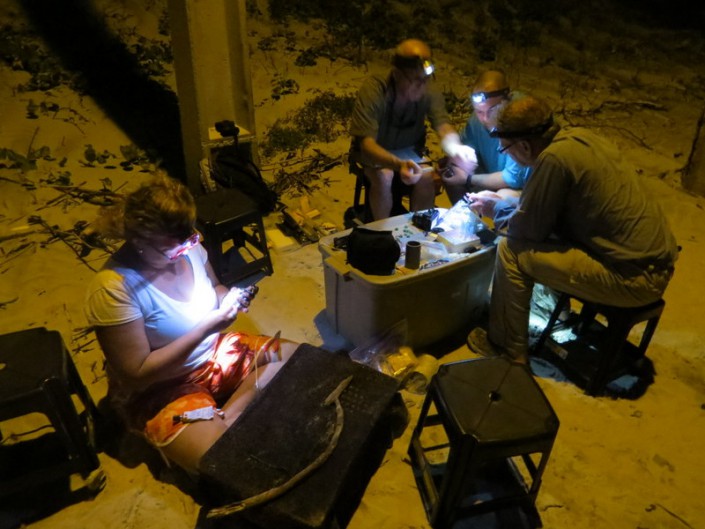
Our crew banding shorebirds in Brazil in 2014.


Learn more:


Dr. Larry Niles has led efforts to protect red knots and horseshoe crabs for over 30 years.


CWF Biologists Travel to Brazil to Study Red Knots

On our Expedition to Study Shorebirds along the Northern Coast of Brazil

By: Dr. Larry Niles, LJ Niles Associates LLC

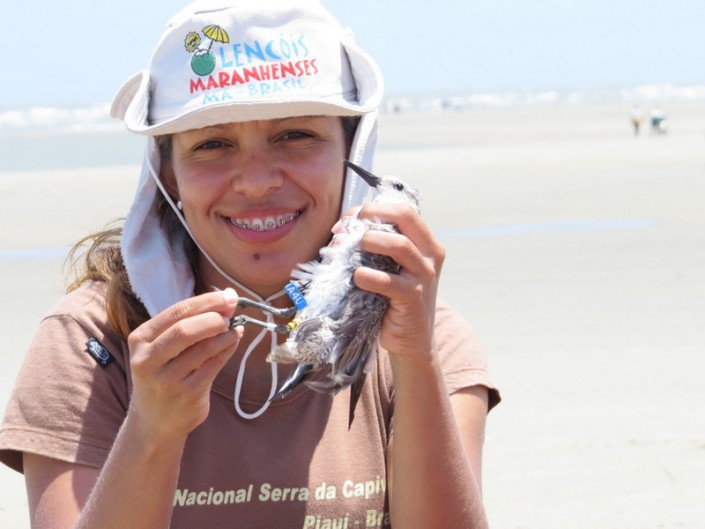
Ana Paula with Red Knot

The largest mangrove forest in the world covers the Brazilian coastline at the equator near the mouth of the Amazon river. The forest extends out into the Atlantic in long peninsulas tipped by wind swept and mostly inaccessible beaches. The forest, beaches and their long intertidal mud and sandy low tide flats support the largest wintering population of shorebirds in the hemisphere, perhaps the world. The red knot, a listed species in both North and South America, also uses this remote tropical coast.

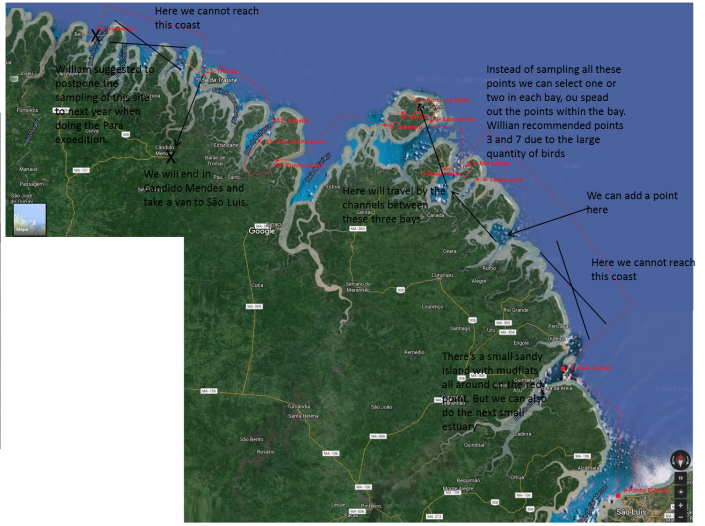
Boat Trip Route
Boat Trip Route
Catamaran
Catamaran


With scientists from the U.S., Canada, England and Brazil, we will attempt a large scale mapping of this important habitat using state-of-the-art satellite mapping. We will do this from a 50-foot catamaran and two zodiacs hopping from one mangrove estuary to another and conducting bird surveys targeting key areas over a 150 mile-section of the coast. We will be the first to survey some areas. Our goal is to figure out the main threats to both bird and habitat.


To understand the importance of this area one has to think about it like a shorebird. Although born in the Arctic they actually spend only a few months there. They spend a few months moving from their nesting area to their wintering area. They spend the rest of their lives, the majority of their year in the wintering area. A threat to the wintering area would be grave.


Most of our survey zone is part of the Reentrancias Maranhenses, a protected area of the state of Maranhao, Brazil. Our catamaran captained by William Thomas will leave from a small town near the city of Sao Luis, Brazil. From there we will sail along the coastline moving in and out of the mangrove islands to survey shorebirds, habitat and marine invertebrates. We will “geo reference” all data, or take detailed coordinates so the data can be reproduced on satellite mapping.

Satellite Map
Satellite Map


Satellite maps aren’t really maps as most people understand — pictures or drawings of a section of the earth — they are digital files of remotely sensed data, they are only wavelengths of light that must be interpreted to represent actual habitat. We will train the satellite data so that each habitat will be represented by a combination of spectral data — colors in sense.

Environmental disturbance. Photo by Mark Peck.

Once completed, we can relate the habitat maps with information on birds, their prey and equally important, the threats to the birds and prey. For example, shrimp farming is growing in this area. Entrepreneurs are stripping the intertidal zone of mangrove forest, diking the area and then growing shrimp. Once the area accumulates too much waste and chemicals, they abandon the site and move on to damage another mangrove forest. We will determine which areas are of importance to the birds and potential targets for shrimp farmers. But there is more: oil spills, disturbance from tourists, water pollution are among many.


Over the next three weeks, we will be reporting on our work on this blog.

Log of Red Knot DbY7 with geolocator.


Learn more:


Dr. Larry Niles has led efforts to protect red knots and horseshoe crabs for over 30 years.
Piping Plover Population Rebounds from Historic Low in New Jersey

Conserve Wildlife Foundation of New Jersey releases 2015 report

by Todd Pover, Beach Nesting Bird Project Manager

Photo by Northside Jim

Conserve Wildlife Foundation today released the 2015 Piping Plover Breeding Report, highlighting the number of nesting pairs, pair productivity, and coast-wide distribution for this endangered shorebird, from data collected by New Jersey Division of Fish and Wildlife (NJDFW) biologists, CWF biologists, and other partners.
 

“The rebound in New Jersey’s piping plover breeding population and a second consecutive year of robust chick productivity was a much needed outcome,” said Conserve Wildlife Foundation Beach Nesting Bird Project Manager Todd Pover. “We need to continue our intensive management for a number of years to sustain any recovery, but we were very pleased to have finally broken the recent cycle of low nesting success and the record low number of nesting pairs in 2014.”


The piping plover – a small sand-colored shorebird that nests in New Jersey as part of its Atlantic Coast range from North Carolina up to Eastern Canada – face a number of threats, including intensive human recreational activity on beaches where they nest, high density of predators, and a shortage of highly suitable habitat due to development and extreme habitat alteration.


Federally listed as a threatened species in 1986, piping plovers have since recovered in some areas of the breeding range. Yet piping plovers continue to struggle in New Jersey, where they are listed by the state as endangered.


“As a species dependent on natural beach habitat, piping plovers face a particularly daunting challenge along New Jersey’s heavily developed and dynamic coast,” said Conserve Wildlife Foundation Executive Director David Wheeler. “Our dedicated scientists, partners, and volunteers are working tirelessly to ensure piping plovers remain a beloved and healthy presence along the Jersey Shore and beyond.”


CWF, in close coordination with NJDFW’s Endangered and Nongame Species Program, oversees piping plover conservation throughout New Jersey. Staff and volunteers help erect fence and signage to protect nesting sites, monitor breeding pairs frequently throughout the entire nesting season from March to August, and work with public and municipalities to educate them on ways to minimize impacts. Although conservation efforts on the breeding ground remain the primary focus, in recent years, CWF has also begun to work with partners all along the flyway, in particular on the winter grounds in the Bahamas, to better protect the at-risk species during its entire life-cycle.


2015 Report Highlights:


  • The population of breeding piping plovers increased 17% to 108 pairs in 2015, as compared to 2014. Despite the increase, the population still remains below the long-term average (118 pairs) since federal listing in 1986 and well below the peak.
  • The statewide fledgling rate, which includes data collected by partners at 19 active nesting sites throughout the state, was 1.29 fledglings per pair, down slightly from 2014 (1.36 fledglings/pair), but still one of the highest statewide levels since federal listing. Furthermore, both years were above the 1.25 fledgling rate believed necessary to maintain the range-wide Atlantic Coast population of piping plovers.
  • Statewide pair-nest success, the percentage of pairs that successfully hatch at least one nest, was high at 79%, well above the average since federal listing. Although population and productivity are ultimately the most important measures of recovery success, hatch success is an important metric to demonstrate the effectiveness of on-the-ground management.
  • Northern Monmouth County, as a region, continued to account for the largest percentage of pairs in the state (55 pairs or 51%), with Gateway National Recreation Area – Sandy Hook Unit accounting for most of those pairs.
  • The region comprised of North Brigantine Natural Area and the Holgate and Little Beach Units of the Edwin B. Forsythe National Wildlife Refuge accounted for the other significant concentration of breeding pairs in the state (43 pairs or 40% of the statewide total).
  • Holgate had the largest jump in abundance for any individual site, doubling its breeding pairs to 24 in 2015 (up from 12 in 2014). This increase was the result of highly suitable overwash habitat created at the site by Hurricane Sandy and the high breeding success that helped spur.
  • Cape May County, the southernmost region of the state, consisting of Ocean City to Cape May Point, continued its long-term downward trend, accounting for just 8 pairs in 2015, compared to 11 pairs in 2014 and 43 pairs in 2004 at its peak.


Learn More:


Todd Pover is the Beach Nesting Bird Project Manager for Conserve Wildlife Foundation of New Jersey.


Banding Together: When the Shorebird Met the Biologist

Celebrating World Shorebirds Day, Sunday, September 6

by Lindsay McNamara, Communications Manager

Red Knot Photo by: Jan van der Kam

As a bird nerd, I’d often look on enviously at photos of biologists posted online holding shorebirds in their “bander’s grip” – the bird’s head in between their index and middle finger, using their thumb and pinky to steady the bird, while allowing its feet to dangle freely.

 
I always wondered: I wish I could do that! Hold a bird in my hands. Yet I never once thought: Wait, how did the bird end up in their hands in the first place?

 
I certainly hadn’t thought biologists run all over the beach chasing after shorebirds like a farmer chasing chickens – I just never thought the process all the way through.

 
This past summer, I was fortunate enough to become part of that process and learned exactly how a shorebird ends up in a biologist’s bander’s grip. The system may surprise you, but the steps have been mastered over nineteen years of practice, each one with shorebird safety as the top priority.


Conserve Wildlife Foundation (CWF)’s Delaware Bay Shorebird Project celebrated its 19th year this summer. The team members, led by Drs. Larry Niles of CWF working with Amanda Dey of New Jersey Division of Fish and Wildlife, are all extremely passionate about what they do and care deeply for the shorebirds they are studying and protecting.

 
I arrived at the team’s house on Reeds Beach, along the Delaware Bayshore, early in the morning. Dr. Niles was concerned about the wind and had scoped out the safest beach for the banding that day. Our group of scientists, volunteers, supporters, interns and staff caravanned to Villas and joined our partner, American Littoral Society, at the site. We all picked up large, colorful plastic tubs, which had cloth covers that fit securely over the top of the box. The cloth cover had a Velcro pocket. We were told that these boxes would help in the shorebird “catch” that day. Larry and Mandy gave us instructions for how the banding day would go, safety tips and background information on the Delaware Bay Shorebird Project. We all listened intently and couldn’t wait for the day to begin!

The team waiting with our bins. Photo by Lindsay McNamara
The team waiting with our bins. Photo by Lindsay McNamara.

Well, we waited a bit before the day truly started. Dr. Niles and his team had binoculars with them and sat down in the sand, watching the shorebirds from afar for about an hour and a half. We waited by the cars up near the houses along the beach. The reason for the long wait? Dr. Niles and his team were waiting for the perfect moment to fire the net over top of the shorebirds along the coastline.

Biologists rolling away the net to reveal more shorebirds. Photo by Lindsay McNamara.

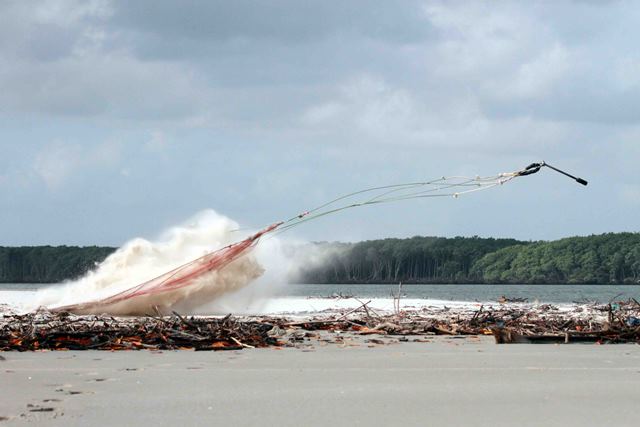
Cannons with gun powder charges fire heavy projectiles that carry the net over the birds only at the perfect moment – when birds are catchable and none in danger. Luckily, it was not a “wet catch,” that day, as the net did not go into the water. As soon as the cannon was shot, we all spirited single file carrying our tubs down the beach, following the biologists. The biologists immediately knelt at the base of the net and started picking up birds and shouting their identification and passing them to us, as they went they rolled the net away to reveal more birds.

 
It was very exciting! The idea was to get the birds out from under the net and into our carrying boxes and sealed in with a Velcro flap, as fast as possible, for the safety of everyone involved.

 
Each bin became devoted to the same bird species, so if the first bird that was handed to us was a sanderling, we kept putting only sanderlings in our bin. Once we had several birds in our bin, our pace completely changed. We walked very slowly away from the net, keeping the bin level at all times, towards the path in the sand at the beginning of the beach, to make the journey as safe for the birds as possible. There, biologists had burlap “keeping cages” for the birds to wait in. Birds were also sorted by species into these cages.

 
When every bird was taken out from under the net, and sitting in their temporary burlap enclosure, we formed “circles.” Each circle was composed of about 6 volunteers led by a core banding team member. Once formed birds were handed to us and finally, I learned how to safely hold a shorebird in my very own bander’s grip!

My very own bander's grip! Lindsay McNamara holding a sanderling.
My very own bander’s grip! Lindsay McNamara holding a sanderling.

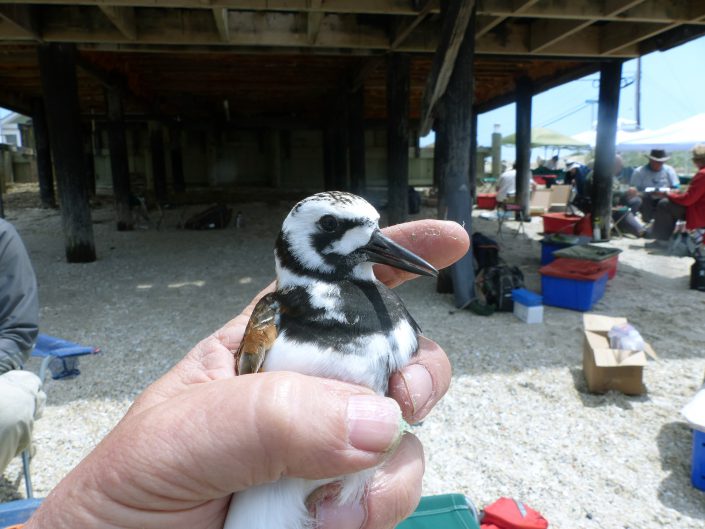
Each bird received a metal band with a federal identification number, and a green tag with a three letter code. One person in the circle put the band on the bird and passed the bird to the next person, who placed the green tag on each birds’ leg and glued them shut. A recorder took notes on the band number and tag letters. Next, the birds’ wingspan and other data points were measured by other members in the circle. Lastly, the bird was weighed before it was released. During my trip with the banding team, we caught a large number of sanderlings and a few ruddy turnstones, federally listed red knots, and semipalmated plovers.

Banding team supplies. Photo by Lindsay McNamara.

Holding a shorebird in my bander’s grip was an amazing experience, but what I enjoyed most of all was taking part in the science of shorebird conservation. I placed the green tags on the shorebirds, which will tell other scientists who may recapture the birds that they once traveled to New Jersey. Our circle helped collect valuable data points, which will be combined with the data from the other years of the Shorebird Project, to assess the health of shorebird populations.

 
I wasn’t just holding a bird, I was helping the bird have a brighter future – and that is the best feeling any bird nerd can have.

 
Today is World Shorebirds Day! You can help shorebirds have a brighter future today by participating in the Global Counting Day Program. Join the hundreds of participants at over 93 locations that will count shorebirds and share their sightings online. Register today!


Learn more:


Lindsay McNamara is the Communications Manager for Conserve Wildlife Foundation of New Jersey.

Restoring the “Natural Mosaic” of Thompsons Beach Salt Marsh

Our Team is using Science-based Methods to Elevate the Marsh and Restore the Balance of High and Low Elevation

by Lindsay McNamara, Communications Manager

To restore Thompsons Beach, along New Jersey’s Delaware Bayshore, our team removed debris from the beach, removed rubble from the road leading to the beach, and placed over 40,000 cubic yards of sand (weighing over 9 million pounds) onto the beach. We were filled with pride when we saw sanderlings and ruddy turnstones feeding this August on horseshoe crab larvae on our newly restored beach. We were delighted to learn that this spring, Thompsons Beach had the highest abundance of horseshoe crab egg clusters out of all the beaches that our team monitors on Delaware Bay.

 
How do we keep the momentum going? How do we ensure our restoration work at Thompsons Beach yields long-term, sustainable results? The answer is clear: we protect the backbone that the beach sits on — the salt marsh behind the beach.


Learn more:


Lindsay McNamara is the Communications Manager for Conserve Wildlife Foundation of New Jersey.

Photography Show to Celebrate Long Beach Island’s Wildlife

Hiding in Plain Sight” to Take Place on Friday, August 14 at Ann Coen Gallery in Surf City

By: Lindsay McNamara, Communications Manager

Ann Coen Conserve Wildlife Postcard

On Friday, August 14 at 6 PM, the Ann Coen Gallery will host “’Hiding in Plain Sight:’ Celebrating LBI’s Wildlife,” a photography show featuring three talented local outdoor photographers.


This – free and open to the public – event will feature a clam bar, refreshments, acoustic music, and the work of three local photographers, Eric Hance, Northside Jim and Ben Wurst, including handmade frames.


Despite their different backgrounds, all three shutterbugs are known to brave the elements all four seasons to bring rarely seen perspectives of our coastal species.


Eric Hance is a professionally trained photographer with beautiful fine art wildlife photographs. Northside Jim is an enthusiast with some outrageous and whimsical pictures showing the lives of local wildlife that live on the Island. Ben Wurst is the osprey expert who takes care of LBI’s osprey and habitat and captures stunning images of both in their most intimate moments.


“Hiding in Plain Sight” is a free event, and proceeds from the sale of photographs will benefit the work of Conserve Wildlife Foundation, a private, statewide nonprofit dedicated to protecting New Jersey’s endangered and threatened species. Photos of Humpback Whales, Bald Eagles, Osprey, Piping Plover, Terrapin, Black Skimmers, and other amazing endangered species that can be found on the Island will be on display at the Ann Coen Gallery.


“I am really excited to host this show and these three photographers. The body of work between them should prove to be very eye-opening to locals and vacationers,” explained Gallery Owner Ann Coen. “I don’t think too many people realize the wildlife we have right in our own backyard. When I approached each photographer for the show, they were all in agreement right from the start that a portion of their sales would go right back to Conserve Wildlife Foundation, which really motivated me and showed the importance each photographer places on the conservation of our wildlife here in New Jersey.”


Eric Hance is a photographer for Ann Coen Photography. His goal is to captivate viewers in the simplest form; to capture a specific scene in the strongest way.


Northside Jim is a self-proclaimed “beach bum with a camera,” from North Beach. He uses a camera to experience, to learn about, and to share stories about LBI’s creatures on his popular blog, Readings From The Northside.


Ben Wurst, photographer and Habitat Program Manager for Conserve Wildlife Foundation, is responsible for managing and protecting ospreys as part of the New Jersey Osprey Project. In addition to photography, Wurst is known for his woodworking with reclaimed materials with his small business, reclaimed LLC.


“Being able to utilize my skills to help raise critical funding and awareness for rare wildlife is a dream come true for me,” exclaimed Conserve Wildlife Foundation’s Ben Wurst. “Working with these species in New Jersey is what spawned my interests in both hobbies. Now they have progressed into lifelong passions of mine. I consider myself lucky to be on the roster for this show!”


Doors open at the Ann Coen Gallery, 1418 Long Beach Blvd. in Surf City, New Jersey, at 6 PM on Friday, August 14 for Hiding in Plain Sight: Celebrating LBI’s Wildlife. The show will remain on display until Friday, August 21.


Learn more:


Lindsay McNamara is the Communications Manager for Conserve Wildlife Foundation of New Jersey.