NEW, WEEKLY UPDATES FROM NEW JERSEY’S BEACH NESTING BIRD PROJECT TEAM
by Todd Pover, Beach Nesting Bird Project Manager
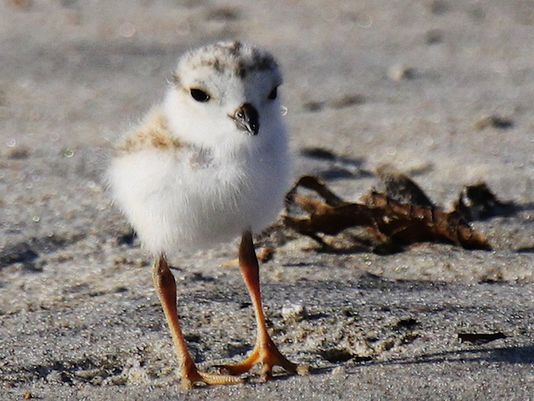
Amazing transformation of a piping plover from tiny chick to fledgling in just 25 days. Both photos by Northside Jim.
The highlight of this past week was our first piping plover fledglings of the season. This means the first group of chicks has reached the stage where they can fly, which is our metric for success. Hatching the chicks is always great, but our goal is population recovery and the primary way we can increase our low population in New Jersey is to produce more fledglings to come back in future years to breed here.
The doubly exciting news is ALL four of the chicks that hatched at Barnegat Light reached the flying stage. This is notable because typically, on average, we only fledge about one chick per pair in New Jersey. This is not enough to grow or sustain our long-term population. Population modeling tells us we need to fledge about 1.5 chicks per pair range-wide to grow the population and about 1.25 chicks per pair to sustain it.
Of course, not all our piping plover pairs will fledge four chicks, in fact, some may not fledge any. So the Barnegat Light news was a good way to kick off our fledgling season and hopefully it is a sign of above average productivity this year.
NEW, WEEKLY UPDATES FROM NEW JERSEY’S BEACH NESTING BIRD PROJECT TEAM
by Todd Pover, Beach Nesting Bird Project Manager
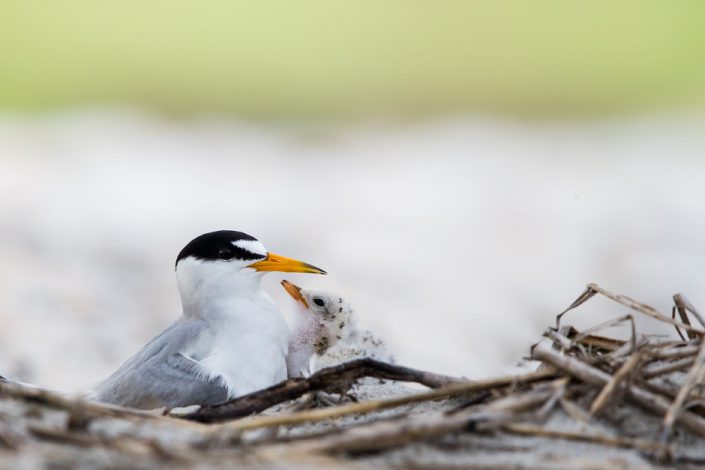
Least tern photo by Northside Jim.
The beach nesting bird field staff is firing on all cylinders now, frantically trying to keep up with nesting activity. In some regions of the New Jersey coast, piping plovers and American oystercatchers are still laying eggs, while at other sites there are chicks on the beach, even one site (Barnegat Light) where the chicks are already approaching their “fledgling” stage when they will be able to fly.
CWF Field Technician Jesse Amesbury busy conducting annual piping plover census at Edwin B. Forsythe NWR.
Most of the least tern and black skimmer colonies are now established, with least terns starting to hatch chicks and black skimmers just laying eggs. Counting the colonies is one of the most challenging parts of the job, imagine trying to count 1,000-1,500 birds at a time in some instances!
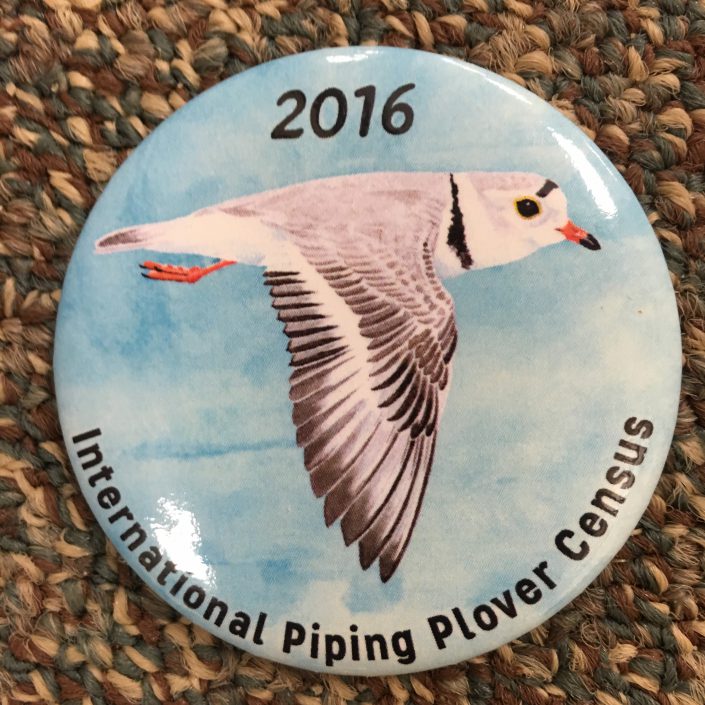
After helping with the winter segment of the International Piping Plover Census in the Bahamas, CWF switched gears this week to help conduct the breeding portion in New Jersey.
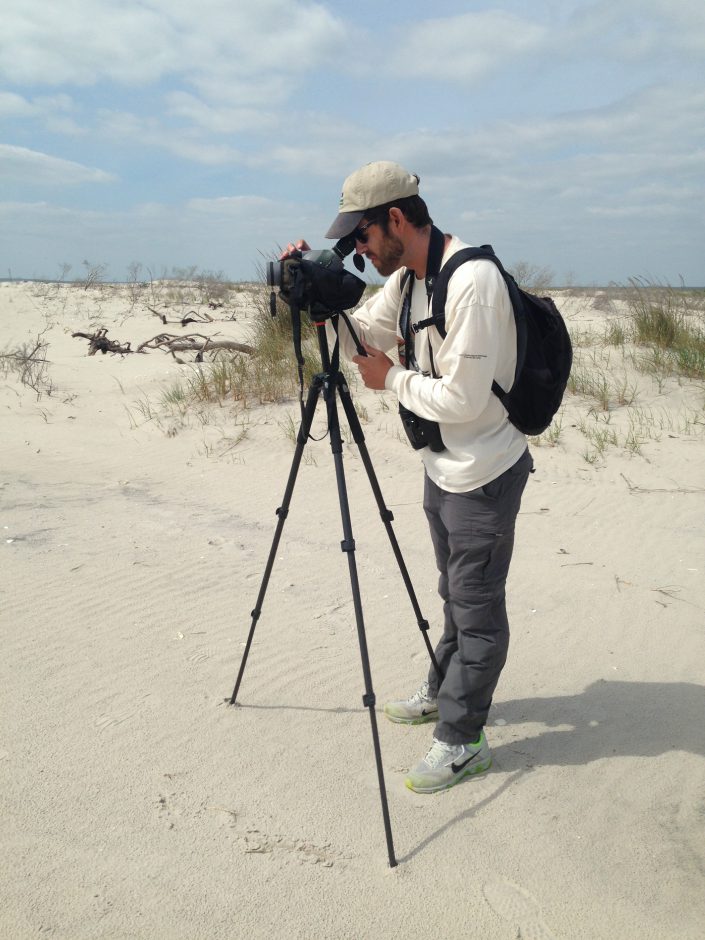
All the normal beachnester tasks are keeping us busy, but the main focus this past week was the annual piping plover “window” census, where field biologists all along the Atlantic coast count the number of birds present between June 1-9, so we can get a range-wide breeding population estimate. As for New Jersey, it looks like our population will go up, at least slightly, for the second year in a row. Although this is still a very preliminary estimate, it looks like we have weathered the statewide low in breeding pairs we recorded in 2014, thanks to good productivity the past two years.
Of special note is a spike in Monmouth County (outside Sandy Hook), where we have gone from 2 pairs the past several years to 12 pairs this year. Although a smaller bump, we also went from 1 pair to 4 pairs within Barnegat Inlet, an area we have long hoped for more pairs. It takes a tremendous effort to realize even small gains in our piping plover recovery effort, so we are especially excited about this news!
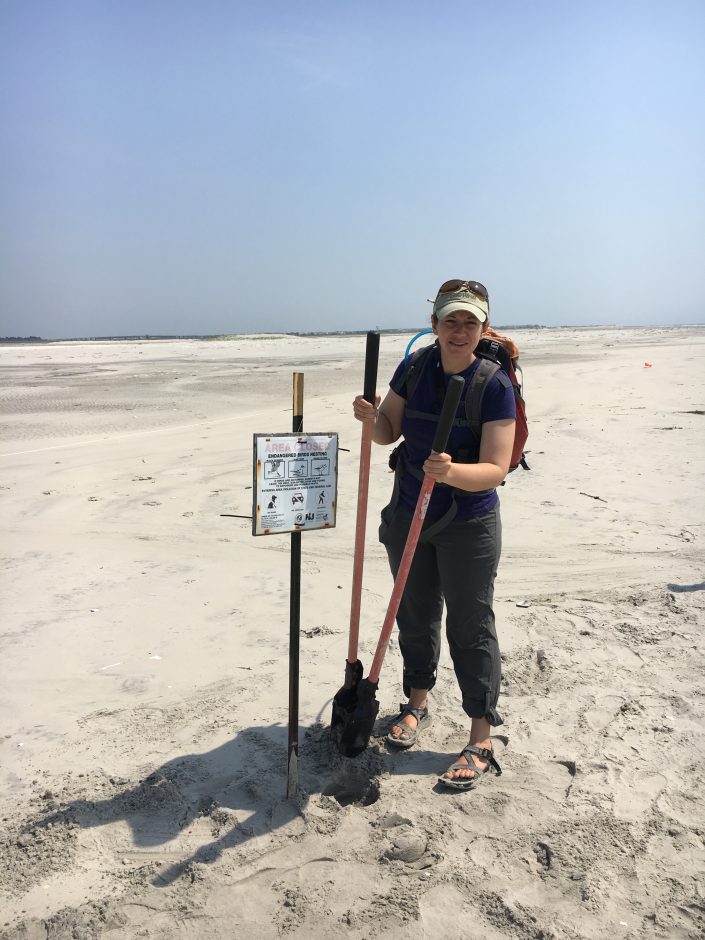
Our work is never done…CWF Wildlife Biologist Emily Heiser posting a new nesting area for endangered least terns.
Technology has proven to be vital to Conserve Wildlife Foundation’s work protecting rare wildlife species over the years. Our biologists depend greatly on modern technologies to band, track, and share online the journeys of wildlife. Our webcams broadcast the most intimate behaviors of nesting birds and bats across the web. And we seek out ever-evolving communications technologies to spread the word about the inspiring stories of wildlife, from social media and infographs to e-books and Story Maps. These technologies offer newfound abilities to share complex data on multiple levels, while still incorporating the awe-inspiring photography and videos that bring wildlife’s stories to life.
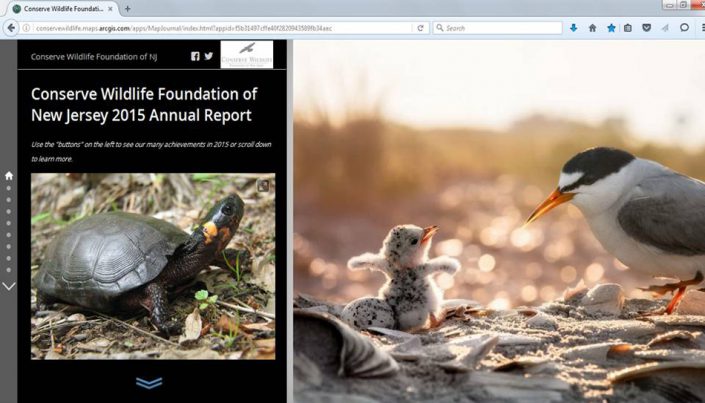
Conserve Wildlife Foundation of New Jersey is excited to offer our 2015 Annual Report in a unique format that utilizes one of those technologies – Story Maps. In the past year, we have explored the lives of seals, eagles, and freshwater mussels with Story Maps – and the annual report allows all of our projects to be highlighted in this interactive format as well.
Visit the multiple pages within this Story Map to learn about Conserve Wildlife Foundation’s many projects and partnerships in 2015, and the imperiled wildlife species in need of our help. Find examples of the innovative and dedicated leadership of our biologists and volunteers. And take an online journey across the state to learn how our projects made a difference in all corners of New Jersey in 2015 – a great year for wildlife in the Garden State!
New, weekly updates from New Jersey’s beach nesting bird project team
by Todd Pover, Beach Nesting Bird Project Manager
American oystercatcher Chick
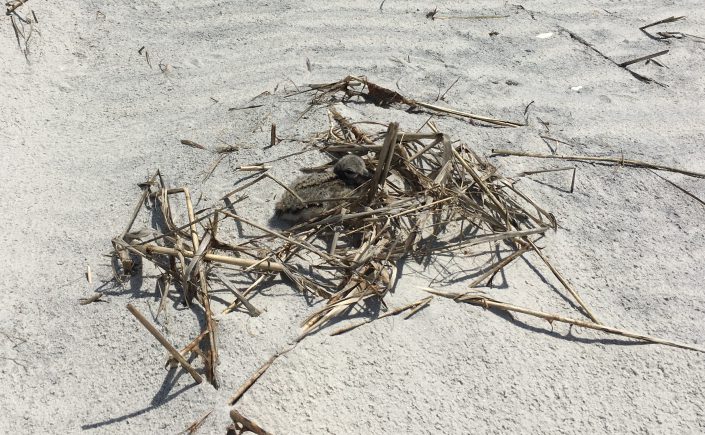
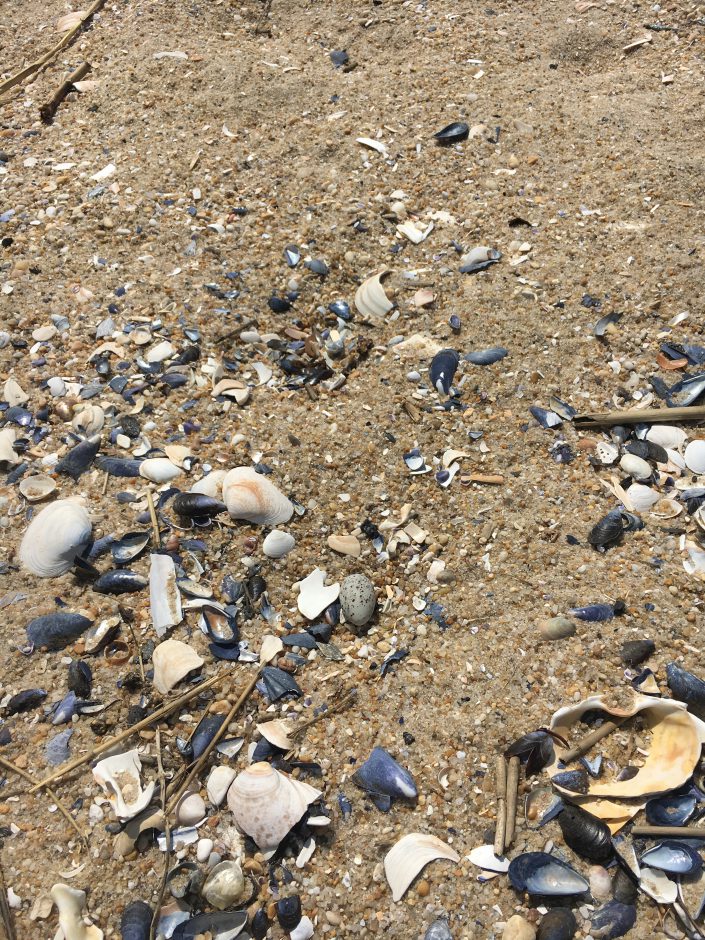
It has been a busy week on the beach nesting bird project! We had our first least tern nests of the season, as the brief spell of warmer weather (finally) made for a burst of breeding activity. The first American oystercatcher nests hatched, so we have chicks on the beach now, as well.
Least Tern Nest
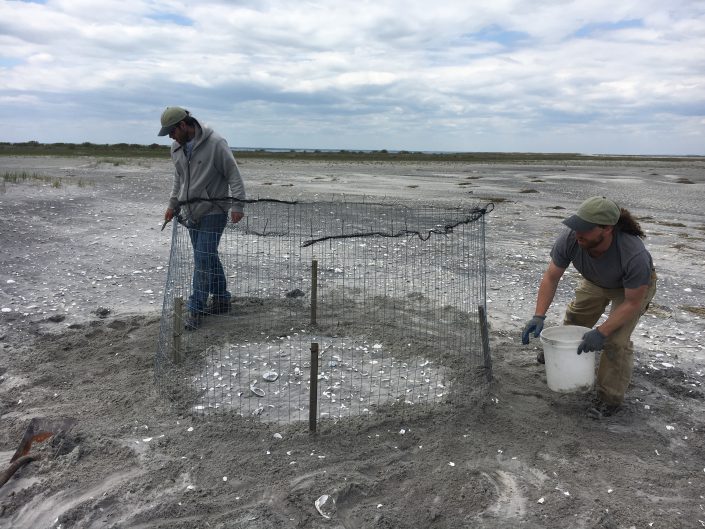
And there was a big spike in new piping plover nests all along the coast, so we were busy erecting “predator exclosures” to protect the eggs from predators, such as crows, cats, gulls, and foxes. While they are not effective or viable to use on every nest, these wire cage structures are one of our best management techniques to increase hatch success by deterring predators.
Piping Plover Exclosure
This week we will be even busier, as we make a mad scramble to protect the nests and colonies before the crowds of beachgoers arrive for the Memorial Day weekend!
CWF is Celebrating International Migratory Bird Day all Week Long
by Lindsay McNamara, Communications Manager
CWF’s blog on the piping plover is the second in a series of five to be posted this week in celebration of International Migratory Bird Day (IMBD). IMBD 2016 is Saturday, May 14. This #birdyear, we are honoring 100 years of the Migratory Bird Treaty. This landmark treat has protected nearly all migratory bird species in the U.S. and Canada for the last century.
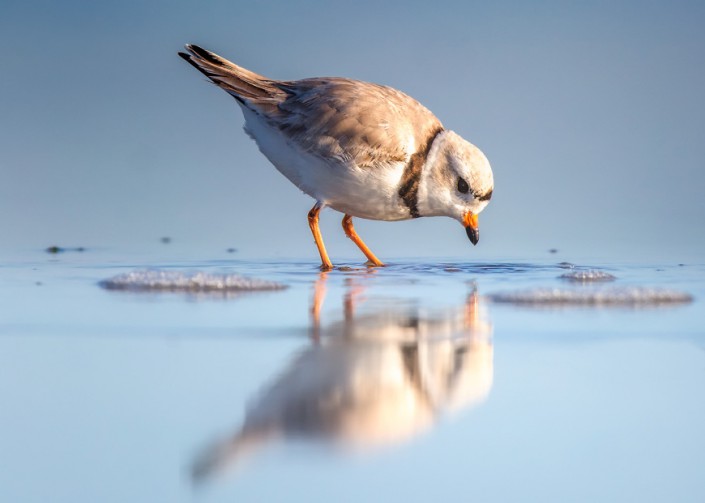
Piping plover photo by Steve Byland
The piping plover – a small sand-colored shorebird that nests in New Jersey as part of its Atlantic Coast range from North Carolina up to Eastern Canada –weighs only one to two ounces and is about six to six and a half inches long. These tiny shorebirds migrate all the way to their wintering grounds along the coast of eastern Mexico and on Caribbean islands from Barbados to Cuba and the Bahamas.
Migrants can be seen in New Jersey from early March to late April and again from mid-July to the end of October. Females are the first to leave the breeding grounds, followed by males, then juveniles. Breeding plover “hot spots” in each coastal county of New Jersey are Gateway National Recreation Area – Sandy Hook Unit, Barnegat Light, North Brigantine Natural Area and Stone Harbor Point.
We see a number of migratory piping plovers in New Jersey because the Garden State is roughly in the middle of their breeding range. Todd Pover, CWF’s beach nesting bird project manager, reasons that we have a high number of Eastern/Atlantic Coast Canadian breeders that stop in New Jersey — based on band resights — albeit usually for just a day on their way north to breeding grounds. Therefore, New Jersey may play an important role in the piping plover life cycle not just for breeding, but for migration as well, which emphasizes the importance of protecting shorebirds in all phase of their lives or “full life-cycle conservation”.
Piping plovers face a number of threats, including intensive human recreational activity on beaches where they nest, high density of predators, and a shortage of highly suitable habitat due to development of barrier islands and extreme habitat alteration. Sea level rise and increased storm activity related to climate change will also likely lead to more flooding of nests.
Federally listed as a threatened species in 1986, piping plovers have since recovered in some areas of the breeding range. Yet piping plovers continue to struggle in New Jersey, where they are listed by the state as endangered. For more information about piping plover nesting results in New Jersey, please read Conserve Wildlife Foundation’s 2015 report.
Piping plover chick, photo credit: Asbury Park Press/Nancy A. Smith
CWF, in close coordination with NJDFW’s Endangered and Nongame Species Program, oversees piping plover conservation throughout New Jersey. Staff and volunteers help erect fence and signage to protect nesting sites, monitor breeding pairs frequently throughout the entire nesting season from March to August, and work with public and municipalities to educate them on ways to minimize impacts. Although conservation efforts on the breeding ground remain the primary focus, in recent years, CWF has also begun to work with partners all along the flyway, in particular on the winter grounds in the Bahamas, to better protect the at-risk species during its entire life-cycle.
We are working hard to link students across the piping plover’s flyway through our Shorebird Sister School Network, where we pair up schools in New Jersey and the Bahamas, one of the most important wintering areas for Atlantic Coast piping plovers. Now, we are hopefully recruiting some Canadian students as well.
Conserve Wildlife Foundation will continue to find innovative ways to save the small migratory shorebird. In 2015, 108 pairs of piping plovers nested in New Jersey, a 17% increase from 2014. What will 2016 bring? Follow us on social media to learn more about the tireless efforts of a team of passionate, dedicated biologists working to save the iconic coastal species.
Reflections Three Years into the Shorebird Sister School Network Program
by Stephanie Egger, Wildlife Biologist
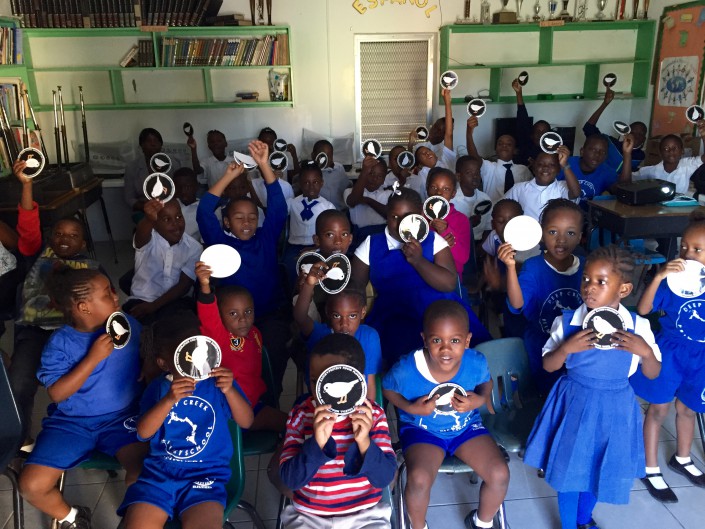
Deep Creek Primary students with the migratory and wintering Piping Plover decal.
As we begin to wrap up our third year of the Shorebird Sister School Network, we are able to reflect on how far we have come in just a short time. In our first year, we started with just one class at Amy Roberts Primary School (Green Turtle Cay, Abaco, The Bahamas), led by teacher Jan Russell, which was paired up with a class at Ocean City Intermediate School (Ocean City, New Jersey), led by teacher Deb Rosander. We presented the students with information on the full life cycle of the Piping Plover, commonly referred to as “our birds” in New Jersey. Really they are residents of The Bahamas, spending over half their life on the warm sandy beaches surrounded by turquoise water. Piping Plovers in The Bahamas, in most cases, see less disturbance than what is experienced by plovers on their breeding grounds in the United States and Canada.
We not only focus on breeding, migration, and wintering of the plovers, but the importance of their habitat to a suite of species. In The Bahamas, the tidal flats used by the Piping Plovers are of huge importance to the ecological value and economy of The Bahamas, as the flats are also used by bonefish, conch, and shark species. We had both classes conduct similar projects — interpretive signs placed on the breeding and wintering grounds — using their writing skills and original artwork. The students also participated in field trips where they learned how to use spotting scopes and binoculars to find and identify shorebirds.
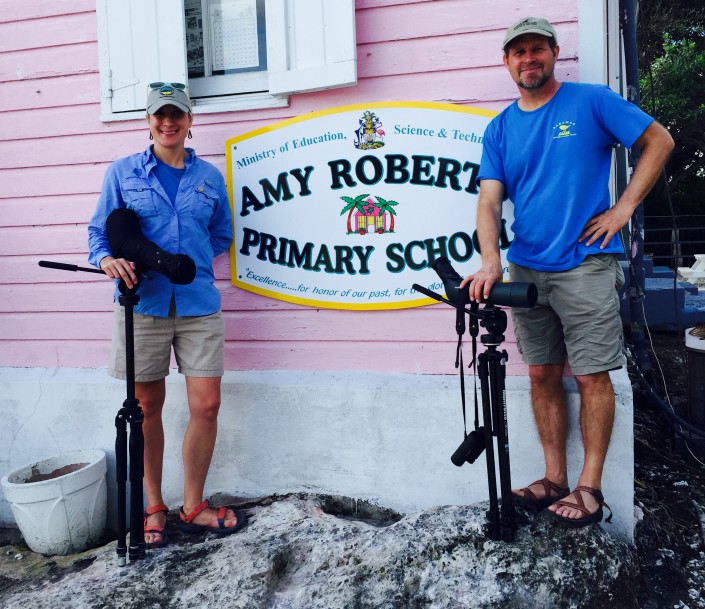
Shorebird Sister School Network leaders and CWF biologists, Stephanie Egger and Todd Pover at Amy Roberts Primary School, one of the first sister schools in the program.
Three years later, we still are teaching our core lessons, but have vastly expanded on the curriculum and projects, as well as extending the program onto another island, Eleuthera, which is just south of Abaco. We now are working with Cherokee Primary in the settlement of Cherokee Sound (Abaco) and Deep Creek Primary (Deep Creek, Eleuthera). We have continued working for the last three years with Amy Roberts Primary School and Ocean City Intermediate School. Back in the United States, we have added a second class from Ocean City, as well as the Leeds Avenue Elementary School Environmental Club (Pleasantville, New Jersey) led by Mary Lenahan. We’ve added new components to the curriculum such as bird anatomy, foraging differences between species of shorebirds, invasive species, habitat assessments (including macroinvertebrates) and marine debris.
We continue to implement interpretive signs as a project with classes that are in their first year of the program, but have come up with new and exciting projects to keep the students (and teachers) motivated and engaged to continue participating as a sister school. For example, during the second year we worked with Amy Roberts, we removed 1,500 Australian pine (Casuarina spp.) from Green Turtle Cay as it degrades the habitat for piping plovers and other species. We created a Piping Plover activity book complete with crossword puzzles, word searches, and mapping activities designed mainly by the students at Ocean City Intermediate School, Leeds Avenue Elementary School, and Amy Roberts Primary School. Because Cherokee Primary and Deep Creek Primary are new to the program this year we hope to have their students create interpretive signs, while the second and third year students in the Program may develop PSA-type videos this year and pen pal letters to their respective sister schools in the United States.
Throughout the year, each class receives one or two classroom lessons and a field trip. We keep busy during the few short weeks we have in The Bahamas; coordinating the field trips, conducting surveys, presentations, and working to continue to build and strengthen our existing relationships with partners, such as Friends of the Environment and local citizen scientists. This year, we’ve reached over 120 students in the program, both from the Bahamas and in the United States.
One of the most rewarding aspects of the Shorebird Sister School Network is that we are able to provide lessons to the some of the same children throughout multiple years in the program, which strengthens the conservation messages we are trying to instill in the upcoming generations. We hope to foster a greater appreciation for wildlife, especially for the Piping Plover and its habitat, and inspire students to help now — and later on in their lives as adults — ensure the recovery and survival of the bird for years to come.
Piping Plover Research and Conservation Five Years Later
by Todd Pover, Beach Nesting Bird Project Manager
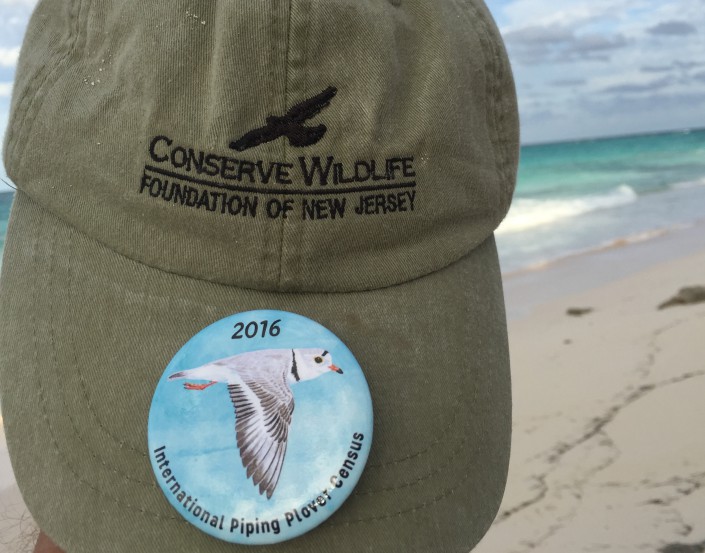
The wintering segment of the 2016 International Piping Plover Census has just wrapped up in the Bahamas. This marks six winters of my own involvement with piping plover conservation work in the Bahamas – starting with the last international census in 2011 – so I thought it would be a good time to reflect on the changes I have observed in the years between the censuses.
First and foremost, we now know much more about how many piping plovers winter in the Bahamas and where they are located, including some areas where there are particular high concentrations of piping plovers and other shorebirds. This knowledge is due to the significant increase in survey effort put forth by partners in the Bahamas during the census, but also surveys conducted by Bahamas National Trust and National Audubon Society, as well as our own work at Conserve Wildlife Foundation of New Jersey (CWF), in the years since 2011 to supplement the earlier surveys and better understand how piping plovers use the sites.
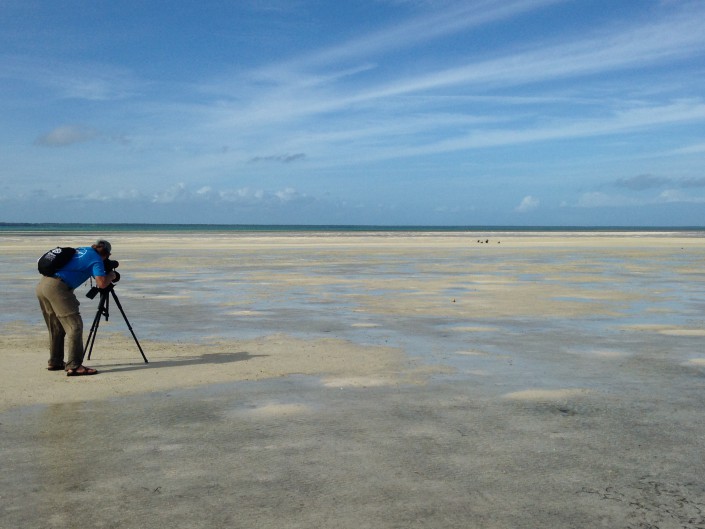
The author, CWF’s Todd Pover, scoping out piping plovers during the census.
This is demonstrated by the results of the 2016 census. As just one example of how this extra research paid off, in 2011 when we visited Casuarina Point on Abaco for the census, we knew from local birders and e-Bird that piping plovers were frequently seen there, but not that it was only for a narrow window during low tide to forage, nor that depending on wind conditions or disturbance, they could be at another more remote flat across Cherokee Sound. So in 2016, we had surveyors in place at the correct tide AND in both locations at the same time, thus allowing us to record 26 piping plovers, instead of 0 in 2011. Using similar information gathered across the island we found 178 piping plovers in 2016, compared to 76 in 2011 (and 82 on Eleuthera in 2016 vs. 30 in 2011).
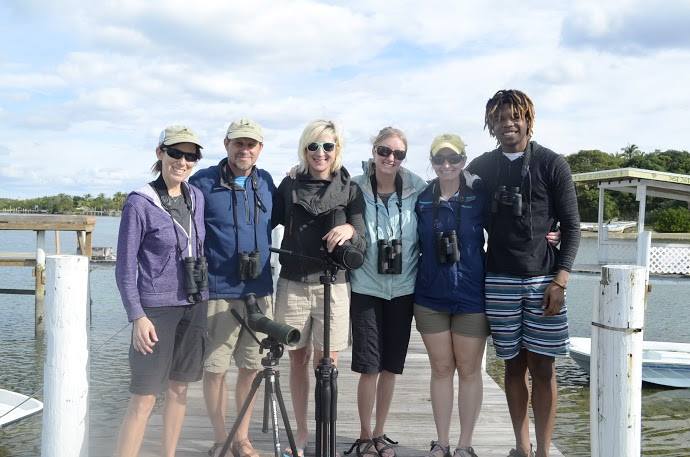
The CWF 2016 International Piping Plover Census team for Abaco and Eleuthera: Pam Prichard, Todd Pover, Stephanie Egger, Michelle Stantial, Emily Heiser, Brendan Toote (left to right).
Even with some oversights like those, the 1066 piping plovers tallied in the 2011 census revealed that the Bahamas was one of the most significant wintering locations for piping plovers, second only to Texas. And with band resight data, we now know that the Bahamas is THE most important winter location for the Atlantic coast population (as compared to the Great Lakes and Great Plains populations). Although the final count for the 2016 census is not complete yet, it has already topped the 2016 figure and will account for a good part of the remaining unknown wintering birds and locations. New surveys in the Turks and Caicos, more intensive surveys in Cuba, as well as the Southeast/Gulf Coast U.S. (which is critical for all three populations of piping plover) should make this the most comprehensive and informative survey to date.
While improved census results are important, one may reasonably still ask how the census is going to translate into better conservation. The Bahamas is a good example of what can be done with the data — last year the Bahamas government set aside the Joulter Cays as one of a series of new national parks, to a large degree based on its importance for shorebirds, especially piping plovers, as a result of information initially gathered from the census and follow-up surveys. This marked the first time shorebirds played a significant role in such a designation, so this is a watershed event for shorebird conservation in the Bahamas (and the Caribbean).
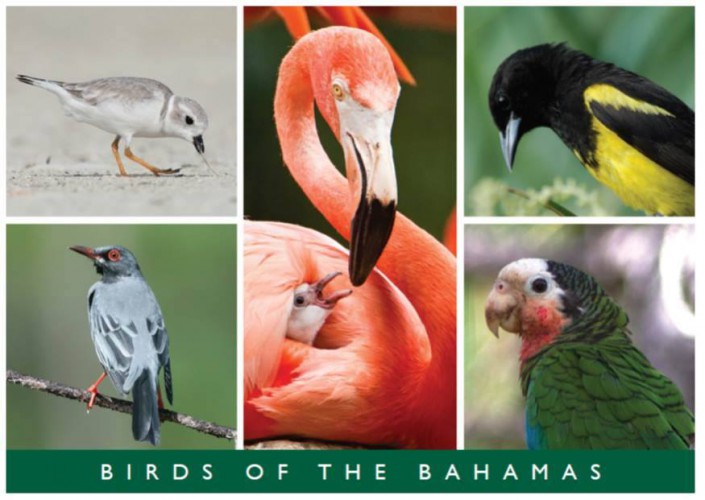
I have noticed other “sea changes” in attitude on a smaller scale. When I first visited the Bahamas (Abaco) during the 2011 census, aside for some birders, piping plovers were little known by the public there. Now when I come, I am recognized as the plover guy and piping plover bumper stickers can be spotted around the island on golf carts and trucks. There is even a new post card, entitled “Birds of the Bahamas” that has a piping plover side by side with a flamingo, the national bird. And there is refreshingly little of the rancor we sometimes have in the states over their protection – the habitats piping plovers use in the Bahamas, especially tidal flats, are also important for valuable resources, such as conch and bonefish, and other marine species, so protecting them is less of a conflict.
The important role the Bahamas plays in the piping plover life cycle is now much better known by the public and other stakeholders. Many of the participating partners have not only provided technical shorebird expertise during the surveys, but worked hard to provide education and outreach towards a long-term conservation goal. One area my colleague Stephanie Egger and I are most proud of in this realm is our Shorebird Sister School Network, where we pair up schools and students in the Bahamas and in New Jersey, using piping plover migration as the link. Now in its third year, this project is working to create a new generation of young conservationists (and piping plover lovers)!
This is not to say our work is done. There is still more to learn, a banding study is being conducted to help us better understand survival compared to other wintering (and breeding) regions, more detailed aspects of site fidelity, and how birds move around sites within islands. Still, piping plovers are no longer a novelty in the Bahamas as was largely the case when I first came in 2011. The challenge over the next five years will be how to harness the increased awareness and knowledge to aid recovery of this endangered species.
A special thanks to Friends of the Environment, who have been our piping plover partner on Abaco from the beginning, please check out all the great work they do! Also to the Disney Conservation Fund and The National Audubon Society for funding, as well as Bahamas National Trust for other support and the conservation work they do in the Bahamas in general. Thanks to the U.S. Geological Survey, sponsors of the International Piping Plover Census, for supporting CWF’s inclusion in the surveys. Thanks to Rolling Harbour Abaco for setting up the Abaco Piping Plover Watch this winter to help us keep track of piping plovers and raise local awareness. Thanks to those who participated in the CWF led 2016 census on Abaco and Eleuthera: Brendan Toote, of the College of the Bahamas, Michelle Stantial, of SUNY – ESF, Pam Prichard, and CWF’s own Stephanie Egger and Emily Heiser. And finally, thanks to our local citizen scientists on Abaco who participated in or provided valuable knowledge for the 2016 census, especially Ali Ball, our “super” volunteer!
Conserve Wildlife Foundation of New Jersey releases 2015 report
by Todd Pover, Beach Nesting Bird Project Manager
Photo by Northside Jim
Conserve Wildlife Foundation today released the 2015 Piping Plover Breeding Report, highlighting the number of nesting pairs, pair productivity, and coast-wide distribution for this endangered shorebird, from data collected by New Jersey Division of Fish and Wildlife (NJDFW) biologists, CWF biologists, and other partners.
“The rebound in New Jersey’s piping plover breeding population and a second consecutive year of robust chick productivity was a much needed outcome,” said Conserve Wildlife Foundation Beach Nesting Bird Project Manager Todd Pover. “We need to continue our intensive management for a number of years to sustain any recovery, but we were very pleased to have finally broken the recent cycle of low nesting success and the record low number of nesting pairs in 2014.”
The piping plover – a small sand-colored shorebird that nests in New Jersey as part of its Atlantic Coast range from North Carolina up to Eastern Canada – face a number of threats, including intensive human recreational activity on beaches where they nest, high density of predators, and a shortage of highly suitable habitat due to development and extreme habitat alteration.
Federally listed as a threatened species in 1986, piping plovers have since recovered in some areas of the breeding range. Yet piping plovers continue to struggle in New Jersey, where they are listed by the state as endangered.
“As a species dependent on natural beach habitat, piping plovers face a particularly daunting challenge along New Jersey’s heavily developed and dynamic coast,” said Conserve Wildlife Foundation Executive Director David Wheeler. “Our dedicated scientists, partners, and volunteers are working tirelessly to ensure piping plovers remain a beloved and healthy presence along the Jersey Shore and beyond.”
CWF, in close coordination with NJDFW’s Endangered and Nongame Species Program, oversees piping plover conservation throughout New Jersey. Staff and volunteers help erect fence and signage to protect nesting sites, monitor breeding pairs frequently throughout the entire nesting season from March to August, and work with public and municipalities to educate them on ways to minimize impacts. Although conservation efforts on the breeding ground remain the primary focus, in recent years, CWF has also begun to work with partners all along the flyway, in particular on the winter grounds in the Bahamas, to better protect the at-risk species during its entire life-cycle.
2015 Report Highlights:
The population of breeding piping plovers increased 17% to 108 pairs in 2015, as compared to 2014. Despite the increase, the population still remains below the long-term average (118 pairs) since federal listing in 1986 and well below the peak.
The statewide fledgling rate, which includes data collected by partners at 19 active nesting sites throughout the state, was 1.29 fledglings per pair, down slightly from 2014 (1.36 fledglings/pair), but still one of the highest statewide levels since federal listing. Furthermore, both years were above the 1.25 fledgling rate believed necessary to maintain the range-wide Atlantic Coast population of piping plovers.
Statewide pair-nest success, the percentage of pairs that successfully hatch at least one nest, was high at 79%, well above the average since federal listing. Although population and productivity are ultimately the most important measures of recovery success, hatch success is an important metric to demonstrate the effectiveness of on-the-ground management.
Northern Monmouth County, as a region, continued to account for the largest percentage of pairs in the state (55 pairs or 51%), with Gateway National Recreation Area – Sandy Hook Unit accounting for most of those pairs.
The region comprised of North Brigantine Natural Area and the Holgate and Little Beach Units of the Edwin B. Forsythe National Wildlife Refuge accounted for the other significant concentration of breeding pairs in the state (43 pairs or 40% of the statewide total).
Holgate had the largest jump in abundance for any individual site, doubling its breeding pairs to 24 in 2015 (up from 12 in 2014). This increase was the result of highly suitable overwash habitat created at the site by Hurricane Sandy and the high breeding success that helped spur.
Cape May County, the southernmost region of the state, consisting of Ocean City to Cape May Point, continued its long-term downward trend, accounting for just 8 pairs in 2015, compared to 11 pairs in 2014 and 43 pairs in 2004 at its peak.
by Laura Hardy and Pam Prichard, Beach Nesting Bird Field Technicians
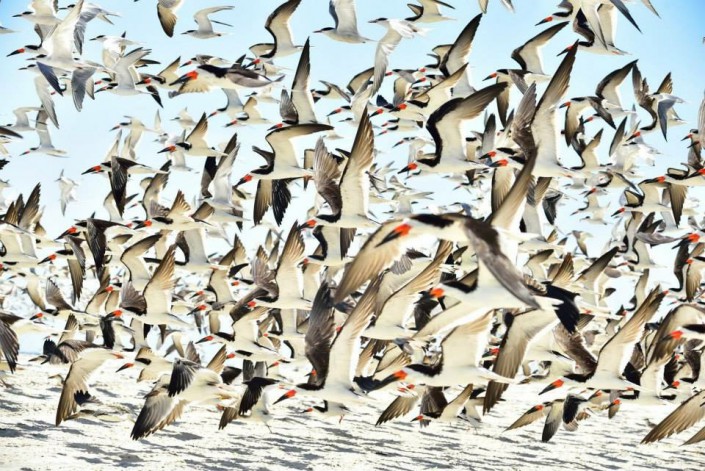
“Where’s Waldo” – Black Skimmer Edition, as the colony takes flight. Photo by Sushanth Allapalli.
by Laura Hardy:
New Jersey’s largest breeding colony of black skimmers is an uncommon joy. I’ve stood many hours this season totally bemused by these boisterous barking birds. I’m thrilled when, en masse, the colony takes flight right over my head, in the purest National Geographic moment I might ever experience. However, as the colony’s primary monitor, my job isn’t to be dazzled by the birds – those candy-corn bills, the funny barking calls, the gorgeous choreography of their flight – instead it’s to conduct biweekly counts of the birds in order to monitor the colony’s size and productivity.
Every summer for the past several years, about 1,000 black skimmer pairs have nested on the little stretch of beach known as Seaview Harbor Marina; nearly 2,600 birds at its peak this season. Black skimmers, plus least and common terns, gather there in an incredibly noisy colony. Piping plovers and American oystercatchers nest on site also.
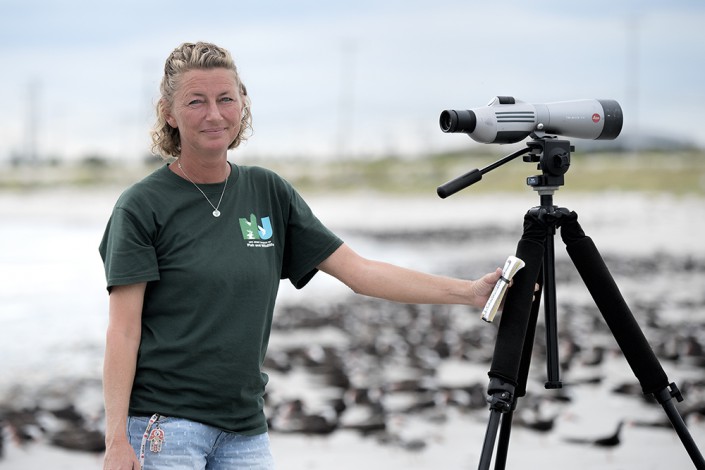
Laura Hardy, one of the blog authors, pauses as she attempts to count a colony of several thousand black skimmers. Photo by Donna L. Schulman.
Have you ever tried to count thousands of raucous swirling birds while being dive-bombed by hot-tempered terns? The first time I tried, I didn’t know how or where to start. I started over at least eleven times that first day just to be sure I was right. Even still, my boss saw my number and said I had probably underestimated the size of the colony. Argh!
During the next count, I briefly considered multiplying my tally by some random number like 1.4297363 in order to accurately reflect the number of birds my boss thought I should be seeing. Instead, he bought me a step stool that made seeing the birds much easier. Nesting adults had become obscured by growing vegetation in the colony — but the stool made me even more of a target for the dive-bombing terns.
During the next couple of count periods, as the colony continued to grow, I worried that I was compensating for the natural tendency to underestimate by over-estimating. The last two or three counts, with the colony at its peak and chicks all over the beach, I thought for sure I was hallucinating – there simply could not be that many birds!
Finally, all kidding aside, I’ve come to believe there is some art to the task but, for the most part, I approach counting as methodically as possible. I count individual birds in the colony, by species, and then check my accuracy by counting in groups of five or ten birds, then 50 or 100. It takes some practice to be able to visualize what 100 or 500 birds look like, but it’s useful to be able to estimate the number of birds you see in a quick glance because the colony will flush any number of times during a typical count day.
Counting is further complicated by the need to estimate the number of birds on nests, and then later in the season, the number of chicks that are near-fledging or already fledged (able to fly). I also had the opportunity to test my accuracy against aerial photos of the colony and was pleasantly surprised with the accuracy of my on-the-ground count.
All of this counting and recounting is important because it allows us to measure the reproductive success of the colony. Black skimmers, and all of our beach-nesting birds, put a huge amount of effort into breeding and the numbers show the Seaview colony had a very productive season with a minimum of 1,000 fledglings so far, but likely as many as 1,500… and still counting!
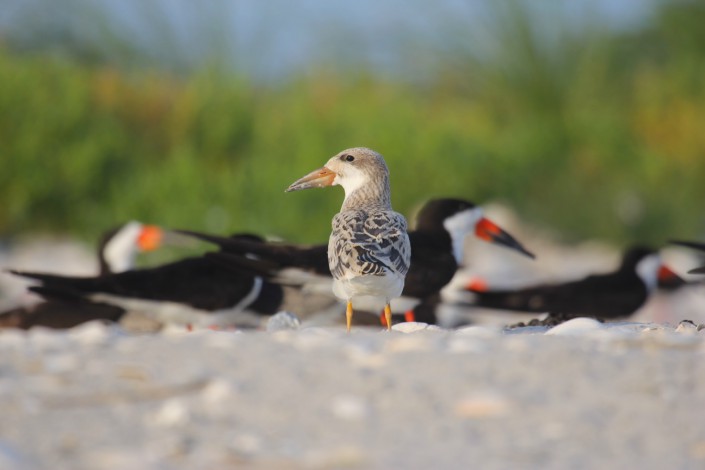
A recently fledged black skimmer chick stands out against the colony. Photo by Laura Hardy.
by Pam Prichard:
To those of us that monitor beach nesting birds in Monmouth County, black skimmers were known only by a simple drawing on our AREA CLOSED signs that are attached to the fencing erected each spring to help protect endangered piping plovers and least terns. This season, however, held an exciting surprise as we witnessed the formation of a significant new back skimmer colony in New Jersey. Sandwiched between two immensely popular and busy beaches (Belmar and Avon), the portion of Belmar’s beach along the Shark River Inlet played host to hundreds of least terns, common terns, a pair of American oystercatchers – and our very own celebrity skimmers.
The skimmers quietly started arriving in mid-June, a few at a time. Were they just hanging out? Or were they actually going to start laying eggs? As more appeared day by day before our incredulous eyes, the reality became undeniable. The skimmers were nesting, for the first time since this habitat was set aside to be “natural.” And wow, what a colony it became, with nearly 200 adult Skimmers!
The nests were somewhat hidden among sea rocket and seaside goldenrod in the middle of the site, and didn’t attract too much attention at first. It wasn’t until the chicks began to hatch and grow that the real show began. The adults brought the chicks out to the front of the beach and their fan base began to form.
Black skimmer fledglings executing their “infamous” sand flop. Photo by Pamela Jo Capone.
In the early mornings, the bird paparazzi (photographers) would arrive. Word had spread about the appearance of these strange looking, charismatic, comical yet majestic, and very photogenic birds. Everyone wanted a photo of adults skimming the water for fish or the tide line for crustaceans. They wanted to capture that moment when a chick was being brooded or fed. When the colony would all fly up at once, swooping and circling, making their distinctive barking puppy sounds, it was a stunning sight to see and hear. And let’s not forget the distinctive way they kick up sand, or flop down, as if their bill was just too heavy to hold up for one second longer. More than one person asked me if they were dead, and I admit, I would often hold my breath, until I thankfully saw some movement!
In addition to the steady stream of photographers, beachgoers visited the site every day to check on the busy colony and find out the latest news. People gathered in front of the fence to watch, enraptured, and to talk about what was going on. They returned day after day, bringing friends, and forging new friendships. Children looked through the scope to see the littlest of chicks, camouflaged so well in the sand. Many people told me they had never seen anything like this in Belmar. The black skimmers were the talk of the town!
A resident told me of growing up and playing behind a truck as it sprayed DDT. He said it has been wonderful to see so many species rebound in New Jersey, species like the osprey, eagle and now black skimmers right in Belmar. As of this date (they are not quite done yet), we have had nearly 150 skimmer chicks make it to the fledgling (flying) stage, no small accomplishment. The beach loving public here truly embraced the black skimmers, giving us lots of positive feedback. We all look forward to the return of our “celebrities” again next year.
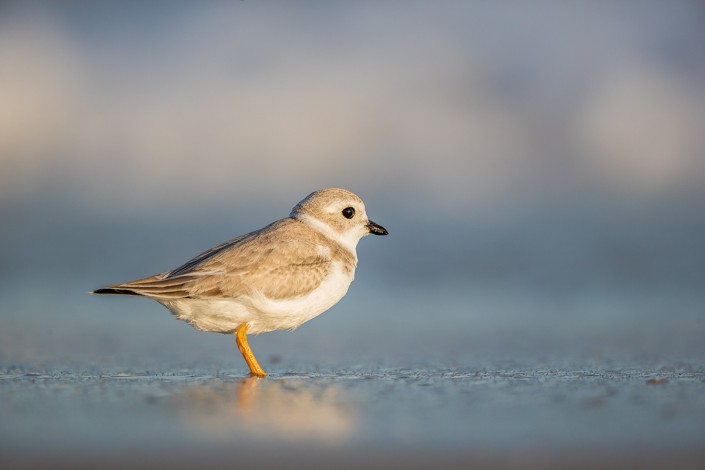
Piping plover sheds its breeding plumage as it readies for migration to wintering grounds. Photo courtesy of Northside Jim.
As summer melds into early autumn, migration comes underway. The nesting season for beach nesting birds is drawing to a close, and shorebirds can be seen feasting along the beaches as they fuel their bodies for their journey south. This was my first season working with endangered beach nesting birds. Watching territory disputes and courtship displays early in the spring transitioned into nest searching and anxiously awaiting the hatch dates of our incubating pairs.
I feel an incredible sense of pride in the birds that have survived to fledge. It is impossible not to become attached when you spend weeks closely watching tiny chicks who take a tumble, are then brooded under their parents’ bodies, and finally mature into independent, fully feathered young birds, preparing for their first migration.
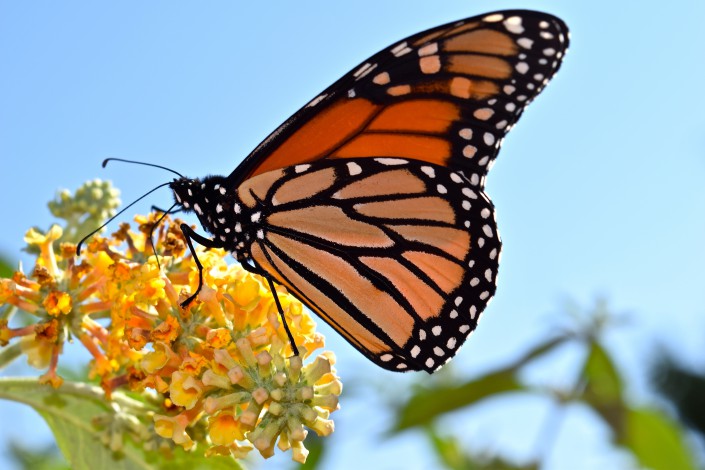
The start of fall migration also marks the reason I originally came to New Jersey one year ago, that being to study the monarch butterflies’ southward migration along the Atlantic coast. Last year was my first season as a field technician with the NJAS Monarch Monitoring Project, a research and education program that performs daily censuses of migrating monarchs, public tagging demos, and educational outreach. The project runs from September 1 through the end of October, and I will be back and working with the team again this fall.
Monarch butterfly refueling in Cape May as it prepares for fall migration to Mexico. Photo courtesy of Lindsey Brendel.
For me, I see the monarch butterfly as the perfect gateway animal into the larger world of conservation. Their widespread range in North America, and easy recognition means that many people are already familiar with this royal insect. Many school age children have learned about their life cycle in school, and may have even raised caterpillars and been witnesses to metamorphosis. Even if you have never learned about monarchs, their bright and bold appearance, sporting the warning coloration of orange and black, make them hard to miss.
That is one of the big differences I see between the beach nesting birds I have grown to love this summer and monarch butterfly. Cryptic and camouflaged are words that describe our beach nesters, specifically the endangered piping plover, who, when standing still, blends in perfectly with the sandy beach landscape. When I talk to people who have gone inside the fenced areas we have on the beaches for the nesting birds, a common response that serves as their rebuttal is that they “didn’t see” any birds, so they thought it would be okay. Situations like this happen frequently, and I have found that teaching, rather than scolding, is a better use of time. I love being able to show people the birds and highlight the fenced off areas as a family zone for our feathered friends; removing any mystery as to why these spaces are off limits.
Coming from a background in the arts, outreach is the arena I feel best suited for. I have had the pleasure of leading the beach nesting bird walks at Cape May Point State Park this summer. I love being able to share with others the life of a beach nesting bird, emphasizing that it really is a family affair, and a difficult one at that. The State Park will serve as a major hub for my work this fall, as that is where the Monarch Monitoring Project holds its butterfly tagging demos, and where we teach the public about the 2500-mile migratory journey the monarch butterfly undertakes to reach its wintering grounds in the mountains of Mexico.
The beach nesting birds I have worked with this summer are endangered. Currently, the monarch butterfly is also under consideration to be listed as an endangered species. One question that comes up at both the bird walks and the butterfly tagging demos is, “Why would it matter if this species was gone?”
Sometimes it is asked with genuine curiosity, and other times it is said as a jab. Either way, it is a difficult question for me to answer, and I have to evaluate why I care. I think and worry a lot about the loss of milkweed, lack of nectar sources, and loss of wintering habitat for the monarchs all the time. After working with beach nesting birds, I will never be able to enjoy a summer thunderstorm the same way again because I will always be picturing a tiny least tern or plover hunkered down on their nest trying to protect their eggs through the wind and the rain.
We protect things of value, but what value do these birds or this butterfly have? Why should we care about endangered species? One argument often made about rainforest deforestation is that there are possible undiscovered medicinal properties that could be cures for diseases. It is unlikely that piping plovers or monarch butterflies hold untapped medical value. So, why should we worry about their declining numbers?
Lindsey Brendel getting up close and personal with American oystercatcher chick, one of several beach nesting bird species she monitored this summer.
For me, my fear is less about losing individual species, and more about the dangers of a widespread ideology where everything is treated as a commodity. I see this as the reason these two species have been pushed to dangerously low numbers and one of the hardest challenges conservation efforts have to face. We live in a very “me centered” culture, and conservation asks us to acknowledge our place as just one of the many functioning pieces in the world around us. If we are going to be on the beach with our family, we need to understand that the least tern flying with a fish in its mouth is bringing food back for his family on that same beach. If we are going to invest in monoculture farms that heavily rely on herbicide use for our food, then we need to realize that we are taking away the food source for monarchs, and many other insect species.
Do I think compromise between humans and critical habitat for endangered species can be achieved? Absolutely. Indeed, one of my favorite parts about working with endangered species is letting go of my role as Supreme Being, and acknowledging that an insect or bird is doing something that I never could. When a monarch butterfly emerges in the fall, regardless of the fact that it has never taken a long flight before, it starts off on more than a 2,000 mile journey to a place it has never been, but knows instinctively to navigate to. When an intruder gets too close to a plover’s nest, the adult will flop around pretending to have a broken wing, making himself look like the vulnerable and easy target, all in an effort to protect its eggs. Some of the best examples of determination and selflessness are happening right around us in the natural word, and we all have the invitation to expand, and learn, and watch it take place. That is the marvel. That is the mystery. That is where I feel the real value of protecting endangered species comes from.