CWF is celebrating International Migratory Bird Day all Week Long
by Lindsay McNamara, Communications Manager CWF’s blog on the great blue heron is the fourth in a series of five to be posted this week in celebration of International Migratory Bird Day (IMBD). IMBD 2016 is Saturday, May 14. This #birdyear, we are honoring 100 years of the Migratory Bird Treaty. This landmark treat has protected nearly all migratory bird species in the U.S. and Canada for the last century.
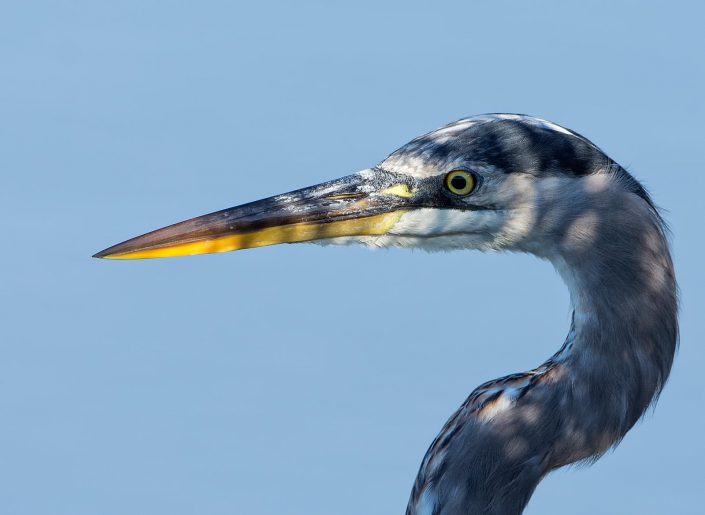
Great blue heron photo by Howie Williams.
Have you seen a great blue heron wading in the marshes of the Garden State? While they are commonly seen along shorelines, river banks, and the edges of marshes, estuaries, and ponds, the breeding population of these wading birds is actually listed as a Species of Special Concern in New Jersey.
The term ‘Species of Special Concern’ applies to wildlife species that warrant special attention because of some evidence of decline, inherent vulnerability to environmental deterioration, or habitat modification that would result in their becoming a Threatened species.
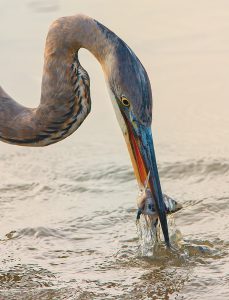
Great blue heron photo by Howie Williams.
Due to its wide distribution, varied diet, and flexibility in nesting near both freshwater and saltwater environments, the great blue heron’s population in North America is stable. However, wetland destruction in New Jersey has caused a decrease in heron populations from their historic numbers. Since the 1950s, habitat loss has occurred at an alarming rate in New Jersey, destroying wetlands critical to breeding herons.
Protecting our wetland habitats from disturbance and development will help protect the great blue heron, the largest wading bird in North America. Great blue herons are 46 inches long and have a wingspan of 72 inches. Despite their large size, great blue herons only weigh 5 to 6 pounds, in part because of their hollow bones — a feature all birds share.
Great blue herons can hunt during the day and night, thanks to a high percentage of rod-type photoreceptors in their eyes that improve night vision. They eat nearly anything within striking distance, including fish, amphibians, reptiles, small mammals, insects, and other birds. Herons nest in colonies or “rookeries” in tall trees near bodies of water.
The oldest great blue heron on record was found in Texas when it was at least 24 years, 6 months old!
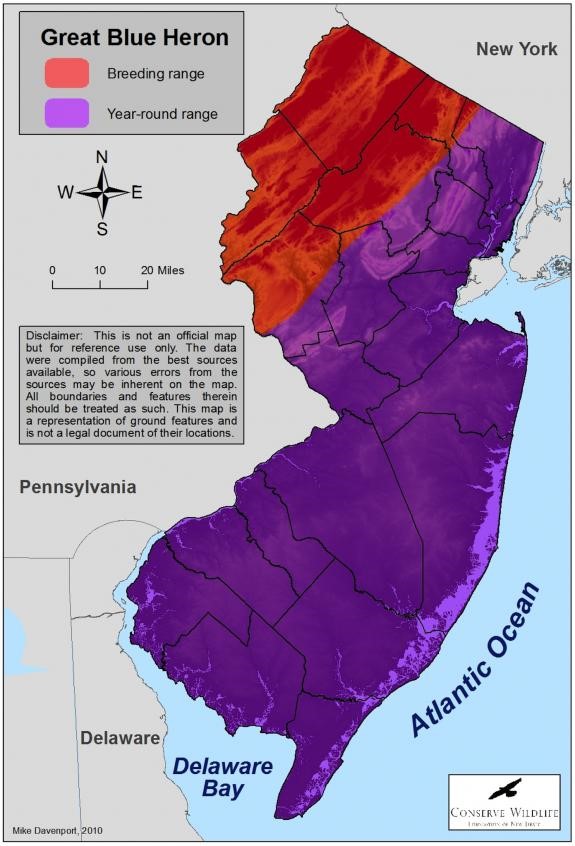
The great blue heron occurs throughout most of North America, from Alaska and eastern Canada in the north to the northern portion of South America in the south. Northern populations of great blue herons east of the Rockies are migratory.
They withdraw from the northernmost portion of their range during the winter, some traveling to the Caribbean, Central America or northern South America. This species breeds throughout New Jersey. They generally do not occur within the northwestern corner of the Garden State during winter. Great blue herons migrate singularly or in small flocks, mainly in daytime.
We still have much to learn about the biology and population status of great blue herons in New Jersey. Research needs to be conducted to find additional breeding sites, check existing nesting areas, and determine whether the population might be decreasing or increasing. You can help! Next time you see a great blue heron in the Garden State, be sure to submit a Rare Species Sighting form.
CWF is Celebrating International Migratory Bird Day all Week Long
by Lindsay McNamara, Communications Manager
CWF’s blog on the red knot is the third in a series of five to be posted this week in celebration of International Migratory Bird Day (IMBD). IMBD 2016 is Saturday, May 14. This #birdyear, we are honoring 100 years of the Migratory Bird Treaty. This landmark treat has protected nearly all migratory bird species in the U.S. and Canada for the last century.
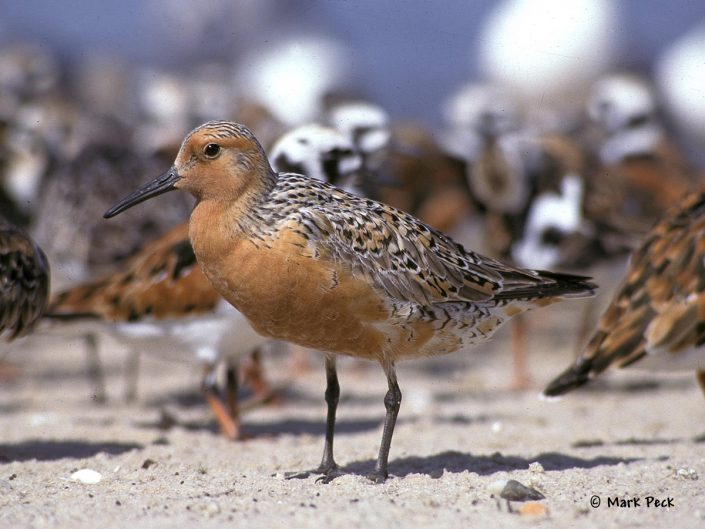
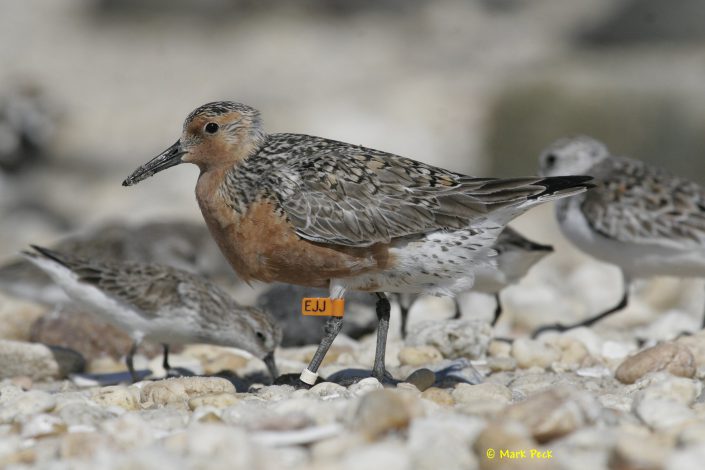
Red Knot photo by Mark Peck.
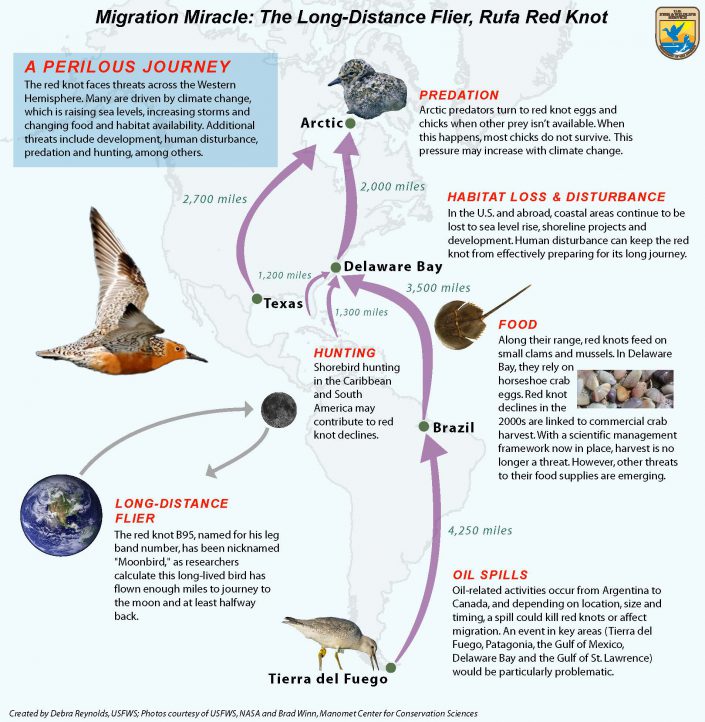
The iconic red knots have returned to New Jersey! These famous, mid-sized shorebirds are state endangered and now federally threatened— the first bird ever listed under the Endangered Species Act with climate change cited as a “primary threat.”
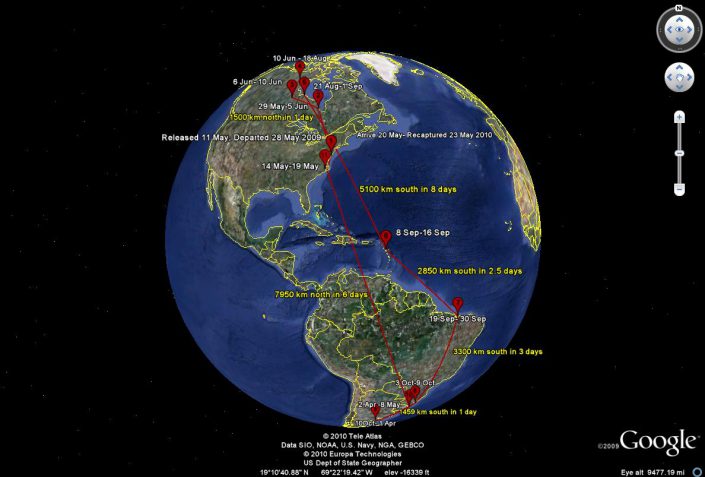
Red knots are only 10 inches long but are among the world’s most extreme long distance flyers — traveling vast distances — some over 18,000 miles in the course of their annual migration from Tierra del Fuego, Argentina all the way up to the Canadian Arctic (and back again). During their trip, the red knots make a vital stop at New Jersey’s Delaware Bay.
This map shows the flight path of a red knot that was banded and fitted with a geolocator along New Jersey’s Delaware Bay.
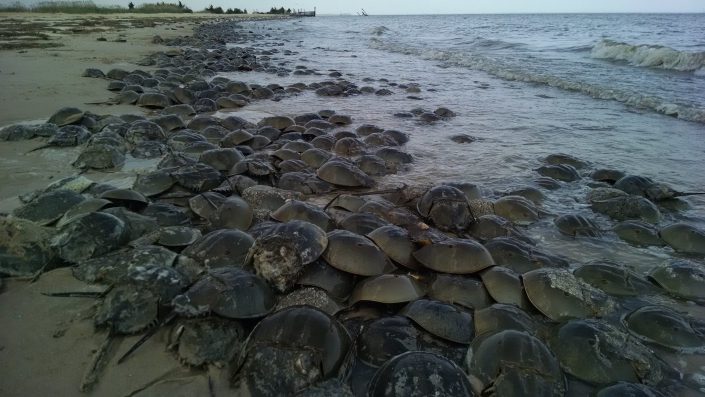
Each spring in Delaware Bay, throughout the month of May, the largest concentration of horseshoe crabs in the world comes onshore to spawn. At the same time, tens of thousands of shorebirds arrive at the Bay, thin and spent from what has been a non-stop, four-day flight from South America. They are en route on a remarkable round-trip journey from southern wintering grounds to Arctic breeding territory, and Delaware Bay is their most critical stopover on this 8,000-mile trip. The shorebirds need to quickly double their weight to complete their migration north and breed successfully. To refuel at such capacities and in only a ten-day window, high-energy horseshoe crab eggs provide essential nourishment. In recent years, countless horseshoe crab eggs have been lost because of the devastating storms that swept away the beaches they depend on.
In the wake of Hurricane Sandy, Conserve Wildlife Foundation and American Littoral Society worked with the U.S. Fish and Wildlife Service, the New Jersey Division of Fish and Wildlife and the New Jersey Recovery Fund to remove 8,000 tons of debris and added 45,000 tons of sand to the beaches just before the annual spring arrival of the red knot in 2013. Additional work after 2012 restored another mile of shoreline, including two new beaches of poor quality even before Sandy. To date, the groups have placed over 85,000 cubic yards of sand and restored seven beaches along New Jersey’s Delaware Bayshore.
To restore one of the beaches, Thompsons Beach, our team removed debris from the area, removed rubble from the road leading to the beach, and placed over 40,000 cubic yards of sand onto the beach. We were delighted to learn that in the spring of 2015, Thompsons Beach had the highest abundance of horseshoe crab egg clusters out of all the beaches that our team monitors on Delaware Bay.
Horseshoe crabs spawning at Thompsons Beach in May 2015. Photo by Joe Smith.
But since the early 1990s, there have been major declines in both the number of adult horseshoe crabs and their eggs. The cause is an exploding crab harvest that grew from only tens of thousands in 1990 to over 2 million in 1996. With the decline of their critical food source, shorebird numbers also plummeted — the Delaware Bay shorebird populations remain around 26% of its historic population size. Over 25,500 red knots were seen in 2015 versus over 90,000 in 1989.
Conserve Wildlife Foundation and the Endangered and Nongame Species Program (ENSP) of the New Jersey Department of Environmental Protection’s Division of Fish & Wildlife have partnered for 20 years, working to conduct research on Delaware Bay shorebirds in order to prevent further decline. Each year, CWF’s Larry Niles and ENSP’s Amanda Dey lead a team of shorebird experts from around the world – from countries as far as Argentina and New Zealand – to conduct research on shorebirds during their stopover. These experts also follow shorebirds to other locations along their migration, including South America and the Arctic. With scientific research and concerted conservation efforts, our hopes are that someday Delaware Bay’s skies will be once again filled with shorebirds.
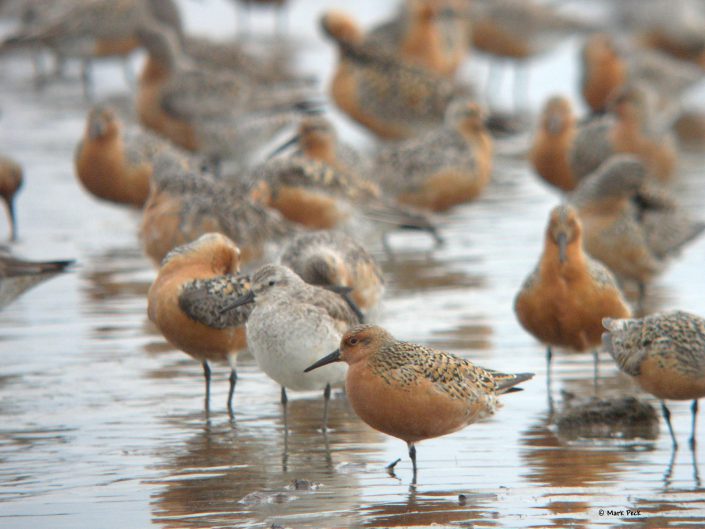
Red Knot photo by Mark Peck.
Last year, nearly every red knot left the bay in good condition, with over 77% reaching weights exceeding 180 grams, the threshold weight required for a successful flight to the Arctic breeding areas. The improvement in the number of red knots reaching 180 grams is a milestone for our shorebird project. The birds left in the best condition recorded since 1998, just as horseshoe crabs were being overharvested. This good news must be tempered by the continued low numbers of birds and horseshoe crabs. We report no improvement in horseshoe crab numbers, so the improvement in the number of red knots making weight is likely a consequence of the restoration of horseshoe crab habitat on Delaware Bay beaches.
Because shorebirds don’t only spend their time in Delaware Bay, shorebird scientists must study them throughout the Atlantic Flyway to get the best understanding of their unique ecology. This year, shorebird project team was awarded a 2-year grant to create detailed shorebird habitat maps in the states of Maranhão and Pará, Brazil. This project will set the foundation for conservation planning and action for decades to come at a shorebird wintering site of hemispheric importance that has received little conservation and research attention with regard to shorebirds thus far.
Over the last 6 years, CWF also has partnered with the USFWS Monomoy Refuge to develop a better understanding of migratory shorebird use on Cape Cod and at the Refuge. Cape Cod, like Stone Harbor and Brigantine, New Jersey, is an important southbound stopover for red knots. At each location, red knots come from their Arctic breeding areas and either build up weight for a flight to South America, or remain to molt and replace vital primary feathers before moving onto shorter distance wintering areas in Florida and Cuba.
Banded Red Knot photo by Mark Peck.
Another important piece of CWF’s shorebird research has been the attachment and recovery of geolocators, small devices that track movements through one to two years of battery life. The migratory tracks from recovered geolocators have greatly expanded our understanding of red knot migratory behavior. In CWF’s last two years of research, we focused on capturing juveniles, which move through the Cape in early September. Red knot juvenile #254 was a recapture two years after release on Delaware Bay. It first left Cape Cod and wintered in North Carolina. In their first year, juvenile red knots don’t go to the Arctic to breed and so #254 flew back to Cape Cod to summer. The following fall, it flew to Cuba to winter, then to North Carolina, then to the Arctic. This was the first known track of a juvenile red knot and one of only a few of any avian species!CWF is continuing our geolocator project this year, so follow along on our blog and social media channels to receive updates on cutting-edge red knot research!
The Birds are Back – Red Knots Arrive Along the Bayshore
by David Wheeler, Executive Director
Photo by David Wheeler.
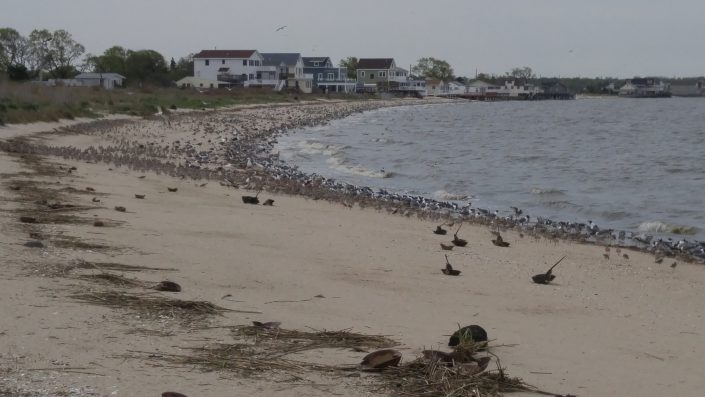
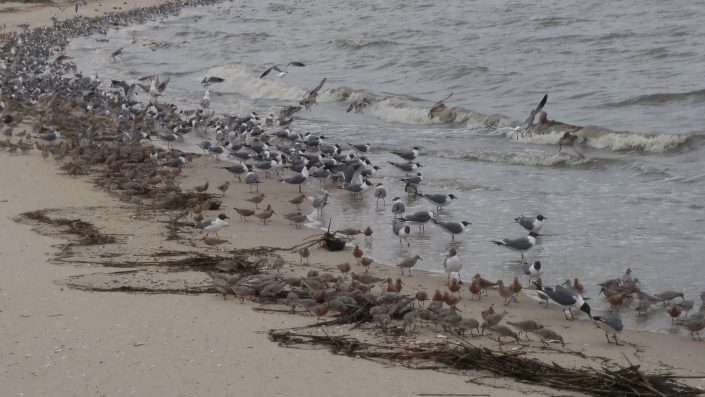
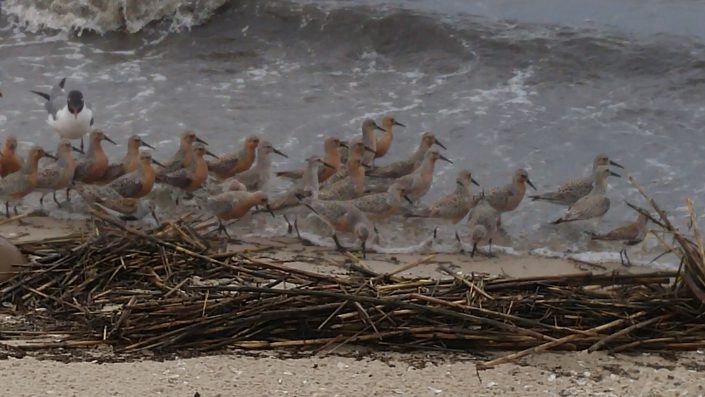
The 2016 mass shorebird migration is officially underway, with the thrilling spectacle of over 1,100 red knots spotted today at North Reeds Beach in Cape May County, New Jersey. A host of other shorebirds, including ruddy turnstones, dunlins, semipalmated sandpipers, and sanderlings, accompanied the red knots at this Delaware Bay hotspot.
The famished flocks fed on horseshoe crab eggs, while much larger laughing gulls congregated along the shoreline and a few crabs used the incoming waves to flip themselves over and return to the bay.
Photo by David Wheeler.
Researchers began seeing a large number of shorebirds arriving over the weekend, and today’s sightings are high for such an early date. A number of the red knots wear leg bands, with a few indicating departure points as far south as Argentina and Chile. Such lengthy migrations for those individual birds only add to the intrigue of their early-season arrivals in New Jersey.
Some red knots fly over 18,000 miles each year in their migrations from southern South America to the Canadian Arctic, with Delaware Bay serving as an irreplaceable stopover.
A team of international researchers and trained volunteers, led by Dr. Larry Niles, Conserve Wildlife Foundation, and the State Endangered and Nongame Species Program will spend the next month surveying and studying the at-risk shorebirds during their stay in New Jersey.
Infographic used from http://www.fws.gov/northeast/redknot/.
CWF Spearheading Project to Recycle Dangerous Fishing Gear and Create Healthier Bay Ecosystem and Local Economy
by Lindsay McNamara, Communications Manager
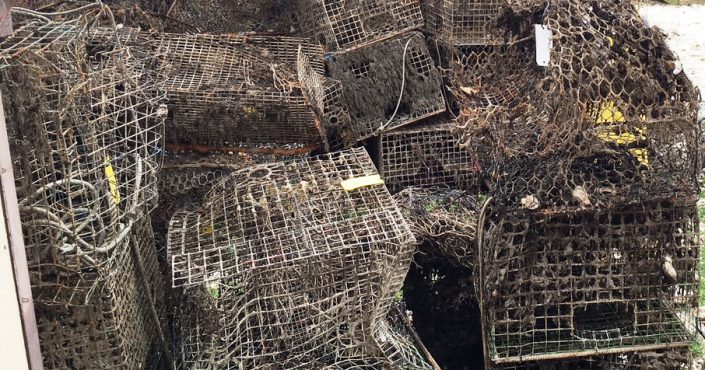
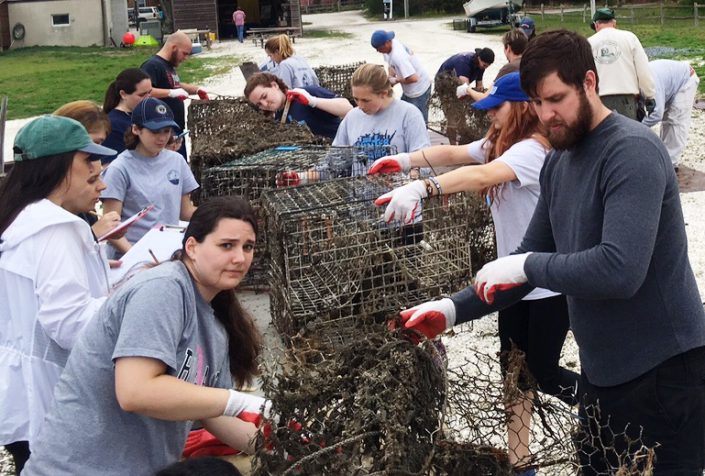
A pile of abandoned crab pots before being processed at the WeCrab community day.
Through a series of public and private partnerships, and with the help of the local fishing community, CWF is leading a project to inventory and remove more than 1,000 abandoned crab pots in Barnegat Bay. These derelict pots, lost from storms or cut lines, can have devastating impacts on the bay ecosystem and local economy.
A phenomenon referred to as “ghost fishing,” these traps will often continue to catch and kill marine life when abandoned, like the Northern diamondback terrapin and otherwise harvestable crabs. These lost harvests translate to economic losses for fishermen and the local community. The pots also disrupt navigation and damage sensitive ecosystems.
In the first year of our two year project, our partners removed 395 of these abandoned crab pots from the Barnegat Bay watershed, championed by local fisherman RJ Cericola and his crew. Almost 260 other pots were assessed but not recovered.
RJ Cericola: 204 abandoned crab pots removed
MATES: 103 abandoned crab pots removed
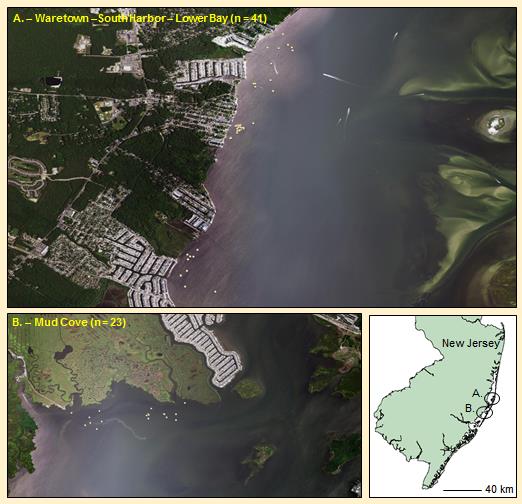
Stockton University: 64 abandoned crab pots removed (40 near Waretown and 24 near Mud Cove, Little Egg Harbor Bay, reflected in the map below)
Abandoned crab pots recovered by Stockton University.
Starting in December 2016, we look forward to working with RJ Cericola, our new partner Jeff Silady — ReClam the Bay boat captain and local fisherman — and bringing on a commercial fisherman to reach our goal of 1,000 abandoned crab pots recovered.
Some of the recovered pots were stored at Stockton University Marine Field Station in Port Republic and were inventoried for data; broken down and recycled by volunteers this past Earth Day.
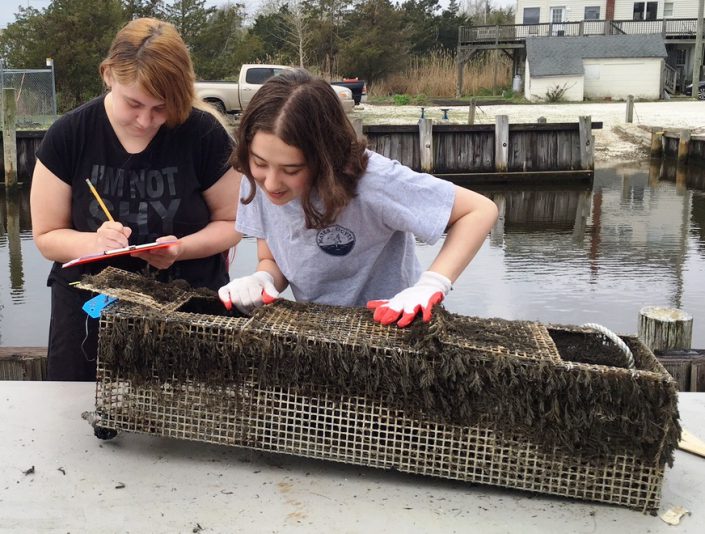
MATES students collecting data at community day.
Scientists, students, commercial crabbers and other volunteers gathered on April 23rd for the WeCrab Community Day to record data, clean and prep the recovered derelict crab pots for recycling. The WeCrab Marine Debris Project is a partnership between the Jacques Cousteau National Estuarine Research Reserve and Stockton University.
Volunteers collected data on condition, cause of loss, weight, among other points. We are working to understand the impacts of abandoned pots and their distribution, gather information on the percentage of pots lost annually and also develop a long-term reporting system for lost pots and other fishing gear. Information collected from recovered pots help aid these efforts.
School Programs Available for Students Grades K-12
by Lindsay McNamara, Communications Manager
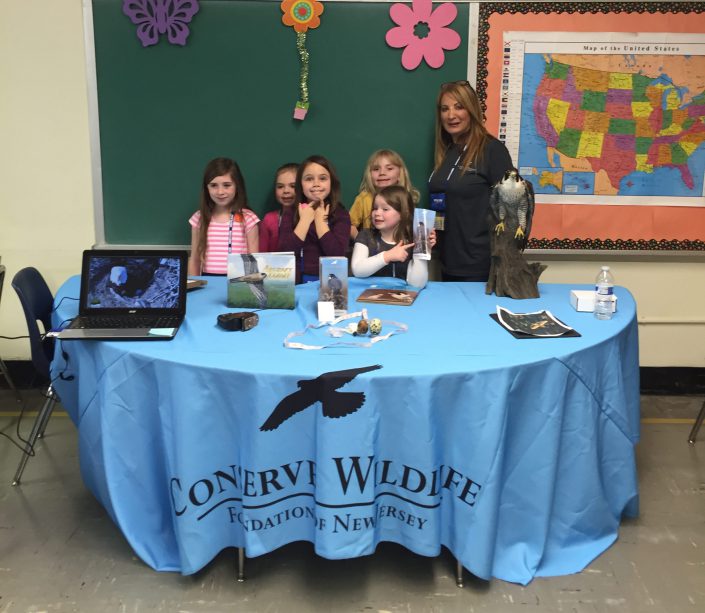
Director of Education Stephanie DAlessio with students from Memorial School in Cinnaminson, New Jersey.
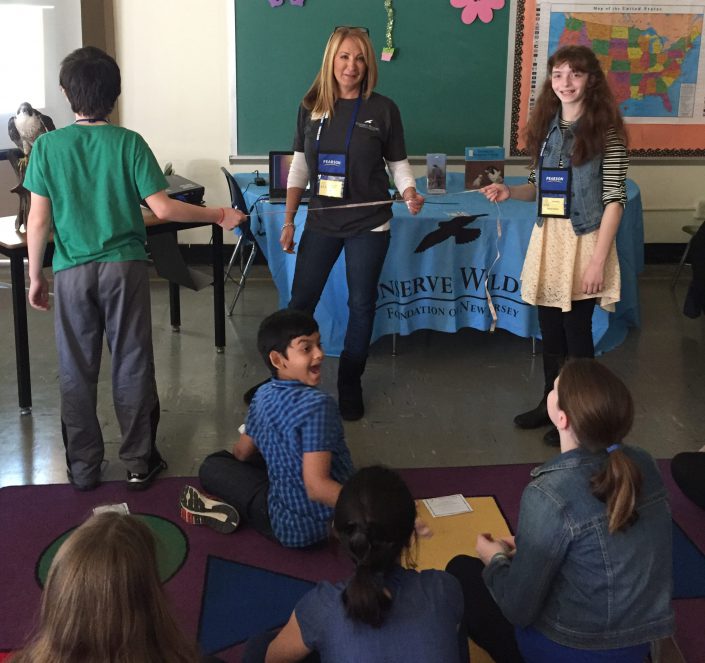
Conserve Wildlife Foundation’s Director of Education Stephanie DAlessio has been out on the road educating students throughout New Jersey about rare wildlife. Last month, Stephanie gave over ten presentations and outreach events, reaching 1,400 children and adults.
Director of Education Stephanie DAlessio with students from Memorial School in Cinnaminson, New Jersey.Director of Education Stephanie DAlessio with students from Memorial School in Cinnaminson, New Jersey.
Stephanie offers specialized programs tailored for your students’ needs and interests! For more information about scheduling a classroom program with Conserve Wildlife Foundation, visit our website.
CWF Biologist Larissa Smith Looking for Data from EagleCam Viewers
by Lindsay McNamara, Communications Manager
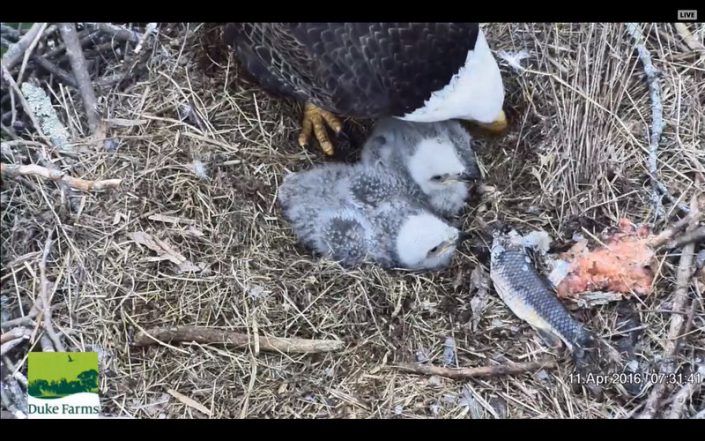
Conserve Wildlife Foundation eagle biologist Larissa Smith has launched a new citizen science project in an effort to learn more about New Jersey’s eagles. We know that many teachers, students and bird lovers watch the wildly popular Duke Farms EagleCam, and now those viewers can help Larissa gather data by participating in the Eagle Food Observation Project.
Larissa holding an eagle at a banding last week.
Jim Wright — author of the popular posts about the eagles for Duke Farms’ “Behind the Stone Walls” blog, as well as, “The Bird Watcher” column for The Record — interviewed Larissa Smith in the most recent post on Duke Farms’ blog. In this interview, Larissa explains her latest citizen science project to learn more about the Duke Farms eaglets’ diet.
‘Jersey Girl’ and Her Mate Rebuild Nest for the 2016 Nesting Season
by Larissa Smith, wildlife biologist
‘Jersey Girl,’ B-64, New nest 2016 Photo by L. Oughton.
We continue to follow the story of “Jersey Girl” B-64. She was banded in Hopewell, Cumberland County, New Jersey in 2004 and this is the fifth season her and her mate have nested in Montgomery County, Pennsylvania. In 2015 after successfully raising three chicks, their nest collapsed due to rain and wind at the end of June, but luckily the three chicks had already fledged.
Nest observer Lind Oughton reported, “Well our great ‘Jersey Girl’ and mate have done it again. They built a brand new nest in the same tree but about 15 feet lower that the first nest. It is much more secure where it is now.” She reported incubation on February 12th and hatching around March 18th. On April 1st, she saw one chick in the nest. We will continue to follow “Jersey Girl’s” story and keep you updated.
“Jersey Girl”, B-64, 2016 new nest. Photo by L. Oughton
Second Annual “Shell-a-Bration” brings volunteers to strengthen coast’s resiliency and habitat
by Lindsay McNamara, Communications Manager
Today, conservation organizations leading the efforts to restore New Jersey’s Delaware Bay beaches today organized the Second Annual “Shell-a-Bration” oyster reef building volunteer event.
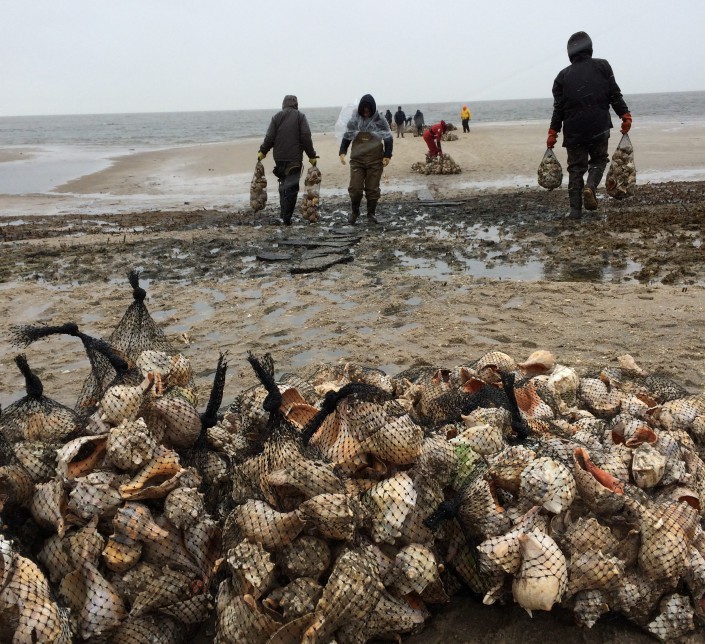
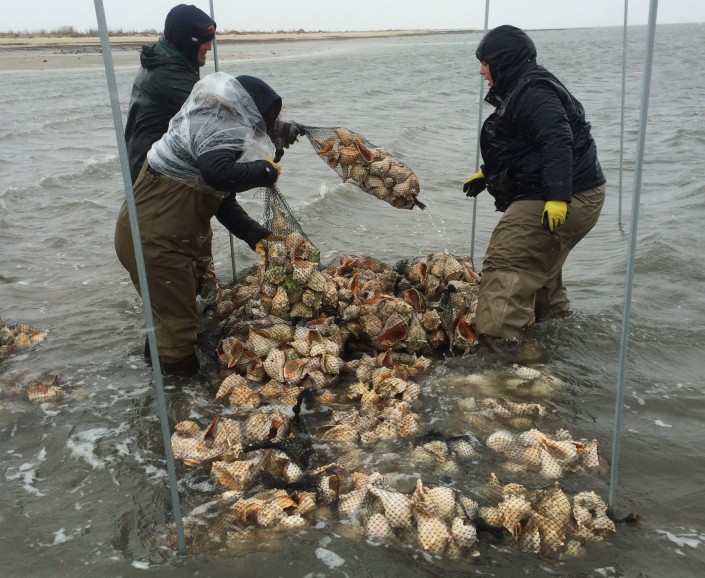
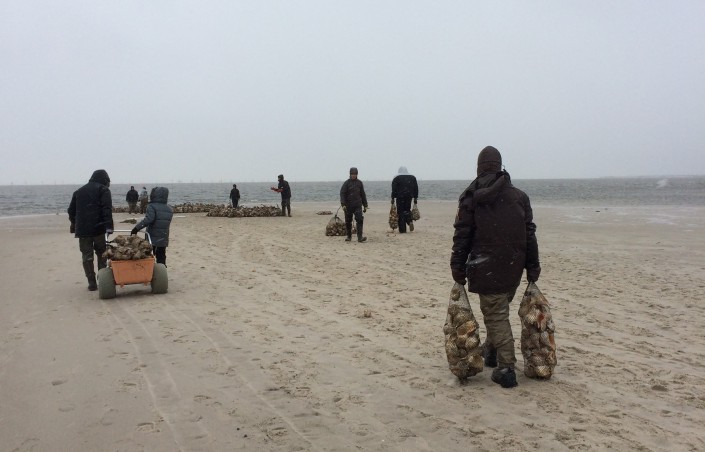
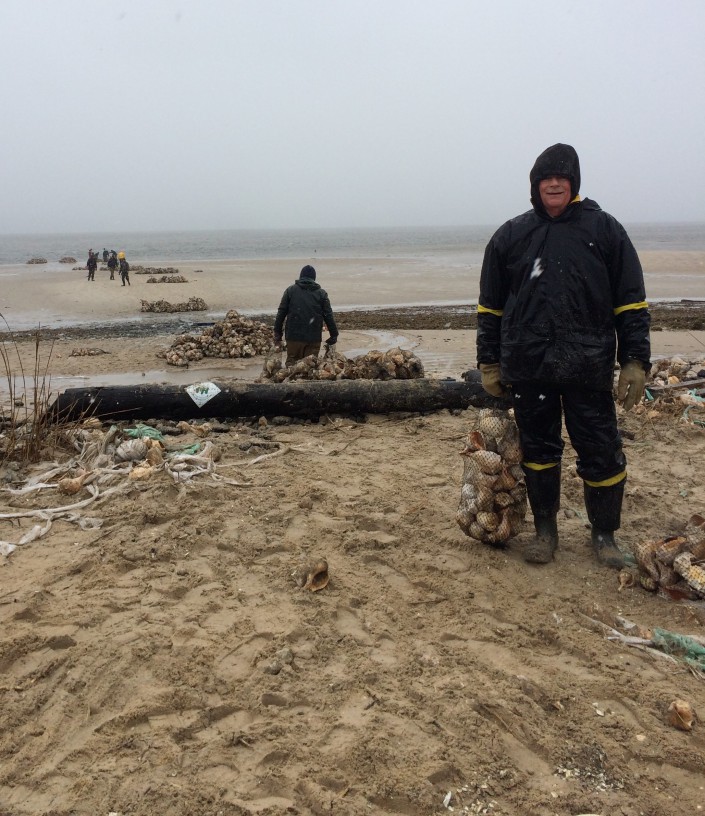
Dedicated volunteers braved the elements and worked alongside American Littoral Societyand Conserve Wildlife Foundation of New Jersey to establish a near-shore whelk shell bar at Moores Beach in Maurice River Township along New Jersey’s Delaware Bayshore. The shell bar was built to prevent sand loss from wind-driven waves. An approximately 200-foot oyster reef was constructed offshore to test whether the reef bars help reduce beach erosion and create calmer water for spawning horseshoe crabs.
“The Second Annual Shell-a-Bration truly celebrates the ecology, community, and culture of the Delaware Bayshore,” stated Captain Al Modjeski, Habitat Restoration Program Director, American Littoral Society. “It reinforces the connectivity between the natural and human-built bayshore communities through reef building and celebrates the significance of the Bay’s resources through restoration.”
“There are many strategies to defend our Delaware Bayshore, but one of the best and most productive are these oyster reefs,” stated Dr. Larry Niles, a biologist with American Littoral Society and Conserve Wildlife Foundation of New Jersey. “They not only replicate a lost but important habitat on Delaware Bay — reefs once covered much of the bayshore — but they provide just enough protection to make a difference in how long our beaches persist against the unrelenting forces of nature. In a way, we are fighting nature with nature.”
Shorebirds, like the federally listed Red Knot, depend on an uninterrupted supply of horseshoe crab eggs when they stopover in Delaware Bay during their migration. In recent years, countless horseshoe crab eggs have been lost because of the devastating storms that swept away the beaches they depend on.
The new oyster reef will attenuate waves but still allow for horseshoe crab breeding. In existing areas where crabs can breed without interruption, like creek mouths protected by sand shoals or rock jetties, egg densities can exceed ten times the egg densities on unprotected beaches.
“New Jersey’s Delaware Bayshore hosts an annual wildlife spectacle of global significance – the time-honored migration of Red Knots to reach the eggs of these ancient horseshoe crabs,” said David Wheeler, Conserve Wildlife Foundation of New Jersey Executive Director. “Red Knots fly to New Jersey’s Delaware Bay from as far away as Tierra del Fuego in South America to feed on horseshoe crab eggs. Volunteer projects like the Shell-a-bration help connect the people of New Jersey with these endangered shorebirds and the largest population of horseshoe crabs in the world.”
Last year, over 130 volunteers and veterans built the South Reeds Beach oyster at the First Annual Shell-a-Bration. Veterans Day on the Bay 2015 dedicated the South Reeds Beach oyster reef to all veterans and highlighted veteran involvement in the effort to restore New Jersey’s Delaware Bayshore. Event attendees honored their own military veterans by inscribing that special person’s name on a shell and placing that shell on “Veterans Reef.” Guests also helped study the wildlife living in this new reef with hands-on, interactive marine science activities like seining, trapping, trawling, and species identification.
Our “assembly line” of volunteers all working together to build the reef.
Veterans Reef and the Moores Beach Oyster Reef are two of the many projects that American Littoral Society and Conserve Wildlife Foundation are working on to restore the ecology and economy of the Delaware Bayshore.
In the wake of Hurricane Sandy, American Littoral Society and Conserve Wildlife Foundation of New Jersey worked with the U.S. Fish and Wildlife Service, the New Jersey Division of Fish and Wildlife and the New Jersey Recovery Fund to remove 8,000 tons of debris and added 45,000 tons of sand to the beaches just before the annual spring arrival of the red knot in 2013.
Additional work after 2012 restored another mile of shoreline, including two new beaches of poor quality even before Sandy. To date, the groups have placed 85,000 cubic yards of sand and restored seven beaches along New Jersey’s Delaware Bayshore. In early 2016, groups began another phase of restoration work at Cook’s Beach and Kimble’s Beach in anticipation of the return of the horseshoe crabs and red knots in May.
After more than a century, fishers are returning to New Jersey
by Kendall Miller, Communications Intern
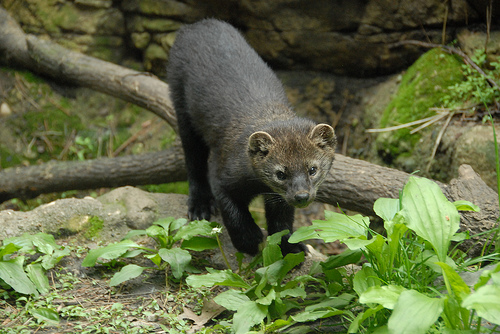
Fisher photo by Josh More via Flickr Creative Commons.
New Jersey’s forests lost a charismatic top predator when the fisher was extirpated nearly a century ago. Exploitation of the fisher for its pelt — coupled with excessive logging practices during the 19th and 20th centuries — caused decimated populations of this North American native across its entire range. However, through the implementation of conservation practices, this small, yet spunky forest carnivore is experiencing a comeback.
Despite its past disappearance from the state, the combined effects of trapping bans and nearby relocation projects (New York and Pennsylvania) are resulting in the fisher’s resurgence in New Jersey. Within the last decade, the return of fishers to New Jersey has been an exciting new possibility, with multiple reported sightings, photos caught via trail camera and anecdotal stories by the public.
Recently, two trappings by state officials in North Jersey, both within a mere month of one another, mark the return of fishers to the state of New Jersey, and speaks for the potential future of this species, as well as others.
What exactly is a fisher?
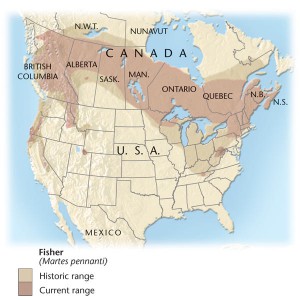
Source: Canadian Geographic
Found only in North America, fishers historically inhabited forested and semi-forested land from coast to coast, ranging from Virginia to Quebec in the east. Found in deciduous, coniferous and mixed forests, they prefer areas with dense canopy cover, and tend to avoid areas with human disturbances.
Also referred to as the fisher cat and Appalachian black cat, this animal looks like fluffy cat meets fox, with a wolverine-like disposition. However, it is neither a feline nor does it catch fish. The fisher (Martes pennanti) is a member of the Mustelidae family, which includes otters, badgers, martens, ferrets, minks, wolverines and more.
The fisher is a long bodied and short legged animal, with a bushy tail that makes up a third of its total body length. There is a substantial size sexual dimorphism between males and females. Males weigh 8-13 pounds and reach lengths between 35-47 inches. Females weigh between 3 and 7 pounds and are between 30-37 inches long. Males have grizzled fur due to blonde guard hairs on their neck and shoulders, while females are a uniform chocolate brown.
A generalist carnivore species, a fisher will eat anything it can catch — typically small- to medium-sized mammals and birds. Carrion and some nuts and fruits also make up a portion of its diet. They are known to eliminate weak or injured deer, especially in times of heavy snow pack.
While its diet may be general, one part is very special: this is the only predator of porcupines in the country. The prickly defenses of the porcupine protect it against almost all predators except the fisher, who has developed a special way of hunting its prey. It will chase a porcupine up a tree until it can go no further and falls. Then, it will make a head-first descent down the tree with the help of semi-retractable claws and feet that can turn nearly 180 degrees. The fall stuns the porcupine, allowing the fisher to access the unprotected underside.
These predators share prey with coyotes, bobcats, foxes and even raptors, creating competition with these species. Fishers have been known to travel hundreds of miles to meet their dietary needs, able to cross water if need be.
They live a solitary life-style, with home ranges between 1-3 square miles, seldom overlapping, which suggests territoriality. They are found to be active at any point during the day or night. Fishers make homes in dens year round, using a variety of forest resources such as tree hollows, stumps, debris piles, natural crevices and underground tunnels. Females with litters will use tree hollows that are far off the ground.
Fishers themselves have no natural enemies and few disease occurrences. Trapping by humans and vehicle collisions likely account for the majority of deaths throughout their range.
Reflections Three Years into the Shorebird Sister School Network Program
by Stephanie Egger, Wildlife Biologist
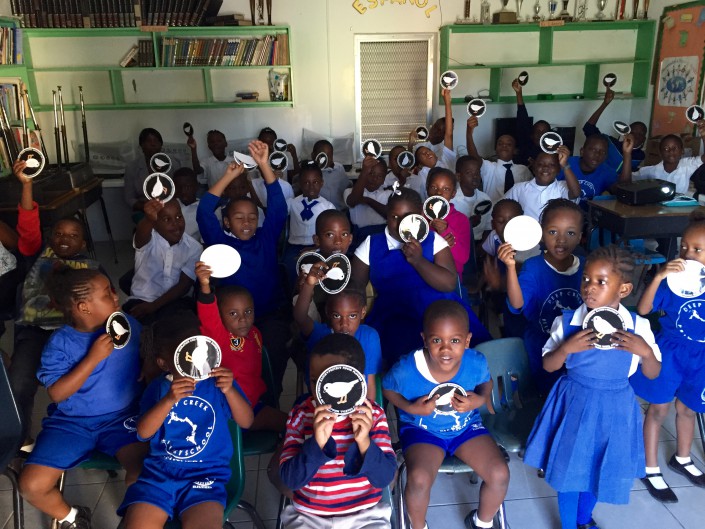
Deep Creek Primary students with the migratory and wintering Piping Plover decal.
As we begin to wrap up our third year of the Shorebird Sister School Network, we are able to reflect on how far we have come in just a short time. In our first year, we started with just one class at Amy Roberts Primary School (Green Turtle Cay, Abaco, The Bahamas), led by teacher Jan Russell, which was paired up with a class at Ocean City Intermediate School (Ocean City, New Jersey), led by teacher Deb Rosander. We presented the students with information on the full life cycle of the Piping Plover, commonly referred to as “our birds” in New Jersey. Really they are residents of The Bahamas, spending over half their life on the warm sandy beaches surrounded by turquoise water. Piping Plovers in The Bahamas, in most cases, see less disturbance than what is experienced by plovers on their breeding grounds in the United States and Canada.
We not only focus on breeding, migration, and wintering of the plovers, but the importance of their habitat to a suite of species. In The Bahamas, the tidal flats used by the Piping Plovers are of huge importance to the ecological value and economy of The Bahamas, as the flats are also used by bonefish, conch, and shark species. We had both classes conduct similar projects — interpretive signs placed on the breeding and wintering grounds — using their writing skills and original artwork. The students also participated in field trips where they learned how to use spotting scopes and binoculars to find and identify shorebirds.
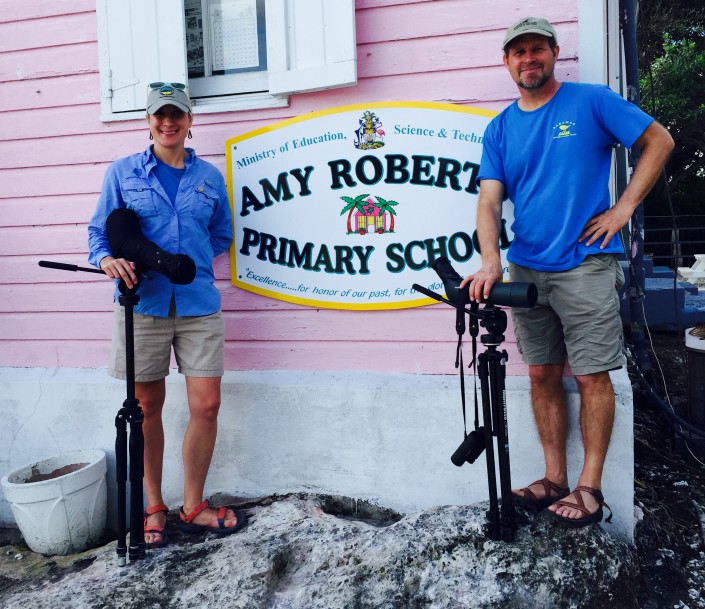
Shorebird Sister School Network leaders and CWF biologists, Stephanie Egger and Todd Pover at Amy Roberts Primary School, one of the first sister schools in the program.
Three years later, we still are teaching our core lessons, but have vastly expanded on the curriculum and projects, as well as extending the program onto another island, Eleuthera, which is just south of Abaco. We now are working with Cherokee Primary in the settlement of Cherokee Sound (Abaco) and Deep Creek Primary (Deep Creek, Eleuthera). We have continued working for the last three years with Amy Roberts Primary School and Ocean City Intermediate School. Back in the United States, we have added a second class from Ocean City, as well as the Leeds Avenue Elementary School Environmental Club (Pleasantville, New Jersey) led by Mary Lenahan. We’ve added new components to the curriculum such as bird anatomy, foraging differences between species of shorebirds, invasive species, habitat assessments (including macroinvertebrates) and marine debris.
We continue to implement interpretive signs as a project with classes that are in their first year of the program, but have come up with new and exciting projects to keep the students (and teachers) motivated and engaged to continue participating as a sister school. For example, during the second year we worked with Amy Roberts, we removed 1,500 Australian pine (Casuarina spp.) from Green Turtle Cay as it degrades the habitat for piping plovers and other species. We created a Piping Plover activity book complete with crossword puzzles, word searches, and mapping activities designed mainly by the students at Ocean City Intermediate School, Leeds Avenue Elementary School, and Amy Roberts Primary School. Because Cherokee Primary and Deep Creek Primary are new to the program this year we hope to have their students create interpretive signs, while the second and third year students in the Program may develop PSA-type videos this year and pen pal letters to their respective sister schools in the United States.
Throughout the year, each class receives one or two classroom lessons and a field trip. We keep busy during the few short weeks we have in The Bahamas; coordinating the field trips, conducting surveys, presentations, and working to continue to build and strengthen our existing relationships with partners, such as Friends of the Environment and local citizen scientists. This year, we’ve reached over 120 students in the program, both from the Bahamas and in the United States.
One of the most rewarding aspects of the Shorebird Sister School Network is that we are able to provide lessons to the some of the same children throughout multiple years in the program, which strengthens the conservation messages we are trying to instill in the upcoming generations. We hope to foster a greater appreciation for wildlife, especially for the Piping Plover and its habitat, and inspire students to help now — and later on in their lives as adults — ensure the recovery and survival of the bird for years to come.
 The great blue heron occurs throughout most of North America, from Alaska and eastern Canada in the north to the northern portion of South America in the south. Northern populations of great blue herons east of the Rockies are migratory.